Elder care nursing careers are rising rapidly in both Japan and Germany due to severe demographic shifts, with aging populations creating acute labor shortages that are driving active international recruitment.
Elder care nursing jobs abroad are turning out to be one of the most in-demand healthcare careers, especially in countries like Japan and Germany. A rapid increase in ageing populations is causing an increase in pressure on healthcare systems. These countries are actively recruiting international nurses to support long-term care services.
According to the World Health Organization (WHO), the global population aged 60+ is expected to reach 1.4 billion by 2030, creating massive demand for elderly care services worldwide. On the other hand, countries like Germany and Japan are facing a severe shortage of skilled nursing professionals, opening doors for foreign nurses, including those from India.
For healthcare professionals, this high demand in elder care nursing jobs abroad shows a unique opportunity to build a stable, high-paying international career with benefits like visa sponsorship, relocation support, and long-term residency options. In this blog, we will guide you through job roles, salary, eligibility, visa pathways, and career scope for elder care nursing in Japan and Germany.
Why Elder Care Nursing Is Growing Globally
Key factors like demographic shifts and healthcare challenges across the world, demand for elder care nursing is increasing.
Aging Population Trends
One of the biggest factors driving the demand is the rapid growth of the elderly population. According to the United Nations (UN World Population Ageing Report), by 2050, 1 in 6 people globally will be over the age of 65.
This aging trend is especially strong in developed countries, where life expectancy is higher, and birth rates are declining.
Rising Demand for Long-Term Care Services
The need for long-term care services such as nursing homes, assisted living, and home healthcare is increasing.
Elderly patients often require continuous monitoring, medication management, and daily assistance, creating high demand for trained nursing professionals.
Shortage of Skilled Nurses
Despite having high demand, there is still a shortage of nurses globally. The WHO estimates a shortage of over 10 million healthcare workers by 2030, with nursing being the most affected field. Germany and Japan have begun recruiting foreigners to help address the situation.
Why Japan & Germany Need Elder Care Nurses
When we talk about Elder Care Nursing Jobs abroad, Japan and Germany are among the top countries with high demand in the world. The healthcare systems are under pressure due to the increase in elderly populations and a shrinking workforce, creating strong demand for international elder care nurses.
Japan’s Aging Demographics
Japan boasts one of the oldest populations in the world. The Ministry of Internal Affairs in Japan has reported that the number of individuals aged 65 and over has been reported to be over 29 percent of the population, the highest in the world.
As fewer youth are entering the labor market, the nation has a dire need for caregivers and nurses in the elderly care centers.
Germany’s Healthcare Workforce Gap
Germany is also undergoing a great demographic transition. The Federal Statistical Office of Germany estimates that by 2035, almost 1 out of 3 individuals will be aged above 60.
Meanwhile, the nation will experience a lack of healthcare workers as they retire and the elderly population grows in need of healthcare services.
Government Initiatives to Hire Foreign Nurses
Both Japan and Germany have come up with programmes to lure in international healthcare workers. Germany provides Skilled Worker Visa programs and foreign nurse recognition programs.
Japan provides care worker programs through bilateral treaties with nations like India.
These programs usually include language courses, assistance with obtaining licenses, and help finding jobs abroad, making it easier for foreigners to work in other countries.
What Is Elder Care Nursing?
Geriatric nursing or elder care nursing is a nursing specialization that deals with the provision of medical and daily care to elderly patients. It is about helping people with age-related health conditions, mobility, and long-term illnesses so that they can continue to live a good quality of life.
Role and Responsibilities
Elder care nurses have a significant role in attending to both medical and personal care aspects of the patients. Their responsibilities include:
- Follow up on health conditions and vital signs.
- The use of drugs and therapies.
- Helping with daily tasks such as bathing, feeding, and moving.
- Caring for patients who have chronic diseases like dementia or arthritis.
- Liaising with doctors and family members.
Work Settings
Depending on their specialization and experience, elder care nurses can work in various healthcare settings:
- Nursing Homes: Long-term care of the elderly residents.
- Hospitals: Support of post-treatment and recovery.
- Home Care Services: Door-to-door care services in the homes of the patients.
- Rehabilitation Centers: Therapy and rehabilitation assistance.
Job Roles in Elder Care Nursing
Elder care nursing jobs abroad have a range of available job roles based on your qualification, experience, and specialization. The roles are designed to provide medical treatment, daily support, and emotional assistance to older patients across various healthcare facilities.
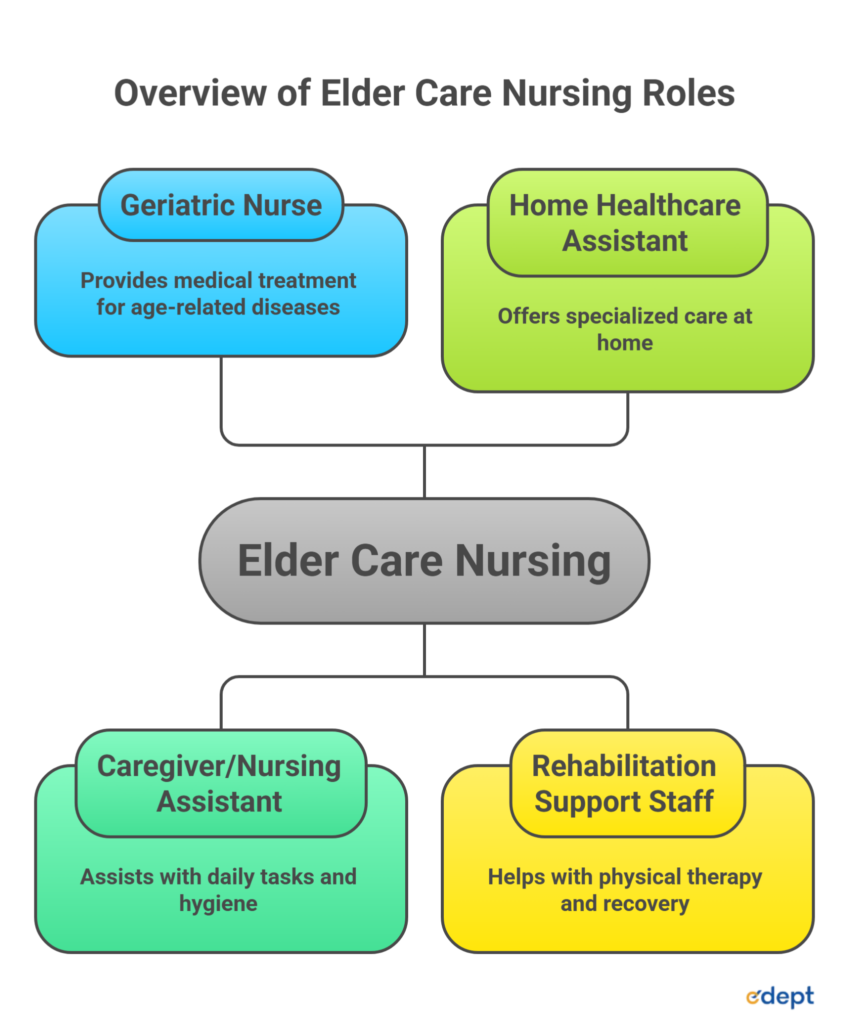
Geriatric Nurse
Geriatric nurses can be characterized as performing nursing services to elderly patients with age-related diseases and conditions such as dementia, osteoporosis, and chronic illnesses. They monitor health, administer treatment, and coordinate with the doctors.
Caregiver/Nursing Assistant
Caregivers/nursing assistants assist the patients in their daily life tasks such as bathing, feeding, mobility, and hygiene. They are very important in preserving the comfort and well-being of elderly people.
Home Healthcare Assistant
Home healthcare nurses offer specialized care at the home of a patient, which may include medication administration, health conditions monitoring, and post-discharge help.
Rehabilitation Support Staff
These workers help older adults in physical therapy, recovery, and mobility enhancement following surgeries or diseases.
Eligibility Requirements for Working Abroad
There are specific qualifications needed to be eligible for elder care nurse jobs abroad in countries such as Japan and Germany. This ensures that you have the necessary competency required to provide quality health care services.
Educational Qualifications
You must have a recognized nursing diploma or degree (GNM/B.Sc Nursing) from an accredited institution.
In some cases of entry-level caregiver jobs, simple healthcare training may be accepted. However, professional nursing jobs demand formal education.
Licensing Requirements
Both Germany and Japan require foreign nurses to get their qualifications recognized, along with passing a country-specific exam.
- Germany: Recognition of qualification + adaptation training or examination.
- Japan: Certification on the basis of caregiver/nursing programs.
Language Requirements
One of the most significant conditions is the language proficiency:
- Germany: German language (B1-B2 level compulsory)
- Japan: Japanese language proficiency (N4/N3 or higher depending on position)
Effective communication abilities are critical in patient care and when integrating into the workplace.
Salary and Benefits in Japan and Germany
Elder care nursing offers a stable income, international exposure, and long-term benefits, especially in countries such as Germany and Japan, where there is high demand. The pay in both countries is competitive and is based on experience, position, and geographical location, and both countries have good social benefits.
Salary in Germany
In Germany, elder care nurses earn between €2,500 and €3,500 per month (₹2.2L–₹3.2L approx). Entry-level workers can be at a lower level, but with license acknowledgement and work experience, salaries rise.
Germany also provides a system of pay scales within healthcare systems, which guarantees a constant increase.
Salary in Japan
In Japan, elder care professionals earn around ¥180,000 to ¥280,000 per month (₹1L–₹1.6L approx). Salaries can be differentiated by the program, employer, and level of experience.
Performance-based increments and long-term employment benefits are also available in some of the roles.
Additional Benefits
Apart from the salary, both Japan and Germany offer other benefits too, including:
- Accommodation support
- Relocation assistance and visa sponsorship
- Health insurance and social security
- Paid leave and overtime benefits
Salary Comparison Table
| Country | Monthly Salary | Annual Salary | Key Benefits |
| Germany | €2,500 – €3,500 | €30,000 – €42,000 | Insurance, PR pathway, high savings |
| Japan | ¥180,000 – ¥280,000 | ¥2.1M – ¥3.3M | Accommodation, stable jobs, visa support |
Visa Pathways for Elder Care Nurses
Having a good understanding of visa pathways is very crucial if you want to work abroad as an elder care nurse. In both Germany and Japan, we can see structured programs that make it easier for international nurses to enter their healthcare systems.
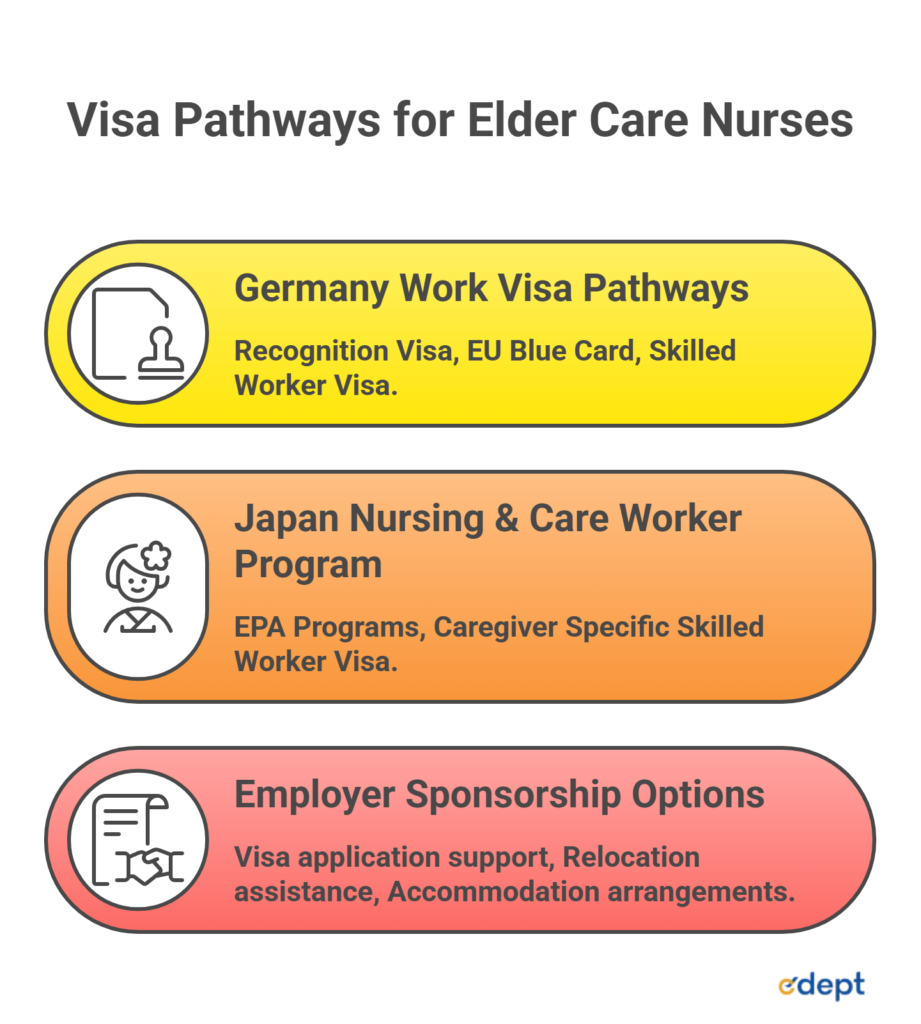
Germany Work Visa Pathways
Germany provides various visa opportunities to healthcare professionals as part of its Skilled Worker Immigration Act.
- Recognition Visa: To the nurses whose qualifications have to be acknowledged in Germany.
- EU Blue Card (in certain cases): This is the case only applicable to highly qualified professionals.
- Skilled Worker Visa: This is provided to the candidate with a recognized qualification and a job opportunity.
Applicants typically require employment opportunity proof, a recognized qualification, and a level of proficiency in the German language (B1/B2) to apply.
Japan Nursing & Care Worker Program
Japan recruits foreign nurses by organised government-sponsored schemes, including:
- EPA (Economic Partnership Agreement) Programs.
- Caregiver Specific Skilled Worker (SSW) Visa.
Such programs often include language training, skills development, and certification assistance before and after arrival.
Employer Sponsorship Options
In both nations, numerous employers cover the visas of prospective employees. This includes:
- Visa application support
- Relocation assistance
- Accommodation arrangements
Employer sponsorship lowers the cost and process involved for applicants.
Skills Required for Elder Care Nursing Careers
To have a successful career as an elder care nurse abroad in countries like Germany and Japan, you must possess a combination of clinical expertise, soft skills, and adaptability. Employers look for professionals who can actually handle both the medical responsibilities and emotional care.
Clinical Skills
Good clinical knowledge is critical in the delivery of safe and effective care. This includes:
- Checking vital signs and health conditions.
- Medication and simple treatments.
- Knowledge of chronic illnesses such as dementia, diabetes, and arthritis.
Communication & Empathy
It is not only the treatment that is involved in elder care, but also emotional support and connection. Nurses should express themselves effectively in front of patients, families, and healthcare teams in a way that is empathetic and tolerant.
This is particularly crucial when dealing with older patients who might feel lonely or insecure.
Cultural Adaptability
Working in countries such as Japan and Germany requires knowledge of cultural norms, work ethics, and patient expectations.
Being respectful, flexible, and open to new environments will help in easy integration into the workplace.
Patient Handling Skills
Elder care involves assisting patients with mobility, daily activities, and recovery. The use of proper handling techniques is critical to help guarantee patient comfort, as well as to prevent injuries.
Challenges Faced by International Nurses
Working in the healthcare field as an elder care nurse in countries like Germany and Japan does come with great opportunities, but it also brings certain challenges. Being aware of these challenges will help you in preparing better and adapting faster.
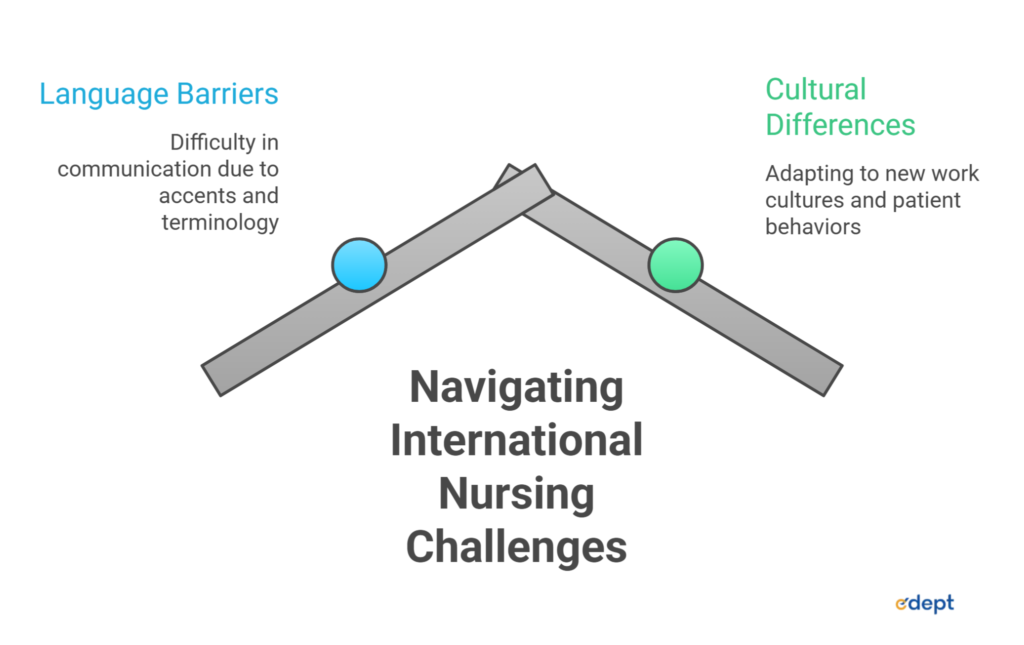
Language Barriers
One of the biggest challenges a candidate faces is communication. Even if you clear language exams, understanding the local accents and medical terminology takes time.
Cultural Differences
Work culture is another challenge an elder nurse faces in these countries. Patient behavior and daily routines are very different between India and these countries. For example, Japan emphasizes discipline and precision, while Germany focuses on structure and efficiency.
Licensing & Documentation Process
The process of documentation, qualification recognition, and licensing is time-consuming. This can cause delays if documents are incomplete or requirements are not met properly.
Why Choosing the Right Nursing Program Matters for Global
Going for the right nursing program is crucial in achieving your long-term career goals. The well-organized program will not only develop your knowledge base but will also keep you informed about global health care standards and employment needs.
Clinical Exposure
The programs with practical training, hospital internship, and work with real patients will allow you to gain practical experience that is necessary to work in a foreign country.
International Training Standards
Programs that meet international standards will mean that your education will be accepted internationally, and it will be easier to satisfy the licensing requirements.
Placement Support
The transition is made easier and quicker by institutes that offer placement assistance, career counseling, and international job assistance.
Why Choose Edept for Global Nursing Career Preparation
In case you wish to work in other countries as a nurse as in Japan or Germany, you need to go to the right training partner. Edept concentrates on this significant part of developing job-prepared, internationally competitive nursing professionals.
Industry-Aligned Nursing Programs
Our programmes are also tailored to the international healthcare needs. By this, we are able to make sure that students acquire the skills that are relevant in a foreign country.
Admission Support & Guidance
edept also offers step-by-step instructions for course selection, the process of application, and documentation, thereby minimizing confusion to students.
International Opportunities Career Counselling.
Professional advice on career path choice, country choice, and employment opportunities in the foreign medical marketplace is given to the students.
Focus on Employability Skills
We at edept particularly focus on communication, practical training, and professional preparedness that are very important in international placements.
Shape the global Healthcare sphere with edept: Click here!
Step-by-Step Roadmap to Work in Japan or Germany as a Nurse
Having a structured step-by-step guide is essential to pursuing a nursing career abroad. Following the right steps can make the process smoother and faster.
Step 1: Complete Nursing Education
Start with a recognized nursing diploma or degree from an accredited institution, specifically a GNM/BSc in Nursing.
Step 2: Learn the required language
- Germany: German (B1/B2 Level)
- Japan: Japanese (N4/N3 level or higher)
Language proficiency is essential for communication and licensing.
Step 3: Apply for Licensing/Certification
Get your qualifications recognized in your preferred country and complete any required exams or training.
Step 4: Secure Job Offer
Apply for roles through job portals, recruitment agencies, or employer programs.
Step 5: Visa Processing & Relocation
Complete all the visa formalities, arrange travel, and prepare for relocation with employer support.
Future Scope of Elder Care Nursing Careers
It can be seen through trends that elder care nursing is one of the most stable and future-proof careers in the world because of the changes in demographics and healthcare demand.
Growing Demand in Europe & Asia
When we mention countries like Germany and Japan, we can observe the shortage of healthcare workers because of the aging population and the decreasing number of workers. This demand will keep on growing in the next few decades.
Long-Term Career Stability
Elder care nursing is a job that provides job security, a steady income, and demand. This renders nursing a secure job option.
Opportunities for Permanent Residency
Many countries also offer pathways to permanent residency for healthcare professionals after a few years of work.
Conclusion
Nursing for elder care is now a booming career field across the world, particularly in countries such as Japan and Germany. Due to their increasing elderly population and shortage of health care professionals, they are recruiting nurses from overseas.
With a clear-cut idea about job positions, remuneration, visa opportunities, and eligibility conditions, you will be able to plan your career path. The right education, language preparation, and well-developed planning are the key to success. Elder care nursing can result in a steady, fulfilling, and global career with proper preparation.
Related Links:
| Nursing Entrance Exams 2026 | Key Skills for a Successful Nurse |
| Best Nursing College for Nursing after 12th | What is Clinical Nursing? |