Business domain knowledge is critical in data analytics because it provides the essential context to interpret data meaningfully, ask the right questions, identify relevant patterns, build accurate models, and deliver actionable, strategically aligned insights, bridging the gap between raw numbers and real-world business value. Without it, analysts risk misinterpreting data, missing key issues, and creating irrelevant solutions, no matter how technically skilled they are.
In today’s world, driven by data, business domain knowledge in data analytics has become as important as technical expertise. While many professionals focus on learning tools like SQL, Python, or other visualization software, real business value comes from understanding how to connect data to actual business goals. According to a report by Gartner, nearly 85% of data analytics projects fail to deliver meaningful outcomes because insights are not aligned with business goals. Analytics often fails to deliver meaningful results without knowing the workings of an organization. A sales dashboard may look impressive, but when it comes to showing how revenue is generated and how customers behave, it has its own shortcomings.
This growing gap between data and decision-making has created a strong demand for analysts who are proficient in combining technical analytics skills with domain understanding. Companies currently are mostly recruiting professionals who can interpret what numbers mean for the growth of the organization and risk analysis.
Check Related Data Analytics Blogs
- Is Data Analytics a Good Career in India 2026
- Data Privacy Laws in India 2026
- Does Data Analytics Require Coding
- Data Analytics Bootcamps vs Degree Courses: Which Is Better?
What Is Business Domain Knowledge in Data Analytics?
Business domain knowledge refers to understanding how a specific industry or function works. In data analytics, this means:
- Knowledge of how a business generates revenue
- Managing costs
- Serving customers while measuring success.
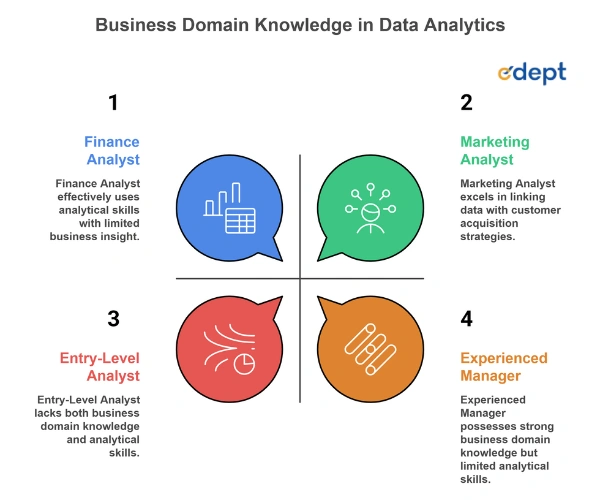
As stated in the World Economic Forum’s Future of Jobs Report 2023, analytical thinking and business insight rank among the top skills needed across sectors because more and more companies are adopting data-driven decision-making processes. When considering the larger picture, the customer acquisition and marketing campaign knowledge is pertinent to the role of the marketing analyst, and the budgeting and profit forecasting knowledge is relevant to the finance analyst.
Domain expertise in analytics allows professionals to link numbers with real business processes, in return making analysis more accurate. Business domain knowledge also includes functional understanding like how marketing campaigns are evaluated, how finance teams track cash flows, how operations manage supply chains, and how HR tracks their employee’s performances. When professional analysts combine this knowledge with their technical analytics skills, they are able to ask better questions and design better models to generate insights that align with their business goals.
Start Your Data Analytics Journey with edept – Explore Courses Now
Why The Technical Skills Alone Are Not Enough
Modern analysts are now capable of accessing and processing large datasets and running complex models in mere minutes. Here, the risk of depending purely on tools and lacking an understanding of the application in the domain can be dangerous in itself because several key activities in the domain of analytics and beyond involve and rely on more than mere execution:
- Data cleaning and validation – The data accurately reflects the business realities
- Key Performance Indicator Mapping – Identifying true business performance metrics
- Predictive Modeling – Outcome Forecasting Using Business Behaviors
- A/B Testing – Comparing Strategies to Learn What Works
- Documentation of business reporting, interpreting key results for business use
One major limitation of tool-only analytics is misinterpretation. Without domain knowledge, even accurate data can lead to wrong strategic decisions. Many organizations also produce dashboards that look refined but fail to answer the questions that matter most to decision-makers.
More details on B.Tech in Business Analytics & Computer Science by Rishihood University. Check Now!
Core Technical Analytics Skills Every Analyst Must Have
While business understanding is critical, technical ability still comes first for the foundation of any analytics role. Professional analysts must have tools and techniques in their scope to handle data efficiently and accurately.
Top Skills for a Data Analyst include:
- Excel is essential for quick analysis and reporting.
- Python for data-processing and automation.
- SQL to work on data in Databases.
- Power BI and Tableau to generate dashboards.
Analysts will also require knowledge on basic statistics and forecasting, as these equally matter for the interpretation of trends as well as the predictions of future outcomes. Based on the Jobs on the Rise 2024 report by LinkedIn, data analysts with technical expertise and strong graphic capabilities rank as the fastest-growing jobs worldwide. However, these technical data analytics skills are only effective when guided by domain knowledge. Tools show “what” is happening, but business understanding explains “why.”
How Domain Knowledge Improves Data Interpretation
When analysts understand how a business operates, they can align metrics with real objectives.
For example, instead of tracking generic traffic on your website, a marketing analyst focuses on customer acquisition cost and conversion rates, which directly affect its profitability.
Domain knowledge also helps in selecting the right KPI (Key Performance Indicators). Not all metrics are equally important, and going for the wrong ones can also mislead professionals in decision-making. Though an analyst with domain expertise knows his performance indicators, which directly reflect the revenue, retention, and its operational efficiency.
More technical expertise, such as knowing Python and SQL, or being able to communicate findings, also results in increased salaries, with some estimates suggesting an average 25-30% bump for someone with expertise in Python and SQL.
Additionally, investing time to acquire higher certifications, such as the Google Data Analytics Certificate or Tableau Specialist, can help improve salaries, as there have been reports of professionals gaining as much as 15-25% more compared to those who are not certified.
Furthermore, business understanding tends to reduce reporting errors. Analysts who know how data is generated can detect anomalies and missing values easily. Ultimately, a combination of technical skills with business insight enables professionals to provide strategic and workable advice rather than just mere reports.
Build Job-Ready Data Skills and Become Data Analyst – Get Personalized Course Recommendations
Key Business Domains Where Analytics Is Applied
Analytics is being applied in numerous operations in the business, and every domain has its own requirements for analyzing the data in its own distinctive manner. In marketing analytics, the marketing team monitors the performance of marketing campaigns, customer acquisition, and overall online activities to identify the source of user acquisition. In finance, analytics is being relied upon for budgeting, revenue analysis, and profitability analysis. In operations and supply chains, analytics is being used for managing inventories, logistics, and costs.
Lastly, human resources utilizes people analytics for analyzing hiring trends, retention, and performance because every domain has its own set of needs and requirements. This is why domain expertise is so essential for effective analytics applications.
Career Impact of Domain Knowledge in Analytics
Professionals can increase their employability by acquiring business domain knowledge about data analytics. Analysts with the ability to own projects, interact with stakeholders, and speak the language of business are in high demand by employers.
These professionals are readily considered for promotions to strategic positions. According to Glassdoor, analytics professionals with strong business understanding earn 15–25% higher salaries compared to those focused only on tools. Additionally, they command higher forms of remuneration, considering that their contributions to the business are readily acknowledged. In a competitive market for human resources, the skills offered by professionals who are both analytical and well-versed in analytics are unique.
How Analytics Institutes Should Teach Domain Knowledge
To prepare students for real-world roles, analytics institutes must go beyond teaching tools and software. Leading programs now include:
- Industry alignedcase studies
- Internships and learning based on projects
- Business scenario modeling
- Real business datasets
Platforms like edept focus on industry-aligned learning, combining technical training with real business exposure so students understand how analytics works in real working environments.
Future of Domain-Driven Analytics
The area of analytics is heading in the direction of business intelligence with the use of AI. The rising levels of automation mean that people with business knowledge are highly needed.
Organizations would depend on domain-specific analytics professionals to assist in decisions pertaining to strategic planning and growth, and the management of risk.
Conclusion
Business domain knowledge in data analytics turns technical work into real business impact. While tools and models are essential, it is business understanding that makes data meaningful. This is also why being in balance enables them to communicate easily with all stakeholders and own their work. This is because technical skills alongside expertise in the industry can lead professionals to facilitate smart decision-making, strong strategies, and success in their careers. Technical skills can be obtained through courses like those offered in edept, which are essential in enabling professionals to deal with the domain-based future. Various courses that encompass domain knowledge along with analytics expertise, including those offered by edept, are essential in preparing professionals for the domain-oriented future that is expected. Therefore, professionals who build domain expertise alongside analytics skills can get faster placements, long-term career security, and higher salaries.
Read Latest Blogs,
| Data Analytics Course Syllabus 2025 | What is Data Analytics? |
| How to Learn Data Analytics? | What Does a Data Analyst Do? |
FAQs
- What is Business Domain Knowledge in Data Analytics?
Business Domain Knowledge in Data Analytics represents the knowledge of a certain domain, an industry, or any business area, which helps the data analyst in understanding the data in its practical context.
- Why Business Domain Knowledge in Data Analytics Careers is Critical in 2026?
Business Domain Knowledge in Data Analytics is essential because it provides important conditions to interpret data accurately. Without it, analysts risk making recommendations that are irrelevant and not practical.
- Can technical analytics skills alone get you a job?
Technical analytics skills alone are not sufficient to secure a job as a data analyst. Along with them, employers also value soft skills like critical thinking, communication, and business-problem solving.
- Which business domains are best for analytics careers?
Best business domains for analytics careers include healthcare, e-commerce, banking and finance, and IT industries.
- How does domain knowledge increase analytics salary?
Domain knowledge increases analytics salary by positioning professionals as experts in specific industries, thus making them more valuable and competitive in the job market.
- Which skills should a business analyst focus on first in acquiring?
Business analysts must strive to improve their basic knowledge and soft skills for problem-solving, critical thinking, and communication skills. Basic knowledge of business concepts can be very important for the early years of a professional, such as a business analyst in this sector.
- How do companies use domain-driven analytics?
Companies use domain-driven analytics by organising data around specific business domains. This helps business teams to own and access their data assets.
- What may the future hold for a business analyst?
Demand exists for business analysts. There is a forecast of increased employment opportunities available to business analysts because of the significant dependence of modern organizations on business analysts to make these organizations relevant to the contemporary business world.
- How can students build domain knowledge in analytics?
Students would be able to gain domain knowledge in the area of analytics by working on real business problems, instead of just focusing on concepts. This is made possible by initiatives in edept, which include working on real-world case studies from the industry.