For Indian students aiming to study and settle abroad in 2026, the best countries offering a balance of high-quality education, favorable work permits, and clear permanent residency (PR) pathways include Germany, Canada, Australia, and Ireland. These countries are actively seeking skilled professionals in sectors like engineering, technology, and healthcare to address labor shortages.
Why More Indian Students Are Planning to Settle Abroad? The ambition of Indian students has shifted. A decade ago, studying abroad was the goal. According to the Ministry of Education’s data, over 1.3 million Indian students were studying outside India as of 2024, and a large majority of them are not planning to return immediately after graduation. The pull isn’t just better universities. It’s better career trajectories, structured PR pathways, higher salaries, and a quality of life that is structurally difficult to replicate at home. Therefore, the hunt for the best countries for Indian students has risen.
What has changed in 2026 specifically is the labour market context. Global employers, particularly in technology, healthcare, and security, are facing acute shortages that no domestic hiring pipeline can fix fast enough. That gap represents a direct opening for Indian graduates who arrive with the right skills.
Better Career Opportunities
Global job markets offer salaries that are three to five times higher than comparable roles in India. More importantly, they offer access to industries operating at the frontier of technology. Fields like cybersecurity, artificial intelligence, cloud computing, and data analytics are not just hiring; they are actively competing for talent across borders. Public and private sectors, from national defence to fintech and healthcare, are openly admitting that they cannot find enough trained professionals. For Indian graduates with the right credentials, this is not a distant opportunity it is an immediate one.
PR & Immigration Benefits
Many countries have built immigration systems that are explicitly designed to retain international students. Canada’s Express Entry, Australia’s Skilled Migration visa, and Germany’s EU Blue Card are not accidental policies; they are structured responses to demographic and skills deficits. For Indian students, these pathways offer a realistic route from a student visa to permanent residency within two to four years of graduation.
Better Quality of Life
Healthcare systems, social safety nets, public safety, and work-life balance in countries like Canada, Australia, and Germany consistently rank among the best in the world. For Indian graduates who have experienced urban overcrowding, long working hours, and limited social infrastructure, this difference is significant, and it compounds over a lifetime.
Global Education & Networking
Studying and working abroad builds a professional network that is simply not replicable from India. Working alongside professionals from 30 nationalities, being mentored by industry leaders in global hubs, and gaining exposure to international business practices accelerates career growth in ways that take decades to achieve otherwise.
Key Factors to Consider Before Choosing a Country
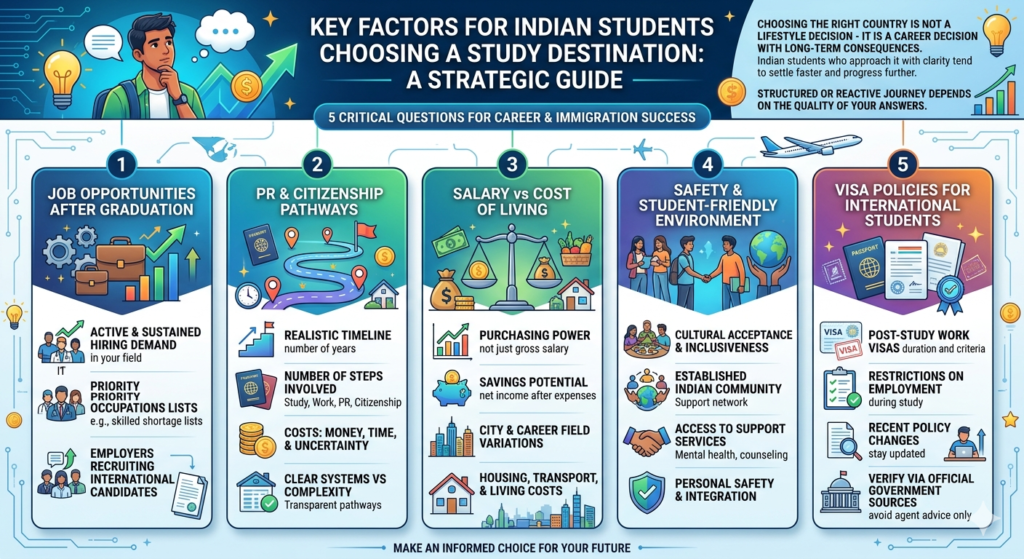
Choosing the right country is not a lifestyle decision; it is a career decision with long-term financial and immigration consequences. Indian students who approach it with clarity tend to settle faster and progress further.
There are five questions every student should be able to answer before committing to a destination. The quality of their answers will determine whether their settlement journey is structured or reactive.
Job Opportunities After Graduation
Does the country have active, sustained hiring demand in your specific field? General demand for technology or healthcare is not enough; the question is whether your occupation appears on priority lists and whether employers in that country actively recruit from international candidate pools.
PR & Citizenship Pathways
How long does it realistically take, how many steps does it involve, and what does it cost in money, time, and uncertainty? Some countries offer clear, transparent systems. Others are complex and frequently changing. Understanding the pathway before choosing the destination prevents expensive course corrections later.
Salary vs Cost of Living
A high headline salary means little if the cost of housing, transport, and living in that country erodes it. The relevant metric is purchasing power and savings potential, not gross salary. This calculation varies significantly by country, city, and career field.
Safety & Student-Friendly Environment
Cultural acceptance, the presence of an Indian community, access to support services, and personal safety are not soft concerns; they directly affect mental health, productivity, and the ability to integrate successfully. Countries with established Indian student communities typically have faster adjustment periods.
Visa Policies for International Students
Post-study work visas, restrictions on employment during study, and recent policy changes can dramatically alter the economics of studying in a particular country. Visa policy is frequently updated; students should verify current rules through official government sources, not just agent advice.
Canada: Best Overall for PR & Long-Term Settlement
Canada has held the top position as the preferred destination for Indian students seeking permanent settlement for nearly a decade. Its immigration architecture is built around attracting and retaining skilled international talent, and in 2026, that architecture has become more refined, not less accessible.
Canada’s Immigration Levels Plan continues to target high overall admissions, with over 400,000 new permanent residents welcomed annually. For Indian professionals, the most significant development in 2026 is the introduction of new category-based draws. Canada’s Immigration Minister announced five new targeted categories in February 2026, covering physicians, researchers, senior managers, transport professionals, and skilled military recruits. Category-based targeted draws now prioritise in-demand sectors such as healthcare, STEM, trades, and transportation.
Strong PR Pathways
Canada’s Express Entry system scores applicants using a points-based Comprehensive Ranking System (CRS). A Canadian master’s degree adds 15 bonus CRS points directly, and a typical Indian MS graduate aged 25–27 with one year of Canadian work experience and strong IELTS scores lands between 440–490 CRS within the Canadian Experience Class draw range. The system is transparent, merit-based, and does not involve a lottery, unlike the US H-1B.
Provincial Nominee Programs provide a 600-point CRS boost, almost guaranteeing an Invitation to Apply, and are designed to fill labour gaps and encourage settlement in specific provinces or territories. For Indian students who want certainty, this is the most reliable route.
High Demand for Skilled Professionals
Canada faces a structural skills shortage in technology, healthcare, and engineering that domestic graduates alone cannot resolve. Indian IT professionals remain strong candidates due to high demand for tech talent, though Express Entry CRS score trends show that many IT professionals now require scores above 480 to remain competitive.
Best Courses for Jobs in Canada
Canada’s category-based draws provide a direct signal of what the country needs most right now: healthcare workers, STEM professionals, and increasingly, cybersecurity specialists. The most employable profiles in 2026 include graduates in data analytics, AI and machine learning, cloud computing, nursing and allied health, and cybersecurity, which has become one of the fastest-growing priority sectors given Canada’s expanding digital infrastructure and government security investments.
Challenges to Consider
Canada’s immigration landscape, while strong, is more competitive than it was five years ago. Simply waiting in the Express Entry pool is no longer effective. Applicants who plan, improve their language abilities, align with labour market needs, and explore provincial options will have a better chance of securing permanent residency in 2026. Housing costs in Toronto and Vancouver remain high, while smaller cities and Atlantic provinces offer better affordability with comparable PR pathways.
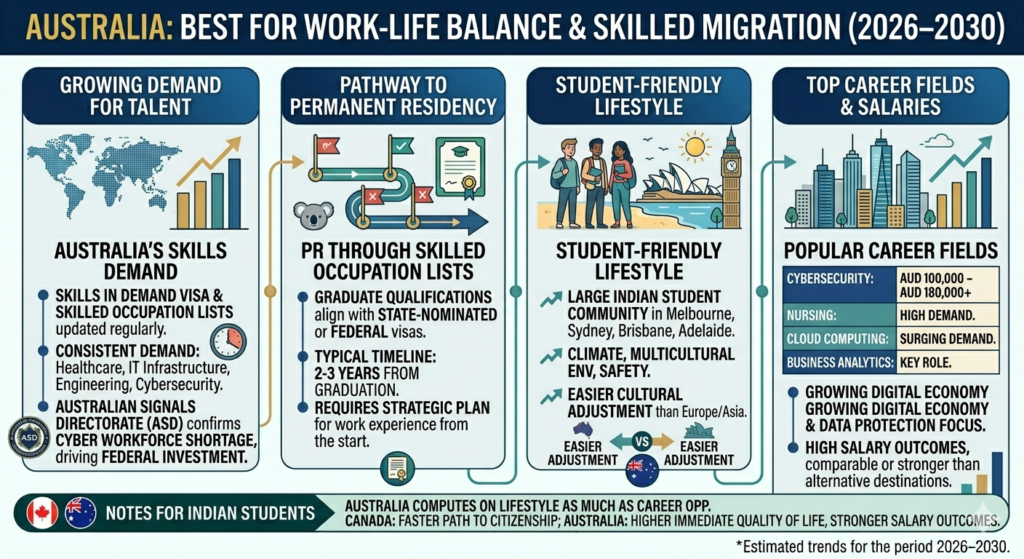
Australia: Best for Work-Life Balance & Skilled Migration
Australia has positioned itself as a destination that competes on lifestyle as much as career opportunities. Its skilled migration system is one of the most structured in the world, and its digital economy is growing at a pace that requires sustained international talent.
For Indian students choosing between Canada and Australia, the distinguishing factor is often personal: Canada offers a faster path to citizenship; Australia offers a higher immediate quality of life and, for many career fields, comparable or stronger salary outcomes.
Growing Demand for International Talent
Australia’s Skills in Demand Visa and Skilled Occupation Lists are updated regularly to reflect real-time labour market gaps. Healthcare, IT infrastructure, engineering, and increasingly cybersecurity are consistently present across occupation lists. The Australian Signals Directorate has publicly acknowledged a national cybersecurity workforce shortage, driving federal investment in talent pipelines.
PR Through Skilled Occupation Lists
Graduates whose qualifications align with Australia’s Skilled Occupation List can apply for state-nominated or federal skilled migration visas. The process typically takes two to three years from graduation for candidates who plan their work experience strategically from the start.
Student-Friendly Lifestyle
Australia has a large, well-established Indian student community across Melbourne, Sydney, Brisbane, and Adelaide. The climate, multicultural environment, relatively safe cities, and outdoor lifestyle make the cultural adjustment considerably easier than in European or East Asian destinations.
Popular Career Fields in Australia
Australia ranks high for cybersecurity salaries, with professionals earning between AUD 100,000 and AUD 180,000 annually. The country’s growing digital economy and increasing focus on data protection have led to a surge in demand for skilled cybersecurity experts, especially in cities like Sydney and Melbourne. Nursing, cloud computing, and business analytics also feature prominently on skilled occupation lists.
Germany: Best for Affordable Education & Engineering Jobs
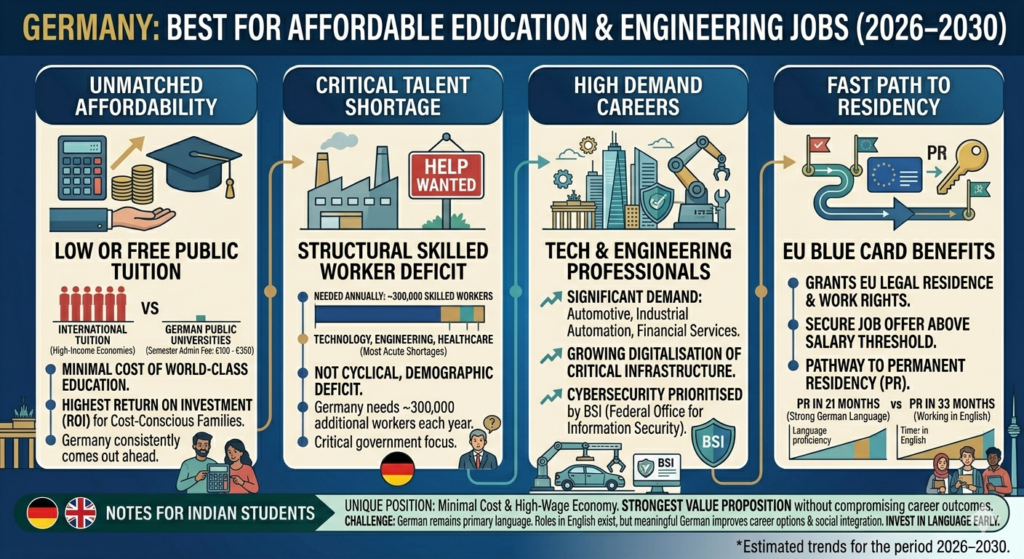
Germany occupies a unique position in the global study-abroad market: it offers world-class education at minimal cost, a high-wage economy, and a structured immigration pathway specifically designed to retain international graduates. For Indian students who are cost-conscious without wanting to compromise on career outcomes, Germany is the strongest value proposition.
Germany’s shortage of skilled workers is not a cyclical problem; it is structural and demographic. The country needs approximately 300,000 additional skilled workers annually, with technology, engineering, and healthcare being the most acute shortages.
Low or Free Public University Tuition
Most German public universities charge little to no tuition fees for international students. Students pay only a semester administration fee, typically between €100 and €350, making Germany one of the lowest-cost-of-education destinations among high-income economies. For Indian families making a financial calculation about the return on investment of studying abroad, Germany consistently comes out ahead.
High Demand for Tech & Engineering Professionals
Germany’s industrial and technology sectors, from automotive manufacturing to industrial automation to financial services, have significant and growing demand for cybersecurity professionals. As Germany’s critical infrastructure becomes increasingly digitised, the need for professionals who can protect it has become a government priority, with the BSI (Federal Office for Information Security) actively advocating for expanded cybersecurity hiring.
EU Blue Card Benefits
Non-EU graduates who secure a job offer above the minimum salary threshold can apply for the EU Blue Card. This grants legal residence and work rights across the EU and can lead to permanent residency in as little as 21 months for candidates with strong German language proficiency, or 33 months for those working in English.
Language Challenges & Adaptation
German remains the primary language of professional life outside major international tech hubs. While roles in English exist particularly in Berlin and Munich’s startup ecosystems, learning German meaningfully improves career options and social integration. Students who invest in language learning before arriving are consistently better placed.
Ireland: Fastest Growing Tech Career Destination
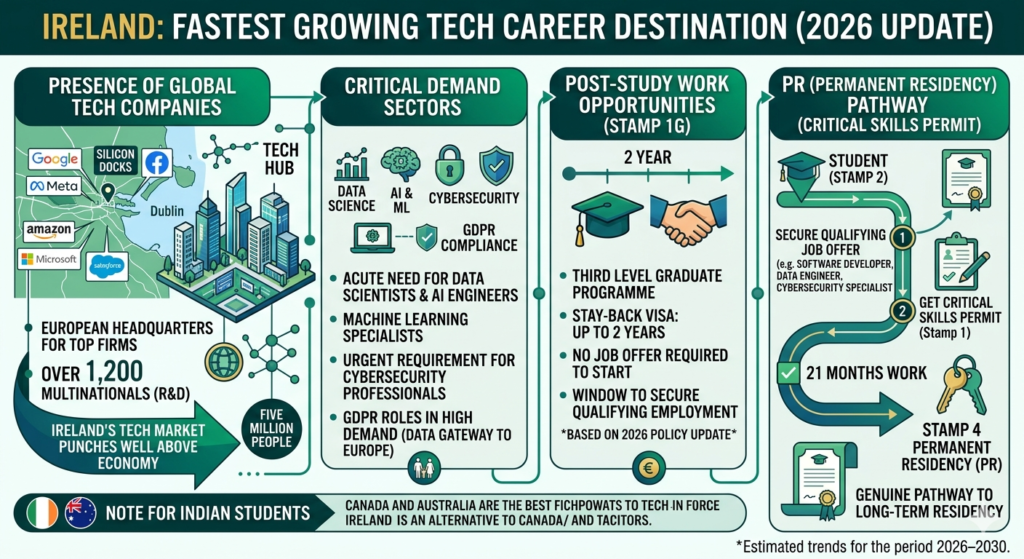
Ireland has quietly become one of the most strategically important countries in the world for technology careers, and in 2026, it is increasingly appearing on the radar of Indian students who previously focused on Canada or Australia.
The concentration of global technology companies in Dublin and its surroundings is extraordinary for a country of five million people. This creates a job market that punches well above Ireland’s economic weight.
Presence of Global Tech Companies
Dublin is home to the European headquarters of Google, Meta, Amazon, Microsoft, Salesforce, and dozens of other global technology firms. This concentration means that Indian graduates entering the tech job market in Ireland can find themselves working directly within global organizations, an experience that is career-defining and internationally transferable.
High Demand for Data & AI Professionals
Ireland’s technology ecosystem has created an acute need for data scientists, AI engineers, machine learning specialists, and, with growing urgency cybersecurity professionals. As these global companies process enormous volumes of European user data under GDPR, security and compliance roles have become particularly in high demand.
Post-Study Work Opportunities
International graduates from Irish universities can apply for the Third Level Graduate Programme, allowing them to remain in Ireland for up to two years after graduation to seek employment. This window is typically sufficient for graduates in technology and data fields to secure a qualifying job offer and begin the work permit process.
PR Possibilities in Ireland
Ireland’s immigration system is more complex than Canada’s or Australia’s, but the Critical Skills Employment Permit provides a genuine pathway to long-term residency for graduates who secure qualifying job offers. Critical Skills occupations include cybersecurity specialists, data scientists, software developers, and engineers, giving Indian graduates in these fields a meaningful advantage.
United Kingdom: Best for Fast Degrees & Global Exposure
The UK remains one of the most respected study destinations in the world, and for Indian students who want to enter the global job market as quickly and cost-efficiently as possible, it holds a specific structural advantage over other English-speaking destinations.
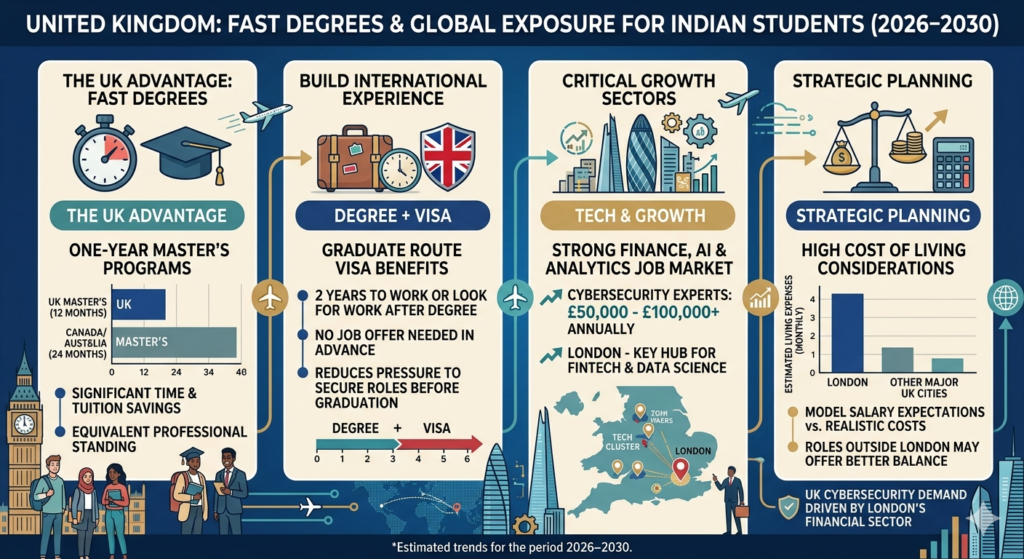
The UK’s one-year master’s programs are unique among major study-abroad destinations. Combined with the Graduate Route Visa, they create a pathway that allows Indian graduates to complete a degree and begin building international work experience faster than anywhere else.
One-Year Master’s Programs
A UK master’s degree takes twelve months. An equivalent degree in Canada or Australia takes twenty-four months. The time and tuition cost difference is significant, and for career fields where credentials matter more than duration, the one-year UK master’s delivers equivalent professional standing at roughly half the investment.
Graduate Route Visa Benefits
The Graduate Route Visa allows international students to remain in the UK for two years after completing a degree, and for PhD graduates to work or look for work without needing a job offer in advance. This removes the pressure of securing employment before graduation, giving candidates a more realistic window to find the right role.
Strong Finance, AI & Analytics Job Market
London’s position as a global financial centre creates sustained demand for finance, fintech, data analytics, AI, and cybersecurity professionals. UK cybersecurity experts can expect to earn between £50,000 and £100,000 annually, with potential for higher salaries in London. The city’s density of financial institutions and regulatory requirements makes cybersecurity particularly critical and well-compensated.
High Cost of Living Considerations
London and other major UK cities rank among the most expensive in the world. Students should model their salary expectations against realistic costs of accommodation, transport, and living, particularly in London, before making a financial commitment. Graduates who secure roles outside London often find a more favourable balance.
Singapore: Best Asian Country for Global Careers
For Indian students who want access to world-class career opportunities while remaining within the same time zone as their families, Singapore is in a category of its own among Asian destinations.
Singapore functions as Southeast Asia’s financial and technology hub. Its regulatory stability, government investment in digital infrastructure, and strategic position as a global business gateway make it uniquely attractive for professionals in technology and finance.
Strong Tech & Finance Ecosystem
Singapore’s government has invested heavily in AI, fintech, and digital transformation through its Smart Nation initiative. This investment has created consistent demand for professionals in cloud security, AI systems, data engineering, and cybersecurity fields, where internationally trained Indian graduates are highly competitive.
Safe & Modern Infrastructure
Singapore is consistently ranked among the world’s safest cities, with excellent healthcare, public transport, and urban infrastructure. The substantial Indian diaspora community, Singaporeans of Indian origin, represents roughly 9% of the population, providing cultural familiarity and professional networking advantages.
Career Opportunities in AI & Data Analytics
Singapore is positioning itself as a global AI hub, with the government committing SGD 1 billion to AI research and talent development. Cybersecurity professionals, in particular, are in high demand as Singapore protects its financial system and digital infrastructure from increasingly sophisticated threats.
Competitive Job Market
Singapore’s job market is highly competitive. The Employment Pass requires a minimum qualifying salary, and candidates must demonstrate strong domain expertise and relevant credentials. Certifications in cloud security, ethical hacking, and incident response provide meaningful differentiation for Indian graduates entering this market.
New Zealand: Best for Quality of Life & Peaceful Environment
New Zealand consistently ranks among the world’s top countries for quality of life, political stability, and personal safety. While it doesn’t match Canada or Australia in volume of job opportunities, it offers something increasingly rare: a high standard of living without the overcrowding and stress of larger economies.
For Indian students who prioritise lifestyle and community alongside career and who are targeting healthcare, skilled trades, or technology, New Zealand’s immigration system offers a relatively accessible and well-structured pathway.
Student-Friendly Immigration Policies
New Zealand’s Post-Study Work Visa allows graduates to work for up to three years, with pathways to residency through the Skilled Migrant Category. The Green List, introduced in 2022, fast-tracks residency for candidates in specific shortage occupations, many of which overlap with the most popular study choices for Indian students.
Demand in Healthcare & Skilled Trades
New Zealand has ongoing and well-documented shortages in nursing, healthcare support, construction, engineering, and increasingly, technology, including cybersecurity. Green List occupations include IT security specialists, making New Zealand one of the few countries where cybersecurity professionals may qualify for expedited residency processing.
Smaller but Stable Job Market
New Zealand’s economy is smaller than that of Canada or Australia, which limits the volume of opportunities in highly specialised roles. However, for candidates in healthcare, IT, and skilled trades, the competition is lower, the hiring timelines are shorter, and the settlement process is often faster and less stressful than in larger migration destinations.
Quick Comparison Table: Best Countries for Indian Students
| Country | PR Ease | Job Opportunities | Cost of Study | Salary Potential | Best For |
| Canada | Excellent | High | Medium | High | Long-term settlement |
| Australia | Very Good | High | High | High | Work-life balance |
| Germany | Good | High | Low | High | Affordable education |
| Ireland | Moderate | High | Medium | High | Tech careers |
| UK | Moderate | High | High | High | Fast degrees |
| Singapore | Limited | High | High | Very High | Asian careers |
| New Zealand | Good | Moderate | Medium | Moderate | Lifestyle |
Best Career Fields for Settling Abroad in 2026
Choosing a destination country is only one half of the settlement equation. The other half, the one that actually determines whether you receive a job offer, a work permit, and eventually a PR, is your career field. Countries don’t just want graduates. They want professionals in specific occupations that their economies are struggling to fill.
In 2026, five career fields stand out as consistently high-priority across multiple settlement destinations simultaneously.
Data Analytics & AI
Data professionals are in demand everywhere. From Canada’s category-based Express Entry draws to Ireland’s tech sector to Singapore’s Smart Nation initiative, the ability to derive insights from data and increasingly to build and secure AI systems is one of the most universally transferable skills in global labour markets.
Cybersecurity
Cybersecurity deserves particular attention in 2026, both as a career field and as a settlement strategy. The global cybersecurity workforce gap has hit a record 4.8 million unfilled roles, a 19% year-over-year increase. The active workforce grew by only 0.1% in the same period, while demand grew by 8.1%. This is not a temporary imbalance; it is a structural deficit that will persist for at least a decade.
According to the World Economic Forum’s Global Cybersecurity Outlook 2025, only 14% of organisations have the skilled people they need in the current cyber landscape. For Indian students, this means entering a job market where employers are not selecting from an oversupply; they are competing with each other to attract qualified candidates.
Canadian cybersecurity professionals enjoy competitive salaries typically between CAD 80,000 and CAD 130,000. Cities like Toronto, Vancouver, and Montreal are at the forefront, driven by a growing tech industry and increasing government investment. Australia, the UK, and Germany offer comparable salary bands in their respective currencies.
Nursing & Healthcare
Nursing professionals are on priority occupation lists in Canada, Australia, New Zealand, and the UK simultaneously. Aging populations in all four countries are creating sustained, long-term demand that will not diminish regardless of economic cycles. For Indian graduates with nursing qualifications and English language proficiency, settlement pathways are among the most accessible available.
Cloud Computing & IT
Cloud infrastructure skills transfer across industries and geographies with minimal friction. As organisations in every sector migrate to cloud environments, the demand for professionals who can build, manage, and secure those environments continues to grow faster than the talent pipeline.
Business & Finance
Strong hiring exists in the UK, Singapore, and Australia for graduates with quantitative backgrounds in finance, accounting, and financial risk management. Singapore, in particular, pays at the upper end globally for finance professionals, with total compensation packages that significantly exceed equivalent roles in most other countries.
Skills That Improve Settlement Opportunities Abroad
A degree and a job offer are the two things most students think they need to settle abroad. They are correct, but they are incomplete. What separates candidates who receive job offers from those who don’t is typically a layer of demonstrable, industry-recognised skill that sits on top of academic qualifications.
In competitive international job markets, employers cannot rely on Indian university rankings or grade transcripts alone. They need signals that a candidate can contribute immediately.
Technical Certifications
Industry certifications are the most universally legible credentials in global hiring. For cybersecurity professionals, certifications such as CompTIA Security+, Certified Ethical Hacker (CEH), CISSP, and cloud security credentials from AWS or Microsoft Azure are actively sought by employers across all the countries discussed in this article. 69% of hiring managers favour candidates who have recently upskilled or gained certifications, and 65% of cybersecurity roles now demand ongoing certification updates. Certifications are not supplementary to a degree; they are increasingly the primary hiring signal.
English Language Proficiency
Strong English language proficiency consistently above minimum IELTS or TOEFL thresholds is a baseline expectation in all English-speaking destination countries, and a significant advantage in Germany, Ireland, and Singapore, where many roles operate in English. Higher language scores also directly improve CRS points in Canada’s Express Entry system.
Internship & Work Experience
Employers in international job markets heavily discount academic qualifications without applied experience. Co-ops, placements, and internships that generate real project outputs, ideally documented in a portfolio, are among the strongest signals a candidate can present.
Communication & Soft Skills
Cultural fit, professional communication, and collaboration ability are consistently cited by international employers as differentiating factors among candidates with similar technical qualifications. Students who invest in developing professional communication skills in addition to technical ones consistently report faster hiring timelines abroad.
Challenges Indian Students Face While Settling Abroad
Settlement abroad is not a linear process, and it is rarely as smooth as promotional material suggests. Understanding the common obstacles in advance rather than encountering them mid-journey is one of the most practical things a prospective emigrant can do.
None of these challenges is insurmountable. But each one requires deliberate preparation rather than improvisation.
Cultural Adaptation
Professional norms, communication styles, workplace hierarchies, and social expectations vary significantly across countries and even across cities within the same country. Indian graduates who have invested time in understanding the professional culture of their target country, not just its job market, adapt faster and build stronger professional networks earlier.
Cost of Living & Financial Planning
The first six to twelve months abroad, before stable employment is established, are typically the most financially stressful. Students underestimate living costs, overestimate the speed of job placement, and sometimes find themselves in financially precarious situations. Realistic financial modelling before departure, including worst-case employment timelines, prevents this.
Competition in Job Markets
International graduates compete with local candidates who have established networks, cultural familiarity, and, in many cases, existing work permits. The candidates who succeed are consistently those with specialised credentials, project portfolios, and increasingly cybersecurity or AI-adjacent skills that are in acute shortage regardless of candidate origin.
Visa & Immigration Changes
Immigration policies are political instruments, not permanent fixtures. They change with governments, economic cycles, and bilateral relationships. Indian students must stay current with official government sources, IRCC for Canada, Department of Home Affairs for Australia, UKVI for the UK, rather than relying on information that may be months or years out of date.
Why Skill-Based Education Improves Global Employability
The gap between holding an Indian degree and being hired by a global employer is real, but it is not unbridgeable. The bridge is a demonstrable skill, the kind that is verified by industry credentials, visible in project work, and practised in conditions that replicate real professional environments.
This is why the choice of education program matters as much as the choice of destination country. A degree that produces theoretical knowledge without applied skill leaves graduates competing at a disadvantage in markets where employers can compare them directly against candidates with hands-on experience.
Employers Prefer Practical Skills
In international hiring, a portfolio of completed projects consistently outweighs academic transcripts. Employers in technology, cybersecurity, and data fields increasingly evaluate candidates through practical assessments, and the candidates who perform best are those whose training involved real-world problem-solving, not theoretical coursework alone.
Industry Projects & Certifications Matter
Internationally recognised certifications serve as a common language between candidates and global hiring managers. For Indian graduates competing in international pools, they reduce the employer’s uncertainty about an unfamiliar degree institution, replacing it with a credential they know how to evaluate.
Job-Ready Programs Increase Hiring Chances
Programs that integrate real-world project work, industry mentorship, and active career placement support consistently produce graduates who enter the job market with better starting positions, faster hiring timelines, and stronger early career trajectories than self-guided learners or traditional classroom graduates.
Why Choose Edept for Global Career Preparation
Build globally in-demand skills with Edept’s industry-focused programs.
Edept has been built specifically for Indian students who want to compete in international job markets, not just study abroad. Its current flagship focus is cybersecurity, one of the most shortage-critical fields globally, and one of the strongest settlement catalysts across every major destination country in this guide.
Edept’s Global Gateway Hub is a comprehensive planning tool that allows students to explore cybersecurity career pathways across countries, including the US, UK, Canada, Germany, and Australia, compare visa routes, simulate living costs, and understand exactly what each market requires. It is the starting point for students who want to move with clarity rather than guesswork.
Industry-Aligned Curriculum
Edept’s cybersecurity curriculum is developed in alignment with what global employers are actively hiring for in 2026: cloud security, AI defence, ethical hacking, incident response, and compliance, and updated continuously to reflect real market demand, not historical syllabuses.
Practical Skill-Based Learning
Every program is built around applied learning: real datasets, hands-on labs, live projects, and simulated environments that mirror what students will encounter on the job from day one. The goal is not graduation, it is employability.
Placement & Career Guidance
Edept provides structured career support across the full settlement journey from resume and LinkedIn optimisation calibrated for specific destination markets, to interview preparation, visa guidance, and job application strategy tailored to Canada, Australia, the UK, Ireland, and Germany.
Programs Focused on Global Opportunities
Whether the goal is cybersecurity in Toronto, cloud security in Dublin, or AI defence in Singapore, Edept’s programs are built around the credentials, certifications, and skill sets that matter in each specific market.
Step-by-Step Plan to Settle Abroad Successfully
Most students who struggle with settlement abroad don’t struggle. They lack talent, and they struggle because they didn’t plan. The students who settle successfully tend to have started their preparation earlier, made more deliberate choices, and aligned their skill-building with their destination’s specific requirements.
Here is a structured approach that reflects what successful Indian graduates have done consistently.
Step 1: Choose the Right Career Field
Select a discipline with active, sustained international demand, ideally one that appears on skilled occupation lists across multiple countries simultaneously. Cybersecurity, data analytics, healthcare, and cloud computing satisfy this criterion in 2026. The more overlap between your field and the shortage lists of your target country, the stronger your immigration case.
Step 2: Select the Best Country Based on Goals
Match your priorities to a country profile: PR speed and stability (Canada), lifestyle and salary balance (Australia), education cost (Germany), tech career density (Ireland), degree speed (UK), or Asian market access (Singapore). Make this decision before committing to a program, it shapes every subsequent choice.
Step 3: Build Industry Skills & Certifications
Invest in credentials that are recognised by employers in your target market. For cybersecurity, this means internationally recognised certifications alongside your degree. For data and AI, it means cloud platform credentials and verifiable project work. This investment should begin before you arrive in your destination country, not after.
Step 4: Gain International Exposure & Experience
Seek internships, co-op placements, freelance projects, or collaborative work with international teams before or during your studies. Build a portfolio that demonstrates what you can do, not just what you have studied.
Step 5: Apply for Jobs & PR Pathways
Start the immigration process early. Most PR pathways require a combination of education, work experience, and language scores that take time to accumulate. The students who receive their PR in year three abroad are consistently those who understood the pathway requirements before they left India.
Future Trends in Global Migration (2026–2030)
Below are some of the future trends in global migration, ranging from 2026 to 2030.
| Trend Category | Key Driver / Metric | Practical Implications |
| Demand for Skilled Professionals | Demographic aging in Western economies (Canada, Australia, Germany, NZ). | Demand is structural, not temporary. A projected global talent shortage of 85M+ workers by 2030. |
| AI & Tech-Driven Hiring | Shift toward skills-based and credential-verified hiring. | Verified certifications (AWS, CompTIA, etc.) now carry more weight than university names alone. |
| PR Program Competition | Increased global awareness of settlement pathways. | Higher CRS cutoffs and longer processing times; early profile building is essential. |
| Cybersecurity Window | Only 15% of firms expect significant skills growth by 2026. | A unique, time-sensitive “leverage window” exists for cyber professionals to enter global markets. |
Conclusion
In 2026, the opportunity for Indian students to settle abroad has never been more structurally supported, or more competitive. Canada remains the strongest overall destination for PR and long-term settlement, with a transparent points-based system and high immigration targets. Germany and Ireland are growing rapidly as tech-forward destinations with lower education costs and direct pipelines into global companies. Australia and the UK continue to offer strong career return on investment, particularly for graduates in healthcare, cybersecurity, and analytics. New Zealand and Singapore round out the list for students prioritising lifestyle quality or proximity to Asian markets.
Across all destinations, the single most consistent differentiator is skill. Countries don’t want graduates; they want professionals who can contribute immediately. The students who settle successfully in 2026 and beyond are those who enter their destination country with industry-recognised credentials, practical experience, and a clear plan. Cybersecurity, in particular, stands out as the field with the widest gap between global demand and available talent, and therefore the strongest immediate leverage for Indian graduates across every country in this guide.
Start your journey toward a global cybersecurity career with edept’s Global Gateway Hub today.