Every day, thousands of cyber attacks hit Indian businesses, government offices and even personal bank accounts. CERT-In’s own threat data points to about 1.3 million cyber attacks every hour across India in 2025. That is not a typo. As more of our daily life moves online, from UPI payments to hospital records, the people who protect this data are becoming just as important as doctors and engineers. This growing threat has created a massive demand for skilled professionals.
Industry reports suggest India needs close to one million cybersecurity experts, but currently has only a fraction of that number trained and ready to work. This gap is exactly why more students after Class 12 are choosing industry-oriented degrees instead of traditional, theory-heavy courses. The B.Voc Cyber Security and Digital Forensics is built for this reality. It mixes classroom learning with real tools, real case studies, and hands-on labs, so students graduate ready to work, not just ready to write exams.
In this guide, we will walk you through the syllabus, career options, salary ranges, eligibility, and admission process for this program, so you can decide if it is the right fit for you.
What is B.Voc Cyber Security and Digital Forensics?
Before we get into careers and salaries, let’s understand what this degree actually is and why it pairs two subjects that go hand in hand.
Understanding the B.Voc Degree
- B.Voc stands for Bachelor of Vocational Studies, a UGC-recognized 3-year undergraduate degree
- Unlike a regular B.Sc. or B.A., it is built around one specific skill set, in this case, cybersecurity
- Along with core academic subjects, students get hands-on training with industry tools from year one
- The structure blends general education with practical, job-ready skills instead of pure theory
Why Cyber Security and Digital Forensics Go Together?
- Cyber security is about stopping attacks before they happen, through firewalls, network defence and secure coding
- Digital forensics is about what happens after an attack, collecting evidence, tracing the attacker and supporting legal cases
- Together, they cover the full picture: protection, detection, investigation and response
- A company does not just want someone who can lock the door. It wants someone who can also find out who tried to break in, and how
Why Study Cyber Security in 2027?
The short answer is demand. Here is what that demand actually looks like across industries and job roles.
Rising Demand Across Every Industry
- Banking, protecting UPI transactions and net banking from fraud
- Healthcare, keeping patient records and hospital systems safe from ransomware
- Government, securing citizen data and public infrastructure
- IT companies and startups, building security directly into apps and platforms
- E-commerce, protecting customer payment details and personal data
Future Scope of Cyber Security Careers
India’s cybersecurity job market is expanding fast. Reports from the ISC2 Cybersecurity Workforce Study and industry staffing firms put India’s talent gap at close to one million unfilled roles
- About 93% of Indian companies are raising their cybersecurity budgets, and 17% plan to raise them by 15% or more, which directly turns into more hiring
- Cloud adoption and AI tools are creating new job roles, such as AI Security Engineer and GenAI Threat Analyst, that barely existed a few years ago
- As long as digital transformation continues across banking, healthcare and government, this demand is unlikely to slow down
Why Practical Skills Matter More Than Theory?
Employers want people who have actually used tools like Wireshark, Burp Suite, or SIEM platforms, not just read about them in a textbook. Hands-on labs simulate real attacks, so students learn to think like both a defender and an attacker. Internships and live projects show students how real security teams actually operate. This is exactly why recruiters increasingly prefer graduates from practical, industry-aligned programs over purely theoretical ones
Read more: Cybersecurity Salary in India
B.Voc Cyber Security Curriculum: What Will You Learn?
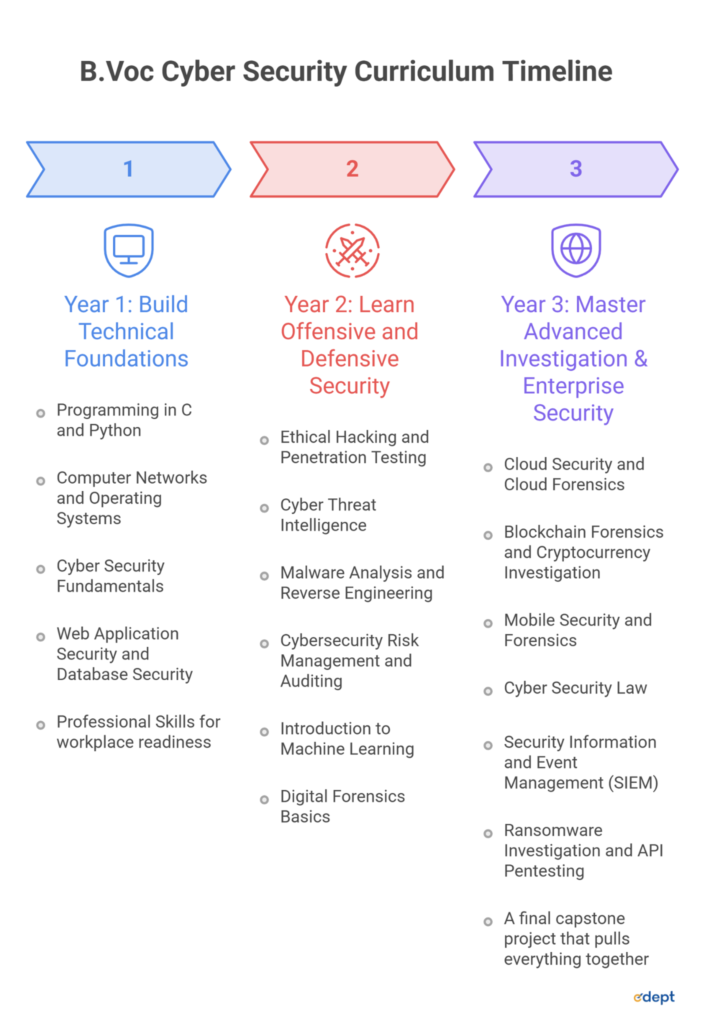
The three-year program is structured so each year builds on the last, moving from basics to advanced, real-world skills. Here is how the semesters break down.
Year 1: Build Technical Foundations
- Programming in C and Python
- Computer Networks and Operating Systems
- Cyber Security Fundamentals
- Web Application Security and Database Security
- Professional Skills for workplace readiness
This year builds the base you need before you can secure anything. You cannot protect a system you do not understand, so this stage focuses on how computers, networks and code actually work.
Year 2: Learn Offensive and Defensive Security
- Ethical Hacking and Penetration Testing
- Cyber Threat Intelligence
- Malware Analysis and Reverse Engineering
- Cybersecurity Risk Management and Auditing
- Introduction to Machine Learning
- Digital Forensics Basics
Second year is where things get hands-on. Students learn to think like attackers through ethical hacking, so they can build stronger defences, while also picking up the investigation skills used in digital forensics.
Year 3: Master Advanced Investigation & Enterprise Security
- Cloud Security and Cloud Forensics
- Blockchain Forensics and Cryptocurrency Investigation
- Mobile Security and Forensics
- Cyber Security Law
- Security Information and Event Management (SIEM)
- Ransomware Investigation and API Pentesting
- A final capstone project that pulls everything together
By the final year, students are working on enterprise-level problems, the same kind of cases that real security teams and forensic investigators handle every day.
Also read: Top Cybersecurity Jobs After Graduation
Tools and Technologies You Will Work With
A cybersecurity degree is only as good as the tools it teaches. Here is what students get hands-on time with.
Industry Tools Included in the Program
- Penetration Testing tools
- Digital Forensics tools
- Network Analysis tools
- Mobile Security tools
- Vulnerability Assessment tools
- Security Information and Event Management (SIEM) platforms
- Threat Intelligence platforms
- Cloud Security tools
- Compliance and Governance frameworks
Knowing the theory behind an attack is not enough anymore. Recruiters often ask candidates to demonstrate tool usage during interviews, and having this experience on your resume already puts you ahead of graduates who have only studied concepts from a textbook.
Career Opportunities After B.Voc in Cyber Security
Now for the part most students really want to know: what jobs can you actually get, and what do they pay?
B.Voc Cyber Security and Digital Forensics Job Roles
- Information Security Analyst
- Security Testing Engineer / Penetration Tester
- Computer Forensic Analyst
- IT Auditor
- Network Security Engineer
B.Voc Cyber Security and Digital Forensics Expected Salary
According to Economic Times data on the industry, average starting salaries for freshers with 0 to 3 years of experience look like this:
- Computer Forensic Analyst: INR 6 to 9 Lakhs per year
- Security Testing / Penetration Tester: INR 3 to 9 Lakhs per year
- IT Auditor: INR 6 to 9 Lakhs per year
- Network/IT Security Engineer: INR 3 to 6 Lakhs per year
- Information Security Analyst: INR 3 to 6 Lakhs per year
Salaries grow quickly once you cross 3 to 5 years of hands-on experience, especially in penetration testing and cloud security roles, where niche skills remain in short supply.
Industries Hiring Cyber Security Graduates
- IT companies and product firms
- Consulting firms
- Government departments and public sector undertakings
- BFSI (banking, financial services and insurance)
- Healthcare
- Telecom
- Global Capability Centres (GCCs) set up by multinational companies in India
Read more: Sklls Required to Become a Cybersecurity Professional
Why Choose the B.Voc Cyber Security Program at Shree L.R. Tiwari College of Engineering?
A degree matters, but so does where and how you study it. Here is what this specific program adds to the standard curriculum.
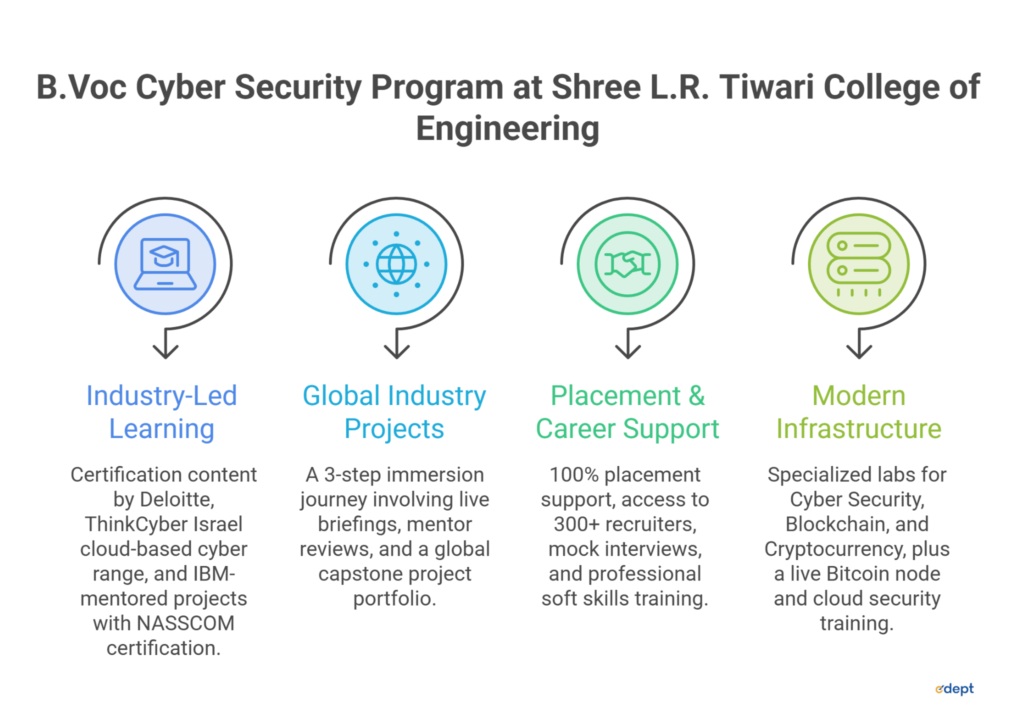
Industry-Led Learning
- Self-paced certification content authored by the Deloitte Learning Academy, with a certification issued directly by Deloitte on completion
- Access to ThinkCyber Israel’s cloud-based cyber range for real-time, scenario-based hands-on training
- IBM-mentored live projects, IBM courseware, and a joint IBM plus NASSCOM certification through the IBM Internship Program
- Practera-powered global industry immersion projects with international client organisations
Global Industry Projects
- A structured 3-step journey, Foundation Immersion, Applied Immersion and Advanced Immersion, building up to leading a global capstone project
- Live project briefings, mentor and client reviews, and executive-level presentations
- Students build a portfolio of real, global project work before they even graduate
Placement & Career Support
- 100% placement support
- Access to a network of 300+ recruiters
- Mock interviews and mock group discussions
- Career guidance, soft skills training and business communication sessions
- Workshops, webinars, guest sessions and industry visits
Modern Infrastructure
- Cyber Security and Blockchain Center of Excellence
- Blockchain Lab and Cryptocurrency Investigation Lab
- A live Bitcoin node for hands-on blockchain forensics
- Cloud Security training setup and an in-house Development Center
- Air-conditioned, Wi-Fi-enabled IT labs
Eligibility, Duration and Admission Process
If this sounds like the right course for you, here is what you need to know before you apply.
B.Voc Cyber Security and Digital Forensics Eligibility
- 10+2 or equivalent, in any stream, no specific subject requirement
- A 3-year degree program, spread across 6 semesters
- Limited intake of 30 seats per batch
B.Voc Cyber Security and Digital Forensics Admission Process
- Fill the MKCL form first, then complete the online application on the college website
- Submissions and admission follow the schedule set by Mumbai University
- Counselling is conducted before final seat allotment
- Seats are limited, so early application is recommended
Also read: Cybersecurity vs Ethical Hacking
Who Should Choose B.Voc Cyber Security and Digital Forensics Course?
This program is not for everyone, and that is fine. Here is who tends to do well in it.
- Students who are genuinely curious about how technology works, not just interested in the job title
- Aspiring ethical hackers who enjoy finding weaknesses before someone else does
- Problem solvers who like piecing together clues, useful for the forensics side of the course
- Students who prefer doing over reading, since this course is lab-heavy
- Anyone who wants a career with strong, steady demand rather than chasing short-term trends
Is Pursuing B.Voc Cyber Security and Digital Forensics Valuable
Cyber security is no longer a backup career choice. It is one of the few fields in India where demand is outpacing supply by a wide margin, and that gap is not closing anytime soon. The B.Voc in Cyber Security & Digital Forensics gives students a practical, industry-backed way into this field, combining a UGC-recognized degree with certifications from Deloitte and IBM, live global projects, and dedicated placement support. If you are finishing Class 12 and looking for a course that leads to a specific outcome, this is worth a serious look.