Artificial intelligence is not just a headline from the future anymore; it is the present reality that is reshaping how software is built, how data is analyzed, and how business is operating across various sectors. AI has transformed daily working reality across software development, cloud computing, cybersecurity, and data analytics. Code that once took hours to be written by a developer can now be written within a few minutes by an AI assistant.
While a B.Sc. IT degree still provides a solid foundation in programming, databases, networking, and software development. Yet when we start discussing the hiring process in 2026, we notice a clear gap between what universities teach and what employers actually need. Employers now expect graduates to walk in with more than textbook knowledge. Recruiters are no longer just asking, “Do you have a degree?” They are asking, “What can you actually do with AI?” So the honest questions that every parent and student is curious about are, ‘Is a traditional B.Sc. IT still enough in the AI era?’ In this blog, we look at what the degree still gives you, what’s missing for today’s market, and what you can add to it so your career stays strong for the next ten years.
How AI Is Changing the IT Industry
AI is shifting the IT industry from a labour-intensive, coding-heavy model to one focused on automation and high-value architecture. It helps in automating routine programming and debugging, reduces manual IT operations (AIOps), and empowers smaller teams to build faster. AI is not replacing any IT professionals. It is redefining what they do. A 2026 analysis by NASSCOM and Deloitte estimates that AI will impact 37% of entry-level IT jobs. Rather than eliminating these roles, AI is fundamentally redefining the nature of the work.
Cloud computing, data analytics, and cybersecurity roles are expanding rapidly, and employers are actively seeking candidates who understand how these domains intersect with AI. Tasks like basic coding, software testing, and data entry are increasingly automated. In 2026, employers in India want three things from fresh graduates: AI skills they can apply from day one, soft skills that make them genuinely good to work with, and real industry experience that proves they have done something before walking in the door. More than 90% of Indian employees are already working with generative AI tools per the India Skills Report 2026. And yet, 82% of Indian employers are struggling to find the talent they need, according to ManpowerGroup’s 2026 Talent Shortage Survey. The problem is that employers want someone who can use AI to solve problems rather than someone who has just the theoretical knowledge of AI.
What a Traditional B.Sc. IT Still Offers
A traditional B.Sc. IT (Bachelor of Science in Information Technology) still remains a highly relevant, foundational degree. It offers a structured blend of theoretical computer science and applied technology, serving as a reliable starting point for diverse tech roles like software development, network administration, cybersecurity, and cloud management. Here you learn how to think logically, how to break a problem into smaller pieces, and how a computer actually processes those pieces. Despite these shifts, a conventional B.Sc. IT curriculum holds real value.
- Programming fundamentals – Programming languages such as C, C++, Java, or Python; logic; and algorithms
- Database management – SQL, data modelling, and relational database design.
- Computer networks – Understanding how systems communicate and stay secure.
- Operating systems – The backbone of all software environments.
- Software development basics – Structured thinking, version control, and application design.
These fundamentals are not outdated; they are the foundation upon which every emerging technology is built. However, they need to be complemented with exposure to emerging tools and real-world applications. Theory alone, without practice, leaves graduates underprepared for the expectations of modern employers. 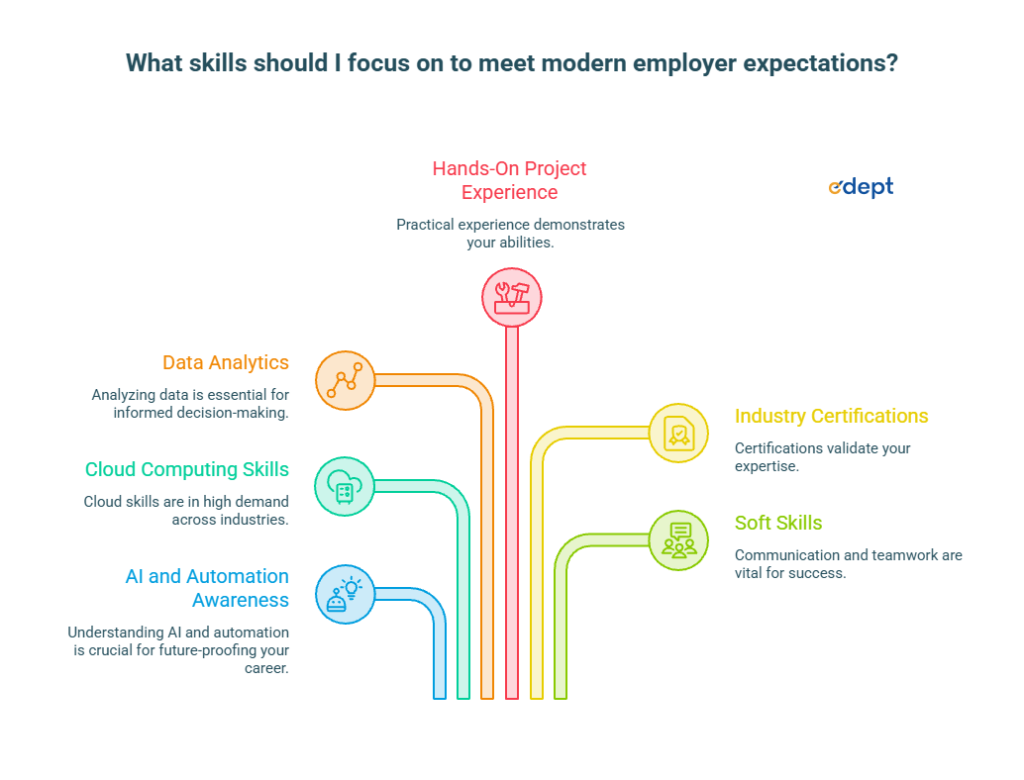
What Modern Employers Expect Beyond a Degree
Today, hiring managers look for more than just a degree. Modern employers prioritize practical capabilities, technical adaptability, and human-centric skills, specifically seeking proficiency in AI tools, cloud computing, and data analytics.
AI and Automation Awareness
You don’t need to be a machine learning engineer, but you need to understand the basics of AI, i.e., how AI tools work, where they fit into workflows, and what their limitations are. Employers nowadays expect professionals to identify routine tasks and apply basic digital tools to make those processes faster and error-free. This includes basic prompt writing, understanding how AI-generated code needs reviewing, and knowing where automation helps. You should know how to use low-code or no-code software to route tasks automatically.
Cloud Computing Skills
Modern employers expect graduates to have practical cloud capabilities, as traditional degrees often lack hands-on platform training. Cloud platforms act as the infrastructure of modern IT. Working knowledge of major services like Amazon Web Services (AWS), Microsoft Azure, or Google Cloud is the baseline requirement. They expect you to apply languages like Python, Bash, or PowerShell to write scripts that manage system operations.
Data Analytics
The ability to interpret data, work with BI tools, and draw meaningful insights is no longer just limited to data science teams. IT professionals across roles are expected to be comfortable with data. Employers expect professionals to be able to write Python scripts to clean data and automate repetitive analytical tasks. They expect candidates to have a blend of technical skills, business knowledge, and soft skills.
Hands-On Project Experience
Modern employers expect candidates to have real hands-on practical experience. They want to see the candidates’ problem-solving and practical skills. Academic assignments are useful, but industry-aligned projects, live coding scenarios, and capstone work that resembles actual business challenges carry far more weight.
Industry Certifications
Certifications from established technology and consulting partners provide graduates with a valid way to demonstrate specific, current skills: cloud fundamentals, data tools, or AI applications. Programmes such as the Deloitte Learning Academy and IBM learning pathways offer credentials that employers recognize and trust. They help in bridging the gap between academic knowledge and industry standards.
Soft Skills
Technical skills can help you appear for the interview, but soft skills such as communication, teamwork, adaptability, and critical thinking help you crack the interview and get the job. As AI handles more routine tasks, the human ability to collaborate, explain, and adapt becomes more valuable.
How Edept Prepares Students for the AI Era
This is where the right programme can make a measurable difference. edept, in partnership with Steinbeis University School of Next Practices in Germany and Shree L.R. Tiwari School of Business Management in Mumbai, offers a structured pathway that goes beyond the traditional degree.
The Master’s in Data Science & AI programme is built as a global 1+1 dual-degree pathway. Students begin with a PGDM in Business Analytics in India, covering modules like Python Programming for Analytics, Machine Learning, Data Visualisation with Tableau and Power BI, and SQL & Database Management. They also receive structured German language training and cultural preparation, which is rare but increasingly valuable for global careers.
The students are then transferred to Steinbeis University in Berlin for advanced modules in Artificial Intelligence, Data Strategy & Governance, High Performance Computing, and a Master Thesis rooted in real industry projects. Steinbeis is known for its practice-oriented learning model, integrating live company projects directly into academic study.
Key differentiators include:
- Industry-aligned curriculum that evolves with market demand.
- AI-integrated learning across both years, not as an afterthought.
- IBM Live Projects and Deloitte Learning Academy Certifications that add recognised credentials to a student’s profile.
- Global immersion projects that build cross-border exposure.
- Practical learning and internships in India and Germany.
- Placement-focused skill development with end-to-end support from application through graduation.
For students asking how to stand out, this model offers a clear answer: combine academic depth with industry exposure, global mobility, and continuous upskilling
Conclusion
A traditional B.Sc. IT degree continues to provide a strong technical foundation; that has not changed. What has changed is the world around it. In 2026 and beyond, a degree alone will not be enough to stand out. In the AI era, employers increasingly seek graduates who bring practical experience, AI awareness, cloud knowledge, industry certifications, and sharp problem-solving skills. The students who can combine academic learning with hands-on industry exposure and a mindset of continuous upskilling are the ones who succeed in this job market. Choosing a programme that builds these opportunities in from day one, rather than leaving students to find them on their own, is increasingly what separates a good degree from a career-ready one.