Data Analytics is often considered an advanced technical field centred around SQL queries, Python programming, dashboards, data visualization, and statistical analysis. While these technical capabilities are essential, they represent only one part of what makes a successful analytics professional. In today’s competitive job market, employers increasingly look beyond technical expertise when hiring. They seek candidates who can actually understand business problems, collaborate with cross-functional teams, communicate insights effectively, and influence strategic decisions. This is why soft skills for data analytics professionals are very important in the long run.
Modern businesses generate enormous amounts of data every day, but data alone has little to no value unless someone can translate it into meaningful business outcomes. This is where soft skills for data analytics professionals become even more important. The ability to explain complex findings in simple language while thinking critically with confidence often distinguishes top performers from technically proficient analysts. As artificial intelligence is automating repetitive analytical tasks, human-centric abilities such as communication, collaboration, adaptability, and decision-making are becoming even more valuable. Professionals who combine strong technical expertise with excellent interpersonal skills are more likely to secure leadership roles, earn higher salaries, and achieve long-term success in a data analytics career.
In this guide, we will explore the most important soft skills for data analytics professionals, explain why they do matter in today’s workplace, and provide practical ways for students and aspiring analysts so they can develop these skills to build successful, future-ready careers.
Why Soft Skills for Data Analytics Matter
Having technical expertise is the foundation of every analytics role, but soft skills for data analytics professionals determine how effectively those technical insights create business value. Organizations don’t hire analysts just to generate reports, but to solve problems, support decisions, and drive measurable outcomes.
Data Alone Does Not Drive Decisions
Raw data has little value without interpretation. Data analysts must identify meaningful patterns, uncover trends, and transform numbers into actionable recommendations that help businesses achieve their objectives.
Insights Must Be Clearly Communicated
Communication is one of the most important soft skills for data analytics professional. It is often considered that analysts who can communicate the findings with managers, executives, and other people who do not necessarily have a technical background excel in their field. Hence, having good communication is important in providing insights to stakeholders to make important judgments.
Business Impact Matters More Than Raw Data
Soft skills in data analytics aim to link the analytical insights to the business needs of the organization. The knowledge about the goals of the company will help the analyst to suggest solutions that will bring increased efficiency, decreased costs, more revenues, and better customer experience.
Employers Want Well-Rounded Professionals
Nowadays, there is an increased need for data analysts with both technical skills and soft skills for data analysts, including critical thinking, teamwork, and problem-solving. Having analytics career skills will help analysts to cooperate with people from different departments, convince decision-makers, and progress in their careers
Why Soft Skills Are Becoming More Important in 2026
The need for soft skills in data analytics professionals has risen sharply due to increased data usage by businesses and the advancement in technologies. Technical knowledge is still important; however, what businesses now seek from data analytics professionals includes their capacity to interpret data, communicate insights, and collaborate with others. By 2026, these soft skills will become very important competitive strengths.
Data Volumes Are Growing Rapidly
Each day, companies produce enormous amounts of structured and unstructured data. Analysis of such data involves not only technical abilities but also critical thinking and business knowledge, and the ability to derive insights that would be beneficial for strategic purposes.
Businesses Need Faster Decisions
Contemporary companies operate under very competitive conditions when rapid decision-making is crucial. It is vital to possess good presentation skills for data analysts in order to make organizations act quickly in response to changing customer preferences and market situations.
Cross-Functional Collaboration Is Increasing
Data analysts interact with marketing, finance, operations, product management, and executive departments daily. Effective cooperation is based on listening skills, teamwork skills, flexibility, and business communication, which is why such skills are necessary for any analytics career.
AI Is Automating Routine Analytics Tasks
Automation is increasingly applied to data cleaning, reporting, and elementary analytics tasks. The value of soft skills for data analysts becomes higher as automation processes develop. Such skills as problem-solving in analytics, data storytelling, decision-making, and stakeholder communication become the core distinguishing characteristics helping specialists to deliver business value. The combination of technical knowledge and soft skills for data analytics professionals will allow them to succeed in leadership positions in the future.
Top Soft Skills Required for Data Analytics Professionals
Technical skills assist data analysts in handling data, while soft skills are those that data analysts use to convert their findings into business benefits. The best data analysts have technical knowledge along with good communication, critical thinking, and leadership skills. The following table explains the business value of the most important soft skills for data analytics professional.
| Soft Skill | Why It Matters | Career Impact |
| Communication | Explain Insights Clearly | Better Stakeholder Trust |
| Critical Thinking | Finds Deeper Insights | Improved decision-making |
| Problem-Solving | Solves Business Challenges | Higher Business Value |
| Business Understanding | Connects data with goals | Better recommendations |
| Data Storytelling | Makes insights actionable | Stronger executive buy-in |
| Collaboration | Improves teamwork | Faster project delivery |
| Adaptability | Keeps pace with technology | Long-term career growth |
| Attention to Detail | Ensures data accuracy | Higher credibility |
| Decision-Making | Converts insights into action | Leadership opportunities |
| Time Management | Handles multiple priorities | Increased productivity |
Communication Skills
Among all soft skills for data analytics professionals, communication is arguably the most important. Analysts regularly present dashboards, reports, and recommendations to managers, clients, and executives who may not have a technical background. Strong communication skills for data analysts help translate complex SQL queries, statistical models, and visualizations into clear business language.
Critical Thinking
Critical thinking enables analysts to move beyond surface-level observations. Instead of simply reporting numbers, they question assumptions, identify hidden patterns, and investigate the reasons behind business trends. Critical thinking remains one of the most valuable analytics career skills because it improves business decisions and supports long-term organizational growth.
Problem-Solving
Companies employ analysts to be problem solvers rather than simply report makers. Problem-solving in analytics is an important skill that helps professionals recognize the problems faced by organizations, analyze relevant data, assess different solutions, and suggest actionable steps.
Business Understanding
Data is worthless without understanding how the business works. Business-savvy analysts who know the organization’s goals and its customers can provide valuable insights that are useful to the organization. Being business savvy enables data analysts to focus on the right metrics, suggest solutions, and measure business performance instead of purely analyzing data.
Storytelling With Data
Storytelling through data visualizations and contextual information helps in making complex information understandable and telling a story in numbers. Be it presenting to executives or reporting to stakeholders, or showing KPIs via dashboards, data storytelling helps people understand complicated information fast. Data storytelling has emerged as one of the most sought-after soft skills in data analytics.
Collaboration Skills
Collaboration is key in current analytics initiatives, where data engineers, software engineers, marketers, financiers, product managers, and business people are all involved in the process. When team members collaborate, they can work together to achieve common goals.
Adaptability
The field of analytics advances at a rapid pace, owing to the constant evolution of AI tools, cloud-based solutions, programming languages, and visualization software. Those individuals who are open to learning keep up to date with evolving technology and maintain their value even when automation takes care of the mundane parts of the analytics task.
Attention to Detail
Any small mistake made in terms of the dataset, in calculation, in dashboarding, or in any business assumptions leads to wrong business decisions. Being detail-oriented is essential for ensuring accuracy and maintaining high-quality standards.
Decision-Making Ability
Analytics professionals are increasingly required to offer recommendations along with findings. The process of decision-making entails the analysis of existing evidence, risk assessment, and making suggestions for action based on the analytic insights. Effective decision-makers assist organizations in their prompt reaction to market changes and potential growth opportunities.
Time Management
Analytics teams have a lot on their plates, including working with several dashboards and reports, handling ad hoc requests, attending meetings, and meeting deadlines for projects. Time management allows professionals to perform relevant activities in an efficient way, avoid missing any deadlines, and deliver accurate findings. Proper planning of tasks, workload management, and focus on business-related activities result in increased productivity and effectiveness. In addition to technical skills, time management is one of the most effective soft skills for data analytics professionals.
How Soft Skills Improve Career Growth in Data Analytics
In addition to improving one’s everyday work, developing soft skills for the data analytics profession will fast-track one’s career development. Although technical skill sets will help one perform data analysis, soft skills will help an individual gain more prominence and earn more from data analytics careers.
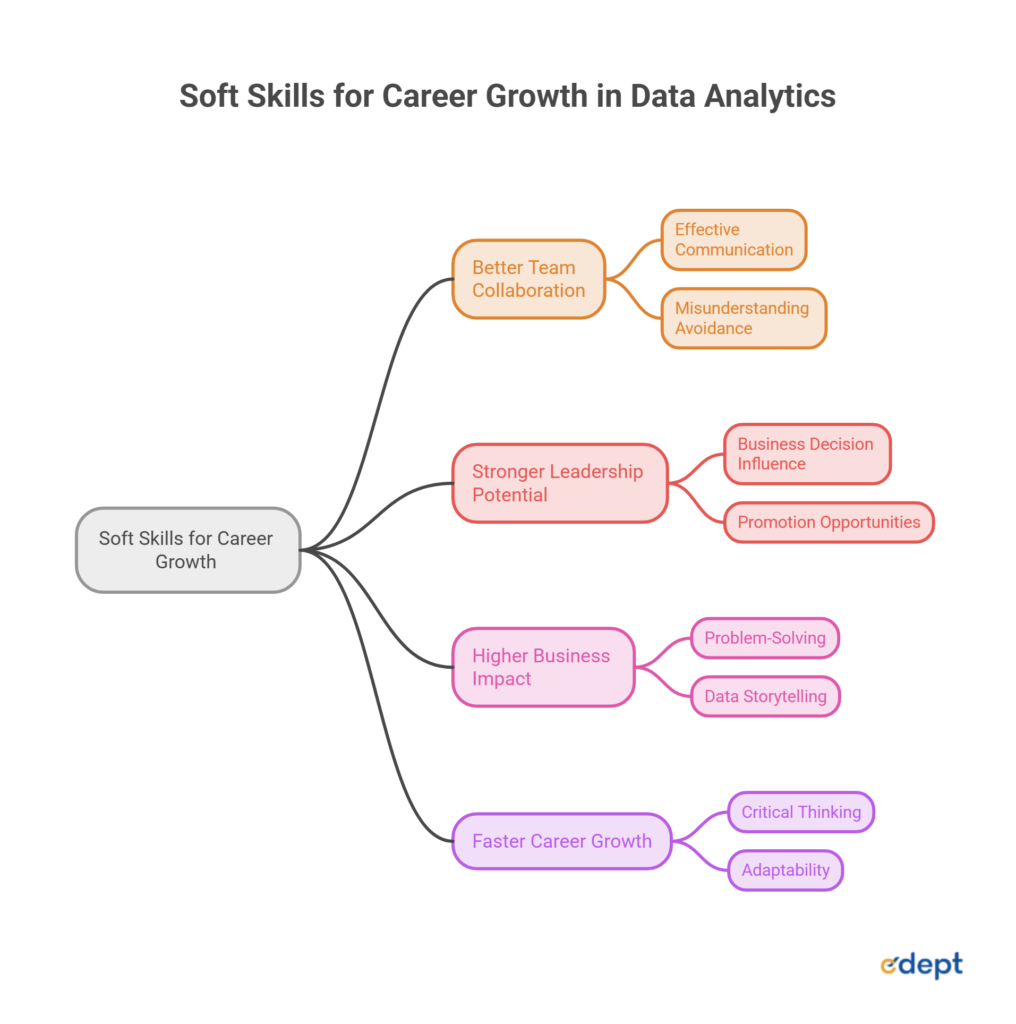
Better Team Collaboration
Analytics experts frequently collaborate with managers, engineers, marketers, and product developers. Effective communication and collaboration are crucial in ensuring that projects operate smoothly and misunderstandings are avoided.
Stronger Leadership Potential
Data analysts who are able to communicate and influence business decisions will be promoted into senior data analyst, data analytics manager, and eventually leadership positions. Soft skills for data analysts become even more important as one gets promoted further.
Higher Business Impact
Companies appreciate professionals who provide tangible business value. Problem-solving in analytics, business skills for data analysts, and data storytelling skills allow for effective communication of the results and recommendations that help to drive revenue, increase efficiency, and boost customer satisfaction.
Faster Career Growth
Many companies appreciate the combination of technical skills and soft skills in data analytics when considering promoting a professional. Effective communication, critical thinking, adaptability, and decision-making result in additional responsibilities, better reviews, increased salaries, and quicker promotions. Data analytics professionals who have mastered both types of skills are destined for success.
Common Mistakes Data Analytics Students Make
Many students spend months mastering SQL, Python, and visualization tools but overlook the soft skills for data analytics professionals that employers value just as highly. Avoiding these common mistakes can significantly improve your career prospects in data analytics careers.
Focusing Only on Technical Skills
Technical knowledge is critical, but depending entirely on technical aspects can be restrictive to your professional development. Companies always look for individuals who can interpret their findings, address challenges and work together with other departments.
Ignoring Business Understanding
Often times, students conduct analysis without being aware of the organization’s goals. Business skills for data analysts can assist you in interpreting findings in accordance with organizational goals and providing useful recommendations.
Weak Presentation Skills
Dashboard creation is not all that there is to it. Data analysts should be able to share their findings with other stakeholders via reports, presentations and other means. Being a good storyteller can significantly help in communicating your ideas and recommendations to others.
Poor Communication
The lack of skill to describe technical ideas using clear language is one of the biggest obstacles for your career. By learning how to communicate clearly for data analysts, you will be able to work successfully with managers, customers, and other professionals in your company. The best way to become a successful data analyst is to have both technical knowledge and communication skills.
How Students Can Build Soft Skills for Analytics Careers
The development of soft skills among data analytics experts should be done on an ongoing basis along with other forms of education. Such students will be more ready to face an interview or an internship and succeed in the chosen career.
Practice Presentations
Present your dashboards, reports, and research conclusions to your classmates, teachers, or online community. Doing so regularly will give you more confidence and improve your communication skills as a data analyst.
Improve Communication
Learn to explain complex technical information to others in plain and clear language. Effective communication is a crucial component of working efficiently with various stakeholders in the field of analytics.
Work on Team Projects
Participating in group projects is a great opportunity to learn to cooperate, lead, resolve conflicts, and work in a team. It simulates real-world situations and helps develop critical analytics career skills.
Develop Business Awareness
Understand how companies from different industries function and what business metrics exist in those areas. Having strong business skills is essential for data analysts.
Learn Data Storytelling
Instead of focusing only on making dashboards, try to master data storytelling skills. Communicate insights through well-structured visual aids, narratives, and recommendations.
Industries Hiring Data Analytics Professionals
The requirement for soft skills in the field of data analytics exists in practically all major sectors. The modern organization makes use of data analytics in decision making, in order to increase efficiency, offer better customer service, and maintain competitive edge. This is why there is great need for good analysts.
Technology
The tech industry uses data analytics to refine products, enhance user experience, improve cyber security and create AI solutions. Data analyst soft skills enable professionals to work with developers, product managers, and business departments.
Finance
Banks, insurance companies, and fintech organizations use analytics for fraud detection, risk assessment, customer segmentation, and financial forecasts. The specialists possessing business skills for data analysts and problem-solving capabilities are highly sought after in the sector.
Healthcare
Data analysis is crucial in healthcare and pharmaceuticals to improve patient treatment, understand treatment results and improve the efficiency of the processes. Communication and critical thinking skills help the analysts to extract insights from medical data.
Retail and E-Commerce
The retail businesses use analytics to understand customers’ behavior, manage inventories, organize personalized campaigns, and predict demands. Data storytelling helps decision-makers of retail companies to make fast and customer-oriented decisions.
Manufacturing
The manufacturing industry utilizes analytics for predictive maintenance, quality control, logistics, and planning of production. The specialists that combine technical skills with soft skills in data analytics are more capable of solving problems and helping businesses thrive in different data analytics careers.
Why Employers Value Soft Skills in Data Analytics Roles
When hiring analytics professionals, recruiters today do not concentrate on technical skills alone. Even though proficiency in SQL, Python, and visualization is important, soft skills of data analytics professionals will determine their ability to work effectively with others, solve business-related issues and help organizations to be successful.
Better Stakeholder Communication
Data analytics professionals interact with various individuals, including managers, executives, and even clients. Communication skills of data analysts will help convey complicated insights in an understandable manner so that decision makers could act accordingly.
Stronger Business Decision Support
Today, employers are looking for professionals that do not limit themselves to providing numbers only. Professionals with business skills for data analysts will know what to recommend to increase efficiency, decrease costs, and grow the business.
Improved Cross-Team Collaboration
Modern projects are carried out through close interaction with such individuals as engineers, product managers, marketers, and even top management team members. Good teamwork and interpersonal skills are therefore critical in order to implement projects successfully.
Higher Leadership Potential
Data analytics professionals with both technical skills and soft skills of data analytics, including communication, critical thinking, and problem-solving in analytics, will have opportunities to head up projects, mentor other people, and move up the career ladder.
Future of Data Analytics Careers Beyond 2026
The future of data analytics careers will be shaped by rapid advancements in artificial intelligence, automation, and cloud technologies. While technical tools will continue to evolve, soft skills for data analytics professionals will become even more valuable as businesses seek professionals who can transform data into meaningful business outcomes.
AI Will Automate Basic Analytics
There are many AI-powered tools that automate tasks such as data cleaning, report creation, and simple analysis. Analytics experts can devote their time to addressing complicated business challenges and providing valuable insights.
Human Interpretation Will Remain Critical
Though artificial intelligence can handle large datasets rapidly, it doesn’t comprehend the business context, goals of the company, or requirements of stakeholders. Therefore, human intuition and critical thinking will always be necessary to interpret the results and make decisions.
Soft Skills Will Become Bigger Differentiators
While technical skills would be easier to acquire, the soft skills for data analytics professionals would distinguish the best ones from others.
Hybrid Professionals Will Lead the Market
Those people who possess technical skills and at the same time have good interpersonal skills and understand the business world would have the best career prospects. This is why soft skills for data analytics is very important for the analytics professional’s long term career.
Why Choose edept for Data Analytics Career Preparation
Preparing for a successful career in data analytics requires more than technical knowledge as it demands global exposure, practical learning, and structured career support. Edept’s Master’s in Data Science & AI, offered in partnership with Steinbeis University (Germany) and Shree L.R. Tiwari School of Business Management (India), provides students with a unique dual-degree pathway that combines academic excellence with industry readiness. The programme is designed to help students build expertise in Data Analytics, AI, Cloud Computing, and emerging technologies while preparing for global careers.
Industry-Aligned Programs
The curriculum is designed around current industry needs, covering Data Analytics, Artificial Intelligence, Machine Learning, Cloud Computing, SQL, Data Visualization, Business Analytics, and innovation-driven learning. Students gain knowledge that aligns with the latest technology trends and employer expectations.
Practical Projects
Students strengthen their practical skills through internships in India, innovation projects, company-linked assignments, and real-world industry projects at Steinbeis University. This hands-on learning approach helps them develop strong portfolios and workplace-ready experience.
Technical + Business Skill Development
Along with technical expertise in AI, cloud technologies, data management, and analytics, the program develops business understanding through subjects like business economics, consumer analytics, financial analysis, and data-driven decision-making.
Career-Oriented Learning
edept supports students throughout their journey with German language training, visa assistance, pre-departure preparation, career coaching, interview guidance, and access to global academic and industry networks. This end-to-end support enables graduates to confidently pursue international careers in Data Analytics, AI, Cloud Computing, and other emerging technology domains, keeping soft skills for data analytics professionals at priority.
Step-by-Step Roadmap to Become a Strong Data Analytics Professional
Building a successful career requires balancing technical expertise with soft skills for data analytics professionals. Follow this roadmap to become job-ready and achieve long-term success in data analytics careers.
Learn Technical Fundamentals
Master core tools such as SQL, Python, Excel, statistics, Power BI, Tableau, and basic machine learning concepts to build a strong analytical foundation.
Build Strong Soft Skills
Develop communication, critical thinking, teamwork, adaptability, and problem solving in analytics. These skills help transform technical insights into business value.
Practice Real Projects
Work on real-world datasets, case studies, and business scenarios to strengthen your practical knowledge and gain hands-on experience.
Improve Communication
Present dashboards, explain analytical findings, and practice data storytelling to confidently communicate insights to both technical and non-technical audiences.
Gain Internship Experience
Internships expose you to real business challenges, improve workplace collaboration, and help you understand how analytics supports decision-making across industries.
Build a Strong Portfolio
Showcase your best projects on GitHub or a personal portfolio website. A strong portfolio demonstrating both technical expertise and soft skills in data analytics significantly improves your chances of securing interviews and building a successful career.
Conclusion
Technical expertise will always remain the foundation of a successful analytics career, but soft skills for data analytics professionals are becoming the true differentiators in today’s data-driven workplace. Skills such as communication, critical thinking, data storytelling, problem-solving, and business understanding enable professionals to transform raw data into meaningful insights that drive business decisions.
While technical skills help analysts collect, process, and visualize data, soft skills in data analytics create real business impact by improving collaboration, influencing stakeholders, and supporting strategic decision-making. Employers increasingly seek professionals who can combine both technical knowledge and strong interpersonal abilities.
As AI continues to automate routine analytical tasks, professionals who develop both technical expertise and data analyst soft skills will be better positioned for leadership roles, higher salaries, and long-term success. Investing in both skill sets today is the key to building a future-ready and rewarding career in data analytics.
Related Links:
| Artificial Intelligence vs Data Analytics | Skill-based vs Traditional Data Analytics Program |
| Complete Guide to Data Analytics Salary | Data Analytics Study Guide in Canada |
Pingback: Top Business Analytics Careers in Consulting Firms in 2026