Demand for skilled data professionals is growing rapidly in Germany, making data analytics in Germany one of the most attractive study and career options for international students. Businesses are moving more towards data-driven decision-making, which in turn has increased the demand for qualified data analysts, business intelligence professionals, and data engineers. There are huge headquarters of global technology companies in Germany, like Google, Microsoft, Meta, Amazon, and LinkedIn. This is one of the main reasons Germany is becoming one of the leading destinations for students looking to study data analytics in Germany.
Data analytics in Germany is particularly appealing cause of its good combination of world-class education, strong industry connections, and one-year master’s programs. These advantages allow students to recover their investment faster while gaining valuable international work experience. According to reports from IDA Germany, the country hosts more than 1,800 multinational companies, creating continuous demand for professionals with expertise in data analytics, artificial intelligence, cloud computing, and business intelligence.
In this guide, you will get to know everything about data analytics in Germany, including top universities, tuition fees, living costs, visa requirements, data analytics jobs in Germany, salary expectations, and future career prospects. This guide will help you make an informed decision about building your global career through data analytics in Germany.
Why Germany Is Becoming a Top Destination For Data Analytics Studies
Germany has become one of the best places in Europe to study technology. This makes Germany an ideal destination for international students to learn data analytics. The country offers quality education in its world-renowned universities, a robust tech environment, great employment prospects, and good immigration laws after studies, which is why students choosing to study data analytics in Germany will have access to all these benefits.
Germany as Europe’s Tech Hub
Often described as the “Silicon Valley of Europe,” Germany boasts the European headquarters of major international tech corporations like Google, Meta, Microsoft, Amazon, Apple, and LinkedIn. The Irish government agency IDA Germany reports that there are over 1,800 multinational enterprises operating in the country and creating a consistent need for specialists in such areas as data analytics, artificial intelligence, cloud computing, and business intelligence. Such a close relationship between academia and industry opens up many networking, internship, and project experience opportunities for those who study data analytics in Germany.
Growing Demand for Data Analytics Professionals
The popularity of data analytics jobs in Germany only grows with time because more and more businesses, including those from finance, health care, retail, pharmaceutical, and technology industries, use a data-driven approach to decision-making. Data Analysts, Business Intelligence Analysts, Data Engineers, and Junior Data Scientists are currently sought after by firms wishing to turn their big data into business insight.
Strong Post-Study Work Opportunities
Some of the main benefits of opting for data analytics in Germany include the existence of the Third Level Graduate Scheme. The international students who qualify are eligible to receive Stamp 1G for 2 years following their master’s course completion, giving them time to obtain professional experience and move to an employment permit. Thus, the stay-back period becomes an excellent addition to the student’s ROI in Germany.
What Is Data Analytics and Why Is It In High Demand?
With companies producing an enormous amount of data every day, data analytics in Germany has emerged as one of the most valuable skills that businesses can use to grow through data analysis. Data Analytics is the process of gathering, organizing, analyzing, and interpreting data to find patterns, address business issues, and make decisions. This increasing importance of data is one of the primary reasons why many people study data analytics in Germany.
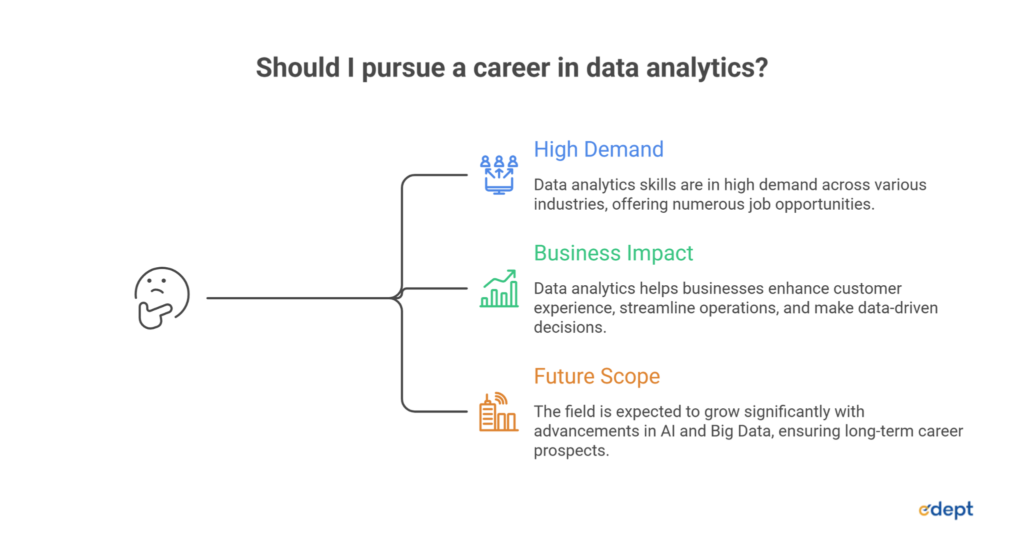
Role of Data Analytics in Modern Businesses
Modern organizations implement data analytics to enhance customer experience, streamline their operations, predict trends, cut costs, and make quicker and data-driven decisions. In all areas, from personalization and fraud detection to supply chain management, data analytics drives innovation.
Industries Hiring Data Analysts
Professionals with experience in working with data analytics in Germany are in high demand in many spheres. Financial institutions use data analytics for assessing risks and detecting fraud; hospitals use data to provide better care to patients; retailers analyze customer behavior to boost sales; tech companies use data to innovate their products and automate processes.
Future Scope of Data Analytics Careers
The prospects for data analytics jobs in Germany will remain extremely promising in the years ahead as technologies like AI and Big Data are revolutionizing industries. According to the World Economic Forum, analytical thinking is one of the most in-demand skills in the workplace, so Data Analytics is a future-proof profession with good salary potential.
Best Universities & Colleges for Data Analytics in Germany
Students who want to study data analytics in Germany can choose from several globally recognized universities offering industry-focused master’s programs. Most data analytics courses in Germany are completed in one year, helping students reduce overall education costs while entering the job market sooner. These programs combine academic learning with practical projects, internships, and strong industry partnerships.
| University | Approx Annual Fees | Duration | Location | Main Intake |
| Steinbeis University | €12,900 + €500 (Matriculation & Exam Fees) | 1 year (Germany Track) | Berlin | January, March & August |
| Technical University of Munich (TUM) | €4,000–€6,000* | 2 year | Munich | Winter |
| RWTH Aachen University | €300–€700 (Semester contribution) | 2 years | Aachen | Winter |
| University of Mannheim | €3,000–€4,000* | 2 years | Mannheim | Fall |
| University of Stuttgart | €3,000–€4,000* | 2 years | Stuttgart | Winter |
When choosing a university for data analytics in Germany, look beyond just tuition fees. Consider the curriculum, industry collaborations, internship opportunities, research facilities, and graduate employability. Universities located in major technology hubs such as Berlin, Munich, and Stuttgart often provide stronger networking opportunities and easier access to internships with global companies. If you’re looking for a career-focused international pathway, programmes such as the dual-degree Master’s in Data Science & AI offered by edept in partnership with Steinbeis University combine academic learning with practical industry exposure and German language training to improve career prospects.
Data Analytics Course Fees in Germany
The understanding of data analytics fees in Germany is essential for students who want to pursue data analytics studies in Germany. Tuition fees differ according to the college where you choose to enroll, course format, and type of management of the educational institution. Nevertheless, Germany proves to be an inexpensive place to pursue such education in comparison to other destinations of study.
Tuition Fees for International Students
At public universities, international students generally pay only a semester contribution, while some federal states charge tuition fees for non-EU students. Private institutions typically charge between €12,000 and €28,000 for specialized master’s programs. For example, edept’s partner Steinbeis University offers its Germany track at €12,900, plus €500 for matriculation and examination fees.
Government vs Private Institution Costs
Public universities normally offer better research possibilities, established connections in the business world, and internationally recognized certificates, but their tuition fees could be relatively higher. Private universities normally offer smaller classrooms, flexible learning, and career-oriented programs at reasonable costs.
Scholarship Opportunities
Many universities and private institutions offer merit-based scholarships, tuition fee waivers, and financial assistance. Through the Steinbeis University partnership, eligible students can receive up to 30% merit-based tuition fee waivers, along with flexible installment plans, early-bird discounts, and corporate sponsorship opportunities.
Also read: Everything about remote data analytics jobs
Cost of Living in Germany for Students
Besides tuition fees, understanding day-to-day living expenses is essential when planning to study data analytics in Germany. Living costs vary depending on the city, lifestyle, and accommodation choices. On average, international students should budget €850–€1,200 per month (approximately €10,000–€14,500 annually) while pursuing data analytics in Germany. Berlin, in particular, offers a good balance of affordability and quality of life compared to many other major European cities.
Accommodation Costs
Accommodation is the largest monthly expense. In Berlin, student accommodation or shared apartments typically cost between €500 and €800 per month, while cities such as Munich and Frankfurt can be more expensive. Planning accommodation early can help students secure better options within their budget.
Food & Transportation Expenses
Students normally pay around €250 – €400 a month for groceries and meals. Traveling is reliable in Germany and convenient for students since the monthly cost of traveling ranges from €80 – €120 per month.
Health Insurance & Miscellaneous Costs
Health insurance is mandatory for international students and typically costs €120–€150 per month. Additional expenses, including internet, mobile plans, study materials, and personal spending, may add another €150–€250 per month. With proper budgeting, students can comfortably manage their expenses while enjoying the high quality of life that Germany offers.
Germany Student Visa Process for Data Analytics Students
If you are planning to study data analytics in Germany, having a correct student visa is essential. Germany does offer a simple visa process for eligible international students, allowing them to study and gain valuable work experience during their course.
Germany Student Visa(Type D)
Students who want to study in Germany on a full-time program that is over three months will have to apply for an Germany Long Stay Student Visa (Type D). It allows them to enter Germany to pursue further education.
Required Documents
To apply for a Germany Student visa for data analytics in Germany, you typically need:
- An official admission letter from a recognized German university
- A valid passport
- Proof of sufficient financial resources (such as a blocked account or sponsor)
- Proof of English language proficiency (IELTS, TOEFL, PTE, or other accepted tests, if required)
- Proof of health insurance
- Visa application documents and passport photographs
Visa Processing Timeline
Student visa processing generally takes 4–12 weeks, depending on your country of residence and the time of application. Applying as early as possible is strongly recommended. edept also provides visa and documentation guidance to support students throughout the process.
Work Rights During Study
International students in Germany can generally work up to 140 full days or 280 half days per year (or under equivalent student work regulations). This allows students to gain practical industry experience, build professional networks, and help manage living expenses while completing their data analytics in Germany program.
Post-Study Work Visa in Germany
One of the key benefits of pursuing a career in data analytics in Germany is having a chance of getting great international experience in the field upon completion of studies. Germany offers great immigration options which make it appealing for students to have a career in Europe.
Third Level Graduate Scheme (Stamp 1G)
International graduates who have completed a recognized higher education course can apply for the Third Level Graduate Scheme (Stamp 1G). With this permission, graduates can stay in Germany and look for full-time employment that corresponds with their area of studies.
2-Year Stay-Back Option
Students who have completed an eligible master’s degree course are usually allowed to remain in Germany for a period of two years based on Stamp 1G permission. Students can use this period to find a data analytics job in Germany, get professional experience in the field, and network with other professionals working with the major multinationals.
Transition to Work Permit & PR
Upon finding an appropriate job that is covered by the criteria of an employment permit, the graduate will be able to apply for one. Such permits include the Critical Skills Employment Permit and General Employment Permit. Graduates will be able to get a job that will allow them to stay permanently in the country.
Job Opportunities After Studying Data Analytics in Germany
There are plenty of career options for graduates of data analytics in Germany because the demand for data analytics jobs in Germany will always be high due to companies’ growing investment in artificial intelligence, cloud computing, and business intelligence.
Data Analyst
The main task of Data Analysts is collecting, processing, and analyzing data in order to find certain trends, make reports, and make decisions based on the obtained results. It is one of the most popular options for employment.
Business Analyst
Business Analysts aim to combine business requirements and technical solutions through data analysis and process optimization. It requires effective communication and data analysis skills.
Data Engineer
Data Engineers create and maintain systems of data storage and delivery from different sources. They work with various types of databases and data pipelines.
BI Analyst
Business Intelligence (BI) Analysts create dashboards and reports interactively using software like Power BI and Tableau.
Junior Data Analyst
Junior Data Scientists use statistics, Python programming, and machine learning methods to resolve business challenges and construct predictive models. Given that Germany has an increasingly thriving AI environment, this job provides great career prospects in the long run. Being proficient in data analytics in Germany gives students all the necessary qualifications for such exciting jobs.
Also read: Complete guide to data analytics course fees in India
Salary of Data Analytics Professionals in Germany
One of the biggest reasons students choose data analytics in Germany is the attractive earning potential. Germany’s strong technology ecosystem and growing demand for analytics professionals enable graduates to secure competitive salaries with excellent long-term career growth.
| Role | Entry-Level | Mid-Level | Senior-Level |
| Data Analyst | €45,000–€60,000 | €60,000–€75,000 | €75,000–€90,000+ |
| Business Analyst | €45,000–€55,000 | €45,000–€60,000 | €80,000–€95,000+ |
| Data Engineer | €50,000–€65,000 | €70,000–€90,000 | €95,000–€120,000+ |
| BI Analyst | €45,000–€60,000 | €60,000–€80,000 | €80,000–€95,000+ |
| Junior Data Scientist | €55,000–€80,000 | €75,000–€95,000 | €100,000–€130,000+ |
Entry-Level Salaries
Graduates who study data analytics in Germany typically earn €45,000–€60,000 per year, depending on their role, employer, and location.
Mid-Level Salaries
With 3–5 years of experience, professionals can earn €60,000–€90,000 annually, particularly in technology, automotive, finance, consulting, and healthcare industries.
Senior-Level Salaries
Experienced professionals and specialists can earn €90,000–€130,000+ per year, especially in leadership, AI, cloud, and advanced analytics roles. Germany’s strong demand for skilled professionals and its pathway to the EU Blue Card make data analytics in Germany an attractive long-term career choice.
Skills Required to Get Data Analytics Jobs in Germany
For a person to get employed in data analytics jobs in Germany, he needs to have knowledge in data analytics but also some skills in the profession. Companies will be looking for people who can analyze data and give insights based on the information. Having such skills will make you employable.
SQL and Database Skills
SQL is the fundamental skill required for you to work as a data analyst to manage and analyze data stored in relational databases. Strong SQL knowledge is required for most analytics roles.
Python & R Programming
Python is widely used for data cleaning, analysis, automation, and machine learning, while R is popular for statistical analysis. Learning either language strengthens your profile.
Power BI & Tableau
Data visualization tools like Power BI and Tableau help transform complex datasets into interactive dashboards and reports. These tools are widely used across industries in Germany.
Business Communication Skills
Data professionals must present insights clearly to stakeholders and collaborate with cross-functional teams. Strong communication, critical thinking, and problem-solving skills are just as important as technical knowledge for succeeding in data analytics in Germany.
Challenges International Students May Face in Germany
While data analytics in Germany offers world-class education and excellent career opportunities, international students may face a few challenges during their academic journey. Understanding these challenges in advance can help you prepare effectively and make a smooth transition to studying and working in Germany.
High Cost of Accommodation in Dublin
Cities such as Berlin, Munich, Frankfurt, and Hamburg offer excellent career opportunities but also have higher living costs. Finding affordable student accommodation can be competitive, especially near universities, so applying early and considering shared housing can help reduce expenses.
Competitive Job Market
Germany has a strong demand for data professionals, but employers also expect candidates to possess practical skills, relevant projects, internships, and, in many cases, basic German language proficiency. Building a strong portfolio and gaining hands-on experience can significantly improve your chances of securing data analytics jobs in Germany.
Need for Industry Networking
Networking plays an important role in building a successful career. Attending university career fairs, industry conferences, LinkedIn networking events, and technology meetups can help students connect with recruiters and employers. Developing German language skills alongside technical expertise further improves employability and long-term career prospects. edept also supports students with German language training and career guidance to help them prepare for the German job market.
Read more: Data Analytics admission eligibility
Why Skill-Based Learning Matters More Than Just Degrees
A degree will help you as a student meet academic requirements, but employers offering data analytics jobs in Germany increasingly prioritize practical skills over qualifications alone. Building real-world experience alongside your education significantly improves your employability and long-term career prospects.
Real-World Projects and Internships
Being involved in live projects and internships helps you utilize what you learn in class and put it into practice to solve actual business problems. Practical experience with working on datasets, dashboards, and analytics tools proves that you know how to solve actual problems.
Industry Certifications
Obtaining certifications in SQL, Python, Power BI, Tableau, Microsoft, Google, and cloud technology proves that you have excellent technical skills and knowledge and improves your CV. It also indicates your dedication to ongoing professional development.
Portfolio Building for Recruiters
Having a good portfolio with examples of dashboards, data visualization work, business cases, and GitHub will definitely help you stand out among other job applicants. Being enrolled in the data analytics program in Germany does not mean as much as practical experience and a good portfolio.
Why Choose edept for Data Analytics Career Preparation
Unlike conventional learning models, edept integrates industry-based learning along with international experience to help students pursue a successful career in the field of data analytics. With collaborations in India and Germany, edept makes sure that students get globally recognized certificates, practical exposure, and career guidance.
Industry-Aligned Curriculum
The course structure takes into consideration current industry requirements. The subjects of learning include Python, SQL, Tableau, Power BI, Machine Learning, Cloud Computing, Data Management, and Business Analytics. Also, there is a provision for German Language Training, which prepares candidates for their international careers.
Hands-On Analytics Projects
The learning process at edept also includes various innovations, internships, research, and projects from companies. Thus, with this practical approach, students can improve their problem-solving skills and build a relevant portfolio.
Placement and Career Support
edept also offers career support to students throughout their studies at edept. This includes internship assistance, preparation for interviews, visa services, cultural orientation, and career services.
Focus on Global Career Readiness
With dual qualifications, international exposure, German language training, and guidance from admission to graduation, edept equips students with the technical expertise and professional skills needed to succeed in global data analytics and AI careers.
Step-by-Step Plan to Study Data Analytics in Germany
Having good preparation can make your career journey for data analytics in Germany smooth and will improve your chances of securing admission and employment after graduation.
Step 1: Shortlist Universities
Research universities based on course curriculum, tuition fees, rankings, internship opportunities, industry partnerships, and graduate employment outcomes. Compare programs to find the best fit for your career goals.
Step 2: Prepare IELTS & Documents
Most Irish universities require proof of English proficiency through IELTS or an equivalent test. Keep your academic transcripts, passport, statement of purpose (SOP), letters of recommendation, and financial documents ready before applying.
Step 3: Apply for Admission
Submit your applications well before the intake deadlines. Applying early can improve your chances of receiving scholarships and securing accommodation.
Step 4: Apply for Student Visa
After receiving your offer letter, apply for the German Type D student visa. Ensure all required documents, including proof of funds and health insurance, are complete to avoid processing delays.
Step 5: Plan Career & Networking Strategy
Start building your professional network even before arriving in Germany. Participate in university career fairs, connect with recruiters on LinkedIn, pursue internships, and build a strong portfolio to improve your chances of landing data analytics jobs in Germany after graduation.
Future Scope of Data Analytics Careers in Germany (2026-2030)
The future outlook of data analytics in Germany seems incredibly bright as firms keep investing in digitization, AI, and data analytics. The good technology environment, along with the presence of international companies in Germany, makes the country an ideal place for those who want to become data analysts.
Growth of AI and Big Data Industry
Due to the fast adoption of artificial intelligence, machine learning, and Big Data, the demand for professionals who can make sense of data and offer insights is growing. Data Analytics has become an important activity for modern enterprises.
Increasing Demand Across Sectors
Data analytics professionals are being hired in fields other than technology firms, like banking, health care, pharmaceuticals, retail, manufacturing, and e-commerce. The constant demand guarantees great career prospects for graduates.
Germany as a Long-Term Tech Career Destination
Data analytics in Germany offers competitive salaries, a dynamic, multinational environment, and a two-year work permit for those eligible after graduating with a master’s degree. Students with technical knowledge, real-world projects, and professional certifications will have strong prospects for forging successful international careers from 2026 to 2030.
Conclusion
Choosing data analytics in Germany is a smart investment for students seeking a globally recognized education and excellent career opportunities. Germany’s one-year master’s programs help reduce overall tuition and living costs, while the country’s thriving technology ecosystem creates strong demand for skilled analytics professionals.
The 2-year post-study work visa further enhances career prospects by allowing eligible graduates to gain valuable international work experience and transition into long-term employment. But success involves much more than just having a degree. Companies are looking for candidates who have practical skills and certifications, real-world experience, and a portfolio. The students who specialize in data analytics in Germany and work on obtaining job-related skills stand a higher chance of landing lucrative jobs in data analytics, business intelligence, and artificial intelligence fields.
In case you are considering a global career in the field of analytics, combining high-quality education with training in skills can greatly boost your chances for employability and ROI. Begin your preparation today and make the first move towards a promising career in data analytics in Germany. Related Links:
| Direct admission in Data Science Courses | Traditional VS Skill-Based Data Science Programs |
| Data analyst salary guide in USA and Germany | Is direct admission in data analytics worth it? |