Not very long ago, moving abroad was mainly about landing a job, but today, professionals are not only searching for jobs abroad but also for long-term settlement opportunities. For most of the students and working professionals, the most important question is, “Where can they build a life abroad?” The answer to these questions is that they can set up a life where there is a stable income, good and fair law, a good healthcare system and a real chance of becoming a permanent resident. For this reason, Work Visa and PR pathways have become so important.
Now, let us understand that the difference between a work visa and permanent residency is very significant, as it helps you to shape your entire career decision. A work visa is a temporary work permit that will allow you to work and live in a country for a fixed period of time. It usually offers quick entry and is usually employer-sponsored. It provides limited job flexibility; some work visas require periodic extensions, and they give no access to PR benefits such as healthcare, pension, or social security.
Permanent residency, on the other hand, provides long-term stability. It is a legal status that grants a foreign national the right to live, work, and study in a country indefinitely without being a citizen. Here you can easily access healthcare, education, and social security benefits. In the case of an employer-sponsored route, a path where any registered company offers you a job and supports your visa application is common in the UK, the US, and parts of Europe.
In the case of skilled migration systems, the government invites qualified workers based on age, education, language, and experience. It is a government framework designed to attract foreign workers who possess in-demand skills, educational qualifications, or experience to fill specific labour shortages and improve the national economy. Some countries have made this transition very easy and smooth, but others, although they provide attractive salaries and exciting career prospects, have a very long, uncertain road between you and long-term settlement.
This blog will break down the key differences between a temporary work visa and permanent residency, compare the major global destinations, and help you figure out which country actually provides a quick, clear and smooth work visa and PR pathway in 2026.
Understanding the Difference Between a Work Visa and PR
Now, let us understand the difference between a work visa and PR pathways.
What Is a Work Visa?
A work visa is an official document that allows an individual to work in a foreign country for a fixed period of time. It is temporary and often valid for a specific period. It is usually linked to a specific employer, a specific job role or for a specific duration. If your visa expires or if you leave your sponsoring employer, then your right to work typically ends with it. Here, the benefits are usually limited. You may not qualify for universal healthcare, subsidized education, or social security, and you may have to rely on private resources. Some of the examples of work visas are:
H-1B (USA): employer-sponsored, highly competitive, tied to a lottery system
Skilled Worker Visa (UK): requires a licensed sponsor and a qualifying job offer
Temporary Skill Shortage Visa (Australia): short-term employer-sponsored option
EU Blue Card (Germany): for highly qualified professionals across European Union member states
What Is Permanent Residency (PR)?
Permanent residency gives you the right to work and live in a country for a long period of time without being tied and dependent on a single employer. It is a direct pathway to permanent citizenship. Here, an individual can settle in the country for an indefinite period of time without needing to renew any right to remain. You have the option to work with any employer; without depending on a single one, you can switch jobs frequently, start a business, or work in any industry.
You will have access to most public benefits, including universal healthcare, social welfare programmes, and lower domestic tuition fees for higher education. It allows you to easily sponsor family members for visas or their own PR. You are free to travel in and out of the country without needing separate re-entry visas.
Why PR Matters for International Professionals
For students who are graduating from international universities as well as professionals who are planning a long-term career abroad, PR is not just a simple legal status for them. It is a financial security. It helps in removing the tension and anxiety of visa renewals, employer sponsorships and dependencies and uncertain changes in policies. It allows you to negotiate salaries with your employer; you can easily sponsor your family without any complicated procedures.
You will have access to most public benefits, including universal healthcare, social welfare programmes, and lower domestic tuition fees for higher education. You have the option to work with any employer; without depending on a single one, you can switch jobs frequently, start a business, or work in any industry.
Factors That Make Immigration Easier
Not every country is equally open for accepting foreign talent. Some countries make the process very clear and smooth, whereas some make it very strict and difficult. Let us discuss the factors that make immigration faster.
Skill Shortage Occupations
The countries that are facing skilled labour shortages in specific domains and industries move faster for visa approvals. Various job roles, such as nurses, software engineers, cloud architects, and cybersecurity professionals, continuously appear on the shortage occupation list across various countries, such as Canada, Australia, the UK, and Germany. If your profession is on the shortage list, then you can easily apply to these countries.
Points-Based Immigration Systems
Some countries, such as Canada, Australia and New Zealand, use a point-based system that is capable of scoring applicants on the basis of age, education, work experience, language ability and job offers. These systems are clearer, more transparent and predictable in nature. Here you know where you stand, and you can plan everything accordingly to it.
Employer Sponsorship Availability
The countries with large, diverse, competitive job markets, such as the UK, Germany, and Singapore, normally tend to have more employers who are willing to sponsor work visas. The MNCs and big tech companies act as the most reliable sponsors, as they possess dedicated legal/HR teams and larger capital budgets to handle government fees and legal compliance. Here a strong job offer often matters more than a high test score.
Post-Study Work Rights
Post-Study Work Rights (PSWR) are a direct, crucial bridge between education and long-term residency. Various countries allow international graduates to stay and work for 2-3 years after they complete their graduation. Canada’s Post-Graduation Work Permit (PGWP), Australia’s Graduate Temporary Visa (Subclass 485), and Germany’s 18-month job-seeker period offer a massive advantage. This allows you to work legally while searching for an employer willing to sponsor a long-term skilled visa.
PR Processing Time
Some countries often process PR applications within 6-12 months (Canada’s Express Entry). Some take 8-12 months (the skilled migration and PR process). In New Zealand resident visas can take 1 to 2 years, depending on the skilled worker category. The predictable timelines usually help you in planning your entire journey without any stress. 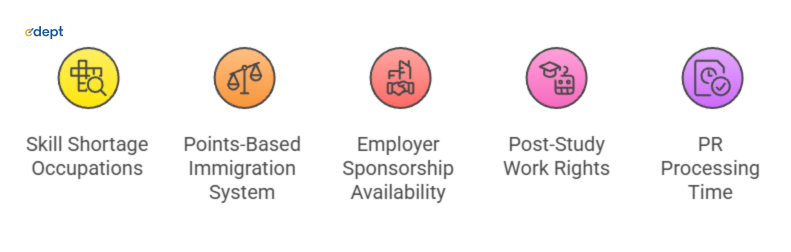
Countries with Easier Work Visa and PR Pathways in 2026
Many Indians nowadays aspire to settle abroad for better job opportunities, attractive salaries, and a good quality of life. Easier work visa and PR pathways allow immigrants to live and work in a country while enjoying some of the benefits as citizens. Several countries in 2026 are making immigration procedures easy and smooth due to skilled labour shortages and economic growth. Now let us find out which are the countries that provide easier work visa and PR pathways.
Canada
Canada consistently ranks as one of the easiest and most accessible countries for skilled professionals in 2026. Here the government continuously invites skilled professionals through a points-based immigration system. Some of the key immigration programmes include Express Entry, the Provincial Nominee Program (PNP) and the Atlantic Immigration Program. The Post-Graduation Work Permit (PGWP) gives eligible international students 1-3 years to work. Temporary Foreign Worker Programs (TFWP) also support employer-specific permits. The Canada Express Entry system offers direct PR for skilled workers. The PR timeline is usually 6-12 months. Some of the major industries hiring are healthcare, technology & IT services, construction and skilled trades, renewable energy and sustainability.
Advantages:
- Fast PR processing
- PR holders get universal healthcare coverage
- A very strong multicultural environment
- Post-Graduation Work Permit (PGWP) for international graduates, valid for up to 3 years
- Easy pathway to Canadian citizenship
- High salaries & job opportunities
Challenges:
- The cost of living in Toronto and Vancouver is relatively high
- Some smaller provinces offer easier PNP access, but require commitment to living in that region
- The Comprehensive Ranking System (CRS) general pool requires exceedingly high scores (often reaching the 530+ range).
- Fluency in French has become one of the most reliable and highly prioritized pathways.
Note: For Indian students and skilled professionals, Canada offers the clearest, fastest, and most accessible route to permanent residency among all major immigration destinations.
Australia
Australia offers one of the most systematic immigration frameworks for skilled professionals. The Australia Temporary Skill Shortage Visa (Subclass 482) is the primary route for sponsored workers in designated in-demand fields. The Australia SkillSelect programme manages points-based and employer-sponsored PR pathways, which typically take 2 to 3 years of work and residency to achieve. Some of the key visa options include the Skilled Independent Visa (Subclass 189), Skilled Nominated Visa (Subclass 190), Skilled Work Regional Visa (Subclass 491), and Temporary Skill Shortage Visa. The PR timeline is usually 8-18 months. Some of the major industries hiring are healthcare and social assistance, IT & cybersecurity, construction & engineering, education & training, and renewable energy and resources.
Advantages:
- They are transparent point-based systems with clear eligibility benchmarks
- Regional migration options normally lower the range significantly for those willing to move outside major cities
- High quality of life and competitive salaries
- Strong job market and clear PR pathways
Challenges:
- General Skilled Migration (GSM) visas (like Subclass 189 and 190) face severe backlogs.
- There is an intense competition for general skilled migration.
- There is a huge reliance on employer sponsorship
- The revised skilled points system heavily penalizes generic degrees and rewards professionals who already have local Australian work experience and English proficiency.
Note: Australia rewards planning. Candidates who research their occupation and the demand for their job role, get their skills assessed early, and consider regional options will find Australia very accessible.
Germany
Germany has become one of the most attractive and easiest destinations in Europe due to high demand for skilled workers and its Skilled Immigration Act. Germany introduced the Opportunity Card to allow skilled workers to enter the country and search for employment. Some of the key visa options include the EU Blue Card, Opportunity Card, and Skilled Worker Visa. The PR timeline is 2–4 years of employment in Germany, depending on the visa category and language proficiency. Some of the major industries hiring are IT & software, engineering & manufacturing, healthcare & life science, and finance & fintech.
Advantages:
- Access to Europe’s largest economy and the broader EU job market
- Free or low-cost public universities for those who choose to study here
- Strong worker protections and excellent work-life balance
- Competitive salaries and work benefits
Challenges:
- German language proficiency is increasingly important for both day-to-day life and long-term settlement.
- Strict Pension and Tax Contributions for PR
- Severe Visa Processing Delays and PR timeline increases
Note: For engineering, healthcare, and IT professionals who are willing to learn German, Germany represents one of Europe’s strongest and most stable immigration destinations in 2026.
United Kingdom
The United Kingdom has been one of the world’s most desirable destinations for international professionals. They offer access to global financial services, world-class universities and a great job market. After working in the UK for five years, individuals can apply for permanent residency. Some of the key visa options include the Skilled Worker Visa, Health and Care Worker Visa, High Potential Individual (HPI) Visa, and Global Talent Visa. For professionals looking to build a career in the UK, permanent residency (officially called ‘Indefinite Leave to Remain’ or ‘ILR’) is typically achieved after 5 years of continuous, lawful employment. Some of the major industries hiring are healthcare & life sciences, IT, engineering & infrastructure, business, finance & management.
Advantages:
- Global career exposure
- Competitive salaries
- Pathway to British citizenship
- London is a global career hub; the exposure and experience are unmatched
Challenges:
- The standard qualifying period for Indefinite Leave to Remain (ILR) has been extended from 5 years to 10 years for most sponsored work visas.
- The minimum salary range for the Skilled Worker route is now at £41,700, making it challenging to secure sponsorship for entry to mid-level professional roles.
- English proficiency requirements for Skilled Worker, Scale-up, and High Potential Individual (HPI) visas are very strict.
Note: The UK is best suited for those professionals who want maximum career exposure and are prepared to invest 5+ years before achieving actual settlement.
Singapore
Singapore offers excellent job opportunities for professionals in the fields of technology, finance and management. It has become Asia’s premier destination for global trade. It provides competitive and attractive salaries along with a great working job environment. It has a very efficient immigration policy. Some of the key visa options include Employment Pass (EP), S Pass, and Tech. Pass. For professionals who are targeting a permanent resident (PR) career in Singapore, the process typically takes 2.5 to 3.5 years. You must first secure an Employment Pass (EP), then work locally for 12–24 months, and finally wait 4 to 6 months for the Immigration & Checkpoints Authority (ICA) to process your PR application. Some of the major industries hiring are IT & communication, financial services & fintech, advanced manufacturing & engineering, healthcare, and logistics & supply chain.
Advantages:
- Global financial hub
- Tax-friendly environment
- High and attractive salaries
- Strong demand for fintech, AI, and data professionals
Challenges:
- Strict visa criteria
- Low PR approval rates
- High cost of living, particularly housing
Note: Singapore is an excellent destination for high-earning professionals in finance and tech, but PR is earned through demonstrated value, not just time served.
Country Comparison: Work Visa vs PR at a Glance
| Country | Main Work Visa | PR Pathway | PR Timeline | PR Ease | Salary Potential |
| Canada | Express Entry / PNP | Express Entry → PR | 6–12 months | Very Easy | High |
| Australia | Subclass 482 / 189 | SkillSelect → PR | 8–18 months | Easy | High |
| Germany | EU Blue Card / Opportunity Card | Employment → Settlement | 2–4 years | Moderate | Good |
| United Kingdom | Skilled Worker Visa | 5 years → ILR | 5 years | Moderate | High |
| Singapore | Employment Pass | EP → PR Application | 2–5 years | Selective | Very High |
Best Countries for Students Seeking Long-Term Settlement
For international students, the country where you are completing your studies often becomes the country where you want to settle down. The best countries for students seeking long-term settlement are those offering transparent Post-Study Work Visas (PSWVs) that seamlessly transition into permanent residency (PR). Now let us discuss the best countries for students seeking long-term settlement.
Best for PR
Canada is the best country for PR. Its immigration structure actively favours international graduates. They provide a post-work study visa for a maximum of 3 years, depending on the programme’s length. The Express Entry system features the Canadian Experience Class (CEC), providing a direct, points-based route to PR. Australia is highly popular for students wanting to combine a world-class education with an excellent work-life balance. It provides a post-study work visa for 2 to 4 years, depending on the degree level and field of study.
Best for Salary
The United States offers attractive and very competitive salaries. Singapore is leading in Asia, and Canada and Australia offer strong salaries relative to the cost of living.
Best for Work-Life Balance
Germany consistently ranks high on work-life balance, strong labour protections, generous annual leave, and a culture that respects personal time. Canada and Australia also perform well on this dimension. Netherlands, New Zealand, and Ireland. also provides a balanced work-life balance.
Best for Tech Professionals
For students prioritizing low tuition fees, Germany is the most attractive destination in Europe. Germany’s EU Blue Card provides the fastest route for IT professionals. Known for its high quality of life and safe environment, New Zealand has highly favourable immigration policies for skilled tech professionals.
Best for Healthcare Professionals
Canada, Australia, and the United Kingdom all have enormous demand for healthcare workers and have created dedicated immigration pathways for nurses, doctors, and allied health professionals.
Which Countries Offer Easier PR for Indian Students?
Canada, Australia, and Germany offer the easiest and most structured pathways to Permanent Residency (PR) for Indian students.
Canada
Canada is the top and perfect destination for candidates seeking long-term settlement abroad. The Post-Graduation Work Permit (PGWP) allows graduates to stay and work for up to 3 years after completing a programme of 2 years or more. The work experience in Canada then directly improves the CRS scores for Express Entry. Many Indian graduate students who come to Canada transition to PR within 3–5 years of arriving.
Australia
Australia is highly popular for its exceptional standard of living and straightforward points-based skilled migration streams. Australia’s Graduate Temporary Visa (Subclass 485) allows international graduates to stay and work for 2 to 4 years, depending on the duration of their study and the location of their institution. Work experience in Australia improves SkillSelect points scores and state nomination eligibility.
Germany
For students who are prioritizing low tuition fees, Germany is the most attractive destination in Europe. Germany’s student pathway is especially attractive for those who are willing to learn the language. International students who graduate from a German university can stay for 18 months after graduation to search for a job. After getting a job in a relevant field, the EU Blue Card pathway to PR becomes easily accessible in as little as 2 years after working.
Industries with Strong Visa Sponsorship Opportunities
The industries that you choose often shape and decide how your immigration procedure shall be. The industries with strong visa sponsorships are mainly the ones with a shortage of domestic skilled professionals or which require highly specialized professionals.
Healthcare
Healthcare is one of the most universally sponsored industries across major immigration destinations. Nurses, physicians, medical researchers, and occupational therapists are in high demand across Canada, Germany, Australia and UK. Many companies even assist in offering language training as a part of the relocation process. Many countries even have created dedicated visa streams specifically designed for healthcare professionals, with faster processing.
Cybersecurity
Due to a very critical global talent shortage and rising cyber threats, the demand for cybersecurity professionals has increased globally. They enjoy smooth visa sponsorship opportunities. Various roles such as security analysts, penetration testers, and cloud security architects are in high demand in UK, Australia and Canada. The employers in these countries are actively sponsoring skilled & qualified professionals. Firms like Deloitte, EY, PwC, and KPMG are among the largest global visa sponsors.
Cloud Computing
The wide adoption of cloud infrastructure across various industries has created huge demand for cloud engineers, architects, and DevOps professionals. Some of the leading global hubs, such as the US, UK, Germany, Canada, and Australia, drive the highest demand for cloud architects and infrastructure engineers. Various certifications, such as AWS, Microsoft Azure, and Google Cloud, provide direct value during the immigration procedure.
AI & Data Analytics
Artificial intelligence and data analytics are among the most highly demanded and specialized roles globally. Various job roles such as machine learning engineers, data scientists, and AI researchers find the immigration pathways very smooth and clear. It has become one of the fastest-growing areas for visa sponsorship. The US, UK, Germany, France, and the UAE ,all these countries have dedicated programmes for AI talent and data analytics professionals
Engineering
For engineers who are seeking international mobility, the most reliable industries for visa sponsorship include semiconductors, renewable energy & power grids, and pharmaceuticals. These fields face crucial talent shortages, and employers actively sponsor visas. Germany, Australia, and Canada face acute talent shortages of engineers. 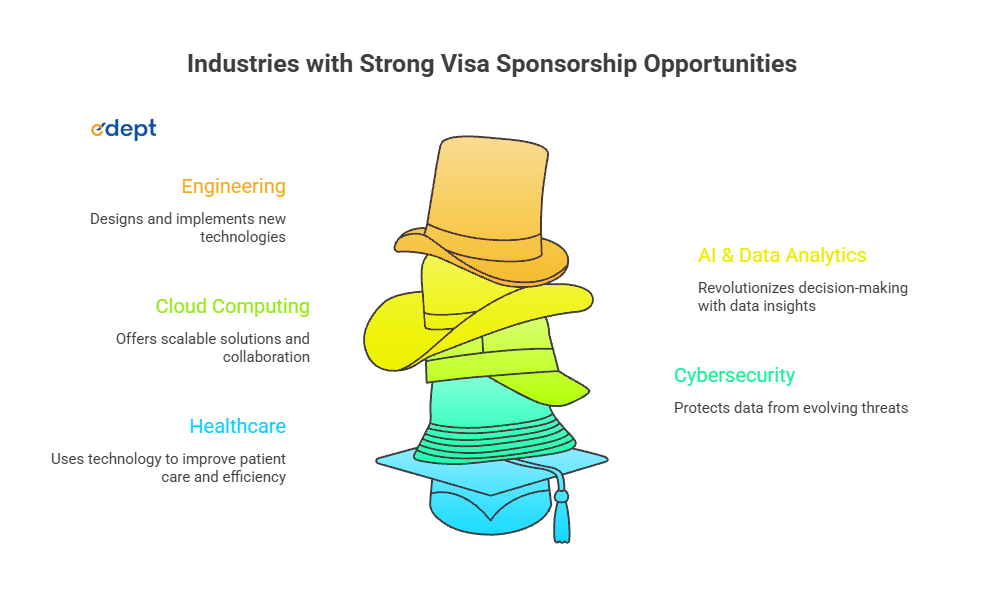
Common Challenges International Professionals Face
International professionals face various hurdles related to communication barriers, cultural adjustments, and complex and strict immigration procedures. Overcoming all these requires a targeted strategy and planning.
Visa Delays
Visa delays, even in countries with efficient immigration systems and processes, can seriously affect career plans for professionals. Various steps, such as document verification, medical examinations, police clearance certificates, and credential assessments, all take time. You should start planning early and keep your documents updated.
Employer Sponsorship Limitations
Not every country will sponsor international professionals. Large multinationals and government health services typically have the most sponsorship capability. Various small companies may be willing to sponsor visas, but they lack administrative experience. You should start targeting large MNCs or big global organizations in your early job search to increase your chances of sponsorships.
Language Requirements
Most major immigration destinations require English proficiency. IELTS, PTE, and OET are usually accepted by Canada, Australia, and the UK. Germany specifically requires German language skills for long-term career plans and settlement. If you start preparing for and clearing these tests well in advance, it helps in avoiding any last-minute delays in the immigration process.
Changing Immigration Policies
Immigration policies and regulations are not static across countries. The policies and rules that may be applied in 2024 may look completely different in 2026. The minimum salary requirement, point score, and occupation lists can change depending on the labour market conditions and political decisions. You should always remain well-informed and make decisions depending on those changes in the policies.
How Skill-Based Education Improves Global Mobility
For an international career path, only a degree is not enough. One of the most common patterns in international hiring is that employers are looking for applied and practical skills and demonstrations, not just your academic degree. A candidate who holds a relevant degree and can show hands-on experience through projects, certifications, and real-world tools is significantly more attractive than one who holds a degree alone.
This shift gradually affects your global mobility because your visa sponsorships depend on this. Various industry-recognised certifications, such as AWS, Azure, Google Cloud, CompTIA Security+, CISSP, PMP, CFA, and data science, help you in directly mapping your roles to the most skilled occupational lists. International graduates who combine their degree with these certifications consistently have better employer responsiveness and faster job offer timelines. Capstone projects, internships, freelance work, and your GitHub portfolio are all important for landing your first international job. Practical, industry-aligned skills education is not just good for your career. For your global career path, it is one of the most strategic investments you can make.
Why Choose edept for Global Career Preparation?
For students and professionals preparing for an international career, the quality of your skill preparation makes a direct difference in how quickly you move from aspiration to employment abroad.
Industry-Aligned Programs
edept’s programmes are designed around actual market demand, not theoretical curriculum. Courses are built in consultation with industry professionals and updated to reflect what employers in Canada, Australia, Germany, and the UK are actively hiring for.
International Career-Oriented Learning
edept prepares students not just with technical skills but also with the professional context that international employers expect. This includes understanding how global workplaces function, how to present skills and experience on an internationally competitive resume, and how to approach job applications in target markets.
Skill Development for Global Roles
From cloud computing and cybersecurity to AI, data analytics, and engineering support, edept’s programs target the exact skill domains that appear on shortage occupation lists across the UK Canada, Australia, and Germany. This alignment is intentional and directly improves visa sponsorship prospects.
Career Guidance and Placement Support
edept provides dedicated support for students navigating the career aspects of international migration, from resume preparation and interview coaching to job-search strategies for specific markets. The goal is not just skill development in isolation but also a clear bridge from learning to landing an international role.
Step-by-Step Roadmap for Students Planning International Careers
To build an international career, you need well-defined planning and strategy.
Choose High-Demand Career Domain
You should start by researching which careers are in huge demand with skill shortages in your target countries. Various domains such as healthcare, cybersecurity, cloud computing, engineering, and AI are in huge demand across major destinations. You should choose a domain with genuine and high market demand, along with various job opportunities.
Build Industry Skills
Along with your degree, you should start gaining hands-on practical experience, work on capstone projects, use GitHub and Kaggle and build a strong portfolio. Employers across global markets are looking for candidates who can demonstrate real capability, not just academic degrees. Build projects, practise with real tools, and document your work.
Gain Certifications
Earn recognized industry certifications in your domain. AWS certification for cloud, CompTIA Security+ or CISSP for cybersecurity, and Google Professional certificates for data. These certifications increase your credibility and help in improving both your job search and your immigration case.
Explore Country-Specific Visa Options
After getting your skills and certifications ready. Start researching the visa pathways for your targeted countries. Start by understanding the points scores or sponsorship requirements; check your occupation on shortage lists; and assess your eligibility for post-study routes if you are planning to study abroad.
Apply for Jobs and Migration Programs
You should start adapting your resume to the standards of your target country. Begin your job search with a strong focus on those employers who are internationally active in your target market. If you qualify for points-based systems, prepare your documentation and submit your Expression of Interest or profile. Then start working with a registered immigration consultant for further information to solve all your doubts.
Future Immigration Trends Beyond 2026
The immigration trends beyond 2026 will focus on highly selective talent acquisition, very strict border rules and policies, and shortages of skilled professionals.
Increasing Global Talent Shortages
Aging populations across Europe, Canada, and Australia define structural labour shortages that will only deepen over time. The countries are raising the minimum salary range for work visas and implementing strict English requirements. Various destinations like Australia, Canada, and Germany are adjusting their immigration pathways to favour specific trades and technical skills to meet their economic needs.
Rise of Skilled Migration Programs
Countries are progressively moving away from entirely employer-dependent immigration and toward independent skilled migrant programmes that give qualified professionals more opportunities to grow. This reflects a global policy shift among developed nations toward targeted, highly specialized immigration to deal with global talent shortages. Germany’s Opportunity Card, Canada’s Express Entry, and Australia’s regional migration options all reflect this trend.
Competition for International Talent
As more countries are making their work visa pathways smooth and clear, the competition for international and qualified professionals is rising day by day. Nowadays, countries are not just assessing applicants; they are marketing themselves as remarkable destinations. For skilled professionals, this competition works in their favour: they have more options, better pathways, and stronger incentives. 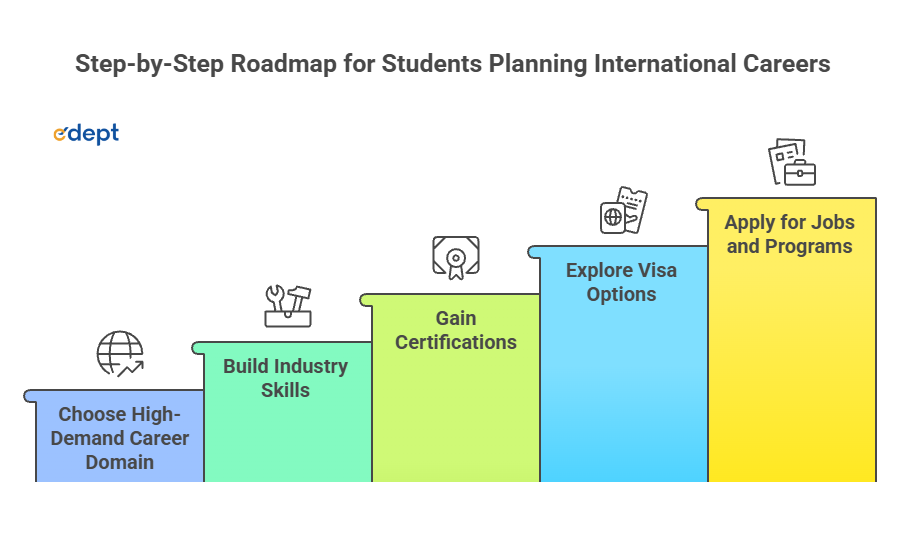
Conclusion
In 2026, the global landscape for work visas and PR pathways will offer real opportunities for skilled professionals, but the outcomes depend on where you want to go and how well you are prepared to achieve that career goal. Every country has its own policies, visa pathways and regulations. Canada offers the clearest and fastest pathway to permanent residency for most skilled professionals and Indian students. Australia provides a well-structured merit-based system that rewards relevant skills and qualifications. Germany is emerging as one of Europe’s strongest opportunities, particularly for engineering, healthcare, and IT professionals willing to invest in language skills. The United Kingdom is a powerful career accelerator but requires a longer horizon before settlement is achieved. The United States delivers unmatched salaries and career exposure, but the path to permanent residency for Indian nationals is time-consuming. Singapore is a highly competitive destination in Asia with excellent short-term career prospects and a selective, non-guaranteed PR process.
Countries are now looking for skilled professionals; employers are looking for candidates with job-ready skills, industry-relevant experience and problem-solving capacity. The best choice depends on your field, your qualifications, and your long-term goals. With the right preparation and the right learning partner like edept, you can have a very smooth and fast global career move
FAQs
Which country gives the easiest PR in 2026?
Canada and Germany offer the easiest and most accessible pathways for Permanent Residency (PR).
Is Canada easier than Australia for PR?
Canada is generally considered easier than Australia for Permanent Residency (PR).
Which country offers the fastest work visa?
The United Arab Emirates (UAE) and Singapore offer the fastest work visas globally.
Is Germany good for Indian professionals?
Yes, Germany is an excellent destination for Indian professionals.
Which countries sponsor work visas easily?
Germany’s Opportunity Card, the UAE’s standard work visa, Singapore’s Employment Pass, and the Netherlands’ Highly Skilled Migrant route are among the fastest.
Is PR easier after studying abroad?
Yes, studying abroad makes securing Permanent Residency (PR) significantly easier.
Which careers get the easiest visa sponsorship?
Careers with critical talent shortages get the easiest visa sponsorship. Healthcare, cybersecurity, cloud computing, AI and data analytics, and engineering see the strongest sponsorship.
Can freshers get international work visas?
Yes, freshers can get international work visas, but it is much more competitive without experience.