Most people assume the IT industry is only for programmers. It is not. From UI/UX design and data analytics to product management and digital marketing, there are dozens of IT jobs without coding that pay well, grow fast, and are genuinely accessible to freshers. If coding was the only thing standing between you and a tech career, this changes that.
The technology industry is hiring far beyond its developer teams, and the numbers in 2026 make that hard to argue with. Forrester’s research found that 87% of enterprise developers now use low-code platforms for at least part of their development work. That shift has created entire categories of non-coding IT jobs that reward analytical thinking, design ability, communication, and domain expertise rather than programming. Tech companies in 2026 are not just hiring developers. They are hiring Product Managers, Business Analysts, and Operations professionals who drive revenue and strategy, with average salaries running from $50,000 to $150,000 per year.
So how do you actually start a career in IT without coding? You pick a role that fits your existing strengths, build the specific tools and skills that role genuinely requires, and walk into an industry that needs far more than just developers.
This blog covers the best IT jobs without coding, what skills each one requires, and the step-by-step path to getting into them from the beginning.
What Are Non-Coding IT Jobs?
Before diving into role lists and roadmaps, it is worth being clear about what non-coding IT jobs actually involve, because the reality is broader and more professionally substantial than most people coming from outside the industry expect.
Non-coding IT jobs are professional roles within the technology sector that do not require writing or reviewing programming code as a core job function. They sit inside technology companies alongside engineering teams, depend on a conceptual understanding of how software and systems work, and contribute directly to how products are built, marketed, and delivered to the people using them. IT jobs without coding span design, analysis, product management, quality assurance, technical communication, marketing, and support, and each of these is a genuine career track rather than a workaround for people who could not learn to code.
Why Non-Coding IT Jobs Are Gaining Popularity in 2026
The rise of non-coding IT jobs reflects something more fundamental than a hiring trend. It points to a structural shift in how technology companies are built and what kinds of people they actually need to function well at scale.
As technology products have grown more complex, the distance between building them and making them genuinely useful to real people has widened considerably. Companies need professionals who bridge technical teams and business stakeholders, who design experiences that work for actual users rather than theoretical ones, who can interpret data without having built the pipeline, and who can take a product from concept to launch without writing the underlying code. Without coding, IT jobs are growing because technology companies are maturing past pure engineering cultures, and the market is responding with strong hiring and salaries that reflect how much these roles actually matter. The best IT jobs without coding are increasingly sitting at the strategic centre of how technology products succeed or fail, rather than at the edges of how they are built.
Top Non-Coding IT Jobs for Freshers
The range of IT jobs without coding that are genuinely reachable at the entry level is wider than most freshers initially realise. These are not fallback options or compromises. Many carry strong salary growth and clear paths to senior roles. Here is what each one involves, what it pays, and what you will actually be working with day to day.
UI/UX Designer
UI/UX designers shape how products look and feel to the people actually using them. They run user research, build wireframes, design interfaces, and test prototypes to check whether the experience holds up in practice. This sits among the most creative non-coding IT jobs for freshers and carries strong demand across product companies, agencies, and startups. A portfolio of real design projects carries more weight than a formal degree at entry level, which makes this one of the more genuinely accessible best IT jobs without coding for people starting without a technical background.
Data Analyst
Data analysts pull meaning from numbers. They gather data, filter it, look for patterns, and turn findings into decisions. Based on this, businesses can then make decisions. This is one of the most in-demand IT jobs without coding in 2026. They actively hire across banking, healthcare, e-commerce, and consulting. SQL, Excel, and Power BI are the practical tools that open the door to this category of non-coding IT jobs, and none of them requires any programming knowledge to learn.
Product Manager
Product managers define what gets built and why. They sit across engineering, design, and business teams, pulling together requirements, setting priorities, and making sure products reach users in a form that actually serves them. This is one of the more senior without coding IT jobs conceptually, but associate product manager programmes now exist at many companies specifically as entry points for non-technical freshers who bring strong analytical thinking and communication skills to the table.
Technical Writer
Technical writers take complex technical information and turn it into documentation that non-technical users can actually navigate. User manuals, API guides, help articles, and process documents all fall within scope. It is one of the more underrated non-coding IT jobs for freshers and one where the ability to write clearly translates directly into professional value. Technical writing is consistently one of the best IT jobs without coding for people who combine genuine writing ability with curiosity about how technology works.
IT Support Specialist
IT support specialists are the people organisations call when something stops working, and nobody knows why. The day-to-day work involves sorting out hardware and software problems, keeping helpdesk tickets moving, maintaining basic network setups, and walking users through technical processes in a way that actually makes sense to them. For freshers looking at IT jobs without coding, this is one of the more straightforward entry points available, and it tends to open doors into IT operations, systems administration, and cybersecurity over time rather than keeping people in the same role indefinitely. Non-coding IT jobs for freshers in support show up across every sector that runs on technology, which at this point is practically all of them.
SEO Specialist
SEO specialists improve how websites rank in search engine results through keyword research, content optimisation, technical audits, and link-building work. This is one of those without coding IT jobs that sits right where technology and marketing overlap, and the demand for it is particularly strong in e-commerce, media, and organisations that have built their entire model around digital channels. SEMrush, Ahrefs, and Google Search Console are the tools you will spend the most time in day to day, and getting genuinely comfortable with all three is what separates candidates who get shortlisted for this category of non-coding IT jobs from those who do not.
Business Analyst
Business analysts work where technology and business requirements meet. They gather what stakeholders need, map existing processes, identify what is not working, and define what a technology solution needs to do before engineers build anything. Business analysts are among the best IT jobs without coding for people who combine strong analytical thinking with the ability to communicate clearly across both technical and non-technical teams. This is also one of the non-coding IT jobs for freshers with the most direct path into senior and consulting roles as experience accumulates.
QA Tester (Manual)
Manual testing of quality assurance testers guarantees that there are no problems in terms of bugs, usability, or inconsistencies in software programs. Testers prepare the test case, perform the test, document any bugs found, and confirm their correction. This is one of the most practical non-coding IT jobs for freshers because methodical thinking and attention to detail matter far more than programming knowledge. IT jobs without coding in quality assurance give freshers genuine insight into how software products are built while providing a credible technical foundation that opens doors to more senior roles over time.
Digital Marketing Manager
Digital marketing managers plan and run the campaigns that bring users to technology products. SEO, paid advertising, social media, email marketing, and content strategy all sit within scope. As technology companies compete harder for user attention, without coding IT jobs in marketing have expanded significantly. The role calls for analytical thinking, creativity, and platform tool proficiency rather than engineering skills, which makes it one of the most reliably accessible best IT jobs without coding across company sizes and sectors.
IT Recruiter
IT recruiters source, screen, and bring in the technical talent that technology companies depend on. Understanding what different roles actually require, how to assess candidates for technical positions, and how to manage hiring pipelines across multiple open roles at once makes this one of the more people-focused non-coding IT jobs for freshers who have strong communication instincts and a genuine interest in how the technology industry works.
Non-Coding IT Jobs: Role Comparison Table
Before diving into individual roles, it helps to see everything laid out side by side. The table below covers the key skills, tools, and salary ranges for each non-coding IT job so you can compare options and narrow down where to focus.
| Job Role | Key Skills Required | Tools You’ll Use | Average Salary (India) |
| UI/UX Designer | Design, creativity, user research | Figma, Adobe XD | ₹3–8 LPA |
| Data Analyst | Analytical thinking, data interpretation | SQL, Microsoft Excel, Power BI, Tableau | ₹4–10 LPA |
| Product Manager | Strategic thinking, communication | Jira, Confluence, Trello | ₹8–20 LPA |
| Technical Writer | Writing, research, documentation | Confluence, Markdown, Microsoft Word | ₹3–7 LPA |
| IT Support Specialist | Problem-solving, networking basics | ServiceNow, Zendesk | ₹2.5–6 LPA |
| SEO Specialist | Keyword research, content strategy | SEMrush, Ahrefs, Google Analytics | ₹3–7 LPA |
| Business Analyst | Requirements gathering, process mapping | Microsoft Excel, Microsoft Visio, Jira | ₹5–12 LPA |
| QA Tester (Manual) | Attention to detail, test case writing | Jira, TestRail, Bugzilla | ₹3–7 LPA |
| Digital Marketing Manager | Campaign strategy, analytics | Google Ads, Meta Ads Manager, HubSpot | ₹4–10 LPA |
| IT Recruiter | Communication, talent assessment | LinkedIn, ATS platforms | ₹3–8 LPA |
Skills You Need to Start an IT Career Without Coding
The skills that non-coding IT jobs require are learnable, and in many cases, they build directly on things people already do well. The difference between someone who stays interested in IT jobs without coding and someone who actually gets hired for one is knowing which skills to develop deliberately and doing that before applying.
None of the best IT jobs without coding require programming. But all of them require specific competencies that employers actively test for. A combination of technical awareness, communication ability, analytical thinking, and tool proficiency is what makes a fresher genuinely competitive for without coding IT jobs at entry level rather than just technically eligible on paper.
Technical Basics (No Programming Required)
Knowing how the internet works, what databases hold, how software products are structured, and how teams build and ship technology gives you enough grounding for most non-coding IT jobs. This kind of conceptual literacy comes through structured courses, deliberate reading, and hands-on time with relevant tools rather than writing any code. It is the foundation that makes freshers credible candidates for IT jobs without coding, even before they have significant work experience to point to.
Communication and Soft Skills
Almost every IT job without coding demands the ability to communicate clearly across teams that work differently and think about problems differently. Writing documentation, presenting findings to stakeholders, running requirements discussions, and maintaining working relationships with engineering teams all require strong communication. For non-coding IT jobs for freshers, this is frequently the capability that separates genuinely competitive candidates from those who have similar tool skills but cannot translate them into something the business can use.
Analytical and Problem-Solving Skills
Whether you are looking at user behaviour, tracing a software bug, measuring campaign performance, or mapping a broken process, analytical thinking is the underlying skill that most IT jobs without coding consistently depend on. Building the habit of breaking problems into components, gathering what is actually relevant, and proposing solutions grounded in evidence rather than assumption is what makes this skill valuable across every type of non-coding IT jobs, rather than just the obviously data-heavy ones.
Tool-Based Skills (Industry Tools)
Proficiency with the specific tools that show up in job descriptions is what converts general competency into genuine readiness for IT jobs without coding. Figma for design, SQL and Power BI for analytics, JIRA for project tracking, Google Analytics for marketing, and Confluence for documentation are all learnable without any programming knowledge and are all directly relevant to the most in-demand non-coding IT jobs for freshers in 2026.
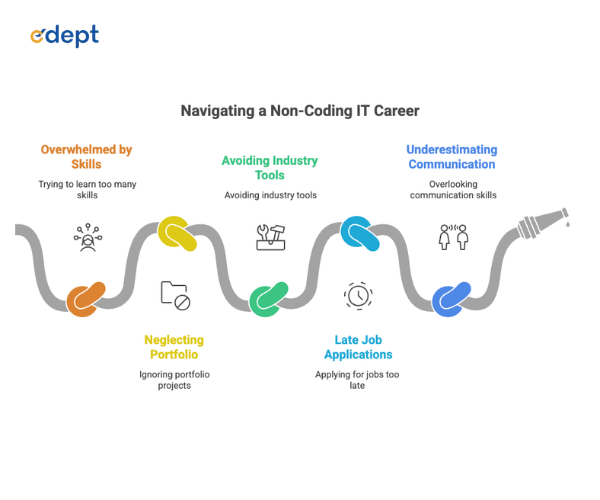
Step-by-Step Roadmap to Start Your IT Career Without Coding
Breaking into non-coding IT jobs works best when effort is sequenced deliberately rather than scattered across everything at once. These five steps move you from where you are to where you want to be in the most direct way available.
Most freshers take somewhere between six and twelve months to go from starting point to being employed without coding IT jobs, but that timeline shortens considerably when steps are followed in order and effort is focused on one role type rather than spread thin across several.
Step 1: Choose the Right Career Path
Pick one non-coding IT job type that fits your existing strengths before building any skills. Splitting effort across multiple IT jobs without coding produces shallow capability across all of them and makes none of them truly competitive. Work through the role comparison table, be honest about where your natural inclinations sit, and commit to that direction fully before doing anything else.
Step 2: Learn Skills from Free and Paid Resources
Once the role is chosen, find out specifically which skills and tools it requires and start building them through structured resources. Google Career Certificates, Coursera, LinkedIn Learning, YouTube, and specialist platforms all carry quality content for most without coding IT jobs. Free resources are a real starting point. Paid programmes from providers like edept add structure, mentorship, and career support that move things along considerably faster for non-coding IT jobs for freshers who want to get hired rather than just stay learning indefinitely.
Step 3: Build Real Projects (Portfolio)
Finishing courses is not enough for most IT jobs without coding. Employers want proof that skills work in practice. Build projects with real tools, a UX case study in Figma, a data dashboard in Power BI, an SEO audit for an actual website, a business requirements document for a problem you noticed. Portfolio work is what makes an application for non-coding IT jobs credible rather than just technically complete. It is the single biggest differentiator for non-coding IT jobs for freshers competing against candidates who have similar credentials but nothing practical to show alongside them.
Step 4: Get Industry Certifications
Certifications validate specific skills in a format that hiring managers can assess quickly when looking at applications for the best IT jobs without coding. Google Data Analytics Certificate, Meta Social Media Marketing Certificate, HubSpot certifications, ISTQB for manual QA, and Google UX Design Certificate all carry recognition across the non-coding IT jobs market. A relevant certification combined with real portfolio work is a considerably stronger application for non-coding IT jobs than either one on its own.
Step 5: Apply for Internships and Entry-Level Jobs
Once the skills, portfolio, and at least one certification are in place, start applying broadly for internships and entry-level roles across non-coding IT jobs without waiting until everything feels perfectly polished. For non-coding IT jobs for freshers, internships are consistently the fastest bridge to a full-time offer rather than a detour around one. LinkedIn, Naukri, Internshala, and company career pages are where the relevant listings live. Put genuine effort into tailoring each application to the specific role rather than firing off the same submission to every IT jobs without coding listing you come across, because hiring managers notice the difference immediately.
Why Choose edept for Your Non-Coding IT Career?
edept is built for people who want to enter the technology industry without a programming background, and everything about how the programmes are designed reflects that specific goal.
- Role-specific programmes: edept has built dedicated tracks around data analytics, UI/UX design, digital marketing, and business analytics, putting students directly on the path toward the best IT jobs without coding that are growing fastest right now.
- Tools training from day one: Rather than introducing tools gradually, every edept programme gets students working with Power BI, Figma, SQL, Google Analytics, and HubSpot from the start, exactly what non-coding IT jobs for freshers descriptions are asking for.
- Real project work: edept builds applied projects into every programme so students finish with a portfolio that shows employers what they can actually do when hired for without coding IT jobs, not just a certificate that confirms they attended.
- Industry-aligned curriculum: edept keeps its content tied to what hiring managers are genuinely looking for in IT jobs without coding candidates today, rather than following academic frameworks that tend to reflect where the market was rather than where it is heading.
- Placement and career support: Resume coaching, mock interviews, employer connections, and job application guidance are all built into edept’s programmes specifically for non-coding IT jobs for freshers entering the market for the first time.
- Accessible for all backgrounds: Whether you come from commerce, arts, science, or somewhere else entirely, edept’s programmes are built to take you from foundational knowledge to job-ready capability in your chosen category of non-coding IT jobs.
Contact edept to explore programmes built around where the non-coding IT job market is actually heading.
Future Scope of Non-Coding IT Careers
The growth trajectory for IT jobs without coding through the rest of this decade is backed by technology adoption trends that are moving faster rather than slowing down.
Data analysts, product coordinators, UX and UI designers, AI operations specialists, and digital business analysts are all growing quickly across industries as businesses adopt low-code and no-code technology at scale. The professionals who combine domain knowledge with digital tool proficiency are exactly who technology companies are building their non-coding IT jobs around, and that demand is consistent across sectors and geographies. Non-coding IT jobs for freshers who enter now are walking into a market with a long and well-supported runway in front of them, rather than one that is starting to flatten.
Conclusion
A coding background has never been the only way into technology, and in 2026, the pathways through non-coding IT jobs are better supported, better compensated, and more widely available than they have been at any previous point.
The best IT jobs without coding reward people who think clearly, communicate well, and use the right tools with genuine proficiency. Whether you are a fresher choosing a first direction or someone changing industries mid-career, without coding IT jobs offer a real and increasingly mainstream path into the technology sector. Pick your role, build the skills it actually requires, create portfolio work that demonstrates you can do the job, and enter an industry that genuinely needs what you bring.