Neither online nor offline education wins outright in 2026, and anyone telling you otherwise is skipping the part where individual circumstances matter. This guide looks at what each actually delivers across cost, flexibility, learning quality, employer recognition, and career outcomes, so you can make a decision based on what your situation genuinely calls for rather than what sounds right in theory.
The online vs offline education debate has been running for years, but 2026 has brought the kind of data that actually settles parts of it. Coursera crossed 197 million registered learners and $757 million in full-year 2025 revenue, up 9% year over year, cementing online learning as a mature category rather than a pandemic experiment. And yet classrooms are still full. The global online education market was valued at $363.72 billion in 2025 and is projected to reach $880.17 billion by 2033 at a CAGR of 11.68%, which tells you the market is growing fast, but does not tell you which format is right for any particular student.
So, which is actually better in 2026, online vs offline classes? Neither wins across the board. Online education benefits students who need flexibility and lower costs and have access to educational programs that do not exist locally. Offline education advantages students who need structure, face-to-face interaction, and hands-on training. Where you land in the online vs offline education comparison depends on who you are, what you are studying, and what conditions you actually learn well in.
This blog works through the real differences between online vs offline classes so you can make a decision based on your actual situation rather than general enthusiasm for one model or the other.
What is Online Education?
Online education in 2026 is not what it was in 2015. The gap between online vs offline classes has narrowed considerably as platforms have grown more sophisticated, more genuinely interactive, and more directly connected to what employers are actually looking for from graduates.
Online education is learning that happens through internet-based platforms, drawing on video content, live virtual sessions, AI-powered tools, interactive assignments, and digital communities to deliver the experience. Students access material from wherever they happen to have a connection, engage with instructors and peers through digital channels, and work through assessments and projects without needing to be physically present in any particular place. Modern online education covers everything from short professional certificates to accredited degree programs and serves an enormous range of learners, from school students to senior professionals reskilling mid-career.
What is Offline Education?
Offline education still represents the dominant model in formal schooling globally and for good reason. Before getting into the full online vs offline education comparison, it is worth being honest about what the offline environment actually delivers that digital platforms have not replaced.
Offline education is learning that happens in physical settings. Classrooms, lecture theatres, laboratories, workshops, and campuses all create an environment where students show up at a specific time, engage with instructors directly, and work alongside peers in person. The schedule is fixed, the accountability is external, and the social environment develops naturally through proximity and shared experience. For students who need that structure imposed rather than self-generated, offline education advantages are not trivial.
Online vs Offline Classes Differences
The differences between online vs offline classes are not just about location. They shape how learning is structured, who can participate, what it costs, and what kind of development happens beyond the academic content itself.
Anyone making an honest online vs offline education comparison has to account for all of these dimensions, not just the ones that favour their preferred conclusion. The table below makes the key differences visible in one place before exploring them in more depth.
| Feature | Online Classes | Offline Classes |
| Learning Environment | Study from home or anywhere | Classroom-based learning |
| Flexibility | High, self-paced or live | Fixed schedule and location |
| Cost | Generally lower | Higher, including travel and accommodation |
| Interaction | Digital through tools and video | Direct, face-to-face |
| Practical Learning | Limited for hands-on disciplines | Strong in labs, studios, and workshops |
| Social Development | Limited peer interaction | Strong campus community |
| Access | Global, from any location | Location-dependent |
| Discipline | Self-managed | Externally structured |
| Personalisation | AI-driven in modern platforms | Depends on instructor and class size |
| Certification | Widely recognised for many fields | Traditional degree recognition |
Online Education Benefits in 2026
Online education benefits have grown considerably as platforms have matured and AI tools have changed what personalised digital learning actually looks like. These are not marginal improvements. These are not minor conveniences. These are not marginal perks that apply to a narrow slice of learners. These are true strengths that have made a significant difference in the balance between online learning and traditional classroom-based learning, and it becomes increasingly difficult each passing year to dismiss them as being secondary to face-to-face interaction.
The reason why there is a different feel about the benefits of online learning in 2026 from what there was a few years earlier lies in the reality of its quality having advanced further than before. Flexibility, lower cost, and learning tools that have grown considerably more sophisticated have combined to make online vs offline classes a genuinely competitive comparison. It is no longer a compromise students settle for when nothing else is available. For many people, it has become a deliberate choice.
Learn Anytime, Anywhere
The freedom to learn without being tied to a specific place or time slot is one of the clearest online education benefits in the online vs offline education comparison. Students with full-time jobs, family commitments, or limited access to quality institutions locally can access such programs. For a lot of people, this is not a convenience. It is the only realistic path to further education at their current stage of life.
Cost-Effective Learning
Tuition fees are often lower for online programs. Beyond that, the indirect costs disappear entirely. No commuting, no accommodation, no relocation. For students managing tight budgets or changing careers without the option of stepping away from income, the financial gap between online vs offline classes is often one of the most decisive factors in the comparison. The online education benefits in cost are not marginal. They are sometimes the difference between being able to study at all or not.
AI and Personalised Learning
A 2025 randomised trial published in Scientific Reports found that AI tutoring produced effect sizes of 0.73 to 1.3 standard deviations over in-class active learning. That is a significant finding in the online vs offline classes comparison and one worth sitting with. AI-powered platforms in 2026 adapt to what individual students are actually doing, not what the average student in a cohort is assumed to need. They identify gaps, adjust content, and provide feedback. This is not possible in a large classroom where a single instructor is managing, and that mentor or teacher cannot focus on one person solely. This is one of the online education benefits that has genuinely shifted the comparison.
Wide Course Availability
No single physical institution offers everything. One of the strongest online education benefits is access to a breadth of programs, specialisations, and instructors that geography would otherwise make impossible. Students can combine programs from different providers, access expertise from institutions in other countries, and pursue niche career paths that simply do not have local offline equivalents. In the online vs offline education comparison on course availability, online wins clearly.
Offline Education Advantages
Offline education advantages are real, and the growth of online learning has not erased them. For specific types of students and specific disciplines, the in-person environment delivers things that no platform has yet fully replicated.
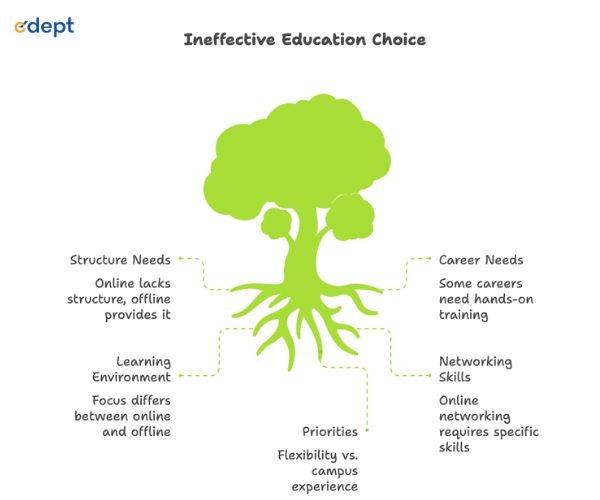
The offline education advantages that matter most are not about tradition. They are about learning conditions. Some students genuinely need external structure. Some disciplines genuinely need physical practice. Some careers genuinely develop through in-person social experience. The online vs offline education comparison is not about which model is superior in the abstract. It is about which one serves a particular student’s actual needs.
Better Discipline and Routine
Fixed class times and physical attendance requirements create external accountability that many students cannot generate for themselves consistently in an online environment. One of the most underrated offline education advantages in the online vs offline classes comparison is this structural discipline. When showing up is required rather than chosen, students who struggle with self-directed motivation often perform considerably better than they would if left to manage their own schedule.
Face-to-Face Interaction
There is a quality of learning that happens in a room where an instructor can read confusion on a student’s face and adjust in real time that video-based delivery has not fully captured. The online vs offline classes comparison on interaction quality consistently shows this gap, particularly for complex subjects where understanding builds through dialogue rather than content consumption. Face-to-face instruction remains one of the genuine offline education advantages that online formats approximate but do not replicate exactly.
Strong Social Skills Development
The social environment of a campus or classroom is not just pleasant. It is developmentally significant. Working with people in person, navigating group dynamics, building professional relationships through proximity, and developing the interpersonal fluency that employers consistently identify as important all happen more naturally in offline settings. The social dimension of offline education is one of its strongest advantages in the online vs offline education comparison, particularly for younger students entering the workforce for the first time.
Practical and Hands-On Learning
For disciplines that require physical practice, the offline education advantages are simply irreplaceable. Medicine, engineering, laboratory science, performing arts, construction, and many other fields need students to do things with their hands and bodies in real environments. Online vs offline classes in these disciplines are not a fair comparison because no digital platform substitutes for hands-on experience in fields where physical competency is the core professional requirement.
Why edept Combines the Best of Both?
edept is built around a straightforward observation: the online vs offline education debate matters less than whether the program actually produces career outcomes. Here is what edept brings to the comparison:
- Industry-aligned programs built around what employers are actually hiring for right now, not what academic tradition assumes they should teach.
- Flexible online delivery that carries genuine online education benefits, including live sessions, self-paced content, and AI-powered personalisation, without sacrificing curriculum rigour.
- Hands-on project work that bridges online vs offline classes by making learning applied from the start, so students graduate with documented capability rather than just a certificate.
- Placement and career support are built into the program from the beginning, not added at the end as an afterthought.
- Practitioner-led instruction from people working in the industries students are entering, which brings current professional knowledge into the learning environment.
- Global accessibility ensures that the quality of education a student receives is not determined by where they happen to live.
Contact edept’s counsellor to explore programs built for where careers are actually heading in 2026.
Conclusion
The online vs offline education question in 2026 does not resolve into a single clean answer for all students in all circumstances. Revenue in the online education market is projected to reach $221.71 billion in 2026, growing at a CAGR of 6.86% through 2030 to reach $289.14 billion, which reflects how decisively online learning has established itself as a permanent part of the education landscape. But offline education advantages have not disappeared alongside that growth. They have remained relevant for the students and disciplines where they genuinely matter.
The most useful conclusion from the online vs offline classes comparison is that the better question is not which model is superior, but which combination of features a particular student actually needs. Online education benefits are most valuable to students who need flexibility, affordability, and broader access to programs than geography allows. Offline education advantages are most valuable to students who need imposed structure, direct interaction, and hands-on learning environments. Most students in 2026 are best served by programs that integrate both rather than forcing a binary choice between them. That is the kind of program worth looking for when making this decision.