The best European countries for AI jobs in 2026 are Germany, the United Kingdom, the Netherlands, and France. These hubs offer mature AI ecosystems, competitive graduate salaries, and dedicated post-study work visas designed to retain global tech talent.
Artificial intelligence is transforming the global economy. It is no longer a niche field; it has become the foundation of Europe’s digital transformation. Currently, Europe has become a hub for AI innovations and expertise. From research labs, institutions, startups, and corporate AI hubs across the continent, there are many opportunities for professionals to launch or scale their AI careers. According to the European Commission’s AI policy framework, reinforced by the April 2025 AI Continent Action Plan, the EU seeks to establish itself as a global leader in “trustworthy and human-centric AI”. This strategy helps in fostering innovation, strengthening competitiveness and promoting ethical and safe AI. Now, let us start understanding in detail about the best European countries for AI jobs.
As of 2026, AI is rapidly changing the European labour market, with more than 60% of jobs in advanced economies expected to be affected by the active AI adoption. Germany is continuously growing its industrial AI and automation systems. London is thriving in its technology and financial power, leading to AI-driven fintech solutions. Paris has seen a massive explosion of AI startups due to its government policies and funding. France is now heavily investing in AI research and talent development through national strategies. The Netherlands and Nordic countries, especially Sweden and Denmark, are famous for their data-driven innovations.
If you are an AI or data science graduate and are willing to build a career abroad, then this is the right time for you to decide on your destination. Europe has become one of the most promising destinations for AI enthusiasts. It offers great opportunities, strong industrial applications, a rising tech ecosystem, and supporting rules and regulations for international talent and offers a dynamic work environment for AI professionals. This guide breaks down everything, whether you are deciding where you want to apply, what skills you need to build, or what career roadmap you need to achieve your global dream.
Why Europe Is Becoming a Major AI Career Hub
Europe is emerging as a hub for careers in artificial intelligence due to the large talent pool, strong ethical human-centric legislation such as the EU AI Act, and massive investment in the industrial application of AI. Artificial intelligence is fast permeating every sector, including healthcare, fintech, automotive, robotics and manufacturing sectors.
Rapid AI Adoption Across Europe
AI is no longer just a niche field; it has emerged as the backbone of Europe’s digital transformation. Europe has been transformed into one of the most dynamic places to build an AI career. AI is fast accelerating its use in diverse sectors such as automating or predicting diagnostic tools in healthcare, fraud detection in finance, and so on.
Germany is continuously growing its industrial AI and automation systems. London is thriving in its technology and financial power, leading to AI-driven fintech solutions. Paris has seen a massive explosion of AI startups due to its government policies and funding. France is now heavily investing in AI research and talent development through national strategies. The Netherlands and Nordic countries, especially Sweden and Denmark, are famous for their data-driven innovations.
Growing Demand for AI Professionals
The demand for AI professionals in Europe is rising continuously and is projected to grow 19.2% annually, reaching over $233 billion. Europe faces a severe AI skill shortage, particularly in tech hubs like London, Paris, Berlin, and Amsterdam. AI professionals only represent 0.41% of the EU workforce as of late 2025. 28% of recruiters in Germany, Spain, and the UK report difficulty finding candidates with strong machine learning or data engineering skills.
The World Economic Forum estimated that approximately 1.8 million new roles are available in AI and will be available by 2030. The United Kingdom has the third-biggest AI market worldwide with roughly 145,000 AI professionals. This shortage is a very good opportunity for the new graduates.
Better Work Opportunities for International Graduates
The international graduates have a strong employment prospect in Europe, which is driven by high demand for machine learning engineers, data scientists, and robotics experts. The North and Western parts of Europe, mainly Germany, Switzerland, the UK, and the Netherlands, are hiring AI professionals at a massive rate. These countries have understood that it is essential to attract global talent to fill up the talent shortages. The EU Blue Card, available in most EU member states, provides a structured pathway for non-EU professionals with a qualifying job offer.
Key Factors to Consider Before Choosing a European Country
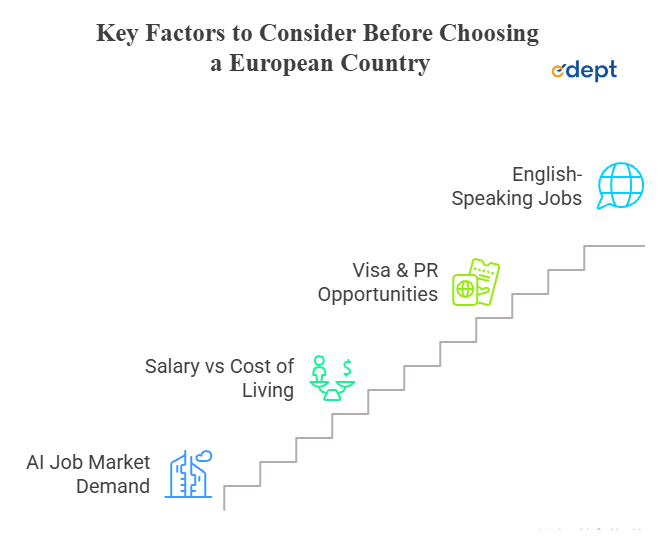
Before you consider a European country, there are a few key factors which you should keep in mind.
AI Job Market Demand
Not every European market provides equal opportunities when it comes to AI jobs. Germany is leading in demand for both AI and machine learning engineers, and the UK has a strong demand for fintech, research, and startups. The Netherlands and Ireland are currently emerging as significant tech hubs. When you start researching and evaluating, you should look beyond the salary amount and check what that particular city and job role is offering, because this will help you in shaping your career goals.
Salary vs Cost of Living
The salaries in Europe vary dramatically and mainly depend on your job role, experience level and location. Switzerland is known to offer the highest salary, with AI solutions architects earning up to €120,000 annually and AI product managers reaching €115,000. Germany offers a salary between €65,000 and €130,000, depending on experience and city. Munich offers comfortable living, whereas Berlin offers a low cost of living. When you want to calculate your real earnings, consider factors such as rent, transport, healthcare and taxes.
Visa & PR Opportunities
The accessibility of a visa varies significantly. Some countries offer a clear pathway for a visa, whereas some provide critical procedures. Germany’s EU Blue Card is a very premium residence permit for high-skilled non-EU nationals, which provides permanent residency after 21-27 months. It requires a minimum salary of €50,700 in 2026. The Netherlands also provides a high-skilled migrant visa with employer sponsorship. If you are looking for a long-term career plan in Europe, then Germany is the best option, as it provides the fastest pathway to permanent residency.
English-Speaking Job Availability
Language consideration is a very genuine factor in Europe. In countries such as the Netherlands and Ireland, English is the working language. In Germany, especially in Munich and Berlin, English is the working language, but if you have German language skills, it can enhance your career opportunities.
Germany : Best Overall for AI Careers in Europe
Strong Demand for AI Engineers & Data Scientists
Germany has become a premier destination for an AI career in Europe. The market is growing rapidly at a CAGR of 38% from 2025 to 2030. It offers high-paying job roles in the automotive, automation, and manufacturing sectors. The companies here are not just experimenting; they are implementing AI solutions that directly impact their production, customer behaviour, and efficiency. Some of the major job roles include AI engineers, machine learning developers, and data scientists. Various industrial companies such as Siemens, Bosch and SAP are building entirely new AI divisions. All these provide excellent job opportunities and career growth for the recent graduates.
Best Cities for AI Jobs
Some of the best cities for AI jobs in Germany include Berlin, Munich, Frankfurt and Hamburg.
Berlin is the leading AI hub in Germany and covers almost 48% of AI jobs. It has almost more than 500 startups, and it is very suitable for early-AI career professionals. It is a very affordable and cost-effective city.
Munich is known as the ‘Silicon Valley’ in Germany. It is best for AI research and offers the highest salaries. It is also home to BMW’s AI research units. Salaries here are higher than in Berlin, but so is the cost of living. The cost of living is usually higher than in Berlin.
Hamburg offers a very balanced working environment and strong work-life balance and provides specialization in logistics, media and e-commerce technology.
Salary Range for AI Professionals
AI professionals in Germany in 2026 generally earn an average annual salary between €70,000 and €100,000+, depending on experience, with entry-level positions starting around €55,000–€65,000 and senior roles often exceeding €120,000.
Germany Blue Card & Work Visa Advantages
The accessibility of a visa varies significantly. Some countries offer a clear pathway for a visa, whereas some provide critical procedures. Germany’s EU Blue Card is a very premium residence permit for high-skilled non-EU nationals, which provides permanent residency after 21-27 months. It requires a minimum salary of €50,700 in 2026. Some of the advantages include flexibility and being open to a broader range of skilled professionals. Once you hold an EU Blue Card, permanent residency becomes accessible after 33 months of contribution, or as soon as 21 months with B1 German language proficiency.
Challenges to Consider
Language consideration is a very genuine factor in Europe. In countries such as the Netherlands and Ireland, English is the working language. In Germany, especially in Munich and Berlin, English is the working language, but if you have German language skills, it can enhance your career opportunities. The German language is not universally necessary for tech roles, but it makes a big difference. Professionals with German language skills have more benefits and better work opportunities.
United Kingdom :Best for AI Research & Fintech Jobs
London as a Major AI Hub
London has become a major powerhouse for AI research and fintech jobs and is driven by massive competition in machine learning, financial services and AI adoption. Some of the most in-demand roles include AI/ML research scientist/engineer, fintech software engineering, data & compliance analyst and product manager. The top companies for AI jobs in London include Google DeepMind, Revolut, Quantexa, Faculty, Tractable, etc.
Strong Opportunities in Fintech & SaaS
The fintech and SaaS sectors in the UK are experiencing a massive surge in AI-related hirings. The companies are heavily investing in AI and transformation. Roughly 70% of all UK fintech roles are based in London. The combination of various global banks, fintech startups, and deep academic research creates a robust working environment. Some of the top hiring SaaS development partners include Bytes Technolab, Softwire, Miquido, Itera, Kainos & BJSS.
Salary Range in UK AI Roles
The salaries for the AI roles in the UK are generally very competitive, ranging from £35,000 for entry-level up to £120,000+ for senior positions in 2026, with London roles often exceeding £80,000–£96,000+ annually. Some of the high-demand roles, like lead AI engineers, can reach £150,000+. Some of the key factors which affect salaries are location, experience level and skill sets. London offers the highest salaries, followed by hubs like Manchester. Finance and technology companies often pay the highest.
Top AI Roles Salary Examples (London & UK)
- AI Engineer: £61,000 – £96,000 (average £80,000 in London).
- Principal Software Engineer – Agentic AI: £92,700 – £120,000.
- Lead Software Engineer – GenAI: £115,000 – £140,000.
- AI Specialist: £23,000 – £89,000 (Average £56,000)
Graduate Route Visa Benefits
The UK Graduate Route visa allows international students to stay and work or look for work in the UK for 2–3 years after graduating without needing a job sponsor or meeting minimum salary requirements. Generally, bachelor’s or master’s graduates can stay for two years, while PhD or other doctoral graduates can stay for three years.
Netherlands: Best for International & English-Speaking AI Jobs
Growing AI Ecosystem in Amsterdam & Eindhoven
The AI ecosystem in the Netherlands is mainly focused on Amsterdam and Eindhoven. It is currently experiencing rapid growth and helps in positioning the country as a leading AI hub in Europe. As of 2026, the Netherlands holds roughly 8% of Europe’s AI talent despite having only 2.8% of its population, creating a massive talent pool. Amsterdam has positioned itself as a vibrant AI hub, mainly focusing on responsible AI, software development, and AI applications, particularly in the creative, fintech, and health sectors. Eindhoven specializes in deep technology and physical, applied AI, sometimes described as the engineering powerhouse.
Strong English Work Environment
The Netherlands offers an English-friendly work environment. Here, the multinational companies mainly operate in English, and the traditional Dutch companies have now adapted to international hiring. This helps in removing the language barrier, which sometimes complicates entry to the European market.
AI Salary & Work-Life Balance
The Netherlands offers strong competitive salaries. Here, the AI engineers generally earn between €55,000 and €100,000+ per year, depending on experience. Meta, Uber, and IMC offer the highest salaries, often exceeding €150K-€200K+ for senior roles. Amsterdam offers the highest salaries, with a median of roughly €109K.
Junior (0–2 years): €45K–€65K base.
Mid-Level (2–5 years): €65K–€85K base
Senior (5+ years): €85K–€120K+ base
Startup & Innovation Ecosystem
The startup ecosystem of the Netherlands is very mature and well-funded. With around 3,712 to 4,500 startups, the scene is driven by high-tech, AI, fintech, and sustainability. Here, the government actively supports innovation through subsidies and tax incentives for research and development.
Ireland : Fastest Growing AI Talent Destination
Presence of Global Tech Companies
Ireland has been Europe’s tech hub over the past decade and continues to grow. In 2026, Ireland is home to 8 companies among the top 10 global IT firms. It serves as the major headquarters for giant companies like Google, Meta, Apple, and Microsoft. The ecosystem in Ireland is focused on AI development and integration, cloud computing and SaaS. Companies like OpenAI and Anthropic have established R&D sites, and AI is deeply integrated by firms such as Accenture, IBM, and Cognizant.
Rising Demand for AI & Cloud Professionals
The demand for AI and cloud professionals is rising at a very high pace. There is a 142% increase in AI job postings and 21–30% growth in cloud/cybersecurity roles. AI, cloud computing, cybersecurity, and data analytics constitute 79.6% of Ireland’s tech talent pool. This rising demand is driven by digital transformation and a strong tech hub. Proficiency and specialized skills in Python and AI modelling are highly valued.
Visa & Post-Study Work Benefits
Ireland offers a very generous post-study work pathway, which is known as the Third Level Graduate Programme (Stamp 1G), allowing international students to stay and work full-time after graduating. Master’s/PhD graduates can stay for two years, while Bachelor’s graduates (Level 8) get one year. This permits full-time work without any sponsor requirements. Graduates can work full-time (up to 40 hours a week) without needing a specific employer sponsor.
Salary Potential in Ireland
The salary potential in Ireland is approximately €44,200 to €45,000 for full-time workers, or about €3,683 monthly before tax. High-demand sectors like tech, finance, and engineering offer strong growth, with salaries often exceeding €100,000 for senior roles, particularly in Dublin. The national minimum wage is set at €14.15 per hour. The average salary is roughly €45,000 annually, with a 5.6% year-on-year growth.
France: Emerging AI Innovation Hub
Government Investments in AI
France had made AI a priority through the “France 2030” initiative and the “IA-Cluster” programme. It has positioned itself as a major European hub for artificial intelligence. In 2025, it invested €109 billion ($113 billion) in AI infrastructure. The government, through the intermediary GENCI, has heavily invested in supercomputing capacity. Paris ranks among the top three European cities for AI research with a strong combination of academic institutions and research centres
Paris Startup Ecosystem
Paris is a global startup hub, which ranks 8th worldwide and number 1 in France, and it features over 3900-plus startups in 2026. Their ecosystem is held by Station F, which is the world’s largest startup campus with strong government support, particularly in areas such as AI, tech, fintech, and climate tech. Some of the major players include AI firm Mistral AI, healthtech leader Doctolib, fintech firms Qonto and Lydia, and mobility firm BlaBlaCar.
AI Research Opportunities
France has become a major European hub for artificial intelligence research, and it is driven by a national strategy (France 2030) that invests heavily in AI talent, infrastructure, and public-private partnerships. Inria leads various French AI programmes, offering numerous positions for researchers, PhD students, and postdocs.
Language Considerations
English is used in many Paris-based technological companies, but as French is the sole official language of France, it increases your options, particularly for roles in larger corporations, public sector AI projects, and mid-sized French companies that have not yet adopted English as a working language. For all commercial and public communication, French is mandatory.
Switzerland: Highest Paying AI Jobs in Europe
AI Salaries & Benefits
AI engineers in Switzerland earn an average annual salary of roughly CHF 120,000–166,000+ (approx. $130k–$180k+), depending on your experience level, location and skill sets. The total salary for senior roles exceeds CHF 200,000 in major tech hubs like Zurich. The market shows high demand (15% growth) with great benefits, including generous bonuses, pension plans, and flexible work options. AI roles generally range from CHF 82,000 to over CHF 145,000 per year. The average base salary is CHF 120,236 per year. The AI roles generally range from CHF 82,000 to over CHF 145,000 per year.
AI Opportunities in Finance & Research
Switzerland is a premier global hub for AI in finance and research, driven by top-tier universities like ETH Zurich/EPFL and a strong financial sector aiming for high-ROI generative AI adoption. Nearly 50% of Swiss financial institutions use AI, along with 91% adopting AI for chatbots, compliance and risk management. It hosts major research labs, Google, IBM and HPE. The finance institute in Switzerland mainly focuses on deep learning, NLP and reinforcement learning.
Cost of Living Considerations
Switzerland is one of the most expensive countries in the world. A single person needs approximately CHF 2,500–3,500 monthly, and families require CHF 6,500–8,000+ to live comfortably, driven by high housing, mandatory health insurance (CHF 250–500/month), and expensive food. Major expenditure is housing, which takes almost 25-35% of monthly income.
Quick Comparison Table: Best European Countries for AI Jobs
| Country | Salary Potential | Visa Ease | English Jobs | PR Opportunities | Best For |
| Germany | High | Moderate | Good | Strong | Long-term tech/AI career |
| UK | High | Moderate | Excellent | Strong | Research, fintech, broader English-speaking market |
| Netherlands | High | Moderate | Excellent | Good | International tech roles, English-first environment |
| Ireland | High | Moderate | Excellent | Good | Big-tech/tech-company ecosystem |
| France | Moderate to High | Moderate | Good | Moderate | AI, startups, and the French Tech ecosystem |
| Switzerland | Very High | Difficult | Good | Limited | Highest compensation, senior roles |
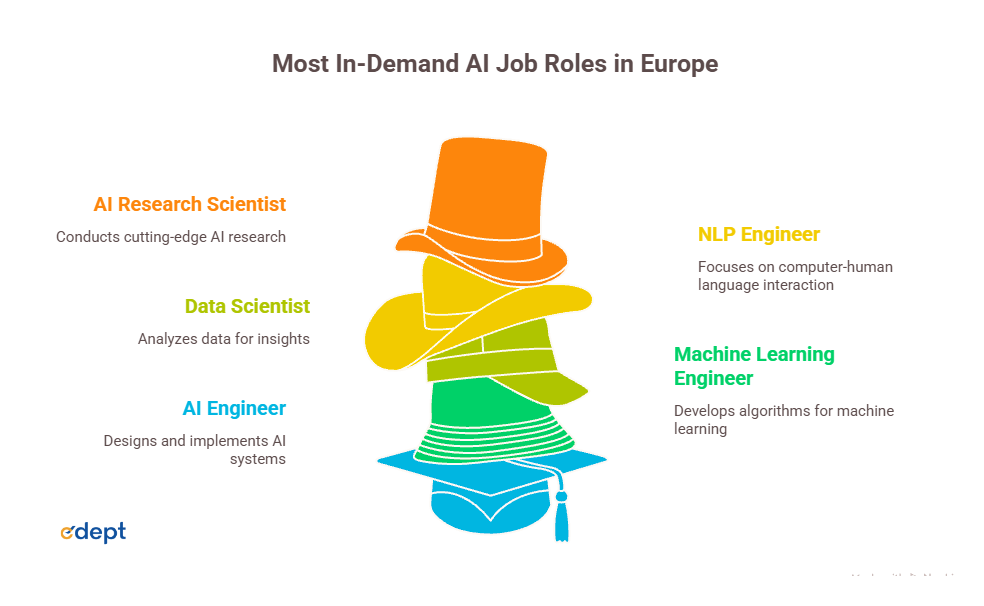
Most In-Demand AI Job Roles in Europe
AI Engineer
The AI engineers help in designing, deploying and implementing artificial intelligence systems. They help in bridging the gap between raw ML models and production-ready applications. This job role requires strong programming skills, mostly Python, and experience with AI frameworks such as TensorFlow or PyTorch.
Machine Learning Engineer
They help in training, evaluating and optimizing machine learning models. They hold the responsibility of creating infrastructure. that help in building scalable machine learning systems. They work with MLOps frameworks such as MLflow or Kubeflow.
Data Scientist
They help in converting large raw data sets into meaningful business insights. They design predictive models and help in analyzing complex data. This job role is in very strong demand.
NLP Engineer
Europe has language diversity; hence, there is a huge demand for NLP engineers, particularly in healthcare and finance. They help in building systems that understand, generate and process human language. They work with large LLMs and processing systems.
AI Research Scientist
They are responsible for developing cutting-edge algorithms, particularly in computer vision and deep learning. These job roles are mainly concentrated in the research institutes, universities and large technology companies.
Skills Required to Get AI Jobs in Europe
Some of the important skills required are:
Python & Programming Skills
Python is the most important and dominant mandatory language for AI development. Proficiency in Python, along with NumPy, Pandas, Scikit-learn, and TensorFlow or PyTorch, is essential for AI job roles. Java, C++, and Scala are also highly valued for building AI applications.
Machine Learning & Deep Learning
You need a strong and solid understanding of core machine learning concepts, deep learning architecture, model training and evaluation. A strong, hands-on experience with frameworks such as TensorFlow and PyTorch is essential for developing neural networks.
Cloud & AI Deployment Skills
To know how to deploy and scale AI models into a cloud environment is essential. Familiarity with cloud platforms such as AWS, Azure, and Google Cloud is highly valued by employers.
Problem-Solving & Communication
Only technical knowledge is not enough; how you present yourself and how you communicate with others are equally important. Employers always look for candidates who can easily convert technical AI-related works into business language. The ability to transform a complex technical problem and explain it to the stakeholders is highly valued.
Certifications That Improve AI Job Opportunities
Google AI Certifications
The Google AI Professional Certification is designed to bridge the AI skill gap in Europe. It focuses on practical AI applications, including prompting, data analysis, and content creation. It is available in multiple European languages.
The Google Cloud Machine Learning Engineer Certification validates expertise in building and deploying AI models on Google Cloud for technical roles. It focuses on advanced machine learning (ML), MLOps, Vertex AI, and deploying scalable AI solutions.
AWS Machine Learning Certifications
The AWS Certified Machine Learning Engineer certification focuses on practical implementation, MLOps, and deploying machine learning workloads on AWS. It is ideal for ML engineers and developers with at least one year of experience.
The AWS Certified Machine Learning certification focuses on covering data engineering, modelling, and deep learning. It also validates expert-level skills in designing and running ML workloads.
Azure AI Certifications
The Microsoft Certified: Azure AI Engineer Associate certification focuses on building, testing, and deploying AI solutions using Azure Cognitive Services, Azure AI Search, and Azure OpenAI Service. It is best for developers, software engineers, and AI professionals.
The Microsoft Certified: Azure AI Fundamentals certification focuses on foundational concepts, AI workloads, and basic Azure services. It is best for beginners, project managers, and non-technical professionals entering the AI field.
Challenges International Students Face in Europe
International students often face various challenges in Europe. Some of them include language barriers, high cost of living, accommodation shortage, and complex bureaucratic processes for visas and residence permits. Beyond financial and administrative hurdles, students also face cultural shock.
Language Barriers
Although the various programmes might be in English in your daily life, it often requires local language skills, for example, German or French, and social norms can be very different, leading to potential social isolation. The graduates who take the time to learn local language skills tend to grow faster in their career journeys.
Competition for Entry-Level AI Jobs
The competition for entry-level AI jobs in Europe is rising continuously due to rapid AI adoption and digital transformation. The entry-level candidates without sufficient experience and internships face significant competition. Recruiters specifically look for what projects you have worked on and what real-world experience you have; hence, to stand out, you require a very strong portfolio with real project experience, such as an internship or research-based experience.
Cost of Living in Major Cities
The cost of living in major European cities such as Switzerland and Scandinavia is the highest, with monthly expenses for a single person often exceeding €2,500–€3,500. Moderate costs are found in cities like Berlin or Madrid, while Eastern Europe and Portugal offer the most affordable options. Rent is the most expensive cost, with top-tier cities like London and Paris being the most costly. Graduates or professionals should budget very carefully before planning for a job abroad in Europe.
Why Skill-Based Learning Matters More Than Just Degrees
Skill-based learning matters more than just degrees because most employers in Europe are looking for candidates who have practical and real-world experience and not just theory-based knowledge.
Real Projects & Portfolio Building
The employers in European countries review your portfolios, your GitHub presence, and any project work you were part of, not just your academic records. A graduate who has built something, contributed to any open-source AI project or has solved a complex business problem will easily outperform a candidate with only academic records.
Internship Experience
An internship, even for a short period of time, offers you a workplace experience. They provide professional adaptability and real work exposure. Graduates with internship experience are recognized early and are highly valued.
GitHub & Practical Exposure
An active GitHub profile is often considered a professional signal when there is AI hiring. Contributions to open-source AI frameworks, documentation habits and the various types of projects you have worked on show your seriousness and technical knowledge to the hiring managers.
Why Choose Edept for AI & Data Science Career Preparation
If you are planning to build a career in AI and data science, the quality of your training matters. Edept’s programmes are built around one goal: making you job-ready.
Industry-Aligned Curriculum
Edept’s curriculum is designed to meet what the industry actually expects. Every module covers real-world job roles and the specific skills employers ask for, not just theoretical content.
Hands-On Projects & Practical Training
Learning at Edept means getting your hands on real-world environments. You work on projects that simulate actual job scenarios. Instead of just watching videos, you get to build real projects, deploy new applications, configure networks, and take on many other interesting tasks.
Placement Assistance & Career Support
Edept provides structured support for your job search, from resume building and mock interviews to job referrals and career guidance. You are not left to figure it out on your own.
Structured Career Roadmap for Students
Whether you are just starting from zero or looking to level up, Edept gives you a clear, step-by-step path, from beginner foundations to expert-level skills. No guesswork, just a structured roadmap that takes you where you want to go.
Programs Focused on Global Careers
Edept’s programmes are designed with international career mobility in mind. Whether targeting Germany’s industrial AI sector, the UK’s fintech scene, or the Netherlands’ tech ecosystem, the curriculum prepares graduates for specific regional markets.
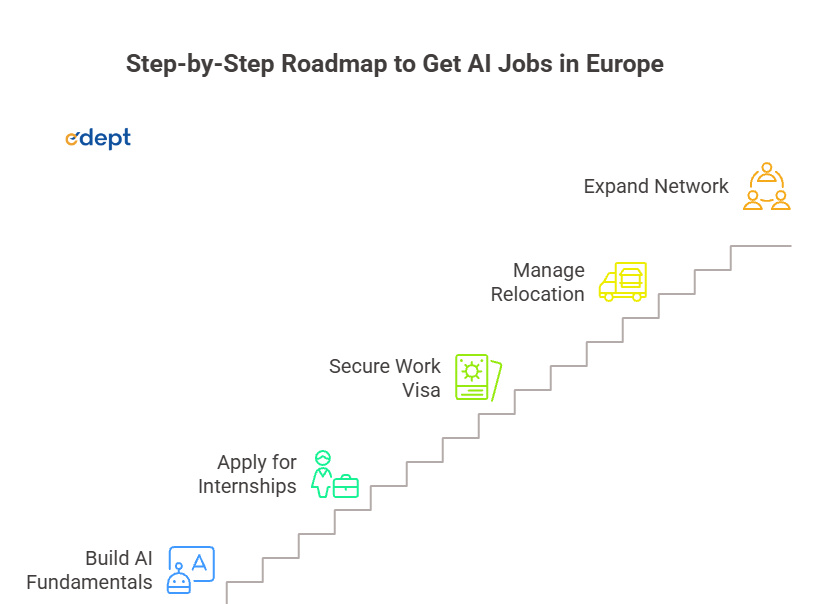
Step-by-Step Roadmap to Get AI Jobs in Europe
Build AI Fundamentals
You should start by building your foundation in Python, machine learning algorithms, and data structures. Start understanding linear algebra, calculus and probability. For data handling, learn libraries such as NumPy, pandas, and SQL. You should never skip the foundation process; this only builds the framework of your whole learning journey.
Gain Real Project Experience
Start building real projects and document and host AI applications on GitHub (e.g., a research agent or automated data analyst). Start participating in Hugging Face projects or Kaggle competitions to show practical ability.
Apply for Internships & Graduate Roles
Start actively researching and applying for internships. Research companies in your target country and location, and start applying. You should target those internships that give an opportunity to become a full-time employee in the future.
Secure Work Visa & Relocation
Once you have your job offer, start discussing with your employer about the immigration process. Germany’s EU Blue Card, the Netherlands’ HSM permit, and Ireland’s Critical Skills Employment Permit are all designed to be processed within a defined and manageable timeline. Prepare all your documentation early.
Future Scope of AI Careers in Europe (2026–2030)
The future of AI careers in Europe is rising dramatically, with projections indicating that 70% of new job roles by 2030 will be directly enabled or influenced by AI technology.
Expansion of AI Regulations & Responsible AI
The EU AI Act, the world’s first comprehensive AI law, entered into force on August 1, 2024, setting a human-centric, risk-based framework with full application by August 2, 2026. It bans AI that manipulates human behaviour and exploits vulnerabilities. The GPAI models depict certain rules for general-purpose AI, including transparency, copyright compliance, and safety evaluations for systemic risk models.
Increasing AI Investments Across Europe
The AI investments in Europe are rising continuously. It is booming, with over $9 billion raised by European AI startups in just the first two months of 2026, with AI accounting for 31% of all regional venture capital.
Rising Demand for AI Talent Across Industries
The demand for AI talent is rising at an alarming rate. The European AI talent market is experiencing a severe talent shortage, driven by rapid generative AI adoption, with over 70% of employers in key markets like Germany and the UK reporting shortages. Ireland, Germany, and the Netherlands are leading in attracting AI professionals. AI model developers, AI researchers, and AI literacy skills are in highest demand.
Conclusion
Europe offers great opportunities for AI professionals and fresh graduates who are willing to build a career abroad in 2026. Germany is continuously growing its industrial AI and automation systems. London is thriving in its technology and financial power, leading to AI-driven fintech solutions. Paris has seen a massive explosion of AI startups due to its government policies and funding. France is now heavily investing in AI research and talent development through national strategies. The Netherlands and Nordic countries, especially Sweden and Denmark, are famous for their data-driven innovations.
If you are an AI or data science graduate and are willing to build a career abroad, then this is the right time for you to decide on your destination. Europe has become one of the most promising destinations for AI enthusiasts. It offers great opportunities, strong industrial applications, a rising tech ecosystem, and supporting rules and regulations for international talent and provides a dynamic work environment for AI professionals. Now your success completely depends on your planning and preparation. Start building a portfolio of real projects and research visa pathways early. Consider language acquisition as a career investment. And approach your job search strategically, targeting countries and companies aligned with your career goals.