Cloud certifications are no longer optional for anyone serious about building a cloud career in 2026. This guide breaks down the certifications that actually matter across AWS, Azure, and GCP, compares costs and difficulty levels, and gives you a practical roadmap from complete beginner to job-ready candidate, without wasting your time on credentials that will not move the needle.
Cloud computing has quietly moved from being a competitive advantage to something closer to a basic requirement for businesses of almost every size and type. The organisations that once treated it as optional infrastructure have largely stopped debating it, and the ones still catching up are doing so quickly. What has not kept pace is the supply of people who actually know how to work in these environments. According to the World Economic Forum’s Future of Jobs Report 2025, cloud computing sits among the top five fastest-growing technology skills worldwide. LinkedIn’s 2025 Emerging Jobs data puts cloud engineer and cloud architect roles growing at over 30% year on year, and the global cloud services market is projected to cross $1.2 trillion by 2028. The professionals with the right cloud certifications 2026 are stepping into a market that needs them badly.
That said, knowing the opportunity exists and knowing how to position yourself for it are two different things. Which cloud certifications actually open doors in 2026? The answer is not the same for everyone. It shifts depending on where you are starting from, which platform aligns with your goals, and the kind of role you are genuinely trying to land. This blog is written to help you work through that decision practically, without wading through every certification that exists just to arrive at the ones that are worth your time.
Why Cloud Certifications Matter in 2026
The cloud job market has grown competitive enough that showing up with general technical knowledge no longer cuts it the way it once did. What you know matters, but how you prove it to someone who has never met you matters just as much.
Rising Demand for Certified Cloud Professionals
Organisations are not just looking for people who understand cloud in theory. They want professionals who can demonstrate validated, platform-specific knowledge from day one. Cloud certifications 2026 have become a shorthand for exactly that. Hiring managers use them to filter candidates quickly, particularly when hundreds of applications arrive for a single role. Having the right cloud career certifications signals that you have gone beyond watching tutorials and actually committed to structured, assessed learning.
Certifications Improve Hiring Chances
Breaking into the job market without prior experience is genuinely tough, and most freshers know it. What cloud certifications do in that situation is give recruiters something solid to hold onto when your CV does not yet have job titles or company names to speak for you. AWS certifications, Azure certifications, and GCP certifications are all familiar to hiring teams at established organisations, and each one communicates something specific about your knowledge and the effort you have put into developing it. When dozens of candidates are applying for the same role, that kind of tangible signal can be the difference between getting a call and getting overlooked.
Better Salary Potential
The pay gap between certified and non-certified cloud professionals is not marginal. According to the Global Knowledge IT Skills and Salary Report, professionals holding cloud career certifications earn somewhere between 20 and 25% more on average than those without. AWS certifications tend to sit toward the higher end of the salary scale, and that pattern is particularly visible in India where demand for AWS-skilled professionals has climbed sharply over the past few years. To put some numbers to it, AWS Solutions Architect roles in India are currently averaging somewhere between Rs. 12 lakh and Rs. 22 lakh per annum, with experience and hands-on project work pushing that figure toward the upper end. That kind of salary trajectory makes the cost and effort of earning cloud certifications 2026 a fairly straightforward investment to justify.
Is Certification Mandatory for Cloud Jobs?
Not always, but more often than you might expect. Whether certification is essential largely comes down to the role you are targeting and the type of organisation doing the hiring.
Roles Where Certifications Matter More
For roles like cloud architect and cloud engineer, cloud certifications 2026 are close to non-negotiable in most enterprise hiring processes. These positions come with significant responsibility, and employers want more than a promising CV. They want proof that a candidate actually understands the platform they will be working on. In organisations running heavily on Microsoft infrastructure, Azure certifications tend to carry the most weight. In technology companies and financial services firms, AWS certifications are typically what hiring teams look for first.
Roles Where Skills Matter More
Startups and early-stage technology companies tend to prioritise demonstrated ability over credentials. If you can show working projects, contribute to a codebase, or solve a technical problem in an interview, many startups will hire you without cloud career certifications. That said, even in these environments, certifications serve as a useful signal when you are trying to get your foot in the door without an existing professional network to rely on.
Certifications vs Practical Experience
The most competitive candidates in 2026 combine both. Cloud certifications validate foundational and intermediate knowledge in a standardised way. Practical experience demonstrates that you can apply that knowledge in real, messy, unpredictable environments. Neither fully substitutes for the other. The professionals who progress fastest are the ones who earn relevant cloud career certifications and build hands-on projects alongside them, rather than treating certification as the finish line.
Best Beginner Cloud Certifications
Not every cloud role has the same expectations, and that is worth understanding before you invest time and money into a certification. Here is a look at where certifications genuinely move the needle and where raw ability tends to speak louder.
AWS Certified Cloud Practitioner
The AWS Certified Cloud Practitioner is the most widely recommended starting point for anyone new to AWS certifications. It walks you through the core building blocks of the AWS platform. This covers essential services, billing structures, basic security concepts, and foundational cloud principles. You can learn all without assuming you have any prior technical background. It is a legitimate starting point in its own right, not a simplified version of something more substantial. If an AWS-focused cloud career is what you are working toward, this is where your cloud certifications 2026 journey should start.
Microsoft Azure Fundamentals (AZ-900)
The AZ-900 is the entry-level credential in the Azure certifications pathway and is particularly well-suited to anyone targeting enterprise environments. Microsoft Azure is the dominant cloud platform in organisations running on Windows infrastructure, and the AZ-900 gives you a grounded understanding of Azure services, pricing models, and compliance frameworks. It is one of the more accessible cloud career certifications available and pairs well with prior IT support or systems administration experience.
Google Cloud Digital Leader
The Google Cloud Digital Leader is the entry point into GCP certifications and is aimed at professionals who want to understand how Google Cloud supports business transformation, without necessarily going deep into technical configuration. It is a sensible first step for anyone who wants to understand the GCP ecosystem before committing to a more technical certification path.
Read More: Ultimate Guide to Cloud Platform: AWS vs Azure vs Google Cloud
Intermediate Cloud Certifications
Once you have an entry-level certification under your belt and some hands-on practice behind you, the next step is building genuine technical depth. Intermediate cloud certifications are where the real differentiation begins, and where employers start taking your profile more seriously.
1. AWS Solutions Architect Associate
The AWS Solutions Architect Associate is one of the most valuable and widely recognised AWS certifications available. It covers designing resilient, cost-effective, and secure architectures on the AWS platform and is the natural next step after the Cloud Practitioner credential. It is consistently among the highest-salary-correlated cloud certifications 2026 employers list in job postings.
2. Azure Administrator Associate (AZ-104)
If you are serious about building a technical career on Microsoft Azure, the AZ-104 is where that journey gets real. It moves well beyond foundational awareness and into the practical work of managing Azure environments, covering identity management, storage, networking, and compute in meaningful depth. Organisations across the UK, Europe, and India consistently list it among the cloud career certifications they actively look for when hiring for infrastructure and administration roles.
3. Google Associate Cloud Engineer
The Google Associate Cloud Engineer is the point in the GCP certifications pathway where things shift from understanding to doing. It is built around the practical work of deploying applications, keeping operations running smoothly, and managing cloud infrastructure on Google Cloud. For professionals who want to show they can actually operate on the GCP platform rather than simply describe how it works, this credential makes that case far more convincingly than a foundational badge ever could.
Advanced Cloud Certifications
Reaching advanced level cloud certifications 2026 is where careers shift meaningfully in terms of seniority, responsibility, and compensation. These credentials are not quick wins. They require substantial hands-on experience and a deep understanding of the platforms built up over time.
1. AWS Solutions Architect Professional
The AWS Solutions Architect Professional is not a certification you walk into lightly. It sits among the most technically demanding AWS certifications available and is broadly regarded as a genuine marker of expertise on the platform. A minimum of two years of hands-on experience is expected before candidates attempt it, and the exam itself covers complex, multi-tier architecture design at a level of depth that reflects that expectation. Most professionals who hold this credential are already working at senior or principal engineer level.
2. Google Professional Cloud Architect
The Google Professional Cloud Architect is the most senior of the GCP certifications and covers designing, developing, and managing robust, scalable, and secure cloud architectures on Google Cloud. It is a challenging credential that carries significant weight in organisations that run Google Cloud infrastructure at scale.
3. Azure Solutions Architect Expert (AZ-305)
The AZ-305 is the advanced tier of the Azure certifications pathway and focuses on designing cloud and hybrid solutions on Microsoft Azure. It requires holding the AZ-104 as a prerequisite and is aimed at professionals who design full Azure environments rather than managing individual components. It is one of the most respected cloud career certifications in the enterprise technology space.
DevOps Certifications That Complement Cloud Careers
Cloud and DevOps have become increasingly difficult to separate in practice. Most cloud engineering roles today expect at least a working familiarity with containerisation, orchestration, and infrastructure automation. These certifications sit alongside your core cloud career certifications and make your profile considerably more well-rounded to hiring teams.
1. Docker Certifications
Docker is the foundation of containerised application deployment, and a Docker Certified Associate credential demonstrates that you understand how to build, ship, and run containers in production environments. For anyone pursuing cloud certifications 2026 with a focus on application deployment and infrastructure automation, Docker knowledge is increasingly expected rather than optional.
2. Kubernetes Certifications
The Certified Kubernetes Administrator and Certified Kubernetes Application Developer credentials have earned their place as genuinely sought-after additions to any cloud career certifications profile. Kubernetes has become the default way most organisations manage containers at scale across cloud environments, and the professionals who can confidently configure, manage, and troubleshoot Kubernetes clusters are finding themselves in demand across AWS, Azure, and GCP environments alike. It is the kind of skill that travels well regardless of which cloud platform an employer happens to run on.
3. Terraform Certifications
The HashiCorp Terraform Associate certification is worth serious consideration for anyone building a cloud engineering career. It demonstrates that you can use Terraform to manage infrastructure as code, which has shifted from being a specialist skill to something cloud engineering roles increasingly expect as standard. What makes it particularly useful is that Terraform is not tied to a single provider. It works across AWS, Azure, and GCP, which means this credential sits comfortably alongside cloud certifications 2026 on any platform and adds practical value without pulling you in a different direction from your primary specialisation.
Cloud Security Certifications
Security has become one of the most critical and fastest-growing areas within cloud computing. As organisations move sensitive workloads and critical data into cloud environments, the demand for professionals who can protect them has grown sharply. These cloud career certifications signal to employers that you understand not just how to build in the cloud, but how to keep it secure.
1. Certified Cloud Security Professional (CCSP)
The CCSP is the leading certification for cloud security expertise and is jointly offered by ISC2 and the Cloud Security Alliance. It covers cloud architecture, data security, platform security, application security, and compliance across cloud environments. Among cloud career certifications focused on security, the CCSP carries the most consistent recognition across industries and geographies.
2. AWS Security Specialty
The AWS Security Specialty is one of the most technically demanding AWS certifications available. It covers identity and access management, data protection, infrastructure security, and incident response within AWS environments. For professionals who want to specialise in securing cloud infrastructure, this credential signals a level of depth that general AWS certifications do not convey on their own.
3. Azure Security Engineer (AZ-500)
The AZ-500 is the security-focused credential in the Azure certifications family, covering identity management, platform protection, security operations, and data security within Microsoft Azure environments. It is increasingly requested in enterprise hiring as organisations take cloud security more seriously and build dedicated security functions within their cloud teams.
Which Certification Should Freshers Choose First?
With so many options across AWS certifications, Azure certifications, and GCP certifications, knowing where to begin can feel genuinely overwhelming. The right starting point is different for everyone, and it comes down to three practical considerations that are worth thinking through before you commit.
Based on Career Goals
If you want to work as a cloud architect or solutions designer, start with the AWS Certified Cloud Practitioner or AZ-900 and work toward the associate-level architecture credentials. If security interests you, begin with a foundational certification and layer in security-specific cloud career certifications as your experience grows.
Based on Platform Preference
AWS certifications open the most doors across the broadest range of employers, which is simply a reflection of how dominant AWS remains in the global cloud market. If your sights are set on large enterprises running Microsoft-heavy infrastructure, Azure certifications are the more logical starting point. For anyone drawn toward data engineering or machine learning, GCP certifications carry a level of credibility in those spaces that the other platforms do not quite match, and hiring teams working in those areas tend to recognise that difference.
Based on Budget and Time
Entry-level cloud certifications 2026 typically cost between $100 and $200 USD to sit. If budget is a constraint, start with one platform and go deep rather than spreading across all three. One well-chosen certification backed by practical project work will serve you better than three surface-level credentials with nothing to show alongside them.
Also Read: Cloud vs DevOps: Which Career Path is Right for You?
Certification Cost Comparison
| Certification | Level | Exam Cost (INR) | Difficulty |
| AWS Cloud Practitioner | Beginner | ₹11,000 | Low |
| AZ-900 Azure Fundamentals | Beginner | ₹3,700 | Low |
| Google Cloud Digital Leader | Beginner | ₹8,400 | Low |
| AWS Solutions Architect Associate | Intermediate | ₹20,000 | Medium |
| Azure Administrator AZ-104 | Intermediate | ₹4,800 | Medium |
| Google Associate Cloud Engineer | Intermediate | ₹13,500 | Medium |
| AWS Solutions Architect Professional | Advanced | ₹27,000 | High |
| Azure Solutions Architect AZ-305 | Advanced | ₇,000 | High |
| Google Professional Cloud Architect | Advanced | ₹17,000 | High |
| CCSP | Security | ₹50,000 | High |
AWS Certification Costs
AWS certifications are priced at $100 for the foundational tier, $150 for associate-level credentials, and $300 for professional-level exams. Retake fees apply if you do not pass on the first attempt, so preparing thoroughly before booking is worth the time it takes.
Azure Certification Costs
Azure certification costs are consistently $165, which is consistent and easy to plan for. Discounted vouchers can be obtained from time to time from Microsoft, depending on learning activities and affiliations; hence, it is recommended that one checks beforehand.
Google Cloud Certification Costs
GCP certifications range from $99 for the Digital Leader to $200 for associate and professional-level credentials. Google also offers free learning paths through Google Cloud Skills Boost, which reduces the overall cost of preparation meaningfully.
Why Practical Learning Matters More Than Just Certifications
Cloud certifications 2026 get you through the door. What happens in the interview, and in the first few weeks on the job, depends on something else entirely. Practical experience is what separates candidates who can talk about cloud from those who can actually work in it.
Hands-On Projects
Cloud certifications 2026 tell employers what you know. Hands-on projects tell them what you can do. Working through real projects on AWS, Azure, or GCP, even modest ones you have put together in your own time, says something about you that an exam certificate simply cannot. It shows you took the initiative to go further than the syllabus and came away with something to show for it.
Labs and Simulations
Platforms like AWS Skill Builder, Microsoft Learn, and Google Cloud Skills Boost all offer free and low-cost lab environments where you can practise in real cloud consoles without risking production infrastructure. Regular lab work alongside study for cloud career certifications makes the knowledge stick considerably better than reading alone.
Building Portfolio Projects
A portfolio of cloud projects strengthens every application you submit. Even straightforward projects like deploying a web application on AWS, setting up automated backups on Azure, or building a data pipeline on GCP show that you have moved beyond theory, but gained knowledge practically. Combined with the right cloud certifications 2026, a portfolio makes a compelling case to any hiring manager.
Why Choose edept for Cloud Career Preparation
Earning cloud career certifications is one part of the journey. Finding a program that prepares you for the actual work, not just the exam, is where most beginners struggle to find the right fit. edept is built around closing that gap.
Certification-Focused Curriculum
Edept’s cloud programmes are built around the certifications employers actually ask for. The curriculum is regularly updated to reflect changes in AWS certifications, Azure certifications, and GCP certifications, so you are always preparing for what the current market requires rather than what was relevant two years ago.
Hands-On Cloud Labs
edept does not rely on slides and pre-recorded walkthroughs to teach cloud concepts. Real lab environments are built into the programmes, giving you time inside live AWS, Azure, and GCP consoles working through actual deployments and configurations. The scenarios are deliberately designed to reflect what you will face both in cloud career certifications exams and in the day-to-day reality of a cloud job.
Placement Assistance
edept’s placement support goes beyond handing you a certificate and wishing you luck. It covers CV building, mock interviews, and direct introductions to hiring partners who are actively looking for cloud talent. The measure of success is not just whether you earn cloud career certifications. It is whether those credentials translate into a job offer you actually want.
Beginner to Advanced Learning Path
Whether you are coming in with no prior cloud experience or looking to progress from associate to professional-level cloud certifications 2026, Edept offers a learning path that is structured around where you are right now and where you are trying to get to, without rushing you through content before you are ready for it. You are not dropped into advanced content before you are ready, and you are not held back once you have mastered the fundamentals.
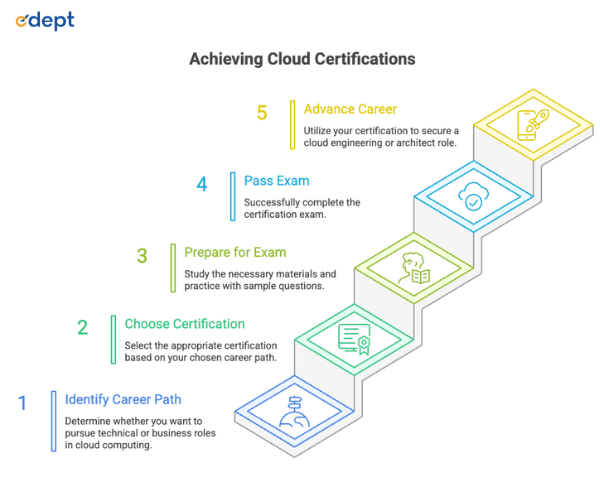
Step-by-Step Certification Roadmap for Beginners
Having the right cloud certifications 2026 matters, but knowing the order in which to pursue them matters just as much. Here is a straightforward, practical roadmap that takes you from complete beginner to job-ready candidate without unnecessary detours.
Step 1: Learn Cloud Fundamentals
Before sitting any exam, spend four to six weeks building a working understanding of what cloud computing is, how the major platforms are structured, and what the core service categories cover. Free resources from AWS, Microsoft, and Google are a solid starting point.
Step 2: Choose One Platform
Pick one platform from AWS, Azure, or GCP and stick with it long enough to build real depth. Spreading attention across all three from the start tends to slow everything down without producing genuine expertise in any of them. The platform you choose should reflect where you actually want to work and the kinds of organisations you are hoping to join.
Step 3: Earn Entry-Level Certification
Sit the foundational exam for whichever platform you have chosen. The AWS Cloud Practitioner, AZ-900, and Google Cloud Digital Leader are all realistically achievable within six to eight weeks of consistent, focused preparation. Each one gives you a verified credential that you can lead with in job applications while you work toward the next level.
Step 4: Build Projects
Do not wait until you have finished certifying before you start building things. While working toward your next credential, put together at least two or three small projects on your chosen platform. Document what you built, upload it to GitHub, and write briefly about the decisions you made and what you took away from the process. It gives your cloud certifications 2026 some context and shows hiring managers that your knowledge exists outside of an exam environment as well as inside it.
Step 5: Apply for Cloud Jobs
Start applying before you feel entirely ready. Entry-level cloud roles are genuinely accessible to candidates with a foundational certification, some project work, and the ability to speak clearly about what they have built and learned. Do not wait until you have every cloud career certification you eventually want before you begin applying.
Common Certification Mistakes to Avoid
Most people who struggle to land cloud jobs after certifying are not lacking knowledge. They made a few avoidable mistakes along the way. Here are the ones that come up most consistently, and what to do differently.
Collecting Too Many Certifications
More certifications do not automatically mean better job prospects. A candidate with three surface-level cloud certifications 2026 and no project work is often less compelling than a candidate with one solid certification and a portfolio of real deployments. Go deep before going wide.
Ignoring Hands-On Practice
Passing a certification exam through memorisation alone leaves significant gaps. Employers will probe your practical knowledge in interviews, and candidates who have only studied for the exam without ever working in a real cloud console tend to struggle. Make lab time a consistent part of your preparation for all cloud career certifications.
Choosing the Wrong Certifications
Picking a certification because it sounds impressive rather than because it aligns with your target role is a common and costly mistake. Research the roles you want, look at what cloud certifications they actually ask for, and let that drive your choices rather than general reputation alone.
Future Scope of Certified Cloud Professionals
The demand for certified cloud professionals is not plateauing anytime soon. The next few years are expected to bring significant shifts in how cloud technology is used, and the professionals who position themselves correctly now will be well placed to grow alongside it.
Multi-Cloud Careers
A growing number of organisations have stopped betting on a single cloud provider. Running workloads across AWS, Azure, and GCP simultaneously has moved from being an edge case to something approaching standard practice in larger enterprises. For professionals holding cloud certifications 2026 across more than one platform, this shift works strongly in their favour. The ability to operate comfortably across multiple environments is no longer a niche advantage. It is becoming something hiring teams actively look for.
AI and Cloud Integration
Artificial intelligence and cloud infrastructure have become deeply intertwined, and that relationship is only going to deepen over the next few years. The major cloud platforms are now the primary route through which AI services are built, deployed, and scaled, which means professionals who understand both sides of that equation are going to be exceptionally well-positioned. GCP certifications carry particular relevance here. Google’s standing in AI research and infrastructure gives its cloud platform a natural home for teams building AI-driven products, and that makes GCP-certified professionals increasingly attractive to organisations working in this space.
Cloud Security Growth
Cloud security is projected to be the fastest-growing segment within cybersecurity through 2030. As organisations move more critical workloads to the cloud, the demand for professionals holding security-focused cloud career certifications like CCSP and AWS Security Specialty will grow alongside it.
Conclusion
The cloud job market in 2026 is genuinely one of the strongest opportunities available to technology professionals at any stage of their career. According to Gartner, global cloud spending is forecast to reach $723 billion by the end of 2025, with no sign of the growth curve flattening. That level of investment translates directly into sustained demand for certified cloud professionals across every sector and geography.
Cloud certifications 2026 improve your credibility, sharpen your knowledge, and give employers a concrete reason to call you in. But they work best when they sit alongside real project work and genuine hands-on experience. The professionals who build the most successful cloud careers are not the ones who collect the most credentials. They are the ones who pair the right cloud career certifications with the practical ability to back them up. Start with one platform, earn your first certification, build something real, and keep moving forward.
Start your cloud career journey with edept today.