Hidden admission criteria for Data Analytics programs often extend beyond standard GPA and degree requirements to include specific prerequisite coursework in statistics, programming, or mathematics, which non-technical applicants may need to complete via bridge courses or conditional admission.
Data Analytics Admission Eligibility: What Colleges Don’t Tell You
In this new era of the data-driven tech world, data analytics is considered one of the fastest-growing career paths today, both for graduates and working professionals. Every year, we see a trend of thousands of students applying for B.Sc, B.Tech, BCA, and other postgraduate programs in this field, which makes data analytics admission eligibility a critical factor in securing a seat in reputed universities.
When you go through the admission portals of colleges to check eligibility criteria, only the basic eligibility, such as minimum marks or subject requirements, are mentioned. In reality, the criteria go beyond these visible basic points. Many students meet the eligibility criteria mentioned, but fail to get admission because they fail to look at the hidden expectations, overlooking them.
In reality, colleges do look far more than just your percentage. They assess your mathematical foundation, analytical thinking, and your hands-on exposure to tools and concepts related to data. Being ready beforehand for your admissions meeting all the criteria mentioned, will keep you one step ahead in your career goals.
In this guide, we will go through everything you need to know, ranging from official eligibility criteria to the least obvious factors that actually influence admissions. You will get to know about the entrance exams, skill expectations, and how you can improve your chances even if you don’t meet all requirements initially.
Basic Data Analytics Admission Eligibility Criteria (Official Requirements)
Having a thorough knowledge of official data analytics admission eligibility is the first step before applying. While there are variations among colleges, the overall structure looks almost the same throughout all the institutions for undergraduate and postgraduate programs. These are the baseline criteria followed, but always keep in mind that just cause you follow these basic criteria, it won’t guarantee your admission.
Eligibility After 12th (Undergraduate Programs)
When we talk about basic criteria for a data analytics course after 12th eligibility, most of the colleges do require students to have their 10+2 completed from a recognized board. Among key subjects, mathematics is compulsory, as it forms the foundation for data analytics.
When it comes to the minimum aggregate score, it varies from 45% to 60%. In addition to this, many universities that provide technical courses also require their students to have some knowledge of Physics, Chemistry, and Mathematics.
Apart from these, there are certain entrance exams or aptitude tests taken up by certain institutes to evaluate your technical and logical reasoning abilities. Such tests serve as one of the primary criteria in screening candidates.
Some popular undergraduate programs include:
- B.Sc Data Analytics
- BCA in Data Analytics
- B.Voc in Data Science & Analytics
These courses are specifically designed to build foundational knowledge in key data analytics skills, which makes mathematics and logical reasoning essential to master from scratch.
Eligibility for PG/Master’s Programs
Most students, after completing their graduate programs, focus on postgraduate programs. For these programs, data analytics admission eligibility becomes more specific and competitive. Candidates must own a bachelor’s degree from a recognized university, specifically in B.Sc. BCA, BTech, B.Com, or even BA, considering mathematics was part of the curriculum.
Most colleges require a minimum of 50-60% aggregate marks, some top colleges have a higher cut-off. In most cases, having mathematics at the graduation level is either mandatory or strongly preferred, as advanced analytics relies heavily on statistical and quantitative concepts.
Entrance exams or merit also alter admissions, depending on the university. Some institutes also conduct personal interviews or aptitude assessments to evaluate analytical thinking. Colleges, through these interviews, can personally check if you are really eligible to be selected for their data analytics program.
Some popular postgraduate programs include:
- MCA in Data Analytics
- M.Sc Data Analytics
- PG Diploma in Data Analytics
These are specifically designed programs to expose students to advanced data analytics tools, machine learning basics, and real-world data applications.
The Hidden Eligibility Criteria Colleges Don’t Clearly Mention
Most students just check the basic eligibility criteria and think that if they meet those criteria, their spot in universities for data analytics programs is guaranteed. But the real selection process is tougher than you think. Colleges often evaluate skills that are not clearly mentioned, which makes many applicants fall behind.
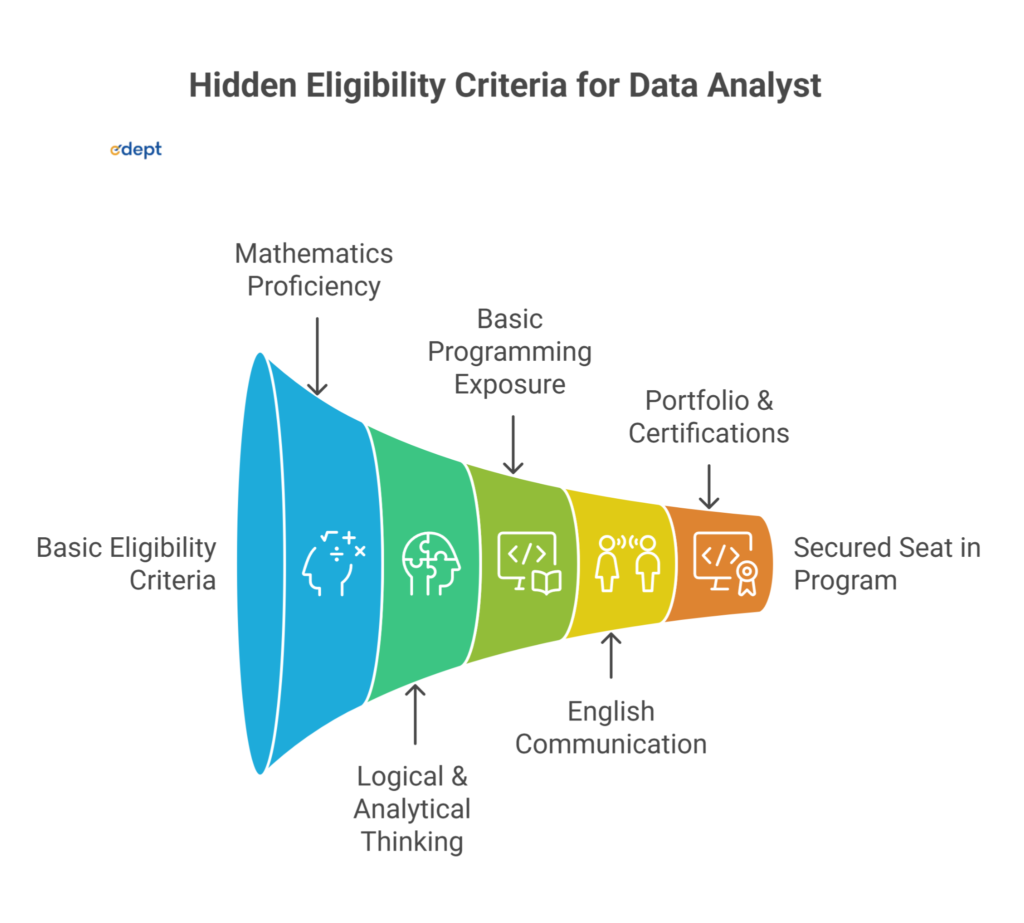
1. Mathematics Proficiency is Non-Negotiable
Colleges do mention that Mathematics is required in their admission criteria list for data analytics programs. At first glance, students think that if they are just proficient in basic mathematics, that will do, but the expectations are much higher. You are expected to have exposure and should be comfortable with calculus basics, probability, statistics, and linear algebra. In analytics programs, these concepts are essential as they are used in data modeling and analysis. Students with weak math foundations often struggle in the starting semester itself, making them lose confidence in their career choices. This is why colleges implement this to filter out ineligible students indirectly.
2. Logical & Analytical Thinking Test
Not all universities mention this, but the analytical ability of the students is always tested. They can either implement these tests through entrance exams, aptitude rounds, or interviews. Questions in logical and analytics thinking tests include logical reasoning, data interpretation, or case-based problem solving. This makes the goal for colleges clear: if you can think like an analyst now, you are eligible to be taught by us and become a future data analyst.
3. Basic Programming Exposure Helps
While this is not mandatory in official criteria asked by colleges, having exposure to Python basics, Excel, and SQL fundamentals is key to giving you a clear advantage over others. During the selection process, like interviews and entrance exams, students with even basic technical knowledge stand out because they are considered to be job-ready.
4. English Communication & Technical Understanding
As we talked about how programming exposure and technical knowledge help students stand out in the competition, data analytics is not just about numbers and code, it also consists of explaining insights. Colleges look for students who are proficient in skills like reading datasets, interpreting case studies, and communicating findings clearly. So if you have good English comprehension and basic report-writing skills, it will play a bigger role in your career than you can realize.
5. Portfolio & Certifications Advantage
This is the biggest hidden decision maker. Students with strong Kaggle projects, internships, online certifications, or even mini projects significantly increase their chance of being selected. These show practical interest and initiative, something colleges value very highly.
With what is shown on the official websites of universities, meeting basic eligibility gets your foot in the door, but these hidden factors decide whether you will actually secure your seat or not.
Entrance Exams for Data Analytics Courses
While merit-based admissions are applicable for many colleges, traditional entrance exams still play a crucial role in data analytics admission eligibility, especially for top universities. These entrance exams are designed to test a student’s analytical ability and mathematical skills to assess their problem-solving skills.
At the national level, exams like CUET are accepted by many central universities offering data analytics and related programs. There are also many state-level entrance exams, like Common Entrance Tests, for admissions in government and affiliated colleges.
Other than national and state-level entrance exams, many universities also have their own institution-level entrance exams. Private colleges may conduct aptitude tests or online assessments as part of the selection process. These tests are usually easier than national-level exams but still require good preparation.
Typical Exam Structure
Most entrance exams follow a similar pattern:
| SECTION | WEIGHTAGE |
| Mathematics | High |
| Logical Reasoning | Medium |
| English | Medium |
| Computer Awareness | Low-Medium |
Among all the mentioned sections, mathematics has the highest weight because it forms the core of data analytics. Logical reasoning tests your problem-solving ability, while English tests your comprehension and communication skills.
While taking into consideration the entrance tests, another critical aspect that needs to be considered is the cut-off marks. It won’t suffice by just appearing for the entrance test as one needs to score more than the cut-off marks to get admitted into the college. The top-ranking colleges usually have tough cut-offs.
Eligibility Difference by Course Type
Not all educational institutions have similar requirements for data analytics. It depends on the program and the level of expertise required to enroll in the courses. Knowing the distinction between these prerequisites would help guide you on which pathway to take.
B.Sc Data Analytics Eligibility
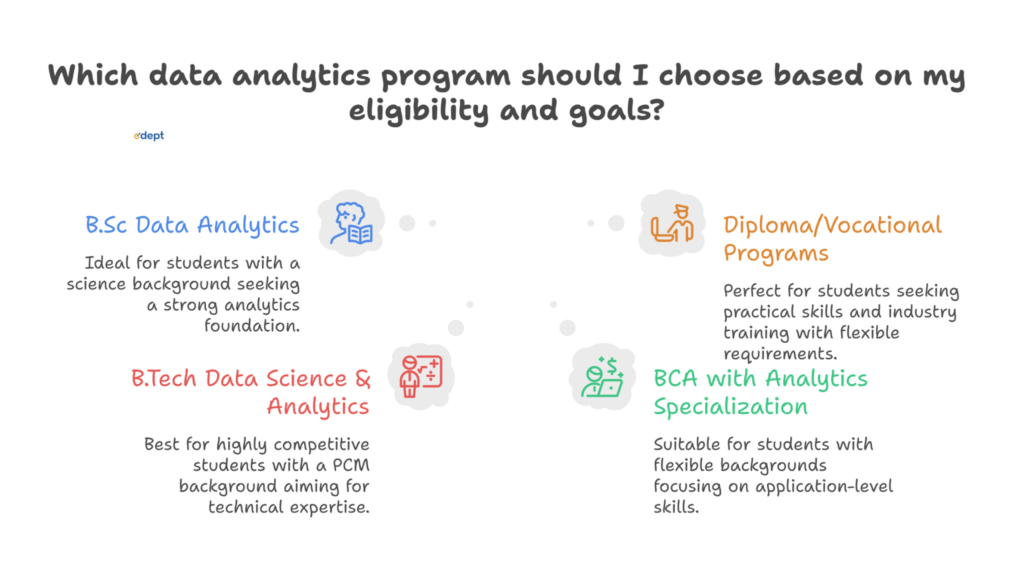
For B.Sc data analytics eligibility, colleges mostly prefer students from a science background. As obvious, mathematics is compulsory usually, as the course involves statistics and data interpretation. Admissions are typically merit-based, though some universities may conduct entrance exams. These programs are perfect for students looking to build a strong analytics foundation at good colleges.
B.Tech in Data Science & Analytics
This is considered the most competitive route. Students should have a PCM background in science, and admission is carried out through entrance exams like JEE or state-level entrance exams. The cut-off score is significantly higher compared to other programs. Btech in data science & analytics is considered more technical and includes key technical skills to master, like programming, algorithms, and machine learning.
BCA with Analytics Specialization
Admissions here are slightly more flexible in comparison to BTech. While mathematics is preferred, some colleges now allow students without a strict science background. In this course, the syllabus mainly consists of application-level skills like programming, databases, and business analytics.
Diploma/Vocational Programs
Diploma or vocational courses have the most flexible data analytics course requirements. For a diploma, students from any stream after 10+2 can apply. These diploma programs teach practical skills and industry training rather than deep theoretical concepts.
Common Mistakes Students Make During Admission
Many students fail to secure admission even if they meet the basic data analytics admission eligibility criteria due to some avoidable mistakes. One of the most common mistakes students make is ignoring mathematical preparation. Since analytics mainly relies on statistics and problem-solving, if you have weak math skills, it can become a major disadvantage for you.
Another mistake is applying without checking the subject requirements. Some students overlook whether mathematics is compulsory or whether a specific stream is required. This leads to rejection even if you are meeting the basic requirements.
Furthermore, there is also a misconception about the fact that coding is unnecessary. Although coding is never listed in any official requirements, candidates must be aware that it might become a part of an interview or assessment process. Moreover, many candidates skip preparation for aptitude tests, believing that their merits are enough.
Finally, missing documentation deadlines can cost you a seat. Avoiding these errors can significantly improve your chances of admission.
Skills That Improve Your Admissions Chances
Having met the basic data analytics admission eligibility is just the starting point. But if you have a good set of skills, you are more than eligible, and it will set you apart from other candidates. Colleges mainly prefer candidates who show practical readiness, not just academic scores. The rise in demand for data professionals also continues to grow in industries, creating this trend of learning new skills.
Some essential skills that can actually boost your chances include:
- Python: Basics of Python will do, it is widely used in data analytics and automation.
- Excel & Google Sheets: Creates a strong foundation for data handling and analysis.
- Data visualization tools: Tools like Power BI/Tableau help in presenting insights clearly.
- Basic SQL: Very important to work on databases.
- Statistics fundamentals: Core skill for understanding data patterns.
- Problem-solving mindset: Critical for analytical thinking.
These skills are essential to align with industry expectations. Recruiters actively search for candidates who can not only understand data but also work with tools and derive meaningful insights. Even basic exposure to these skills will show that you are serious about your career goal of being a data analyst and will land a good package if college lets you into their program.
How To Prepare If You Dont Meet Eligibiltiy Criteria
Chances are, some students won’t be able to meet the data analytics admission eligibility. If you are one of them, don’t be demotivated; it just means you need a smarter, structured approach. Many successful students take alternative paths and still build strong careers in data analytics.
First, start strengthening your basics through bridge courses in mathematics, especially topics like statistics and algebra. This will help you to meet both academic and practical expectations. Alongside this, take online Python certificates to build technical skills that colleges value during selection.
You can also look for enrolling in diploma programs before a degree. It will act as a stepping stone in your career goals and improve your profile. Some universities offer foundation year options, which are specifically designed for students who need to build core skills before entering a full program.
Consistency is key in following through with a plan that will improve your skills and prepare you for college. This will increase your chances of qualifying and being selected in subsequent admission processes.
Conclusion
Understanding data analytics admission eligibility is not just about meeting minimum marks, but more about meeting real expectations. Nowadays, colleges look beyond your percentages and focus more on whether a student has the mathematical foundation, logical thinking ability, and basic technical readiness required for the field.
Students who fail to prepare for these hidden requirements miss out on getting shortlisted. Skills like problem-solving, basic programming, and data understanding play a crucial role even during the admission stage.
The smartest approach to preparing for your data science entrance is to prepare both academically and practically. Build your fundamentals, develop relevant skills, and stay consistent in your preparation.
Following the mentioned steps and strategies religiously will not only increase your chances of admission, but also make you job-ready for real-world data analytics challenges. In the end, it all boils down to strong preparation aligned with actual expectations, which is what truly helps you succeed.
Related Links:
| Data Analytics courses for Students | Data Science Eligibility in India |
| What degree do i need to be Data Analyst? | Data Scientist to Data Analyst |