MBA admission for the 2026-2027 session requires a bachelor’s degree (minimum 50% marks) and valid scores from national/state exams like CAT, XAT,MAT or MAH CET.
Every year, thousands of students in India ask themselves one question: “How can I get into a good MBA programme?” Currently, this question is getting harder to answer every passing year. Competition is rising at an alarming rate, and the institutions are making the selection process harder every single year. This, in its entirety, is affecting the entire MBA admission procedure.
In 2027, only for the CAT examination, approximately 3 lakh to over 3.3 lakh candidates are expected to register, which shows how intense the race is becoming for the Top B schools. For this reason, early planning and goal setting are essential; it is not an option anymore. To secure a premier position in a good business programme, a proper and timely execution, as well as a clear understanding of the full enrolment landscape, is important.
Finally, the good news is that although the admission process is highly competitive, it has a structured, predictable format. Once you get a full understanding of the eligibility requirements, the admission process, the fees, and the time and date of the exams, everything becomes easy for you to plan and move forward. This guide will cover everything you need to know, from eligibility to fees, the exam timeline, and the admission process. It will help you plan your MBA journey with more clarity and confidence.
MBA Admissions 2027 – Key Highlights
Before you start knowing the details, here is a sneak peek of what the MBA admissions process looks like. MBA admissions normally include a mixture of entrance exams and college-based shortlisting, and in a few cases, direct admission also. If you want to target the Top B schools, then you need a bachelor’s degree and qualifying marks, along with performing well in GD and PI.
Important Dates & Timeline
The key important dates and timelines for MBA exams, such as CAT, XAT, NMAT, and SNAP, are normally scheduled from October 2026 to January 2027, with exam notifications usually starting from July/August 2026.
- The CAT exam 2026, for the 2027 sessions, is expected to be held on November 29, 2026. Registration usually opens on August 1, 2026.
- For XAT 2027, the exam is expected to be held on January 3, 2027. Registration usually opens mid-July 2026.
- MAT usually takes place 4 times a year, in Feb/March, May, September, and December 2027. Note: Official dates for 2027 are usually announced 2–3 months before each session by AIMA.
- For NMAT by GMAC, 2026-2027, the exam is expected to be between October and December. Registration usually starts from August 2026.
- For SNAP 2026-2027, the exam is likely to be held in December 2026, and registration usually starts from August to November.
- For CMAT 2027, the exam is likely to be held in January or February 2027, and registration usually starts from December to January.
Note: These dates are tentative and are based on the examination patterns.
Types of MBA Programs
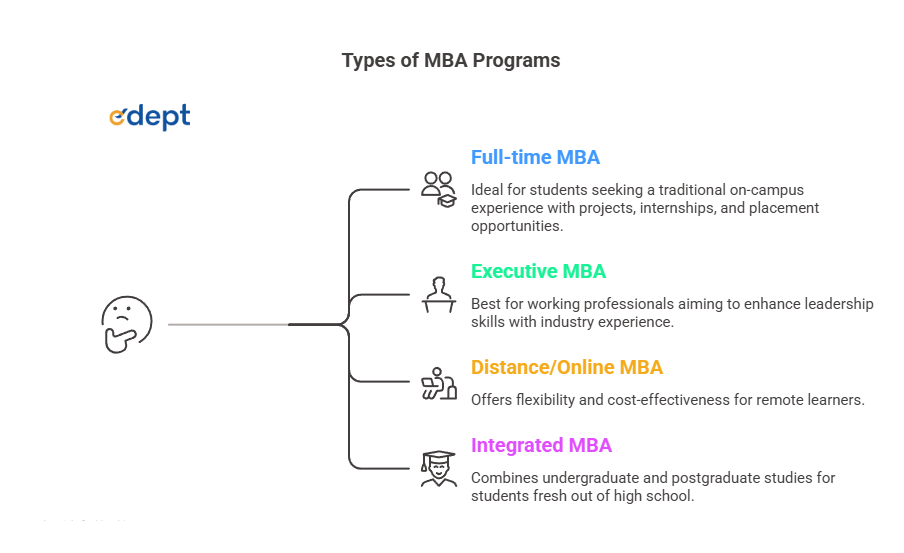
The MBA programmes in India are designed to meet the industry requirements and career growth of individuals. They are divided into full-time, part-time, executive, distance learning, and integrated programmes.
- The full-time MBA programme is a 2-year programme with traditional on-campus learning. It involves projects, internships, and placement opportunities.
- The executive program is mainly for working professionals who have industry experience and want to be equipped with more advanced leadership skills.
- The distance and online MBA is a flexible programme which offers remote opportunities and is cost-effective in nature.
- The integrated MBA is a 5-year programme combining graduation and postgraduation, which is beneficial for students who have just passed 12th grade.
Admission Pathways
The admission pathway for an MBA in India follows 2 paths: an entrance-based exam and direct admission. A direct entry often requires 50% marks on graduation, along with a personal interview. An entrance pathway includes examinations such as CAT, XAT, MAT, CMAT, etc., along with a GD and PI round. If you want to apply for top-tier business schools, then you should start preparing for CAT/XAT/GMAT at least 12 months before the examination. If you can’t handle too much exam pressure and don’t have much time for exam preparation, then you should start your research on the top PGDM programmes that offer you direct admission.
MBA Eligibility Criteria 2027
When you try to apply for an MBA, you must check the eligibility requirements first. They are mostly standard and consistent for almost all universities.
Educational Qualification
Candidates who want to apply for an MBA must have a bachelor’s degree in any discipline from a UGC-recognised university. A minimum of 50% marks is required (45% for the reserve category). The final-year students who are waiting for their results can also apply. Some of the top-tier premier institutions, such as IIMs and IITs, often set a higher percentage of marks, with a minimum CGPA of 6.5.
Entrance Exam Requirements
For MBA admissions 2027, some of the top entrance exams are CAT, XAT, CMAT, and MAT. A bachelor’s degree from a recognized institution in any field with a minimum of 50% marks, 45% for the reserved category, is required. Most MBA institutes, especially the top-tier ones, require a valid score of at least one well-recognized exam entrance test. CAT is widely accepted, and it is the most common exam, followed by XAT, CMAT, and MAT. The minimum passing marks vary from one institute to another. The top institutes require 99% in the CAT examination, and a few other private institutes accept students with a 60-89 percentile.
Work Experience
For a full-time MBA programme, work experience is not compulsory, but for an executive programme, a minimum of 3-5 years is required. Work experience can add value to your profile and also help you during your personal interview round.
MBA Entrance Exams 2027
The MBA entrance exam acts as the primary gateway to your MBA dream. They are perfectly structured to test your analytical, reasoning, and quantitative skills and knowledge. Let’s discuss some of the important exams.
National-Level Exams
Some of the most important MBA national-level entrance exams include CAT, XAT, CMAT, NMAT, and MAT. CAT, which is the common admission test, is conducted by IIM every year, usually in the month of November. It is the most competitive and widely accepted entrance test in India. XAT is the Xavier Aptitude Test. It is usually conducted by the XLRI group in January. This exam includes a specific decision-making section, which is very unique.
Another important exam is CMAT, the Common Management Admission Test, which is usually conducted by the AICTE for government-supported MBA programmes and is held in February or March. NMAT by GMAC allows three attempts to perform the examination. The MAT management aptitude test is generally held 4 times a year, and it is widely accepted by the private institutes.
State-Level MBA Entrance Exams
Some of the top state-level MBA exams include MAH MBA CET, TANCET, and KMAT. These exams are very important for state-specific and private institute admissions. The MAH MBA CET is conducted by the Maharashtra State. The examination is usually held in March or April. TANCET is the Tamil Nadu Common Entrance Test and is usually held in March. KMAT is the Karnataka Management Aptitude Test. All these exams have lower competition than the CAT, and you have a better success rate here.
MBA Exam Preparation Strategy
To crack an MBA exam successfully, you need to set up a 6-9 month timeline and focus on building a foundation, followed by complete syllabus coverage and, finally, taking mock exams. The core syllabus includes aptitude, logical reasoning, data interpretation, and verbal and reading-writing capabilities. In the first one to two months, start building your foundation and understand the pattern and syllabus of the exam. In the next three to five months, try to complete 100 per cent of your syllabus and start checking your speed and accuracy. The next six to seven months start with taking mock tests and maintaining a timer. In the last month, revise everything thoroughly and start focusing on time management.
MBA Fees in India
The MBA fees in India vary greatly, depending on the type of institution, location, and placement assistance. This is a very important thing that a student should follow before applying for any programme. MBA fees in India usually range between 2 lakhs and over 30 lakhs. Some government and public institutes offer affordable fees, but the top-tier and premier universities charge a lump sum of fees, almost 20 lakhs, for the complete course.
MBA Government Colleges Fees
Some of the top government colleges in India, such as IIMs, offer premier education and placement, but the fees are generally high and fall between 20 and 27 lakhs, whereas low-cost alternatives such as FMS Delhi and IITs offer affordable fees within 2-15 lakhs.
| Colleges | Approximate Fees |
| Faculty of Management -Delhi | ₹ 2 Lakhs |
| Jamnalal Bajaj Institute of Management Studies (JBIMS), Mumbai | ₹2–3 Lakhs |
| IIT Kanpur (DIME) | ₹6.4 Lakhs |
| Department of Management Studies, IIT Delhi | ₹8–12 Lakhs |
| SJMSOM, IIT Bombay | ₹11–15 Lakhs |
Top-Tier MBA Colleges in India
| Colleges | Approximate Fees |
| IIM Bangalore (IIMB) | ₹24–26 Lakhs |
| IIM Calcutta (IIMC) | ₹25–27 Lakhs |
| IIM Ahmedabad (IIMA) | ₹27.5 Lakhs |
| IIM Lucknow (IIML) | ₹20.7 Lakhs |
| IIM Kozhikode (IIMK) | ₹20.5–22.5 Lakhs |
MBA Private Colleges Fees
The private colleges’ MBA fees in India usually range between 8 and 25 lakhs for top-tier premier colleges, and for some elite programmes, they can also exceed 30 lakhs. Some of the most important and famous private institutions are:
| Colleges | Approximate Fees |
| ISB Hyderabad | ₹37–₹40 Lakh |
| XLRI Jamshedpur | ₹24–₹59 Lakh |
| MDI Gurgaon | ₹16–₹26 Lakh |
| SPJIMR Mumbai | ₹14.5–₹29 Lakh |
| SIBM Pune | ₹13.5–₹25 Lakh |
| NMIMS Mumbai | ₹13–₹25 Lakh |
| Amity University (Noida) | ₹6–₹15 Lakh |
Additional Costs
The students should also keep in mind the additional tuition expenses and plan accordingly. The hostel and accommodation costs in most of the institutes can add 1 to 2 lakh per year. Laptops, internet, travel, and study materials also fall under additional expenses. In some colleges, they charge exam registration fees separately. These are all hidden costs, and all students should keep this in mind before applying for an MBA programme
MBA Application Process 2027
An MBA application process starts with planning and preparing for the examination, then submitting an online application to various institutes and top-tier universities, and then clearing various multi-stage parts of the exam selection procedure, including GD, PI, etc.
Step-by-Step Application Process
- First, you need to shortlist which colleges you want to target. Do complete research on the eligibility, fees, additional expenses, and placement record history. Then decide which MBA exam matches your target college.
- Now, start registering for the examinations (CAT, XAT, CMAT, MAT, etc.) that are required to achieve your goal. Do not miss the deadline for any exam; be very careful.
- Start preparing for the examination with full determination, and finally appear for your exam with full confidence and give your best.
- Check your exam result percentage. This is the first step that will help you to get shortlisted
- Now start filling out the various college application forms that you want to apply for. Most of the colleges have their own admission portal.
- Start preparing for the GD/PI rounds. Once you are shortlisted, you will be called for the GD and PI rounds. These are very important for you to get selected
- If you are selected, you will receive an admission letter very soon. Go through it in detail, check the fees, and compare it with other colleges you have applied for. Choose very wisely.
- Once you are sure and have taken your final decision, submit your fees and book your seat in your dream MBA college
- Complete all the documentation procedures and finally be ready for your onboarding.
Documents Required For MBA Admissions
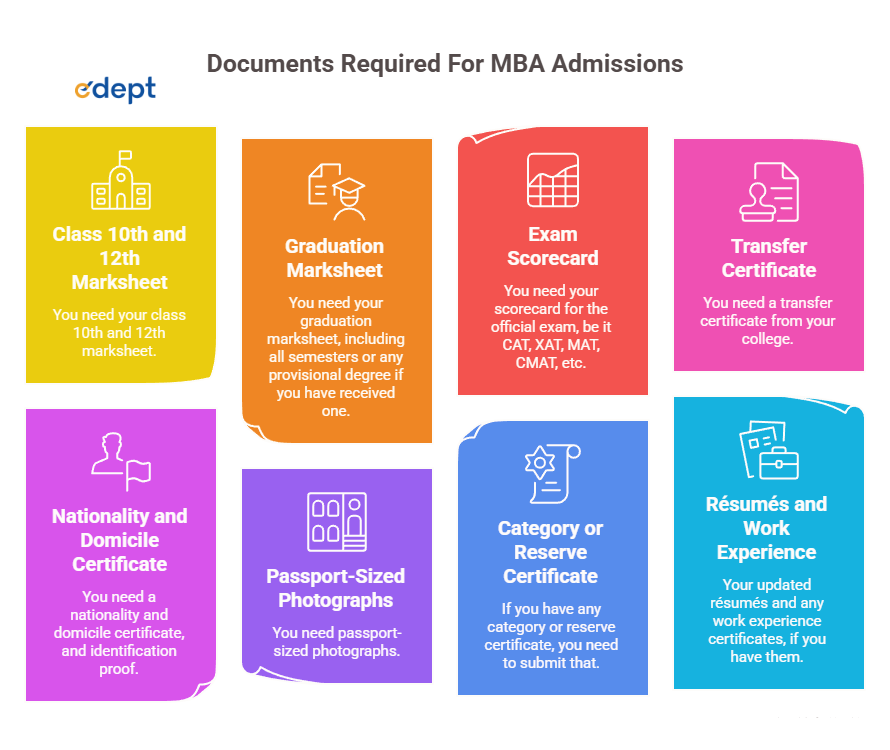
Most of the colleges ask for the following documents:
- You need your class 10th and 12th marksheet
- You need your graduation marksheet, including all semesters or any provisional degree if you have received one
- You need your scorecard for the official exam, be it CAT, XAT, MAT, CMAT, etc.
- You need a transfer certificate from your college
- You need a nationality and domicile certificate, and identification proof
- You need passport-sized photographs
- If you have any category or reserve certificate, you need to submit that
- Your updated résumés and any work experience certificates, if you have them
MBA Admission Process Tips
A few small things you should always keep in mind before you start applying.
- You should not apply to every college. Do your research in a very detailed manner, and then decide which colleges you genuinely want to apply to. A well-researched 8-9 college list is much more effective.
- You should not miss any deadline for any application. These timelines and deadlines are really important. You should always research all these in advance.
- You should start preparing for your GD and PI rounds, even before results are declared, because once results are declared, you won’t get much time for preparation
- You should keep all your documents in a very organized way in one folder
MBA Admission Without Entrance Exams
MBA admission in India is not only based on competitive exams. Some aspirants want to earn an MBA, but they don’t have enough time to prepare for such competitive exams, or they fail to score well in the competitive exams. Various universities approved by the AICTE offer MBA admissions based on applicants’ graduation marks, a personal interview, and sometimes work experience.
Direct Admission Process
A direct admission process for an MBA is widely available in India. They focus on academic percentages and personal interview rounds. You need to score a minimum of 50-60% (it may vary according to the institutes) of marks in graduation to apply for such MBA degrees. Before you want to apply for an MBA directly, you should do complete research on the colleges which provide such degrees. Start applying through college websites and start preparing for your personal interview and GD rounds; some colleges also include a written ability test to check your abilities.
Colleges Offering Direct MBA
Several colleges in India offer direct admission for an MBA degree. Some of the top universities include:
- MIT World Peace University (MIT-WPU), Pune
- UPES School of Business, Dehradun
- O.P. Jindal Global University, Sonipat
- Jaipuria Institute of Management, Noida/Jaipur
- Lovely Professional University (LPU), Punjab
- SRM School of Management, Chennai
- SGT University, Haryana
Pros & Cons
Some of the advantages of direct admission to an MBA are the following:
- You don’t need to prepare for any competitive exam, and it saves a lot of your time
- The application process is very simple and fast here
- It is easily accessible to candidates who have failed to clear any entrance exam or have missed any exam registration deadline.
- It is very beneficial for working professionals who do not have much time to prepare for an entrance exam.
Some of the disadvantages of direct admission to an MBA are the following:
- You will not be able to get admission to top-tier and elite business schools
- Placement assistance may vary a bit depending on the institutions that provide direct admission.
- Some companies favour candidates with an MBA degree from a reputed top-tier college instead of colleges that provide direct admission without any entrance test.
Specializations in MBA
Choosing the correct specialization is as important as choosing the right college. Your specialization should depend on three things: your strength, your scope of interest, and what the current market demand is. You should always align your specialization with your goal and the target industry you want to work for.
Popular Specializations
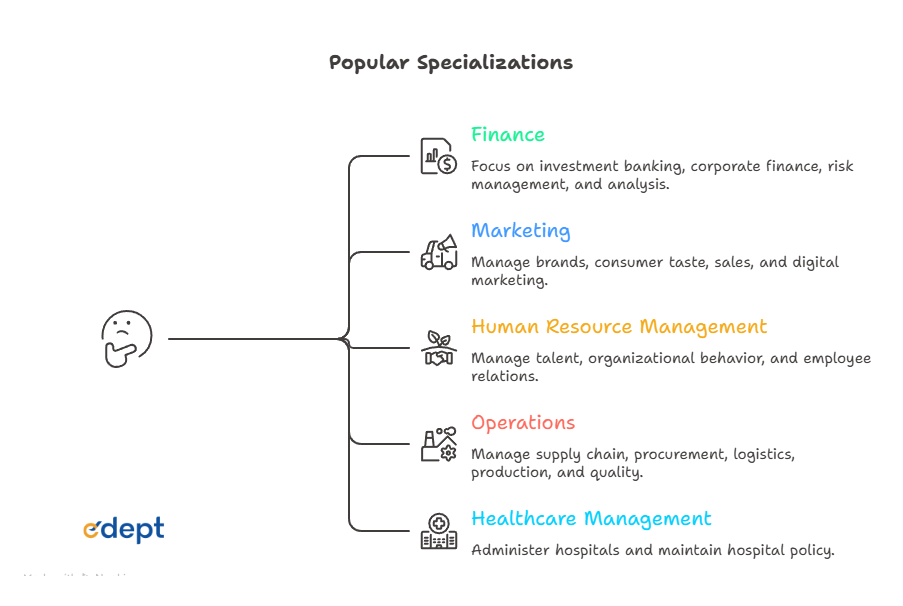
Some of the most popular specializations are the following:
- Finance, which includes investment banking, corporate finance, risk management, and analysis.
- Marketing, which includes managing brands, consumer taste and behaviour, sales, and digital marketing
- Human resource management, which includes managing talent, maintaining organizational behaviour, and professional employee relations
- Operations, which include supply chain management, procurement, and logistics; production planning; and controlling quality
- Healthcare management, which includes administering hospitals, maintaining hospital policy,
Emerging Specializations
Some of the emerging specialization in MBA include the following:
- Business analytics and data science
- Digital marketing and communication
- Digital Finance
- Entrepreneurship and innovation
- Product management
How to Choose a Specialization
Choosing the right specialization is very important when you want to earn an MBA degree. Your specialization should depend on three things: your strength, your scope of interest, and what the current market demand is. You should align your goals, skills, and interests with the current industry demand and your future career path. You should start your research on what is trending in the industry, then you should decide how it can align with your own skills and interests; then you should check what specializations are available in your selected colleges and the placement opportunities, and finally, you should go for your dream career.
MBA Placements & Salary Trends
The most important reason a candidate pursues a degree in MBA is because of the placement assistance, but the problem is salary is not a fixed number after completion. Salary depends on the market condition, the reputation of the college, your job profile quality, and your specialization. A good MBA programme from a reputed and well-recognised institute can change your earning potential.
Average Salary Range
The top-tier and elite institutes offer an average salary between ₹25 and ₹40 LPA, whereas an MBA degree from a tier 2 or tier 3 institute offers an average salary from ₹8 to ₹15 LPA. The entry-level salary usually starts from 5 to 8 lakhs, whereas with 5 years experience you can earn more than 15 lakhs. With more than 10 years of experience, your salary can exceed 25 lakhs.
Top Recruiters
Some of the top companies hiring MBA professionals in India are:
- McKinsey & Company
- Boston Consulting Group (BCG),
- Accenture
- Deloitte
- Amazon
- Microsoft
- Flipkart
- Cognizant
- Wipro,
- IBM,
- JP Morgan Chase
- Goldman Sachs
- ICICI Bank,
- HDFC Bank,
- PwC.
- Hindustan Unilever (HUL),
- Procter & Gamble (P&G),
- Nestlé, ITC,
- Reliance Retail.
Factors Affecting Salary
The factors that affect the MBA salary in India are:
- The reputation of the institution
- The specialization you have selected for your program
- Your prior work experience
- The market conditions and various sectors of the industries
- The geographical location
- Your skills and certifications
- How well you have performed in your placement interview
- The role and the specific company you are giving your interview for.
Tips to Secure MBA Admission in 2027
If you want to secure admission to a top-tier college for your MBA dream, then you should start thinking strategically and plan accordingly. Your goal should be very clear, and you should give 100 per cent to achieve your goal.
Start Early Preparation
The first thing is that you should start preparing early. You should not wait till the last minute. If you start early, you will get a lot of time for revision; you can learn everything in detail and appear for many mock tests before the final exam. This will help you to improve your weak points without any last-minute preparation and pressure. With a structured and daily planned schedule, you should start your exam preparation.
Choose Colleges Wisely
You should choose the colleges by doing very detailed research. Do not just rely on social media reviews. Check every single detail, such as
- How is the placement support?
- How much industry exposure will you get from the programme?
- The faculty quality
- The fee structure
- The lab structures
- Is the curriculum industry-focused?
- Are any industry certifications included in the programme
- Is the college affiliated to a recognised university (UGC approved)
Build a Strong Profile
If your dream is to crack an entrance exam and pursue an MBA degree, you should not wait till the time comes when you will actually appear for the interview, because it will be very late by then. Interviewers not only check your entrance exam score; they look into every detail, such as your class 10 marks, your class 12 performance, what extracurricular activities you were involved in, if you have taken part in any community activities, if you have completed any internships, and do you have any certifications?. All these are very important for building a strong profile and contributing to your GD and PI rounds.
Conclusion
MBA admissions in India are becoming very competitive, but those who start early planning can surely achieve their goal. The MBA journey is a process; those candidates who are sure about their target colleges, which exam they should apply for and how they should start preparing for that, can easily crack an MBA interview.
Candidates who want to apply for an MBA must have a bachelor’s degree in any discipline from a UGC-recognised university. A minimum of 50% marks is required (45% for the reserve category). The final-year students who are waiting for their results can also apply. Some of the top-tier premier institutions, such as IIMs and IITs, often set a higher percentage of marks, with a minimum CGPA of 6.5.
The MBA fees in India vary greatly, depending on the type of institution, location, and placement assistance. This is a very important thing that a student should follow before applying for any programme. MBA fees in India usually range between 2 lakhs and over 30 lakhs. Some government and public institutes offer affordable fees, but the top-tier and premier universities charge a lump sum of fees, almost 20 lakhs, for the complete course.
The first thing you should do is start your planning; if you plan strategically, then you can easily clear any entrance exam. First, start doing complete research on which colleges you want to apply to, what specialization you want to choose, and what exams you want to appear for. After finalizing everything, create a structured exam schedule and start your preparation. An MBA is easily achievable for someone who is well-disciplined, a good planner and has a clear goal.