Wondering Will AI Replace Data Analysts? AI can automate repetitive tasks, but skilled data analysts will always stay in demand as they are essential for interpretation, strategy, and decision-making. Explore why a career in data analytics is future-proof and how it can help you stay relevant with industry-ready skills.
The question “Will AI replace data analysts? is evolving more relevant nowadays as artificial intelligence is digging into transforming industries worldwide. To answer your question in short, we can say that no, AI will not completely replace data analysts, but it can significantly reshape and modify their roles. At the same time, AI-driven tools can automate repetitive tasks such as data cleansing, processing, and pattern recognition, human judgment, domain expertise, and critical thinking that remain irreplaceable.
In today’s AI-powered world, data analysts who acclimate by integrating their analytical skills with AI credentials will thrive. To understand why, let’s dive into how AI is impacting data analysis, what it can still do for the betterment, what it can’t do, and how future analysts can prepare themselves for this shift.
Kickstart Your Career in Data Analytics
Train with edept and gain hands-on skills to become a job-ready data analyst.
Understanding the Role of a Data Analyst
A data analyst plays a crucial role in organizations by converting raw data into actionable understandings. The responsibilities of a data analyst have been listed below:
- Collection, cleansing, and preparation of data sets from numerous references, so that there is enough precision.
- Using statistical methods and visualization to identify the patterns in data and determine potential trends.
- Translation of complicated numerical data into business strategies that help in supporting business development.
- Help in communicating findings to stakeholders and internal teams for the decision-making process in such a way that it becomes easy to understand.
In short, data analysts bridge the gap between complex data and practical business results. They not only have the capability to crunch the numbers but also interpret what these numbers when concerning of the ultimate goal of the company.
Start Your Data Analytics Career With Confidence
Master in-demand analytics skills and stay future-ready with Edept’s industry-aligned training.
The Rise of AI in Data Analytics
Artificial intelligence has become a game-changer in data analytics. What once took the analysts hours or even hours and days to process can now be done in minutes using the advanced AI-powered tools. The AI in data analytics is responsible for automating repetitive jobs to finding patterns that are hidden deep within massive datasets. AI is reshaping how organizations understand and use data.
Natural language processing (NLP), machine learning, algorithms, and AI-powered automation tools can –
- Analyse and process an immense number of data sets at lightning speed and more accurately than ever before.
- Use machine learning models extensively to predict future trends.
- Help in the generation of reports and visualizations automatically, which saves time for analysts.
- Provide real-time insights that help companies act quickly and efficiently to stay competitive.
Despite all the powerful capabilities, artificial intelligence is here to replace human analysts; it is here to enhance what they can do. By taking over the heavy lifting, AI allows the data professionals to concentrate on what truly matters. Interpretation of results, integrating the right questions, and interpreting meaningful business decisions.
How AI Is Changing Data Analysis?
AI isn’t just speeding up the data analysis field, but it’s completely transforming how it is done. Traditionally speaking, data analysts spend a high amount of time cleaning data, running repetitive calculations, and building reports. Now, AI-driven tools are stepping in to manage those consuming tasks, releasing analysis to focus on deeper insights and strategy.
Here is how AI is making a difference in the data analysis field:
- Automating the basics – Certain tasks like data cleaning, sorting, and formatting can now be performed by AI-powered software with minimal human effort.
- Smarter pattern recognition – Systems conducted by artificial intelligence can scan millions of data points to find hidden patterns that might take humans much longer to uncover.
- Prediction of outcomes – When they involve machine learning, organisations can now forecast sales, market shifts, and customer behaviour accurately.
- Enhanced visualisation – Creation of a real-time AI-powered dashboard helps dig out visual insights,
Now, what’s exciting is that the AI isn’t replacing analytics; it is advancing their role. Instead of spending time on repetitious work, data analytics can now focus on strategy and applying human judgment where it actually counts.
Become an AI-Empowered Data Analyst
Build strong analytical and technical skills to stand out in an AI-driven world.
What AI Still Can’t Do?
Despite all the strengths that artificial intelligence has, it still cannot duplicate human emotions, which is crucial for impactful data-driven findings. Some of the limitations that AI faces are:
- Contextual understanding – AI cannot fully capture the cultural, emotional, or business context that humans can offer.
- Critical thinking – Artificial Intelligence can induce results, but cannot question assumptions or validate exceptions ike a human analyst.
- Creativity and innovation – This requires recognizing new opportunities or unconventional resolutions, which is still a uniquely human skill.
AI vs. Human Data Analysts: Competition or Collaboration
Instead of presuming the artificial intelligence as a competition, it is better to take it ot as a collaborative partner. To figure out AI vs. Human Data Analysts, let’s see if AI is a competition or a collaboration.
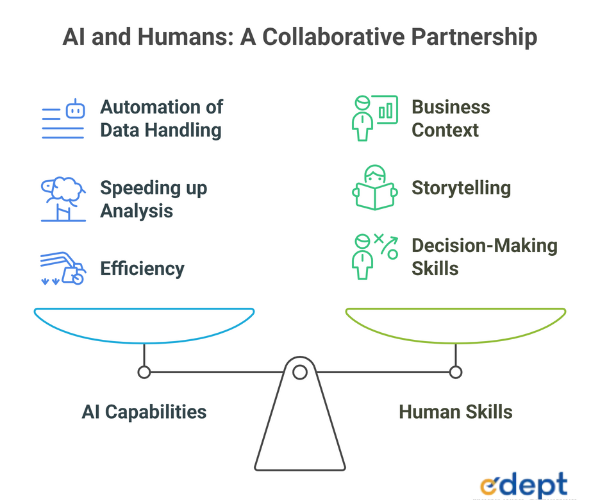
- AI capabilities include automation of data handling at a large scale and speeding up analysis.
- Human data analytics brings business context, story telling and decision-making skills handy.
When together, a combination of AI and humans creates a hybrid model where AI backs up efficiency, and the human data analysts add definition.
Which Data Analytics Tasks Will Be Automated — and Which Require Humans
AI is rapidly automating the majority of technical and repetitive parts of data analysis, which include integration, data cleaning, report generation, and basic identification of trends. These procedures are faster and much more efficient, and accurate when handled by AI-driven tools. Despite AI shaping the entire procedure, human touch remains essential for areas such as understanding business context, interpreting results, making strategic decisions, and solving complex problems. Critical thinking, creativity, and ethical reasoning are some of the essential skills that human data analysts bring to the table, which AI can’t replace, apart from processing data. The future lies in balancing automation with human expertise for smarter and meaningful perspicuity.
Best Practices for Integrating AI Into Data Analysis
One of the misconceptions we encounter is that incorporating AI into data analysis is all about using new tools. However, it is all about redefining how humans and technology function together. When both of them amalgamate, AI can make the analysis faster, smarter, and more accurate while allowing analysts to focus on strategy and creativity.
The goal is to build a partnership between AI and human intelligence by ensuring that insights are both contextual and backed by data. Below are some of he best practices to follow:
- Commitment to Lifelong Learning Opportunities – You need to stay updated with the latest modifications in AI and analytics to remain adaptable and future-ready.
- Collaborate and Don’t Compete – One of the things that needs to be addressed is to treat AI as an assistant that can enhance your efficiency and not a replacement for human judgment.
- Verify results created by AI – It is important that you make a habit of double-checking AI-generated reports for inaccuracies.
- Leveraging AI Tools – Some of the user platforms, like Power BI, Python-based AI tools, and Tableau, are used for automation and precision.
Therefore, when AI and human insights are balanced well, they can create a data ecosystem that’s both intelligent and efficient.
Skills to Develop to Stay Relevant
In an AI-driven data analytics world, simply knowing how to analyze data isn’t enough. As a human analyst, you must know how to handle AI tools, manage data ethics, and interpret complex models responsibly. To develop a blend of technical and soft skills, you will help professionals to stay relevant and indispensable.
Focus on these key skills:
- Statistical and Mathematical Skills need to be strengthened, along with the foundation to validate AI results.
- AI and Machine Learning Fundamentals: Learn how algorithms work and where they apply.
- Data Visualisation: To present insights in a more compelling way that is easy to understand.
- Domain Expertise: To structure a deep understanding and knowledge in your industry to apply in a real-world context.
When you master these, the analysts can transition from executing reports to influencing business strategy and innovation.
Apply for Post Graduate Program in Business Analytics at Ramaiah Institute of Management, powered by edept!
AI’s Impact on Data Analytics Jobs and Career Outlook
Well, AI isn’t replacing data analysts – it is reshaping the careers of the professionals. Other than eliminating jobs, AI is devising new opportunities for professionals who work in a hybrid setup and understand both data and intelligent systems.
- New Roles Emerging: Data analyst job roles, such as AI business analyst, data scientist, and machine learning specialists, are in high demand all across the world. As per the U.S. Bureau of Labor Statistics, projections show a drastic growth in database administrators, which is expected to grow by approximately 8.2% from 2023 to 2033, and database architects, by 10.8%, both more rapid than average job growth.
- Evolving Skill Requirements: A thorough knowledge of AI tools and ethical data practices is a must-have. As per Noble Desktop cites, the job roles are about to increase by 25% from 2020 to 2030, with over 10,000 openings in metropolitan areas.
- Cross-Functional Partnership: The analysts work closely with data scientists, data engineers, and artificial intelligence teams.
In short, AI isn’t ending the profession in data analytics; it is all about opening the door to a smarter and more dynamic future for those candidates willing to grow.
Challenges and Opportunities with AI in Data Analysis
The adoption of artificial intelligence in data analytics comes with both risks and opportunities. While automation and machine learning help in improving efficiency, they also introduce ethical and technical threats that can only be managed by humans. It is crucial to steer this proportion thoughtfully.
Let’s check the challenges and opportunities:
Challenges
- There is a risk of job displacement for those who don’t upskill.
- Overdependence on automation often leads to lesser critical thinking.
- There are often data preferences and ethical issues within the AI models.
Oppurtunities
- Data analytics functioned with the help of AI is faster and more accurate in the decision-making process.
- This enhances forecasting and cost efficiency.
- There is a rising demand for professionals who integrate human insights and artificial intelligence.
As a climax, we can say that those who view AI as a growth pattern rather than a challenge can easily get their hands on endless possibilities to lead this evolving terrain.
Apply for B.Sc in Data Science by Shree LR Tiwari Degree College powered by edept!
The Future of Data Analysts in an AI-Driven World
Now, let’s take a look at what the future of data analytics with AI is all about. It’s not about replacement but about evolution. As artificial intelligence becomes a powerful partner in handling technical tasks, human analysts will be centered in areas that require empathy, strategy, and creativity. Let’s check the future of data analysts in an AI-driven world:
- AI handles the repetitive work. It cleanses, organises, and processes the data efficiently.
- Humans cause strategic insights. They are responsible for applying critical thinking, creativity to data outcomes and ethics.
- It is essential to have continuous learning. Those candidates who keep on developing will be directed to the next surge of analytics innovation.
- The new norm is innovation when we look at the upcoming time of data analytics backed by AI.
Contextually, the most successful data analytics will be those that harmonize technology and human interpretation to shape impactful and data-driven stories.
Enroll in edept’s AI-driven data analytics courses
Are you interested in enrolling in data analytics courses? If you are wondering how to build a future-proof career in this era of AI, the answer lies in upskilling with the right course. At edept, we specialise in bridging the gap between AI-powered processes and traditional data analytics. Our AI-driven data analytics courses are developed to assist candidates in progressing beyond basic data handling into advanced analytics, AI integration, and predictive modeling.
Why Choose edept’s Data Analytics Programs?
- The course curriculum integrates the latest tools such as R, Python, Tableau, SQL, Power BI, and AI-driven platforms.
- Hands-on experience with real-world projects and case studies.
- Industry experts as mentors working in data science, AI, and several other areas of data analysis.
- Flexible learning paths and 100% placement assistance.
Apply for B.Tech in Business Analytics & Computer Science at Rishihood University powered by edept!
Will AI Replace Data Analysts?
So, the answer to this question, whether AI will replace data analytics or not, is No. But it will transform the professional on a different level. AI-driven tools will handle repetitive heavy data sets. On the other hand, human analytics will always be required for decision-making, contextual purposes, and building a constructive strategy. The real future lies in humans collaborating with AI to unlock the full potential of data. Data analysts can ensure they remain critical in this evolving field by upskilling and harnessing AI-powered tools.
Check,
FAQs
- Will AI replace data analysts completely?
No, AI can’t replace human data analysts. They can automate repetitive tasks, but domain knowledge, human judgment, and communication skills are irreplaceable.
- What parts of a data analyst’s job can AI automate?
Artificial intelligence can automate a substantial portion of a data analyst’s job that includes data collection, pattern recognition, cleaning, and reporting.
- How can data analysts use artificial intelligence?
Data analysts can utilise AI-powered tools to acquire insights, have faster access to real-time dashboards, and employ predictive analytics. These tools enhance data interpretation and decision-making processes by enabling analysts to find trends and patterns efficiently, eventually driving better results and techniques based on convenient and accurate details.
- Which data analytics tasks still require humans?
Some of the tasks of data analytics that still require humans include managing bias, interpreting ambiguous results, strategic decision-making, and applying business context.
- What are the challenges of using AI in data analytics?
Some of the challenges that AI in data analytics face are ethical issues, bias in algorithms, national security risks, and the constant requirement for continuous upskilling.