Clinical nursing involves providing direct, specialized patient care, monitoring health conditions, administering treatments, and educating patients in various settings like hospitals, clinics, and home care. Daily tasks include taking vital signs, managing care plans, and assisting in procedures
One of the most important pillars of modern healthcare is Clinical nursing. So what is clinical nursing? Most people don’t have a clear idea of what work in clinical nursing occupations looks like. When people ask what clinical nursing is, they are often referring to nursing care provided to patients in hospitals and clinics.
Unlike management and administration-focused roles, clinical nursing focuses on bedside care and real-time patient interaction. Tasks like checking vitals and organising medication routines, with supporting patients emotionally, clinical nurses are involved at every stage of the care process.
With the growth of healthcare infrastructure worldwide, clinical nursing is becoming one of the most stable and respected career choices. Bloom in medical technology and expanding healthcare access is creating opportunities for skilled clinical nurses to deliver patient care. When talking about healthcare, most of the people talk about doctors and big hospitals, but clinical nurses play a key role in patient care and are respected equally.
What is Clinical Nursing?
Clinical nursing is referred to as the practice of providing direct, hands-on care to patients in healthcare settings. The primary focus of clinical nurses lies in assessing patient conditions, delivering treatments, and monitoring the recovery of patients with safety.
Clinical nursing emphasizes real-time patient care instead of policy making, staffing, or hospital operations, unlike administrative or managerial nursing roles. Clinical nurses work closely with the doctors, therapists, and other healthcare professionals, using care plans and responding to the needs of patients in real time.
Read more: Types of Nursing Courses You Can Pursue After 12th Grade
Daily Tasks of a Clinical Nurse
Clinical nursing’s daily duty revolves around a wide range of responsibilities that support patient health and recovery.
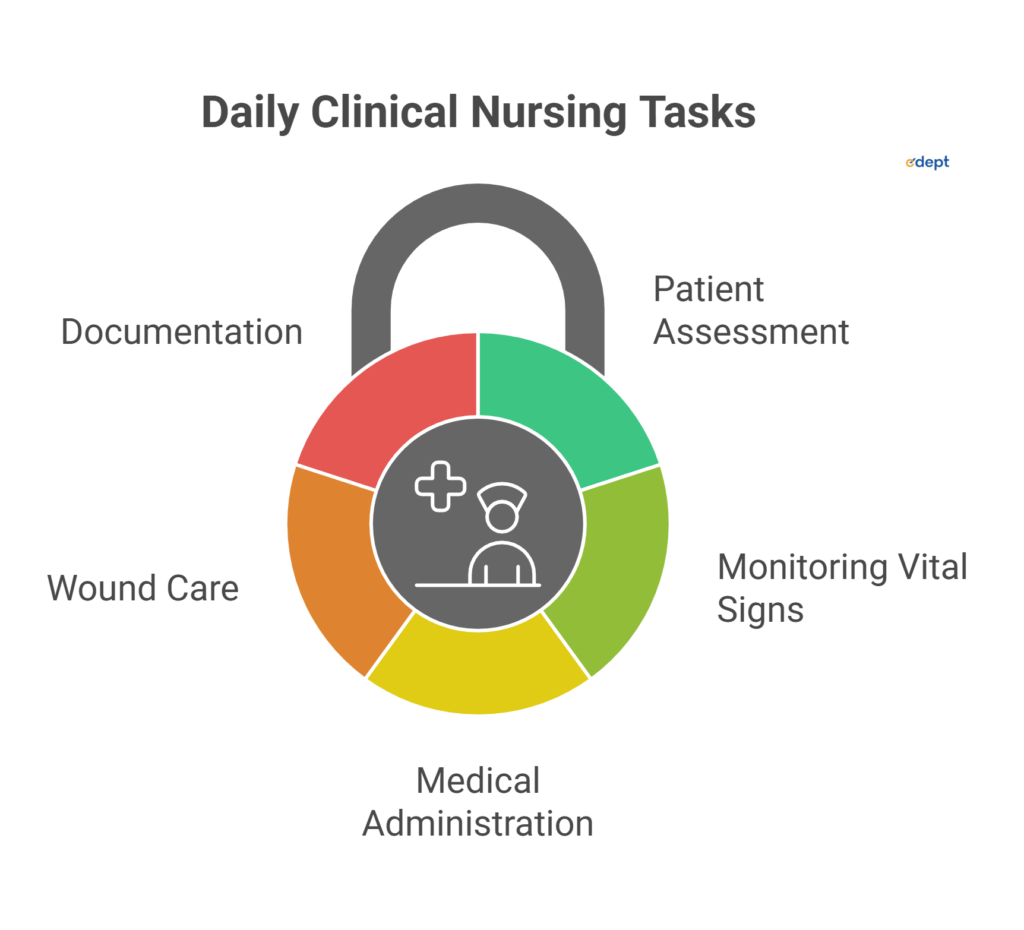
Multiple daily tasks of nurses revolve around the following operations:
- Patient assessment: Evaluation of patient conditions, symptoms, and medical history.
- Monitoring vital signs: Checking the vitals of patients, such as blood pressure, temperature, heart rate, and oxygen levels.
- Medical administration: Providing prescribed medications to the patients.
- Wound care: Cleaning and monitoring of the wounds to prevent infections.
- Documentation: Having the data of patients documented for their care.
These are the daily responsibilities of a clinical nurse to ensure high-quality patient care with good observations and treatment plans.
Types of Clinical Nursing Roles
The roles of a clinical nurse vary based on specializations and patient population. Some of them include:
Staff Nurse
Providing patients with general care across hospital wards. The primary contact person is the staff nurse. The staff nurse is of utmost importance when it comes to the coordination of services.
ICU Nurse
For critical conditions with intensive monitoring. For effective intensive care unit nursing, good clinical assessment and decision skills are required to respond to emergencies. The nurse working in such areas needs good mental strength, e.g., to remain calm and precise in critical conditions involving complex patient health conditions.
Pediatric nurse
Care of infants, children, and adolescents. They monitor the growth and administer vaccinations to children with long-term support for chronic conditions.
Emergency Nurse
Proficiently works in fast-paced emergency departments, handling urgent cases. This role requires quick decision-making, adaptability, and the ability to work under pressure. They access patients who need immediate care, like trauma management, and priority is given based on severity.
Each of the following roles demands specific skills in its domain but shares the same foundation of patient-centred care.
Skills Required for Clinical Nursing
The profession of clinical nursing is a very demanding profession that requires nurses to have a combination of skills, both technically and socially. Indeed, a clinical environment is a place that a clinical nurse must be armed to handle.
Clinical Skills
Strong clinical skills are the main foundation of effective nursing practice. Clinical nurses must be well-equipped with skills like patient assessment, medication administration, wound care, and the use of medical equipment. As we see advancements in healthcare, clinical nurses must also be equipped with new treatment methods and protocols through continuous learning and training.
Communication
Good communication skills come in handy to emotionally support the patients and interact with the doctors in providing them with the reports of the patients. Clear and effective communication reduces misunderstandings and improves patient satisfaction with coordinated care delivery.
Critical Thinking
Clinical nurses should have critical thinking in their skill pocket to make quick decisions in high-pressure situations. This enables the nurses to observe symptoms that a patient has, thus enabling them to act promptly. Whether it be reacting to sudden changes in condition or prioritizing care in emergencies, this skill helps ensure patient safety and effective treatment outcomes.
Emotional Intelligence
For this, emotional intelligence needs to be understood and managed by both them and others, and clinical nurses should have the required emotional support skills. The patient’s emotional spectrum involves various feelings such as fear, panic, pain, anxiety, etc., and the clinical nurse needs to have the required capabilities to respond to these feelings with compassion and sympathy. This will establish a relationship between the patient and the nurse, which in turn will yield positive outcomes in treatment.
Together, these skills empower clinical nurses to deliver high-quality, patient-centred care while the advancement of healthcare is in full bloom.
Also read: What to Expect in Clinical Training as a Nursing Student
Career Opportunities in Clinical Nursing
Clinical nursing encompasses a broad range of career opportunities across a variety of healthcare settings, allowing nurses to select roles based on their skill sets and personal lifestyle preferences. As health care delivery continues to expand beyond the hospital walls, clinical nurses now have a host of professional pathways to choose from.
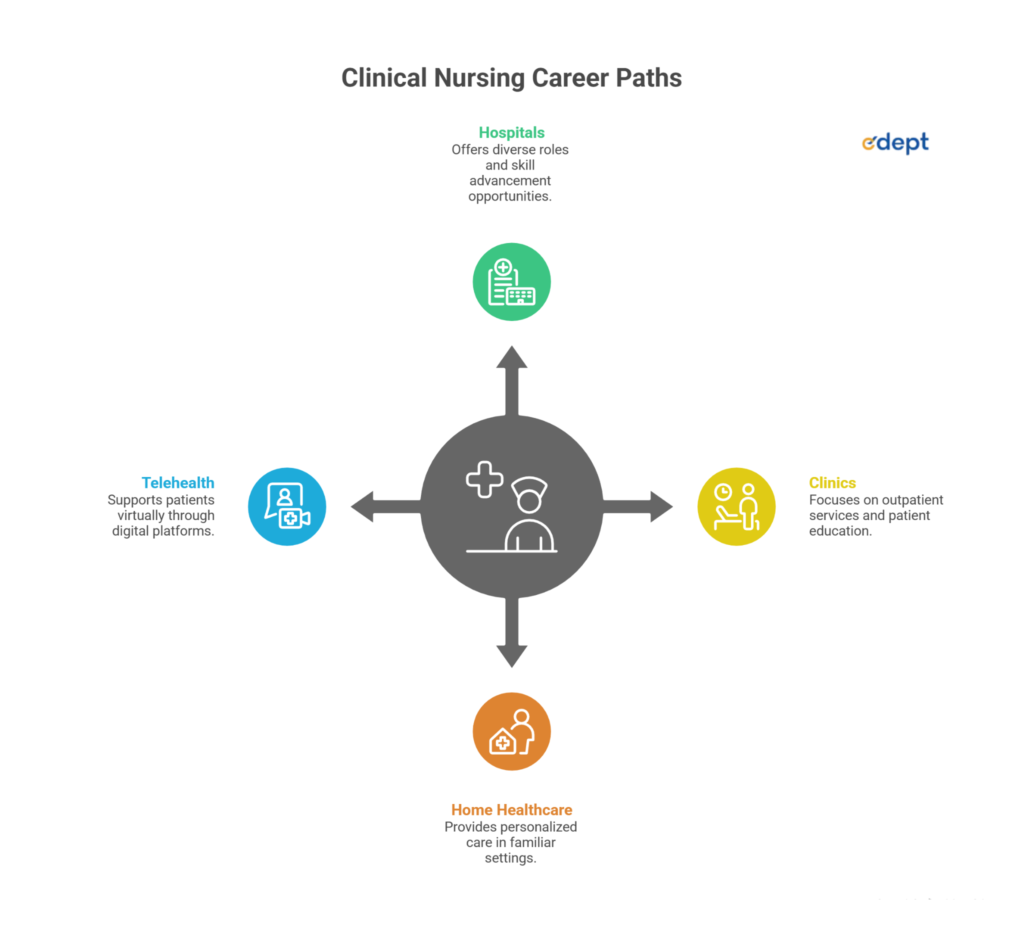
Hospitals
Hospitals are the main workplace for clinical nurses. In hospitals, there is horizontal movement between departments, i.e., general wards, intensive care departments, and casualty departments. In addition, hospitals contain multidisciplinary teams and exposing experiences of varied medical conditions, making them an ideal place where an individual can advance his/her skills.
Clinics
At the clinics, the focus is usually on outpatient services by the clinical nurses for patient education through routine check-ups and diagnostic procedures to ensure long-term relationships with the patients based on their schedule, as it is less hectic compared to hospitals.
Home Healthcare
Home healthcare nurses provide personalized care to patients in their homes. This role involves monitoring health conditions and assisting recovery after hospitalization. Home healthcare provides flexibility while allowing nurses to deliver patient-centred care in a familiar environment.
Telehealth
With the boom in digital healthcare, telehealth has emerged as a modern career option for clinical nurses. Telehealth nurses support patients through virtual consultations and digital health platforms. A mix of expertise in technology and clinical skills works together in expanding access to care and offering flexible work opportunities.
Also read: Role of Nurse in Care of Elderly People: Complete Guide
Salary and Growth Prospects
This career path in clinical nursing has stable earning prospects as well as a good work-life balance in the long run. There are several nursing career paths a candidate can choose from, all of which have good pay prospects. Based on the degree of experience gained in a specific domain or in the medical environment in which the nurse helps those in need, the long-term prospects of this job assure a well-paying career path for the candidates who choose this career path in nursing as a profession.
Entry-Level Salary
Competitiveness in the prevailing market is usually ensured by an entry-level clinical nurse’s salary. It reflects the essential nature of their role and how much they are in demand in healthcare delivery. In terms of structure, newly qualified nurses working in hospitals and clinics earn well in pay, apart from benefits such as health insurance, shift allowances, and overtime compensation. Entry-level salaries may change from region to region and employer to employer, but they generally increase with an increase in experience and expertise.
Career Progression Paths
A variety of opportunities are available for clinical nursing to grow. For instance, nurses might move into senior clinical positions with the right clinical experience or specialize in fields like critical care, paediatrics, and emergency departments. They can also take up higher education or specialized training and seek opportunities like nurse educators or nurse practitioners.
Seasoned clinical nurses can also advance to a position in leadership, research, and/or training; however, these roles must always have a strong association with clinical nursing. Thus, a system is formed to promote professional growth and rising income potential in the clinical nursing profession.
How to Become a Clinical Nurse
The process to become a clinical nurse involves the process of education, licensing, and practical sessions. With an increase in the need for healthcare all around the world, the position of a clinical nurse is highly in demand and considered to be an economically stable position in the medical field.
Education
The first step towards a career in clinical nursing is to graduate from a theoretical curriculum that is approved for a profession in nursing. The curriculum can include a diploma in nursing, a BSc in Nursing, or an equivalent degree that is approved by national authorities on nursing education. In addition, according to global data on the global health workforce, nearly 50% of the global population are nurses, making the importance of education for nurses a key consideration.
The curriculum in nursing education can include various degrees, including anatomy, physiology, pharmacology, patient care, ethics, etc. Clinical nurses need a good foundation, as theoretical learning is essential, coupled with practical knowledge.
Licensing
Once formal education has been completed, the aspiring clinical nurse has to undergo a professional licensure program to become eligible to practice the field. Licensing normally occurs by clearing a national or regional nursing examination provided by a particular nursing council that governs the professional field. Such a move ensures that all practicing nurses are competent and safe. In most nations, licensed clinical nurse practitioners have to renew their licenses and engage in continuous education. Licensing has critical value in the maintenance of a safe clinical nursing approach.
Training
Training includes theoretical knowledge as well as hands-on practical experience and supervised practice in hospitals, clinics, and simulation labs to develop essential nursing skills. It involves various critical areas such as medication administration, health assessment, disease management, and ethical decision-making, which help nurses to prepare for the healthcare environment
Future Scope of Clinical Nursing
The future for clinical nursing is growing and changing dynamically to respond to new and emerging technological and healthcare demands. As a matter of fact, clinical nurses will always play a leading role in the delivery of healthcare services.
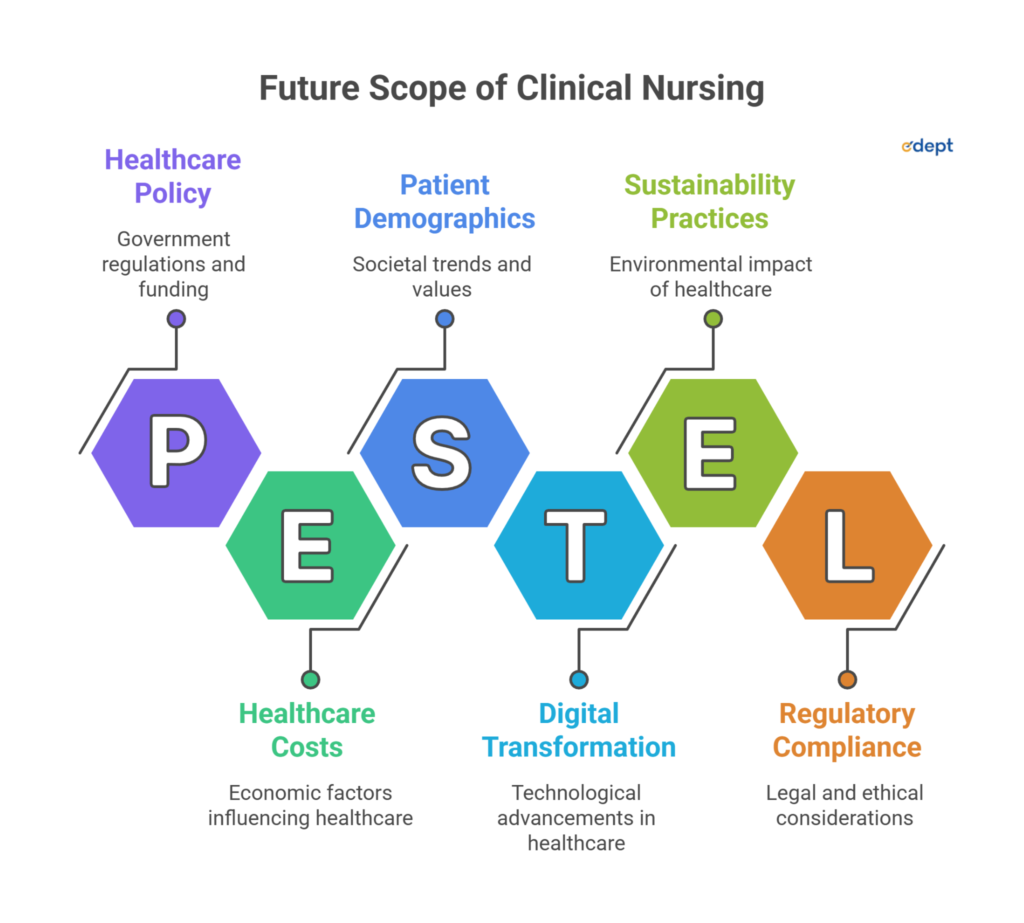
Technology Integration
The way technology is changing the face of a clinical nursing practice is noteworthy. Electronic Health Records, smart patient-monitoring technology, wearable health tech, and AI technology are on the rise to support patient treatment in the digital age. The aforementioned technology assists nurses in accurately tracking patient condition, streamlining paperwork, and improving patient management. For instance, real-time patient-monitoring technology can enable a clinical nurse to recognize patient complications before they arise. As technology continues to find its way into healthcare settings, patient management technology literacy would be instrumental in a clinical nursing practice, making a clinical nurse who is tech-adaptible very crucial to the profession.
Telemedicine Growth
The rapid growth of telemedicine significantly extends the boundaries of clinical nursing. Telehealth platforms allow nurses to provide care for patients remotely through virtual consultations, follow-ups, chronic disease management, and post-discharge care. This model improves access to healthcare, especially for patients residing in remote or underserved areas. Clinical nurses working in telemedicine can assess symptoms, give advice, monitor recovery, and coordinate care-all without requiring patients to be physically hospitalized.
As telemedicine begins to take its place as a part of the standard medical system in countries across the globe, this will have a number of effects on the role of the clinical nurse. For one, their jobs will not be limited to conventional care scenarios. Many will have the opportunity to practice in a hybrid environment that provides the best of both in-person care solutions and telemedicine options. Overall, the days of static roles in clinical nursing will soon be the exception rather than the rule.
Get future-ready in the field of healthcare with curated courses from Edept. Click here
Final Verdict: How Clinical Nursing bends the core foundation of the healthcare industry
At the heart of the delivery of healthcare are clinical nursing functions, acting as the essential link between the medical system and the patients. Through the entire length of this career path, the clinical nurse delivers direct, empathetic, and skilled service in order to enhance the recovery of the patients. One of the principal ways in which the importance of clinical nursing jobs can be appreciated is the extent of the tasks involved in the clinical nursing functions.
Besides skills and knowledge, clinical nursing requires communication skills, emotional intelligence, and critical-mindedness. The skills help clinical nurses move about complex health environments while offering reassurance and support to health clients and their loved ones. Across the clinical nurse specialties of hospitals, clinical practices, home health care services, and online health services, nursing professionals can choose career options that suit their interests and skills.
The future of clinical nursing is just as bright. The advancement in healthcare technology, the growth in the number of patients, and the expansion of the field of telemedicine serve to create a continuous and rising need for competent and efficient clinical nurses globally. For individuals who wish to pursue a meaningful and stable profession where they can have a positive impact on other people’s lives in a long-term sense, a clinical nursing profession provides these opportunities and can have a positive impact on society on a larger level than many other fields can offer.
Related Links:
| 7 Nursing Courses to Take If You Want to Be a Nurse | How To Become A Nurse: A Complete Guide |
| What is NCLEX Exam? | The Process of Becoming a Registered Nurse in Australia: A Step-by-Step Guide |
FAQs
What is clinical nursing?
Clinical nursing is referred to as providing hands-on care to patients in healthcare settings, such as hospitals, clinics, and community care facilities.
What does a clinical nurse do daily?
Daily tasks include patient assessment, administering medications, wound care, and maintaining medical records.
Is clinical nursing a good career?
Yes, clinical nursing offers job stability, career growth, global opportunities, and the satisfaction of making a direct impact on patients’ lives.
What skills are needed for clinical nurses?
Key skills include clinical expertise, communication, critical thinking, emotional intelligence, and adaptability.
What is the salary of a clinical nurse?
Salaries vary by location, experience, and specialization, with steady growth as nurses gain experience.
How long does it take to become a clinical nurse?
Typically, it takes 2–4 years, depending on the nursing program and licensing requirements.
What is the difference between staff nurse and clinical nurse?
A staff nurse is a type of clinical nurse working in general care units; clinical nursing is the broader category.