Top cybersecurity skills blend technical expertise in areas like cloud security, networking, ethical hacking, threat intelligence, penetration testing, AI/ML, data protection, and scripting (Python), with crucial soft skills such as analytical thinking, problem-solving, communication, and adaptability to handle evolving threats and complex challenges. Understanding operating systems, firewalls, IAM, and incident response forms a strong foundation for both beginners and advanced professionals.
In 2026, cybersecurity stands as one of the fastest-growing and essential technological industries. As these businesses are digitalizing, cyber threats come hand in hand; professionals with the right cybersecurity skills are in great demand. If you are aiming to become a cybersecurity expert, a security engineer, or an ethical hacker will define how you succeed in this field by developing both technical and soft top skills For Cybersecurity.
According to the WEF Global Cybersecurity Outlook 2025, only 14% of organizations are currently working with the skilled talent necessary to achieve their cybersecurity objectives. Alongside, in the U.S., 2025 job posting data shows that 40% of the top 25 cybersecurity functional roles experienced growth. This shows the widening gap of talent in the cybersecurity sector, which emphasizes the urgent need for constant upskilling. Other things that need to be considered are AI-driven threat management expertise, a strong collaboration between academia and industry to prepare a future-ready workforce.
What Are Cyber Security Skills?
Top Skills For Cybersecurity refer to the analytical and technical abilities that allow professionals to protect their networks, computer systems, and data from cyber attacks, security threats, and other vulnerabilities. These skills include all the essentials from understanding intrusion prevention systems and network security controls to accessing security exposures and implementing defense techniques.
As a cybersecurity expert, you need to be well-versed in detecting, analyzing, and mitigating threats across various systems that ensure integrity, confidentiality, and, lastly, availability of data. In short, cybersecurity skills are the foundation of digital security in today’s interconnected world.
Build Job-Ready Top Skills For Cybersecurity with edept
Gain hands-on experience in ethical hacking, digital forensics, network defense, and more through edept’s industry-aligned B.Voc Cybersecurity program.
→ Explore the B.Voc Cybersecurity Course
Why Learning Cyber Security Skills Is Crucial in 2026?
The majority of companies are converting to cloud environments and adopting AI-driven systems, and cybersecurity is becoming faster and smarter. The global cybersecurity workforce gap has surpassed 4 million unfilled job positions, highlighting a massive demand for skilled professionals.
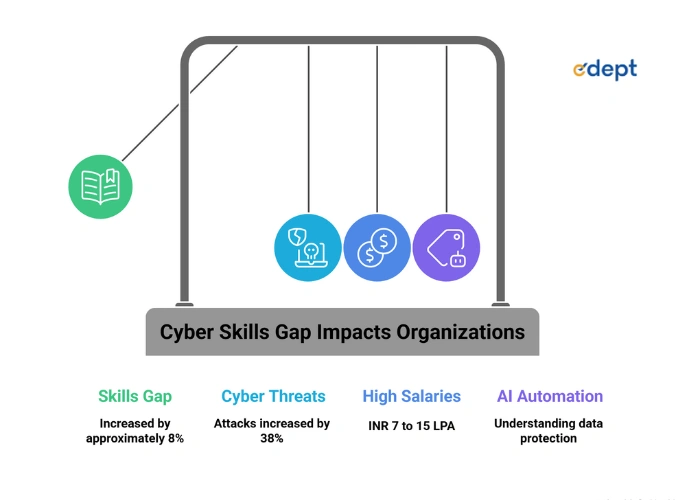
According to WEF’s Global Cybersecurity Outlook 2025 report, as of 2024, the cyber skills gap has increased by approximately 8%. Only 14% of the companies have confidently said that their current workforce has the right skilled person in the field of cybersecurity. Here are some of the Top Reasons to Learn Cyber Security Skills in 2026:
- Subsequent Rise in Cyber Threats – Cyberattacks have increased by over 38% in 2024, which has been affecting organizations, enterprises, and small-scale businesses.
- High-paying roles – The average cybersecurity salaries in India range between INR 7 to 15 LPA, while international jobs offer an average of $100,000 annually.
- AI and automation – As AI-powered tools become commonplace, understanding not only data protection and automation is crucial for cybersecurity professionals.
Key Technical Skills Required for Cyber Security
To flourish in the cybersecurity domain, you must develop a concoction of technical and analytical expertise. Here are some of the top technical skills required for a cybersecurity professional.
1. Networking and System Administration
Networking and system administrators help in understanding networking security controls, firewalls, VPNs, and routing protocols that help in identifying where vulnerabilities exist and how systems communicate. Therefore, knowing HTTP protocols, TCP/IP, and DNS is fundamental to defending network architectures.
As per the Economic Times, in India, 51% of respondents admitted that cloud computing is among the Top Skills For Cybersecurity.
2. Operating Systems and Virtualization
Operating systems and virtualization are something that you need to know. As a professional, you should be comfortable with Linux, Windows, and macOS environments. Virtualization skills through the use of tools such as VirtualBox and VMware are valuable for testing defenses and stimulating attacks.
3. Threat Analysis, Intrusion Detection & Programming
You have to learn how to use the Intrusion Detection Systems (IDS) and Intrusion Prevention Systems (IPS) like SNORT and SURICATA is extremely fundamental to notice anomalies and stop attacks in real time.
While knowing all the programming languages is mandatory, knowledge of scripting, such as Python, Java, C/C++, and SQL, helps in analyzing malware and automating security tasks.
4. Security Assessment and Penetration Testing
Penetration testing tools such as Metasploit, Burp Suite, and Nmap play a crucial role in cybersecurity by allowing professionals to actively identify and address vulnerabilities within systems before they can be exploited by malicious hackers.
Metasploit offers a comprehensive framework for developing and executing exploit code against a remote target, while Burp Suite focuses on web application security, assisting you in uncovering weaknesses in web-based services. Nmap, on the other hand, is essential for network discovery and mapping, which allows security experts to assess protection levels effectively.
5. Cloud Security & Cryptography
As companies migrate to AWS, Azure, and Google Cloud, cloud security management, which includes encryption, access control, and data protection, has become a must-have skill.
As businesses transform to AWS, Azure, and Google Cloud, having strong skills in cloud security management is essential. This includes managing access controls, implementing encryption, and ensuring data protection.
6. Incident Response and Forensics
When you effectively address any security breaches, it requires a deep understanding of digital forensics, thorough log analysis, and detailed evidence collection. Such elements are critical in identifying the breach’s source, considering its impact, and most importantly, executing measures to prevent future incidents.
Soft Skills Required for Cyber Security Professionals
We have gone through the technical skills above. However, these are not enough in cybersecurity. Professionals also require soft skills to coordinate and work effectively in teams and make critical decisions. Below is the list of soft skills that are essential to becoming a successful cybersecurity professional.
- Analytical and Critical Thinking – As a cybersecurity professional, you should be able to analyze threats, detect anomalies, anticipate attack vectors, and evaluate logs. Based on ISACA’s state of cybersecurity survey 2025, critical thinking is identified by 57% of respondents as a top soft skill required.
- Problem-solving ability – Cyber threats have been evolving rapidly, and cybersecurity professionals must be prompt with actions and respond dynamically.
- Attention to detail – Precision is crucial. Small misconfigurations, weak access controls, and overlooked logs often lead to breaches.
- Teamwork, collaboration, and cross-fusion influence – Cybersecurity does not operate in isolation. All incident responses involve legal, HR, PR, etc. Therefore, to make any security decisions, audit, and policy changes, cybersecurity plays an important role.
Become a Certified Cybersecurity Expert
Also Read, Cyber Security Courses After 12th – India vs Global Markets
Emerging Top Skills For Cybersecurity
The cybersecurity domain is evolving rapidly, and demanding professionals are emerging with new skills that need to align with the emerging threats and technologies. Talking about 2025 and the upcoming years, artificial intelligence and machine learning for threat detection are crucial for automating anomaly detection and predicting cyberattacks prior to their occurrence. Zero Trust Architecture Implementation is becoming a global security standard, which focuses on NEVER TRUST, ALWAYS VERIFY” for every device and user.
As decentralized systems expand, Blockchain Security confirms the protection of smart contracts and digital assets while quantum-resistant cryptography prepares organizations for post-quantum encryption threats. The growth in connected devices also fuels the need for IoT and Industrial Control System (ICS) Security, essential for safeguarding vital infrastructure. Lastly, Cyber Risk Management Compliance remains vital to meet global protection standards. Altogether, these advanced Top Skills For Cybersecurity define the future-ready cybersecurity expert of the digital era.
How to Develop Cyber Security Skills?
Below is a descriptive roadmap to start building your cyber security skillset from scratch.
- Start with basics – Firstly, it is important to learn the basics like networking, basic security principles, and system administration.
- Get hands-on practice sessions – You need to make free usage of the labs such as Hack the Box, Try Hack Me, and OverTheWire for a real-world motivation.
- Learn coding – To excel in scripting and automation, you have to start with Python for better enhancement.
- Mastering tools – You must practice with tools like Wireshark, Nmap, Splunk, and Metasploit.
- Enroll in the Cybersecurity Course from Shree L.R. Tiwari College of Engineering, powered by Edept, which concentrates on both defensive and offensive security techniques while acquiring crucial digital forensics skills.
- Stay updated – Get connected through LinkedIn, follow cybersecurity news, and attend webinars to get sculpted with Top Skills For Cybersecurity.
How edept Helps You Develop the Top Skills For Cybersecurity?
B.Voc in Cybersecurity and Digital Forensics offered by edept is built to equip students with the cutting-edge skills that security professionals demand today. The course is built to blend hands-on training, real-world projects, and guided mentorships, ensuring students master both theory and practical sessions.
- Experimental and interactive learning – Students get to engage with real threat scenarios like phishing, malware, and insider risks, which will help to sharpen defensive instincts and response strategies.
- Regular evaluation and feedback – The experts evaluate the students with frequent assessments in the form of interactive sessions like quizzes, lab exercises, and projects. These help them to track their progress and rectify their weaker areas through targeted feedback.
- Expert faculties and mentors – As guided by the industry veterans, this course equips the students with core cybersecurity topics using real-world scenarios and anchoring these concepts in practice.
- In-depth knowledge – The Cybersecurity course curriculum by edept covers some of the critical domains like SIEM, vulnerability assessment, mobile & cloud security, network analysis, digital forensics, penetration testing, threat intelligence, and compliance & governance.
- 100% placement assistance – At edept, we promise to offer you 100% career support in the form of mock interviews, internships, guest sessions, and industry visits to bridge the campus to job.
When you integrate technical tools, soft skills, and industry immersion, edept guarantees graduates that you not only get certified, but you get ready to step into roles like a security analyst, pen tester, or a digital forensics expert since day one.
Demand for cybersecurity experts all across the world is skyrocketing. Join today at edept’s B.Voc Cybersecurity & Digital Forensics course to gain hands-on in-demand skills, exam preparation, and 100% placement support; all tailored for the next-gen digital world.
Is It Worth Learning Cybersecurity Skills in 2026?
The demand for cybersecurity experts is booming, and so is the competition in the coming years. When you build the right combination of technical, analytical, and interpersonal skills, it is where you stand out. Starting from understanding the network security protocols and intrusion prevention systems, to mastering soft skills such as problem-solving and communication. Cybersecurity offers a career that is dynamic as well as rewarding.
Start learning from today with structured guidance from edept, you can become a part of the new generation of cybersecurity professionals shaping and safeguarding our digital future.
Future-Proof Your Career in Cybersecurity
Join Edept’s expert-led Cybersecurity & Digital Forensics program to learn cutting-edge tools, real-world case studies, and secure top industry placements.
Related Links:
FAQs
- What are the Top Skills For Cybersecurity expert?
Some of the key skills required to become a cybersecurity expert are threat analysis, cryptography, networking, and incident response. The soft skills that can shape you are problem-solving, communication.
- Do I need coding skills for cyber security?
The basic knowledge of coding can be beneficial. Basic coding skills in Python, C++, and Java help automate tasks and understand vulnerabilities, though not mandatory for all roles.
- What are the best certifications to improve cyber security skills?
Top certifications that can help you improve your cyber security skills are CEH, CISSP, Security+, and CISM. You need to note that these certifications are built to target different expertise levels.
- Which soft skills are important for cyber security professionals?
The soft skills that are important to become a cyber security professional are teamwork, attention to detail, and effective communication.
- How can beginners start learning Top Skills For Cybersecurity?
To start with cyber security, you can enroll in specialized programs and start with the basics through our edept’s cyber security course, join the hands-on lab sessions, expert guidance, and gradually move towards certifications.
I am typically to blogging and i actually appreciate your content. The article has really peaks my interest. I’m going to bookmark your web site and keep checking for brand spanking new information.
Ꮐreetings! Very helpful advice in this paгticular article!
It is the little changes which will make the most significant changes.
Many thanks for sharing!
My web-site – trading platform