Become a data analyst by learning Excel, SQL, Python, and data visualization tools like Power BI/Tableau. Build real projects, gain internships, understand statistics, develop business insights, and earn relevant certifications.
If you have ever wondered how to become a data analyst, you are not alone. As there is a rapid rise in the global demand for data professionals, a career in data analysis plays a crucial role. In today’s data-driven world, the majority of organizations depend on professionals who can analyse data and provide actionable insights for the decision-making process to work better.
The critical role of a data analyst lies there. They handle commerce platforms optimising sales to healthcare providers, which helps in improving patient care. Thus, data analytics is the backbone of modern industries. In this blog, we will help you walk you through what the data analyst does, the essential data analyst skills, and job opportunities you can taste as a successful data analyst. Apart from this, we will discuss the main aspect of this blog, i.e., how to become a Data Analyst, focusing on the step-by-step route and growth opportunities.
What is a Data Analyst?
A data analyst is a professional who is responsible for collecting, organizing, and interpreting raw data to help companies make data-driven decisions. They equip technical skills like data cleaning, programming, and data visualization. Through analysis, analysts transform complex data into clear understandings. Data analysts act as problem solvers who bridge the void between the tech team and business leaders by transforming information into strategies that help push growth.
Types of Data Analyst
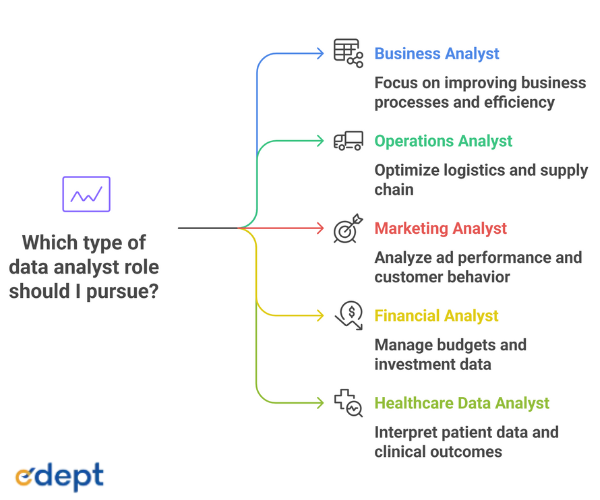
The types of data analysts depend on the industry and specialization. Below are the listed domains of data analysts:
- Business Analysts – Concentrate on business processes, operational improvements, and efficiency.
- Operations Analyst – Advance logistics, organisational workflows, and supply chain.
- Marketing Analyst – Looks after ad performance, customer behaviour, and campaign rate of interest.
- Financial Analyst – Operating with budgeting, investment data, and monetary planning.
- Healthcare Data Analyst – Interpretation of patient data, clinical outcomes, and hospital performance.
What Does a Data Analyst Do?
The roles and duties of a data analyst are primarily to turn numbers into stories that organisations can work on. Check the brief responsibilities below.
- Collection and Cleansing Data – You get to prepare datasets by eliminating inconsistencies and errors.
- Transformation of Data – The data analysts get to organise large amounts of data and information into usable formats.
- Analysis of Data – Application of statistical models and Machine Learning techniques whenever it is required.
- Creating Reports & Dashboards – You get to present understandings using visualizations.
- Problem-solving – Data analysis suggests data-driven strategies to improve industry results.
Why Start a Career as a Data Analyst?
If you are interested in working with numbers, patterns, and cracking real-world challenges, this is a job worth pursuing. So, if you want to start a career as a data analyst, it will be favorably rewarding for the following reasons.
- Higher Demand – As per the World Economic Forum, the data-related role lists from among the top emerging jobs across the globe.
- Attractive salaries – The average data analyst salary in India is somewhere between INR 4,00,000 to INR 10,00,000 per annum. The salary slab depends on the skills and experience of the aspirant.
- Pathway to Data Science – Many data analysts grow into advanced careers such as data scientists or machine learning engineers.
Read: How to Choose the Right Data Analytics Course
How to Become a Data Analyst?
To become a Data Analyst, starting a career in data analysis requires a mixture of technical expertise, practical exposure, and analytical thinking. Check the detailed structured roadmap to start your career as a data analyst here:
Development Strong Foundations in Statistics & Mathematics
Data analysts mostly rely on statistics, probability, and problem-solving skills. You are required to strengthen your basics to develop yourself as a data analyst. These subjects help in the interpretation of patterns, validate results, and make logical conclusions. The key areas to master in this section are listed below:
- Mathematical reasoning and problem-solving
- Probability theory and distributions
- Explanatory and inferential statistics
- Hypothesis testing and reversion accounting
Programming Languages
It is imperative that you gain experience in Python, R, and SQL so that you can handle and query large amounts of data. Python is widely used for data analysis with the help of libraries like NumPy, Pandas, and Matplotlib. R is a popular data analyst tool for statistical analysis and research-heavy modeling. You should have a heavy command over SQL and Python, as it is negotiable for a role like a data analyst.
Data Cleaning and Transformation
You have to master data cleaning and transformation since most of the work involves cleaning and preparing datasets. Therefore, learning data cleaning techniques is essential. 70% of the time, a data analyst has to cleanse data before any analysis as the raw data is most of time messy, unstructured. Therefore, you should learn techniques so that you can handle missing outlines and values, standardize and normalize datasets, merge, split, and transform data into meaningful insights. Automation of repetitive cleaning tasks like R and Python is useful. These steps ensure you, as a data analyst to prepare datasets that are ready for analysis and reporting.
Data Visualization Practicing
It is essential to practice certain tools like Power BI, Excel, and Tableau to help present a complex understanding clearly and interactively. Communication of findings is just as crucial as analysing them. Therefore, practicing data visualization allows you to present complex insights clearly and constructively. Let’s check where the data visualization works:
- Tableau is used for interactive dashboards.
- Excel is widely used for reporting and sharp analysis.
- Power BI is one of the most popular tools in corporate environments.
- Python visualization libraries through Matplotlib, Seaborn, and Plotly.
When you have proper visualization skills, it makes your work more impactful by turning numbers into facts.
Working on Real Projects
To become a Data Analyst you are required to apply skills to real-world datasets is the best way to showcase your capabilities. There are open-source datasets and Kaggle contests that serve as wonderful starting points.
- Open-source datasets that will be obtainable on platforms like Kaggle as well as the UCI Machine Learning Repository.
- Small freelance or personal projects that translate practical problems.
- Competitions on Kaggle to test your skills against peers.
Building Portfolio
When you display your assignments on GitHub or individual websites adds credibility and pushes you to stand out to recruiters. Check below for some of the best portfolios that can help showcase your recruiters.
- Jupyter Notebooks help with end-to-end analysis.
- Dashboards are created using Tableau or Power BI.
- GitHub holds well-documented projects.
- Case studies or blog posts describing your insights and findings can be beneficial.
When you have a strong portfolio, it not only highlights your technical skills but also your potential to communicate the findings properly.
Get Certified
It is not mandatory, but certifications in data science, machine learning, and data analytics can add weight to your resume, along with a significant amount of credibility. Some of the useful certifications are provided below:
- Microsoft Certified: Data Analyst Associate
- Google Data Analytics Professional Certificate
- IBM Data Analyst Professional Certificate
Gain Practical Experience & Updated with Industry Trends
Data analytics is a constantly evolving field where you can get practical experience for internships, freelance projects, or even volunteering with NGOs, providing hands-on experience. If you keep up with the latest technology, it is ensured you get long-term career success. You have to stay updated with Artificial Intelligence, machine learning, and big data analytics through the help of webinars, industry reports, and blogs. As the technology is evolving rapidly, a successful career in data analytics requires continuous learning.
Data Analyst Job Opportunities & Career Growth
A career in data analytics offer not just growth in responsibilities but also you get to taste a decent upgradation in salaries. The demand for data analytics is expanding worldwide as companies across all industries depend on data-driven decision-making. As per the industry reports, the global data analytics shows that the expected growth is at a CAGR of over 25% from 2024 to 2030. This will generate millions of jobs across the world. As per LinkedIn, the rank of data analytics is among the most in-demand skills that ensure excellent career security and growth. Check some of the job advantages after you become a Data Analyst.
- Junior Data Analyst – As a junior data analyst, you can join a team that focuses on cleaning and analysing datasets or as a business intelligence analyst that concentrates on cleaning and analysing data. After substantial experience, you get upgraded to Senior Data Analyst.
- Business Intelligence Analyst – Hired at the entry level, who makes use of tools like Power BI and Tableau to generate business insights to operate business strategies with the help of insights available.
- Data Scientists – With good hands-on experience or preferably mid-level experience, data scientists are hired who require proper handling of Advanced Analytics, Machine Learning, and Artificial Intelligence.
- Data Engineer or Machine Learning Engineer – Building data channels and infrastructure can be done with the help of promotion to Machine Learning Engineer.
- Analytics Manager – At the senior level, you may be promoted as an analyst manager ot even executive roles like Chief Data Officer (CDO) who builds analytics teams and assignments.
With a handful of experiences, you can get into job roles such as Chief Data Officer, Machine Learning Engineer, etc.
Become a Data Analyst with edept
At edept, we assist aspiring candidates like you to acquire industry experience and ready skills in data analytics. Through this course, you can focus on:
- Get hands-on training in visualization, data cleaning, and the transformation of data into insights.
- Building strong foundations in problem-solving and data analysis.
- Learn programming languages such as SQL, Python to sharpen your skills.
- You get to be under expert mentorship from reputable sources to guide you through your career path.
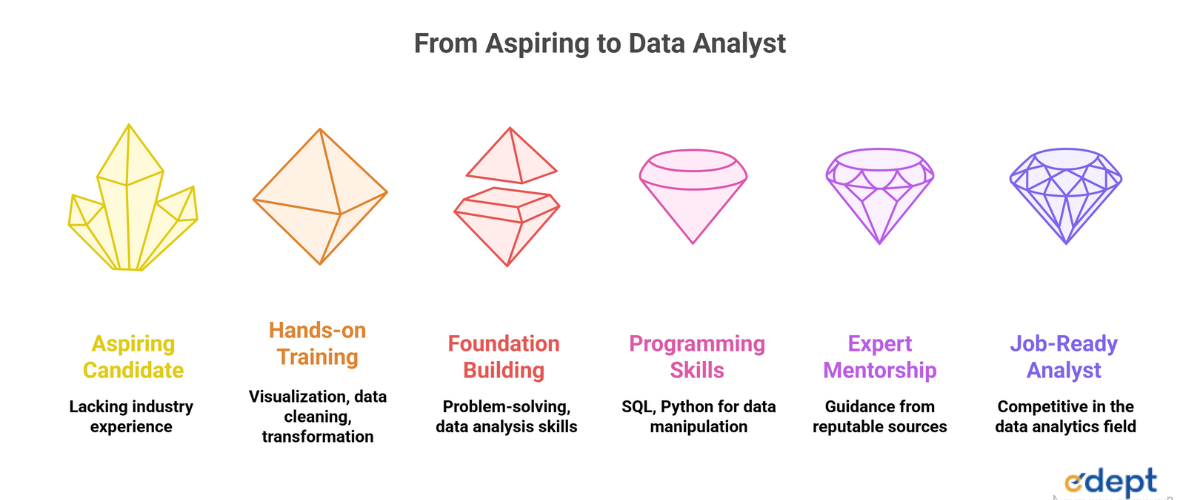
With edept’s data analysis course, you just don’t learn, you become job-ready in the competitive data analytics field.
Learn Business Analytics Course by edept here!
Related Links:
| Is Data Analyst a Good Career? | How to Learn Data Analytics |
| How to Choose the Right Data Analytics Course | Practical Learning in Data Science: Unlocking Career Opportunities |
Conclusion
The journey to Become a Data Analyst professional is both challenging and rewarding. By developing the right technical skills and regular practice of data cleaning and visualization, the application of knowledge to real-world assignments can build a strong career in this high-demand field. If you are passionate about pattern analysis, numbers, and problem solving, is it the right time to leap? It is better to equip yourself with the right set of skills, and a successful career in data analytics will follow.
FAQs
How to become a data analyst without a degree?
To become a data analyst, you still enter the field by learning through online courses, certifications.
How to become a data analyst without experience?
To start a career in data analytics without experience, you have to start by working on personal projects, internships, and freelance work to showcase your skills practically.
What tools do data analysts use?
SQL, Python, R, Tableau, Power BI, and Excel are some of the data analytics tools in use. However, some industries accept SAS and Google Analytics.
What industries hire the most data analysts?
Finance, E-Commerce, IT, Healthcare, Government, and Marketing are some of the industries that hire data analysts.
How long does it take to become a data analyst?
It takes approximately 6 to 12 months with consistent effort through the course and projects. If you are pursuing a bachelor’s degree, it may take 4 years.
What is the average salary of a data analyst?
The average data analyst salary is approximately INR 4,00,000 to INR 10,00,000 annually.