The cyber threat intelligence lifecycle is the structured process security teams use to turn raw threat data into actionable intelligence that actually improves defences. It runs through six phases, including planning, collection, processing, analysis, dissemination, and feedback, each one building on the last in a continuous loop. Organisations that follow this process consistently are better positioned to detect threats earlier, respond faster, and make security decisions grounded in real-world attacker behaviour rather than assumptions. This blog breaks down the full cyber threat intelligence process, the tools that support it, and the use cases where it delivers the most measurable value.
If you have been paying attention to the cybersecurity industry in 2025, the investment numbers alone tell you everything you need to know about where priorities are headed. The global threat intelligence market is projected to grow from USD 11.55 billion in 2025 to USD 22.97 billion by 2030, growing at a compound annual growth rate of 14.7%. Organisations across every sector are pouring resources into understanding threats before those threats become incidents, and the cyber threat intelligence lifecycle is the framework that makes that possible.
So, what is the cyber threat intelligence lifecycle? It is the structured, repeatable process that security teams use to collect raw data about potential threats, turn that data into actionable intelligence, and feed it back into the organisation’s defences in a way that actually improves security outcomes over time.
This blog walks through the full cyber threat intelligence process from planning through feedback, covers the most important cyber threat intelligence tools available today, explores real-world cyber threat intelligence use cases, and outlines the best practices that separate mature CTI programmes from programmes that never quite deliver on their promise.
What Is the Cyber Threat Intelligence Lifecycle?
The cyber threat intelligence lifecycle is the end-to-end framework that guides how organisations gather, process, analyse, and act on information about the threats targeting them. It is not a one-time exercise. It is a continuous loop where each completed cycle feeds into and improves the next one.
Understanding the cyber threat intelligence lifecycle matters because raw data about threats is not the same as intelligence. Threat data without context, analysis, or structure is noise. The cyber threat intelligence lifecycle is the process that turns that noise into something a security team can actually use to make better decisions, respond faster to incidents, and build defences that are shaped by real-world attacker behaviour rather than generic assumptions.
The CTI lifecycle phases provide a consistent structure that works across organisations of different sizes, industries, and maturity levels. Each phase builds on the previous one, and skipping or rushing any phase tends to produce intelligence that is either inaccurate, irrelevant, or delivered too late to be useful. The cyber threat intelligence lifecycle diagram most commonly used in the industry shows these phases arranged in a circle to reflect the continuous and iterative nature of the process rather than a linear sequence with a defined end point.
Cyber Threat Intelligence Process
The cyber threat intelligence process unfolds across six connected phases. Together, they form the complete cycle that turns raw information into actionable intelligence and feeds insights back into the organisation’s security posture continuously.
Planning
Planning is the phase where the entire cyber threat intelligence process takes its direction. Before any data is collected or any analysis begins, the security team needs to clearly define what questions they are trying to answer and what decisions the intelligence will inform. This means identifying priority intelligence requirements, understanding which threat actors are most relevant to the organisation’s industry and geography, and aligning the CTI programme with the broader security strategy. Without clear planning, the rest of the cyber threat intelligence process tends to produce outputs that are interesting but not actually actionable for the people who need to use them.
Collection
Collection is where data is gathered from the sources identified during planning. The cyber threat intelligence process draws on a wide range of collection sources, including open-source intelligence, dark web monitoring, threat feeds from commercial vendors, information-sharing communities, technical sensors like network logs and endpoint telemetry, and human intelligence from industry contacts. The quality and relevance of what is collected in this phase directly determine what is possible in every phase that follows, which is why the collection strategy deserves serious attention rather than simply pulling from as many sources as possible and hoping for the best.
Processing
Raw collected data rarely arrives in a form that is ready for analysis. The processing phase of the cyber threat intelligence process involves normalising, structuring, deduplicating, and filtering the collected data so that it can actually be analysed efficiently. This includes translating data from different formats into consistent structures, removing irrelevant or low-confidence data points, and enriching indicators with additional context. Processing is the step that most organisations underinvest in, and it shows in the quality of the analysis that follows when data arrives inconsistently formatted and cluttered with noise that should have been cleaned out earlier.
Analysis
Threat intelligence analysis is where processed data is examined to produce the actual intelligence that informs decisions. Analysts look for patterns, identify threat actor tactics and techniques, assess relevance to the organisation’s specific environment, and determine the confidence level behind each finding. Good cyber threat intelligence analysis goes beyond simply describing what happened and answers the questions that matter to decision-makers: Who is behind this activity? What are they after? How do they operate? And what does that mean for our specific defences? This stage is the most intellectually demanding phase of the CTI lifecycle phases and the one where experienced human judgement matters most, even as automation handles more of the underlying data processing.
Dissemination
Intelligence that sits in an analyst’s notebook or a platform that nobody checks does not protect anyone. The dissemination phase of the cyber threat intelligence process is about getting the right intelligence to the right people in the right format at the right time. Strategic intelligence goes to executives and risk teams in clear, non-technical formats that support business decisions. Tactical intelligence goes to security engineers who need to update detection rules and controls. Operational intelligence goes to incident responders who need to act quickly. Matching the format and content of intelligence products to the audience receiving them is one of the most consistently undervalued skills in a mature CTI programme.
Feedback
Feedback closes the loop of the cyber threat intelligence lifecycle and is what turns it into a continuously improving cycle rather than a one-time effort. Security teams, analysts, and decision makers who receive intelligence products should regularly communicate back to the CTI team about what was useful, what was missing, what arrived too late, and what questions remain unanswered. That feedback directly shapes the planning for the next cycle, improving the relevance, timeliness, and quality of intelligence produced over time. Organisations that skip the feedback phase tend to find that their CTI programmes gradually drift away from what stakeholders actually need.
Read More: Why Every Student Should Learn the Basics of Cyber Hygiene
Cyber Threat Intelligence Tools
The right cyber threat intelligence tools make a significant difference to how efficiently and effectively each phase of the lifecycle runs. These are the platforms that security teams rely on most heavily across the cyber threat intelligence process.
IBM X-Force
IBM X-Force is one of the most comprehensive threat intelligence platforms available, offering access to a vast repository of threat data, including malware analysis, vulnerability research, IP reputation data, and threat actor profiles built from IBM’s global security operations footprint. It integrates directly with SIEM and SOAR platforms, making it one of the more practically deployable cyber threat intelligence tools for organisations that need intelligence flowing into their existing security stack rather than sitting in a separate portal. The platform is particularly strong for cyber threat intelligence analysis of advanced persistent threats and financially motivated actor groups.
ThreatConnect
ThreatConnect is a threat intelligence platform built around the idea of operationalising intelligence rather than just collecting it. It allows security teams to aggregate threat data from multiple sources, apply cyber threat intelligence analysis workflows, collaborate across teams, and push intelligence directly into defensive controls and response playbooks. One of its strongest features is the ability to measure the actual impact of threat intelligence on security outcomes over time, which makes it easier for organisations to demonstrate the value of their CTI programmes and refine them based on evidence rather than assumption.
Recorded Future
Recorded Future is widely considered one of the leading cyber threat intelligence tools for organisations that need broad, real-time visibility into the threat landscape. It continuously collects and analyses data from open web, dark web, technical, and proprietary sources, using machine learning to surface relevant intelligence and reduce the time analysts spend on manual collection and triage. Its natural language interface and integration capabilities make threat intelligence analysis more accessible for teams that do not have large dedicated intelligence staff, and its coverage of threat actor activity, vulnerability exploitation, and geopolitical risk is particularly strong.
MISP
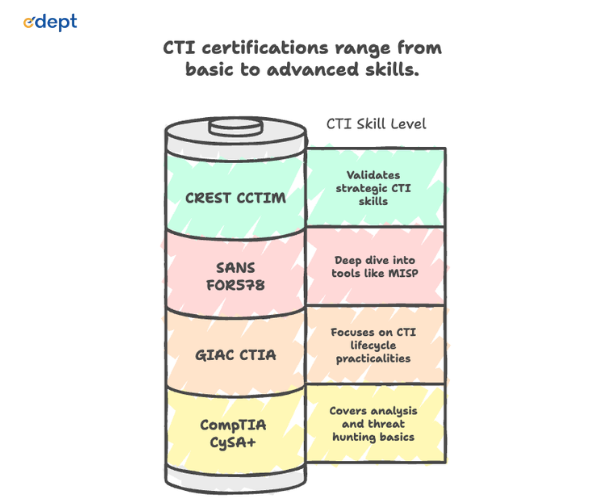
MISP, the Malware Information Sharing Platform, is an open-source threat intelligence platform designed specifically for sharing and correlating indicators of compromise across organisations and communities. It is one of the most widely deployed tools for cyber threat intelligence in the information-sharing community because it is free, highly flexible, and directly supports the STIX and TAXII standards that allow threat data to move between organisations and platforms consistently. For organisations that participate in sector-specific information sharing groups or government threat intelligence programmes, MISP is often the foundational platform that makes structured sharing practically achievable.
Use Cases of Cyber Threat Intelligence
Understanding the cyber threat intelligence use cases that deliver the most value helps organisations prioritise where to apply their CTI capabilities first and build a business case for expanding the program over time.
Incident Response and Threat Hunting
One of cyber threat intelligence’s biggest real-world impacts shows up in incident response and threat hunting. When an attack is underway, CTI delivers vital background on the threat actor’s tactics, techniques, and procedures so responders can gauge what else got hit, predict the next move, and lock things down effectively. For threat hunting, it supplies the key hypotheses and indicators that let analysts proactively sniff out hidden intrusions missed by automated tools, cutting down how long attackers linger inside.
Vulnerability Management and Patching
Not every vulnerability can be patched immediately, and prioritisation decisions made without intelligence context often focus on severity scores that do not reflect actual exploitation risk. CTI changes that by providing real-world data on which vulnerabilities are being actively exploited, by which threat actors, and against which types of organisations. This is one of the most practically valuable uses of cyber threat intelligence for security and IT operations teams because it directly translates intelligence into patching decisions that meaningfully reduce risk rather than simply working through a list.
Risk Assessment and Business Continuity Planning
Strategic cyber threat intelligence gives organisations a clear-eyed view of risks tailored to their industry, location, and tech stack, making it vital for risk assessments and business continuity plans. Instead of leaning on vague generic assumptions, mature CTI programmes let teams base their models on hard evidence of actual threat actor moves, arming leadership and risk committees with solid facts for smarter investment calls and priority setting.
Fraud Detection and Brand Protection
Digital risk protection is one of the growing cyber threat intelligence use cases, particularly for organisations in financial services, retail, and consumer-facing industries. CTI capabilities applied to monitoring the open web, social media, and dark web can surface phishing sites impersonating the organisation, leaked credentials being sold in criminal forums, counterfeit products, and brand impersonation campaigns before they cause significant damage. Catching this intelligence early slashes the damage from fraud and brand abuse, way more effectively than scrambling to respond once customers are already hit.
Cybersecurity Awareness and Training Programmes
CTI is increasingly being used to make security awareness and training programmes more relevant and effective. Rather than running generic phishing simulations and awareness content, organisations can use cyber threat intelligence analysis of recent campaigns targeting their industry to build training scenarios that reflect actual current attacker behaviour. This makes the training more credible to employees and more likely to produce the behavioural changes that matter, which is one of the more underappreciated cyber threat intelligence use cases in the full picture of how CTI adds value beyond the security operations centre.
Also Read: How Cybersecurity Safeguards Data during the E-Commerce Boom
Best Practices in Implementing Cyber Threat Intelligence
Having the right structure and habits in place makes the difference between a CTI programme that genuinely improves security outcomes and one that produces reports nobody acts on.
1. Establish a Dedicated Threat Intelligence Team
The cyber threat intelligence process requires people who understand both the technical and analytical dimensions of the work. Organisations that try to add CTI responsibilities on top of existing SOC analyst roles without dedicated capacity tend to find that the depth and quality of threat intelligence analysis suffer when incident response demand is high, which is precisely when good intelligence is most needed. Building a dedicated team, even a small one, with clearly defined roles and responsibilities, provides the foundation that everything else depends on.
2. Use Standard Frameworks (STIX, TAXII)
STIX and TAXII are the standard formats and protocols for representing and sharing threat intelligence in a structured and machine-readable way. Using these standards across cyber threat intelligence tools and processes ensures that intelligence can move efficiently between platforms, be shared with external partners and information-sharing communities, and be consumed by automated defensive systems without requiring manual translation. Any CTI program aiming to scale and integrate with a broader security ecosystem should treat adopting STIX and TAXII as a baseline requirement rather than an optional enhancement.
3. Use Structured Data Formats
Related to standards adoption but worth stating separately, the value of the cyber threat intelligence lifecycle is significantly reduced when intelligence is produced in unstructured formats that cannot be easily ingested by the systems and people who need to act on it. Building templates, taxonomies, and data models that produce consistent, structured intelligence products makes every downstream use of that intelligence faster, more reliable, and easier to measure over time.
4. Integrate Threat Intelligence into Security Operations
Intelligence that sits in a separate platform and requires analysts to manually check it and translate findings into defensive actions creates friction that reduces how much of the value of CTI actually reaches the security controls that matter. The most effective cyber threat intelligence use cases are almost always the ones where intelligence is directly integrated into SIEM, SOAR, EDR, and firewall platforms so that indicators and context flow automatically into detection and response workflows. Integration is what turns intelligence from a research output into an operational capability.
5. Implement Continuous Monitoring and Feedback Loops
The CTI lifecycle phases only deliver their full value when they run continuously rather than in periodic bursts. Continuous monitoring keeps your collection and processing steps fresh and relevant to today’s threats, instead of relying on info that was spot-on three months back but stale now. Feedback loops ensure that the planning phase stays aligned with what stakeholders actually need rather than drifting toward what the CTI team finds most analytically intriguing. Both habits are essential for a CTI programme that maintains its relevance and impact over time.
6. Engage with Information Sharing Communities
No single organisation has complete visibility into the threat landscape on its own. Engaging with sector-specific information sharing and analysis centres, government threat intelligence programmes, and community platforms like MISP networks multiplies the coverage and relevance of the intelligence available to the programme without proportionally increasing its cost. The organisations that get the most out of the cyber threat intelligence lifecycle tend to be active contributors to these communities rather than passive consumers, because the quality of what comes back is directly related to the quality and timeliness of what gets shared.
Conclusion
The case for building a mature cyber threat intelligence lifecycle has never been more clearly supported by evidence. According to Statista, the global cyber threat intelligence market is valued at $7.3 billion in 2025 and is expected to reach $29.5 billion by 2032, growing at a CAGR of 22%. That growth rate reflects how quickly organisations across every industry are recognising that reactive security is no longer sufficient and that the cyber threat intelligence process is what makes proactive defence practically achievable.
The organisations that get this right are the ones that treat the CTI lifecycle phases as a genuine operational discipline rather than a compliance exercise. They invest in the right cyber threat intelligence tools, build the analytical capabilities needed for serious cyber threat intelligence analysis, and connect their intelligence programme directly to the decisions and actions that improve security outcomes. The cyber threat intelligence lifecycle is not a diagram on a slide. It is the operating model for how modern security teams stay ahead of the threats that are evolving faster than any static defence can keep up with.
Related Links:
FAQs of Cyber Threat Intelligence Lifecycle
How is threat intelligence used by a SOC?
A security operations centre uses cyber threat intelligence to enrich alerts with context about known threat actors and their techniques, prioritise which incidents deserve immediate attention, guide threat hunting activities, and update detection rules based on current attacker behaviour. CTI helps SOC analysts move faster and make better decisions by giving them a clearer picture of what they are dealing with, rather than responding to raw technical indicators without context about what those indicators actually mean in the current threat environment.
What is the difference between SIEM and threat intelligence?
A SIEM collects and correlates log and event data from across an organisation’s environment to detect suspicious activity in real time. Cyber threat intelligence provides external context about the threat landscape, including threat actor profiles, attacker tactics and techniques, and indicators of compromise from outside the organisation. The two are complementary rather than competing. SIEM benefits significantly from threat intelligence feeds that enrich its detection capabilities, and the cyber threat intelligence process benefits from SIEM data that shows how external intelligence maps to what is actually happening inside the organisation’s environment.
What tools are used for threat intelligence?
The most widely used cyber threat intelligence tools include IBM X-Force for broad threat data and integration with enterprise security stacks; Recorded Future for real-time collection and machine-assisted analysis; ThreatConnect for operationalising intelligence across security workflows; and MISP for open-source structured intelligence sharing across organisations and communities. The right combination of cyber threat intelligence tools depends on the organisation’s size, budget, existing security stack, and the specific CTI lifecycle phases they need the most support with.
What are the 6 phases of threat intelligence?
The six CTI lifecycle phases are planning, collection, processing, analysis, dissemination, and feedback. Planning defines what intelligence is needed and why. The collection gathers raw data from relevant sources. Processing normalises and structures the data for analysis. Cyber threat intelligence analysis turns raw data into insights you can actually use. Dissemination gets those insights to the right people in clear, practical formats. Feedback ties it all together by steering the next planning cycle with lessons from what worked well, what missed the mark, and which questions are still hanging.