A strong, expert-level math background is not strictly required to start a career in data science, but a solid foundation in statistics and probability is essential. While advanced calculus is rarely used daily, understanding the underlying mathematical concepts helps in building models and interpreting data.
“Data science is all about complex equations and advanced mathematics.” If you’ve ever heard this and felt a wave of anxiety, you’re not alone. This is one of the biggest fears that holds back thousands of students from pursuing one of the most exciting and high-paying careers of our time. The demand for data science professionals in India is growing at an extraordinary pace. From banking and healthcare to e-commerce and fintech, every industry today needs people who can make sense of data. But does that mean you need to be a math genius to get started? Not quite. The reality is far more beginner-friendly than most people think. So, is a Math Background for Data Science very much required? Math plays a role in data science, but the level you actually need depends on where you are in your learning journey and which career path you choose.
In this guide, we’ll break down exactly how much math data science requires, which concepts matter, which roles need less of it, and how you can start learning today – even if your math background is basic.
Is Math Required for Data Science?
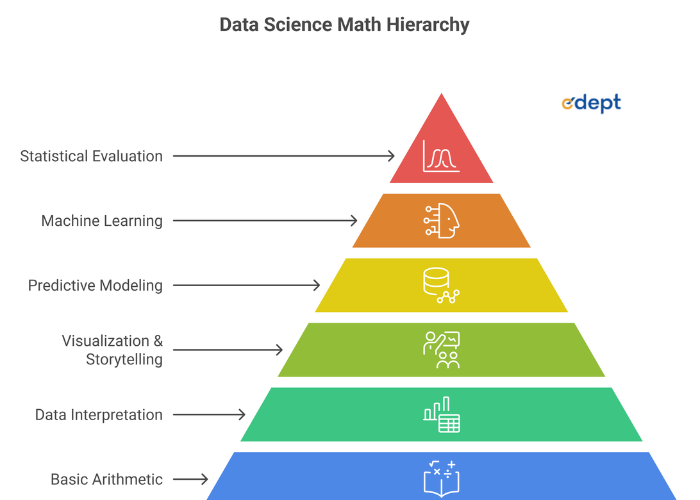
No, math is not mandatory at the beginner level. You can start learning data science with just basic arithmetic and a willingness to explore. As your skills grow, you’ll naturally pick up the math concepts you need, one step at a time.
Where Math Is Used
Math becomes relevant when you move into areas like building predictive models, training machine learning algorithms, and evaluating statistical outputs. Concepts from statistics, linear algebra, and calculus form the backbone of how data science models actually work under the hood.
Where Math Is Less Important
Entry-level roles like data analyst or business analyst rely far more on data interpretation, visualization, and storytelling with data than on advanced equations. Here, tools and software do the heavy lifting, and your ability to ask the right questions matters more than solving them manually.
Key Math Concepts Used in Data Science
Some key concepts in mathematics are statistics, calculus, and linear algebra. Let’s check them one by one.
Statistics
- Statistics is the most used branch of math in data science.
- You’ll regularly work with concepts like mean, median, mode, probability distributions, and hypothesis testing.
- These help you understand data patterns, identify trends, and draw meaningful conclusions.
- The good news is that foundational statistics is taught in most school curricula and is far more approachable than it sounds.
Linear Algebra
- Linear algebra deals with vectors, matrices, and how data is structured and transformed.
- It becomes particularly relevant when working with machine learning models, recommendation systems, and image processing.
- While the deeper aspects require practice, the basics are well within reach once you understand how data is organized in rows and columns.
Calculus
- Calculus in data science is primarily used for optimization, i.e., understanding how a model improves or adjusts its predictions through repeated learning.
- Concepts like derivatives and gradients appear in deep learning algorithms.
- For beginners, this level of calculus is rarely needed, and even intermediate practitioners often rely on libraries that handle it automatically.
How Much Math Do You Actually Need?
To understand how much mathematics you need to handle exactly while learning Data Science courses, we have segregated the pointers into beginner level, intermediate level, and advanced level.
- Beginner Level – At this stage, you need only basic statistics and arithmetic. Understanding averages, percentages, distributions, and simple probability is enough to begin analyzing data, creating dashboards, and drawing basic insights. No advanced formulas are required, and most learning platforms are designed to walk you through the math as you go.
- Intermediate Level – As you progress, applied statistics becomes important. You’ll start working with regression models, correlation analysis, and some elements of linear algebra. This is where a structured learning environment helps, as you need both the theory and hands-on practice working together to build genuine understanding.
- Advanced Level – At this stage, think machine learning engineering, deep learning, or AI research – strong mathematical foundations become essential. You’ll need a firm grasp of calculus, probability theory, and matrix operations. However, most professionals reach this level gradually over years of practice, not before they even begin.
Data Science Roles Based on Math Requirement
| Role | Math Requirement | Key Skills |
| Data Analyst | Low | Excel, SQL, Visualization |
| Business Analyst | Low | Reporting, Dashboards |
| Data Scientist (Applied) | Medium | Statistics, Python, Modeling |
| ML Engineer | High | Algorithms, Linear Algebra, Calculus |
| AI/Research Scientist | Very High | Advanced Mathematics, Research |
Low Math Roles
- Data analysts and business analysts work primarily with structured data to generate reports and visualizations.
- The focus is on understanding business problems, cleaning data, and presenting insights clearly.
- These roles are perfect entry points for students from commerce, arts, or any non-science background who want to enter the data field.
Medium Math Roles
- Applied data scientists use statistical models and machine learning tools to solve real-world problems.
- You’ll need working knowledge of statistics and some linear algebra, but much of the computation is handled by Python libraries.
- The emphasis here is on knowing which model to apply and how to interpret its results, not on deriving equations from scratch.
High Math Roles
- Machine learning engineers and research scientists build and optimize algorithms at a deeper level.
- These professionals need strong mathematical foundations to design new models, improve existing ones, and work on cutting-edge AI applications.
- These roles typically require advanced study and years of specialization.
Can You Learn Data Science Without Strong Math?
Sure, it is possible to study data science without being a pro at mathematics, especially when you’re just getting started. Even though data science is based on statistics and linear algebra, there are ways to work with data that will help you rely more on logic and intuition than on doing all of the calculations yourself.
Use of Tools and Libraries
Python libraries like NumPy, Pandas, Scikit-learn, and TensorFlow perform complex mathematical operations automatically. You don’t need to manually compute a matrix multiplication or write a gradient descent function from scratch. These tools abstract the math away, allowing you to focus on applying the right techniques to real data.
Focus on Practical Skills
Many highly effective data professionals spend most of their time on data cleaning, transformation, and visualization rather than advanced modeling. Learning to work with messy real-world datasets, build clear charts, and communicate findings to non-technical stakeholders is genuinely valuable – and math-light.
Step-by-Step Learning Approach
The smartest approach is to learn math alongside the tools, not before them. When you encounter a concept like standard deviation or gradient, look it up in context. Understanding why it matters in a real project makes it stick far better than studying formulas in isolation. Start with the practice, and let the theory follow naturally.
Data Science Skills That More Important Than Math
Although math forms the core, some skills of data science deemed as more necessary for everyday life and success are business intelligence, advanced programming skills (Python/SQL), data manipulation, storytelling abilities, and intellectual curiosity. This combination of skills is needed to turn data into useful information in terms of business decision-making.
Programming Skills
Python and SQL are arguably more important than math for most data science roles. Python is used for data manipulation, model building, and automation, while SQL is essential for extracting and querying data from databases. These are learnable skills regardless of your academic background, and strong coding ability can compensate for gaps in advanced math.
Data Handling Skills
Knowing how to clean, transform, and organize data is a foundational skill that every data professional uses daily. Real-world data is messy – it has missing values, inconsistencies, and errors. The ability to spot these problems, fix them, and prepare data for analysis is what separates capable data professionals from those who struggle in practice.
Business Understanding
The most valuable data professionals are those who understand what the data means for a business. Translating numbers into actionable insights, identifying what problem needs solving, and communicating findings clearly to stakeholders – these skills require critical thinking and domain knowledge, not differential equations.
What are the Challenges Without a Math Background in Data Science?
The difficulties you may face without a mathematics background and willing to pursue a career in data science include comprehending advanced algorithms, statistical theories, such as probability distribution functions, and linear algebra in machine learning. If you are someone without mathematical expertise would have problems optimizing models, overly depending on frameworks, and thus would not be ideal candidates for research positions.
Understanding Algorithms
Without a basic understanding of how algorithms work mathematically, it can be difficult to diagnose why a model is underperforming or how to tune it effectively. You may be able to run the code, but deeper troubleshooting becomes harder over time.
Slower Learning Curve
Students with no math foundation may initially progress more slowly through topics like probability, regression, and model evaluation. While this is entirely manageable with the right support and structured guidance, it does require patience and consistent effort.
Limited Advanced Role Access
If you aspire to roles like ML engineer or AI researcher without building your math skills over time, it will eventually become a ceiling. Advanced roles have a genuine mathematical requirement, and skipping the foundations entirely will limit your long-term career options.
How to Improve Math for Data Science?
Below are some of the effective ways to improve your mathematics skills for data science –
Start with Basic Statistics
Begin with descriptive statistics: mean, median, mode, range, variance, and probability. These concepts appear in virtually every data science task and are the most practical place to start. Numerous free and paid resources teach statistics specifically through a data science lens, making them highly relevant and easier to absorb.
Learn Through Practical Examples
Don’t study math in the abstract. Instead, apply every concept to a real dataset. For example, calculate the average salary in a dataset, find the probability of customer churn, or plot a normal distribution with real numbers. Learning in context accelerates understanding and makes the material feel purposeful rather than academic.
Use Online Resources and Tools
Platforms like Khan Academy, Coursera, and YouTube offer beginner-friendly math modules designed specifically for aspiring data professionals. Tools like Python’s statistical libraries also let you visualize mathematical concepts interactively, reinforcing your understanding with immediate feedback.
Best Courses for Non-Math Students
Check the options provided below if you are someone who does not belong to a math background, yet has a keen interest in pursuing data science from a reputed college.
Beginner-Friendly Programs
Structured undergraduate programs like the B.Sc. in Data Science offered by Shree L.R. Tiwari Degree College in partnership with edept are designed with students from all academic backgrounds in mind. The curriculum begins with Python Programming and Descriptive Statistics in Semester I, building mathematical foundations gradually alongside practical coding skills – so no prior advanced math is assumed.
Practical, Project-Based Courses
Programs that emphasize live projects, capstone assignments, and industry internships allow students to learn by doing. edept’s academic partnership model focuses precisely on this – students work on real industry problems, which naturally builds the mathematical intuition needed for professional roles without overwhelming beginners with theory upfront.
Certification Courses
Industry certifications, such as those offered through edept’s partnership with KPMG in India, add credibility to your profile and demonstrate applied skills to employers. These certifications are built around real-world competency, not just theoretical math, making them accessible and highly valued by recruiters across the 300+ companies in edept’s hiring network.
Do You Actually Need a Strong Math Background for Data Science?
Here’s the reassuring truth: you do not need a strong math background to begin your data science journey. Thousands of students from arts, commerce, and science streams have successfully transitioned into data science careers by starting with the basics and building their skills step by step.
Math becomes progressively more important as you advance, particularly for machine learning and AI-focused roles. But for the vast majority of entry-level and mid-level positions, practical skills such as programming, data handling, and business thinking matter far more.
The key is to choose a structured learning path that introduces math in context, supports you with mentors and real projects, and gradually builds your confidence alongside your competence. Start where you are. Learn what you need. The math will follow.
FAQs
1. Is math required for data science?
Math is not required to start learning data science. Basic statistics and arithmetic are sufficient at the beginner level. Advanced math becomes important only for specialized roles like machine learning engineering or AI research.
2. Can I learn data science without mathematics?
Yes, especially at the entry level. Tools like Python libraries handle complex calculations automatically. Many successful data analysts work effectively with minimal advanced math by focusing on data handling, visualization, and business insight.
3. What level of math is needed for data science?
Beginners need basic statistics. Intermediate learners need applied statistics and some linear algebra. Advanced practitioners working in machine learning or deep learning need calculus, probability theory, and matrix operations.
4. Which roles require less math in data science?
Data analyst and business analyst roles require the least math. These positions focus on data interpretation, reporting, and dashboard building rather than algorithm development or model optimization.
5. Are statistics important for data science?
Yes, statistics is the single most important area of math for data science. Concepts like probability, distributions, hypothesis testing, and regression appear across virtually every data science task and role.
6. Can arts or commerce students learn data science?
Absolutely. Many universities, including programs like the B.Sc. in Data Science at Shree L.R. Tiwari Degree College (open to all streams), welcome students from non-science backgrounds. The curriculum is designed to build skills from the ground up.
7. How can I improve my math for data science?
Start with basic statistics, learn through practical examples using real datasets, and use tools like Khan Academy or Python libraries to visualize concepts. Learning math in the context of actual data problems is far more effective than studying it in isolation.
8. Do data science tools reduce the need for math?
Yes, significantly. Python libraries like Scikit-learn, NumPy, and TensorFlow automate complex mathematical operations. You still benefit from understanding what these operations do, but you rarely need to compute them manually.
9. Is coding more important than math?
For most entry and mid-level roles, yes. Proficiency in Python and SQL opens more doors faster than advanced mathematics. As you progress into specialized roles, both become equally important, but coding is the more practical starting point.
10. How long does it take to learn data science basics?
With a structured program, most students develop solid foundational skills within 6 to 12 months. A full undergraduate degree, like a 4-year B.Sc. in Data Science, provides the most comprehensive preparation, combining academic rigor with industry exposure and placement support.