Data science courses after 12th (B.Tech/B.Sc/BCA) and graduation (M.Sc/M.Tech/PGP) provide essential technical skills in Python, SQL, and machine learning. Top options include undergraduate degrees like B.Tech CSE (Data Science) and postgraduate certifications from institutes like IITs, IIITs.
Nowadays, data science has become one of the fastest-growing career fields worldwide. Businesses across sectors, from healthcare and fintech to e-commerce, retail, banking, and government, depend on data-driven decision-making & are generating more data than ever before. Now, if you are trying to explore data science courses after 12th or you are considering a specialized programme after graduation, 2026 is the perfect time for you to move forward.
According to NASSCOM, India faces a massive shortage of over 200,000 data professionals, with projections indicating a shortfall of 1.4 to 1.9 million tech workers in 2026. The shortage is driven by the massive adoption of AI/ML and demand for analytics roles. Today, industries are not only looking for data scientists; they want data analysts, data engineers, business intelligence experts, and big data analytics engineers across various sectors.
Many students are confused about where they should start. Should they go for a full-time degree just after graduation, or should they pursue a specialization course after graduation? Is just a diploma enough, or should they go for a Master’s degree? This guide will help you answer all your confusions. Whether you are trying to pursue a data science programme after class 12 or you want a specialization degree after graduation, here is a clear and complete roadmap for data science admission in 2026, which covers courses, eligibility, fees, and career outcomes.
Why Choose Data Science in 2026?
Data science is not just a trend; it has become the infrastructure of modern business, and in 2026, the demand for skilled data professionals is increasing rapidly. Choosing a data science career in 2026 is a very strategic and planned move, which is driven by intense, growing demand across various industries. India alone is expected to generate 11 million job openings in data science and analytics. As the rise of AI and automation shows a growing trend, this field has now moved towards various high-value roles such as machine learning engineers and data architects, delivering competitive salaries, high job security, and the capability to turn insights into strategic business findings.
Here is why you should choose a career in data science in 2026:
- High Demand and Job Growth: Data roles are among the fastest-growing jobs worldwide. Every sector, including MNCs, fintech, and healthcare, is hiring data professionals.
- Competitive salary and strong career stability: Data science is one of the highest-paying career paths in 2026. Even when there is an economic crisis, businesses depend on data-driven decision-making, thus ensuring job security and significant career advancement.
- Value for Specialization: AI tools and automations can handle routine tasks, but there is a high demand for professionals who can deploy such tools and machine learning models, as well as handle complex data structures and finally interpret data.
- Creates an important impact on business: Data scientists are responsible for handling complex data structures, solving business problems and driving innovation, making them a very important and strategic part of the organization.
Industries hiring data professionals include IT, banking, financial services, insurance, healthcare, pharma, and EdTech, as well as government agencies. Entry-level data analysts usually earn ₹4 to 8 LPA, whereas mid-level professionals earn between ₹12 and ₹25 LPA, and senior professionals with 7+ years can earn ₹25 to 50+ LPA.
Data Science Courses After 12th
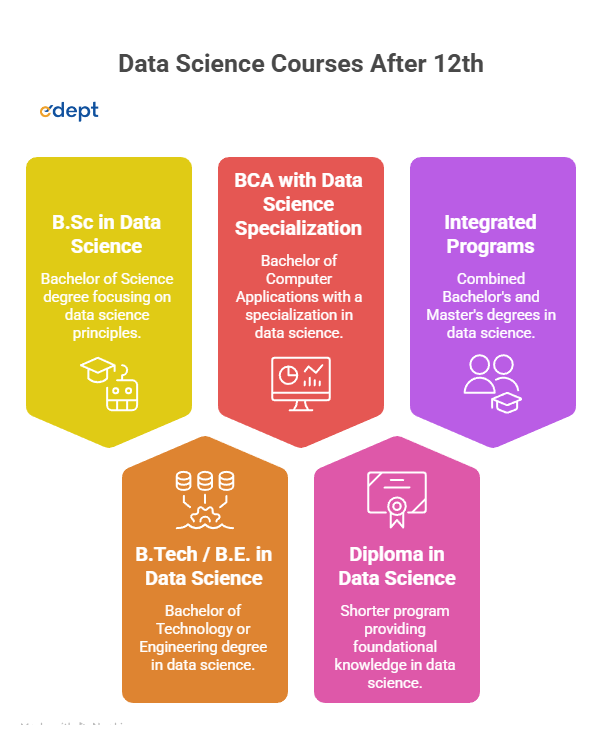
1. B.Sc in Data Science
The BSc in data science is a 3-year undergraduate programme, which is focused on analyzing data sets to derive meaningful insights. The curriculum includes statistics, Python programming, machine learning, data visualization and database management. It is ideal for students who are from the PCM or PCB streams and who are comfortable with numbers and have an interest in critical and logical thinking. Institutions like IIT Madras, Christ University, and several state universities are now offering this programme, with fees typically ranging from ₹50,000 to ₹300,000 per year. This course provides a strong foundation, and nowadays many universities partner with renowned industries, which expose students to practical live projects and internships.
2. B.Tech / B.E. in Data Science
The B.Tech. in data science is a 4-year undergraduate engineering programme that focuses on machine learning, data analysis, artificial intelligence, algorithmic thinking, and applied coding. It provides a combination of core computer science fundamentals and a data science specialization – covering areas such as machine learning, data structures, AI, and cloud computing. Admission is based on JEE Main, MHT CET, or other university-level exams. Fee ranges usually fall between ₹100,000 and ₹400,000 per year. Some of the key skills required include the ability to analyze datasets, build predictive models and implement data-driven decisions.
3. BCA with Data Science Specialization
A Bachelor of Computer Applications (BCA) with a Data Science Specialization is a 3-year undergraduate programme that combines foundational computer science with advanced data analytics, machine learning, and AI. Here you will learn programming languages such as Java, Python, R, and C++, along with database management and data visualization tools such as Tableau, Power BI, etc. After completing graduation, the students find employment in technology, finance, healthcare, and retail as data analysts, data scientists, machine learning engineers, and database administrators.
4. Diploma in Data Science
A diploma in data science is usually a 6-12-month programme that is usually designed for practical job-ready skills rather than only theoretical knowledge. It is useful to equip learners with skills in Python, SQL, machine learning, and data visualization. It is suitable for students who want to enter the workforce quickly or for someone who wants specialized data science knowledge.
5. Integrated Programs (B.Sc + M.Sc)
Several universities now provide integrated programmes (B.Sc + M.Sc), which are 5-year, 10-semester dual-degree courses that allow students to combine undergraduate and postgraduate studies, often available immediately after Class XII. These programmes usually provide specialized research-based education in subjects such as Physics, Chemistry, Mathematics, and data science. They allow students to complete both degrees in a single continuous track, saving an entire year rather than doing it separately. This programme is ideal for students who are confident and have made up their mind that they want to pursue a long-term career in data science and want to avoid the effort of re-applying for a master’s degree later.
If you are sure about starting a career in data science and your inclination towards maths, statistics, and technology is great, then starting after 12th is a great decision. It will give you 3-5 years of both theoretical knowledge and practical skills. The ideal candidate is someone with a genuine interest in critical thinking and problem-solving, a curiosity for technology, and the discipline to stick with a technical curriculum over three to four years.
Data Science Courses After Graduation
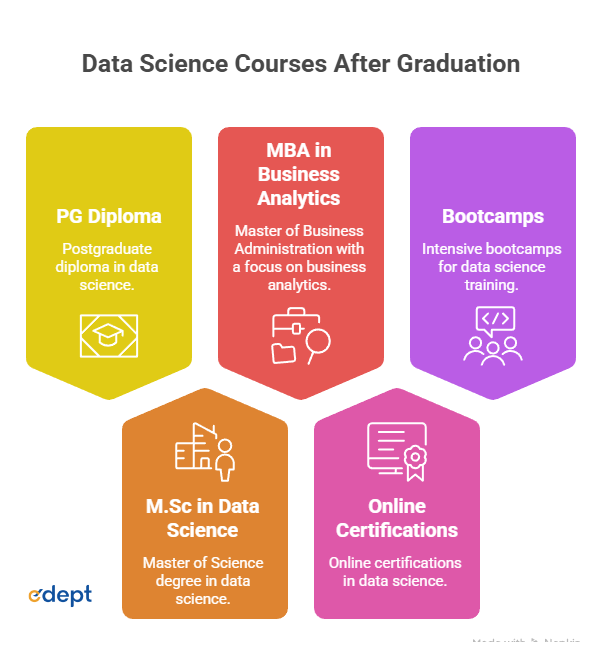
1. PG Diploma in Data Science
A PG Diploma in data science is a six- to twelve-month intensive industry-focused programme, which is designed to build practical and job-ready skills very quickly. It is used to equip graduates and professionals with various skills such as AI, Python/R programming, SQL, and data visualization as well as real-world projects. Normally, it requires a bachelor’s degree in engineering, science, or computer science, although many programmes allow graduates from any discipline if they have some industry experience or strong aptitude and critical thinking skills.
2. M.Sc in Data Science
An MSc in data science is a 2-year postgraduate programme that provides advanced training in statistics analysis, machine learning, and programming to solve complex and real-world problems. It requires a bachelor’s degree in STEM, with 50% marks. The curriculum typically includes Python programming, database management systems (SQL), machine learning algorithms, data visualization, data mining, and big data analytics. Universities like LPU, IGNOU, Amity Online, and several IITs offer this programme.
3. MBA in Business Analytics
An MBA in business analytics is a 2-year postgraduate programme that blends management principles with data science, training students to use tools like Python, R, and SQL for data-driven business decisions. It usually combines predictive modelling, AI, and data visualization, which helps in preparing graduates for roles such as business analyst, AI strategist, or consultant across industries. The curriculum covers core subjects such as finance, marketing, and strategy, along with technical skills such as data mining, predictive modelling, and machine learning.
4. Online Certifications
Some of the top certifications for data science professionals include professional certificates from industry leaders like Google, IBM, and Microsoft. Some of the key programmes include Google Advanced Data Analytics Professional Certificate, IBM Machine Learning, and Harvard’s Data Science Professional Certificate. These certifications provide specialized skills in machine learning, Python, and data visualization. Some of the key platforms where you can easily start a certification include Coursera, edX, UpGrad, and DataCamp.
5. Bootcamps
Bootcamps are very intensive and skill-based programmes which generally run for 3 to 12 months. A data science bootcamp is designed to prepare individuals for a career in AI, data analytics, data science, machine learning, etc. They basically focus on practical skills such as Python, SQL, machine learning, and AI tools. They provide hands-on, practical experience where students work on real-life projects and solve critical problems. Some of the core curriculum includes programming, data analysis, machine learning, generative AI, and portfolio building. The top providers include CodeBasics, Springboard, Dataquest, UpGrad, etc.
Engineering graduates can move directly into M.Sc. programmes, PG diplomas, or MBAs in analytics, based on whether they want technical depth or management exposure. Commerce and arts graduates can successfully enter data science through PG diplomas, online certifications, or bootcamps – a mathematics background can help sometimes, but it is not always a necessity. Career switchers from any field tend to benefit most from bootcamps and certification programmes that focus on applied, practical skills.
Eligibility Criteria for Data Science Admission
Understanding the eligibility beforehand saves your time and helps you choose the right programme.
After 12th:
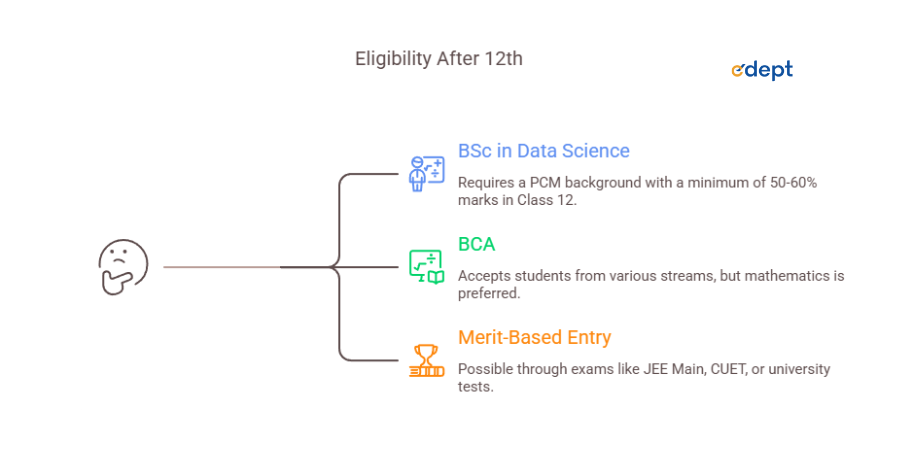
- The BSc in data science programmes require a PCM – Physics, Chemistry & Mathematics – background, and maths is important for most universities.
- You should have a minimum of 50–60% marks in Class 12 (which varies by institution and programme)
- For the BCA programmes, many universities accept students from different streams, but mathematics is preferred.
- Sometimes merit-based entry is possible via exams such as JEE Main, CUET, or specific university tests.
After Graduation:
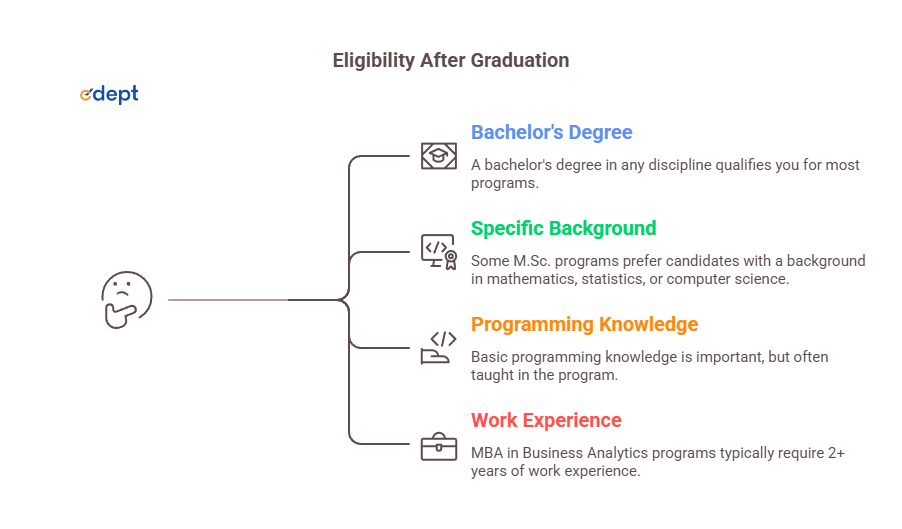
- You need a bachelor’s degree in any discipline – B.Sc, B.Tech, BCA, B.Com, or BA – to qualify for most PG programmes.
- A few M.Sc. programmes prefer candidates with a background in mathematics, statistics, or computer science
- Basic programming knowledge is important, but is often taught as part of the programme.
- A minimum of 50% marks in graduation is required (varies by institution)
- Mostly MBA in Business Analytics programs typically prefer candidates with 2+ years of work experience
Admission Process 2026
The admission process for data science programmes in 2026 usually depends on the type of institution and programme level.
- Merit-based admissions.
Many private universities and online platforms usually provide direct admission based on 12th marks or graduation percentage. They do not require entrance exams. For B.Sc. programmes, many central universities now use CUET scores for merit-based admissions. - Entrance exam: For B.Tech programmes, JEE Main is one of the primary national-level exams, while state-level tests like MHT CET, KCET, and AP EAMCET are widely accepted in their respective regions. Private universities often conduct their own entrance tests or offer direct admission based on academic records
- For admission to an MBA in business analytics, CAT, XAT, and GMAT are the most commonly accepted entrance exams. Programs at IIMs must have strong CAT scores, while private business schools may accept a wider range of tests
- Most of the universities open their admission cycle between March and June. Some universities also offer rolling admissions for online and PG diploma programmes throughout the year.
- The documents which are typically required include 10th and 12th marksheets, a graduation certificate for PG programmes, identity proof, and a passport-size photograph.
Course Fees & Duration
Fees for data science programmes in India usually depend on the institution, mode of learning, and programme level. Here is a structured comparison.
| Course – After 12th | Duration | Approx. Fee Range |
| B.Sc. Data Science | 3 years | ₹1.5 Lakhs – ₹3.5 Lakhs |
| B.Tech Data Science | 4 years | ₹2 Lakhs – ₹12 Lakhs |
| BCA Data Science | 3 years | ₹2 Lakhs – ₹4 Lakhs |
| Diploma in Data Science | 6-12 months | ₹50,000 – ₹2 Lakhs |
| Integrated B.Sc + M.Sc | 5 years | ₹3 Lakhs – ₹20 Lakhs |
| Course – After Graduation | Duration | Approx. Fee Range |
| PG Diploma | 6-12 months | ₹1 Lakh – ₹ 6 Lakhs |
| M.Sc. Data Science | 2 years | ₹2 Lakhs – ₹8 Lakhs |
| MBA Business Analytics | 2 years | ₹6 Lakhs – ₹12 Lakhs |
| Online Certifications | 3-6 months | ₹30,000 – ₹1 Lakh |
| Bootcamps | 3-6 months | ₹50,000 – ₹3 Lakh |
ROI note: While B.Tech and MBA programmes involve high costs, they typically offer stronger placement support and higher starting salaries. Online certifications and bootcamps offer excellent value for money, especially for career switchers seeking a practical, quick entry into data roles.
Career Scope & Salary After Data Science Courses
A data science career offers high demand, competitive salaries, and significant job opportunities across industries such as finance, retail, and technology. Entry-level roles in India usually start at ₹4–8 LPA, mid-level roles at ₹10–18 LPA, and experienced and senior positions at ₹10–18 LPA. Some of the key job roles include data scientist, data analyst, ML engineer, and data architect.
Entry-level roles:
- Data Analyst: They help in interpreting and collecting data to help businesses make informed decisions.
- Junior Data Scientist: They help in building predictive models as well as work with machine learning algorithms.
- Business Analyst: They help bridge the gap between data insights and business strategy as well as decisions.
- Machine Learning Engineer: They help in building and designing self-running software for predictive modelling.
Industries hiring data professionals include IT, banking, financial services, insurance, healthcare, e-commerce, logistics & supply chain, as well as government and public sectors.
Freshers in India usually earn between ₹4 and ₹8 LPA, depending on the location, job role and skillset. Those who join big MNCs or top product-based companies can start with a package of ₹10 LPA. After 3-5 years of consistent skill building and industry experience, professionals can move into more important job roles such as senior data scientist, lead analyst, or data engineering manager. This field has a large scope for continuous learning and upgrading, which leads to more advanced career growth and attractive salaries.
Conclusion
Data science is one of the fastest-growing and most in-demand career options in today’s digital world. Organization completely depend on data to make informed decisions, improve their performance and also drive innovations. Because of this rapid evolution in data science, the highly skilled professionals in data science are highly valued worldwide.
Whether you are trying to start a career in data science just after your 12th grade with a BSc or BTech degree or you want to enter this field after completing graduation, a career in data science offers a clear and successful pathway. Data science offers significant career opportunities and a rewarding career path. For individuals and students who are interested in solving complex problems and have a critical thinking mindset, this career is exactly for you.
FAQs
Which data science course is best after 12th?
The best data science courses after 12th are B. Tech. in Data Science, BSc in Data Science, BCA in Data Science/analytics and Diploma in Data Science.
Can I do data science without mathematics?
Yes, you can start a career in data science without a strong, advanced mathematics background, but you cannot avoid it entirely
Is data science a good career in 2026?
Yes, data science is an excellent career in 2026, with a high demand and significant career opportunities.
What is the eligibility for data science courses after graduation?
Eligibility for data science courses after graduation generally requires a bachelor’s degree, preferably in STEM fields (computer science, engineering, mathematics, statistics, or IT) with at least 55–65% marks.
How much does a data science course cost in India?
Data science course fees in India typically range from ₹15,000 to over ₹1,000,000, depending on the intensity and type of programme. Short-term certifications and bootcamps usually cost ₹30,000–₹150,000, while postgraduate (PG) diplomas cost ₹100,000–₹400,000+ and full-time M.Sc/B.Tech degrees range from ₹2 to ₹10 lakhs.
What entrance exams are required for data science admission?
Data science admission requires entrance exams focused on mathematics, physics, and logical reasoning, primarily JEE Main for B.Tech, CUET for central universities, and institution-specific tests. Postgraduate admissions (M.Sc./M.Tech) usually require GATE or university-specific tests like IIT JAM
Can commerce students pursue data science?
Yes, commerce students can absolutely pursue a career in data science.
What is the average salary after completing a data science course?
The average salary for a data scientist in India after completing a course typically ranges from ₹5 LPA to ₹10 LPA for freshers, with overall averages frequently around ₹9–14 lakh per year
Is online data science certification valuable?
Yes, online data science certifications are valuable for building foundational skills, boosting resumes, and switching careers
Should I start data science after 12th or after graduation?
Starting a data science career after 12th is better for a specialized and tech-oriented career. After graduation, a data science course can help you to build domain expertise and can be a great career switcher. Students who are focused on a tech-orientated career and love solving complex problems should surely go for a data science course after 12th.