Cybersecurity for startups is crucial for protecting data, building trust, and ensuring survival, focusing on core practices like strong access control (MFA, least privilege), regular software updates, firewalls/antivirus, data backups, employee training (phishing/social engineering), secure cloud use, and incident response planning, often with cost-effective tools like VPNs to prevent costly breaches. Startups are attractive targets due to limited resources, so a proactive, culture-focused approach from day one is key.
Startups face one uncomfortable truth: cyberattacks hit small businesses more often than large enterprises. Limited budgets, rapid scaling, and lean tech teams make startups prime targets. In 2026, with the digital transformation of businesses, governments, cybersecurity has become one of the most critical job domains in India. Almost every day, organisations face cyber threats like phishing, ethical hacking, ransomware, and data breaches. As per the industry reports, India has witnessed more than 1.3 million cyber attacks in 2023, which highlights the emergence of urgent need for trained cybersecurity professionals. As a consequence, cybersecurity is no longer an optional field in the education sector; it has become a necessity. Top companies in India and abroad are now heavily investing in cybersecurity experts, which makes it one of the most lucrative and future-proof professions. But one of the main questions lies in “is cybersecurity a good career in India?” Well, in this blog, we will discuss all the aspects that justify the scope of Cybersecurity for Startups in India.
What is Cyber Security?
Cybersecurity is the practice of protecting computer systems, digital data, and networks from unauthorised access, attacks, and, most importantly, damage. It comprises a wide range of techniques that include firewalls, encryption, monitoring systems, and ethical thinking to make sure that the sensitive data remains safe and secure. Some of the key features of Cybersecurity for Startups are listed below:
- Protecting the companies when financial losses due to data violations.
- Safeguarding candidates from identity theft.
- Assisting businesses in complying with global laws like GDPR and ISO norms.
- To ensure national security against cyber war.
Scope of Cyber Security in India
Cybersecurity is the backbone of safe digital operations. The scope of cybersecurity is growing rapidly due to advanced cybercrime and digitalisation. As India is one of the largest digital economies in the world, protecting sensitive data has become a top priority for both private and government sectors. Check the pointers below that highlight the growing demand for cybersecurity:
- Rising cybersecurity cases – India ranks as one of the top nations targeted by cyber attacks. Hence, the scope of cybersecurity in India is always trending.
- Government initiatives – Cyber Security Policies made by the government aim to guard India’s digital infrastructure through the National Cyber Security Policy. These policies help strengthen national security, create vast opportunities, incident response, etc, and build digital trust.
- Corporate Investments – Data protection is heavily required om Banking, Healthcare, Information Technology, e-commerce.
- Job opportunities – Based on NASSCOM, India will require more than 1 million cyber security experts by the end of 2025, which shows that the demand for cybersecurity jobs is massive. The average cyber security salary in India is observed to be between INR 5,00,000 to INR 30,00,000 Per Year.
Is Cyber Security a Good Career in India?
Yes, cyber security is one of the most promising job options in India today. With the rapid rise in digitalisation, cyber threats are growing at an alarming rate, which creates a massive demand for skilled experts. The demand for cyber security exceeds the current supply of professionals in India, ensuring strong job security for those willing to enter the field. Moreover, professionals enjoy lucrative cyber security salaries, which are often higher than the CTC offered at ITs, and the skills gained by them are valued globally, offering excellent international exposure to career opportunities. actors will use automation and AI-driven attacks, meaning every startup, tech, healthcare, fintech, and retail company needs a basic cybersecurity foundation. This guide breaks down Cybersecurity for Startups in simple terms so founders, early-stage employees, and first-time tech teams can take practical steps.
Why Startups Are High-Value Targets in 2026
Founders often believe attackers target only big tech. Reality is sharper.
Reports show over 43% of cyberattacks now target small businesses, especially those in sectors handling customer data: healthcare, e-commerce, and education.
Startups store high-value information: user data, intellectual property, prototypes, financial records, and early investor documents. Attackers know defenses are weaker, making intrusion easier.
Most Common Cyber Risks for Startups
Cyber risks are evolving, but startups typically face five high-impact threats.
Ransomware: Hackers encrypt systems and demand money. Startups with no backups often go down for days.
Phishing: Employees unknowingly clicking fake emails or links—the most common startup data breaches.
Credential Leaks: Weak passwords or reused credentials exposed in data dumps.
Cloud Misconfigurations: Incorrect security settings leave storage buckets publicly accessible.
Insider Errors: Non-technical staff accidentally expose sensitive files.
Startups don’t need enterprise-scale setups, but they do need basic controls to avoid catastrophic downtime.
Beginner-Friendly Cybersecurity Measures Every Startup Must Adopt
Strong cybersecurity doesn’t always require massive spending. The fundamentals alone reduce risk significantly.
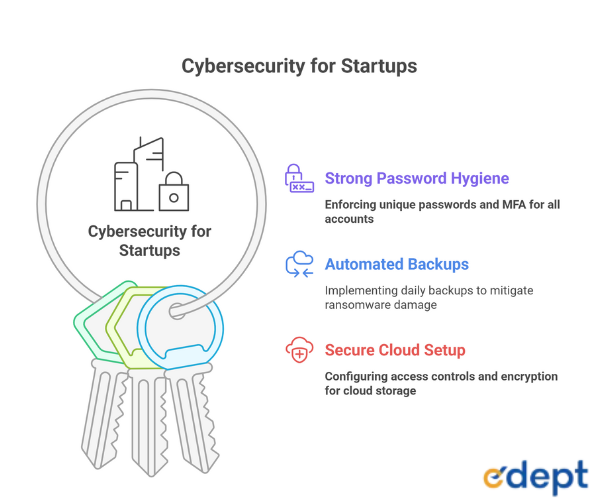
Three Cybersecurity for Startups essentials that matter most are:
1. Enforce strong password hygiene and MFA
Every employee should use unique passwords and multi-factor authentication for email, internal tools, and cloud accounts.
2. Enable automated backups and version history
This reduces ransomware damage drastically. Daily backups for all critical data are non-negotiable.
3. Use a secure cloud setup
Configure access controls, enable encryption, and ensure no storage buckets or databases are publicly accessible.
These steps act as the foundation upon which more advanced security tools can be added.
Essential Cybersecurity Tools for Early-Stage Startups
Even bootstrapped companies can secure their operations with basic tools.
Endpoint protection for laptops and devices.
Password managers for secure credential storage.
Cloud security tools (AWS, Azure, GCP built-in controls).
Firewalls for workspace networks.
Email security filters to catch phishing and spam.
The goal is not perfection, but sustainable protection.
Why Founders and Early Teams Must Understand Cybersecurity Basics
Cybersecurity is no longer optional literacy.
Whether it’s a healthcare app, an e-commerce platform, a fintech product, or an AI tool, user trust depends on security.
A single data breaches can derail funding, credibility, and product adoption.
Founders with cybersecurity awareness make smarter decisions around product design, tech-stack choices, customer data handling, and compliance readiness.
How Cybersecurity Courses Help Startup Professionals
Upskilling helps teams build security-first cultures from day one.
Programs like CEH, SOC Analyst, cybersecurity diplomas, and entry-level security certifications help professionals:
• set up secure cloud and API workflows
• design compliant data pipelines
• understand secure coding practices
• prevent ransomware/phishing attacks
• build incident response playbooks
• create a scalable security roadmap
For tech and non-tech roles alike, cybersecurity skills are now a strategic advantage.
FAQs
1. Why is cybersecurity important for startups in 2026?
Startups with limited defenses experience higher breach rates. Strong cybersecurity builds customer trust and protects business continuity.
2. What is the biggest cyber threat for startups?
Phishing remains the top attack vector, followed by ransomware and cloud misconfigurations.
3. Are advanced tools required for early-stage companies?
Not initially. Basic controls, password hygiene, MFA, and backups cover most beginner needs.
4. Can non-technical founders implement cybersecurity?
Yes, with structured guidance and beginner-focused learning programs.
5. Do cybersecurity skills help in startup product development?
Yes. Secure architecture, encrypted data flows, and safe user onboarding directly impact product adoption and trust.