Cybersecurity awareness and education are critical for Indian students due to the rapid digitization of education and the increasing sophistication of cyber threats.
In the digital era, young learners of India mostly depend on the internet for education, communication, entertainment, and financial transactions. Online classes and social media, digital payments, and cloud storage are all examples of how technology is intertwined with our everyday lives. A negative aspect of this ever-increasing digital dependence is that students are continuously becoming vulnerable to cyber threats. That is why cybersecurity awareness is crucial.
Knowing what is cyber security awareness is enables students to identify online dangers, keep their personal data safe, and be considerate users of technology. As the number of cybercrime cases is escalating in India, cybersecurity awareness education for students is no longer a matter of choice but a vital skill for living. Correct cybersecurity awareness and training help youngsters to be secure on the internet and, at the same time, lay a foundation for good digital practices in the future.
What Is Cyber Security Awareness?
Cybersecurity awareness is basically about informing people regarding the kinds of risks that exist online and what they can do to stay digitally safe. It also includes knowing what one can do to secure the systems, devices, and personal data from being compromised by cyber threats. People must get familiar with the most commonly used forms of attack, like phishing, malware, identity theft, and hacking, and also the knowledge of how to prevent these vulnerabilities from becoming a reality.
Cybersecurity awareness programs are there to help people realize how hackers think and operate, and then simple things like using strong passwords, steering clear of suspicious links, and securing sensitive information can drastically lower the risk level. For students, such awareness educates them on their digital responsibilities and, at the same time, helps to ensure that they can use the internet safely both for academic purposes and personal life.
Read more: Remote Work Cyber Risks to know
Importance of Cybersecurity Awareness in the Digital World
With the rapid expansion of digital platforms, cybercriminals are constantly upgrading their tactics. Educational institutions, banking systems, mobile apps, and social media platforms are always under the threat of cyber attacks. Users, if not properly informed, quite often turn out to be the weakest link in cybersecurity. This is the exact reason to know what is cyber security awarenes.
The key benefits of Cybersecurity in the digital world are:
- Staying one step ahead of the cyber attackers by knowing the exact patterns of their attacks and types of attacks helps you to stay safe from losing sensitive data and information. This is why cybersecurity awareness is important.
- Cybersecurity awareness training programs for students help them build healthy cyber habits and practices at an early stage.
- Teaching individuals how to respond effectively to security breaches and suspicious online activities.
- Encourages individuals to use the internet responsibly and learn about ethical online behavior.
Cybersecurity awareness and training make it possible for people to know the ways in which data breaches happen and how tiny errors on their part could result in big financial and privacy damages. The importance of cybersecurity is evident when one thinks of how it ensures that academic records are safe, and it also helps in the fact that online transactions are secure. Awareness is considered to be the first line of defense in a world where everything is becoming extremely technological.
Why Cybersecurity Awareness Is Important for Indian Students
Indian students rank among the highest internet users; in most cases, they access online platforms via their mobile phones and from public networks. This makes them a highly vulnerable group for cyber scams and other kinds of digital fraud. In fact, India experienced a growth of over 30% in cyber attacks every year, with the education sector being the most vulnerable due to the lack of strong security practices.
By knowing the reasons why cybersecurity awareness is essential, students will be able to avoid such traps as fake scholarship links, online gaming scammers, phishing emails, and social media impersonation. Learning what online in safer environments looks like, keeping the personal and financial data safe, lowering the chances of being cyberbullied and having one’s identity stolen, all of these points must be established in young age to enable strong digital habits at a very young age.
Types of Cyber Security Students Should Know
Students must know the major types of cybersecurity, such as network security that helps to protect Wi-Fi and online communication; application security that ensures that software & applications are well secured; cloud security that helps to protect online storage; and endpoint security that helps to protect devices such as phones and laptops. These are a few things that make students safe in the cyber world.
Network Security
Network security is about defending internet connections and internal networks from unauthorized access, hacking attempts, and malicious traffic. It facilitates the reliable and safe transmission of data among various devices and a server.
Endpoint Security
Endpoint security is a defense mechanism for individual devices such as smartphones, laptops, and tablets against malware, viruses, and cyber intrusions. Students are heavily reliant on various gadgets in their daily lives, hence the importance of this kind of security.
Application Security
Application security is about protecting mobile applications, websites, and online platforms from potential threats that hackers can take advantage of. It also keeps users safe when surfing or conducting financial transactions.
Cloud Security
Cloud security is concerned with protecting the confidential nature and safety of the data stored on cloud services such as Google Drive and online educational portals.
Data Security
Data security is geared towards protecting personal data, educational records, and financial information from being disclosed or accessed by unauthorized individuals.
Common Cyber Threats Faced by Indian Students
Some of the risks that Indian students may be exposed to include phishing attacks, fake scholarship websites, social media fraud, downloading malware, and identity theft. A lot of students have to deal with online bullying and fake job offers. When you know such dangers, you will be able to recognize the moment you are in danger and thus avoid becoming a victim of cybercrime.
Phishing Emails and Fake Links
Phishing emails or messages that look real but are designed to steal login details or personal information are a very common trick used on students.
Online Fraud and Scam Calls
Using fake prize giveaways, loan offers, impersonation, etc., cybercriminals convince students to share their private information, which they then misuse.
Social Media Hacking
Poorly chosen passwords and harmful apps expose social media accounts to hackers.
Identity Theft and Data Breaches
Victims’ personal information is used to open accounts in their names, carry out fraud, or blackmail them.
Malware and Ransomware Attacks
Being careless if one downloads files from insecure sources leads to infection, data being locked, or stolen.These are just some of the cybersecurity awareness tips that emphasize how important it is for students to always be vigilant when they are online. Gain hands-on training in ethical hacking, digital forensics, and more through Edept’s B.Voc Cybersecurity Program aligned with industry needs.
Best Practices and Cybersecurity Awareness Training
As the number of cyber threats keeps increasing in this digital world, it is nowadays a must for students and regular users to know and practice online safety habits. Cybersecurity awareness training gives people insight into the ways cyber attacks take place and also shows them straightforward actions that can help avoid very large security breakdowns. By implementing the right methods, students can safeguard their personal information, online accounts, and digital identities when they are surfing, studying, and carrying out online transactions.
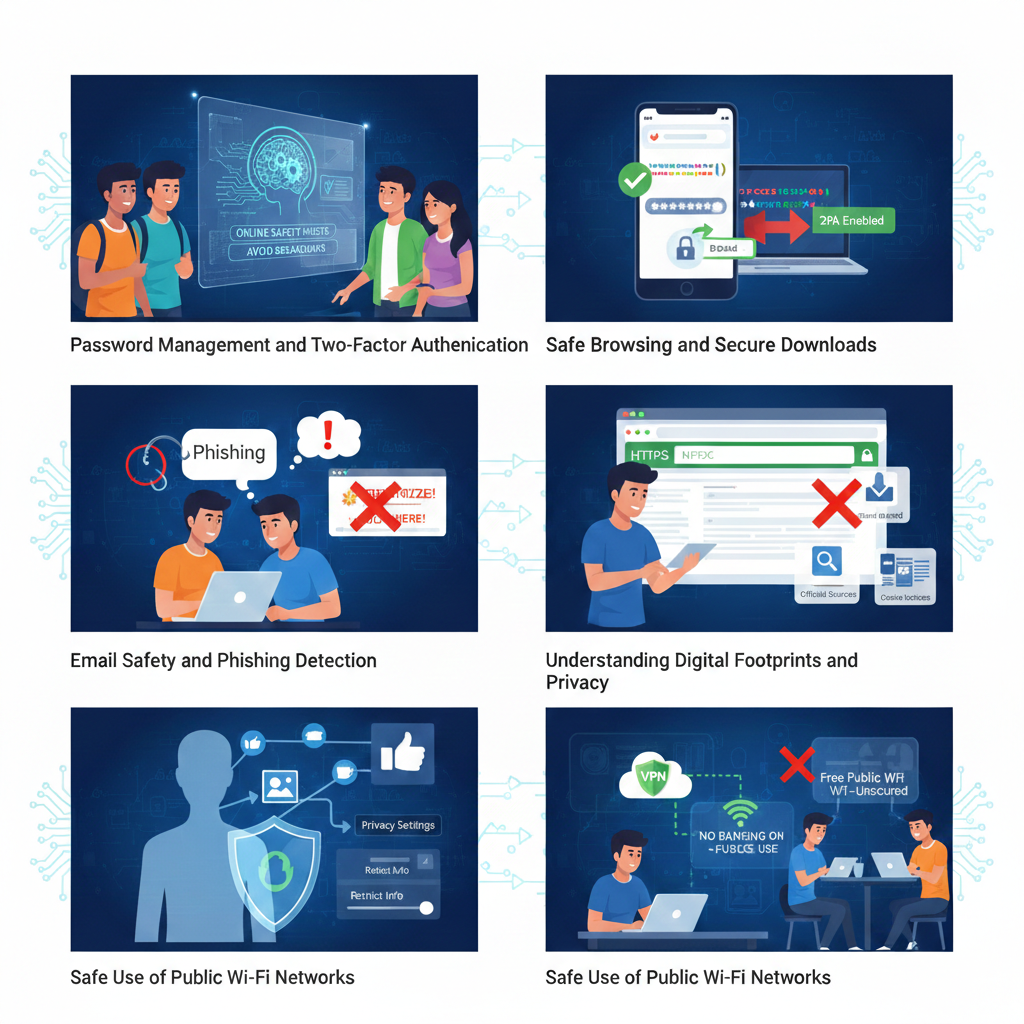
Password Management and Two-Factor Authentication
Strong password practices are the first line of defense against cyber threats. A significant number of cyber attacks are effective due to the use of weak or simple passwords by users on various platforms. An effective password must have both uppercase and lowercase letters, numbers, and special characters. One should not use personal information like the birth date or easy-to-guess names as well.
Two-factor authentication (2FA) represents an additional security measure that involves verifying the identity by another means, like a one-time code delivered to a cell phone or a mail inbox. Although a hacker is able to access a password, 2FA can still stop unauthorized access. The use of unique passwords under various accounts and two-factor authentication wherever feasible can be one of the most highlighted issues when it comes to cybersecurity awareness programs, as such a measure can go a long way in preventing account breaches.
Safe Browsing and Secure Downloads
Safe internet browsing is a significant aspect of avoiding malware attacks and cyber attacks. The students should not be clicking on unknown links, pop-up advertisements, or suspicious content on websites that claim to offer free prizes or downloads. Most cybercriminals create fraudulent websites that appear real to obtain login details or install malicious software on computers.
Another practice that is essential in terms of security is downloading only software from official websites or trusted applications. The unofficial sources have files that may have malware hidden in them, which could end up tracking activities or stealing personal information. The awareness training on cybersecurity helps users know how to identify secure websites by ensuring that they have HTTPS in the address bar, and to exercise caution whenever leaving their personal information on the Internet.
Email Safety and Phishing Detection
Phishing is one of the most used cyberattacks among students and other internet users. Fraudsters tend to send spam emails in the form of banks, universities, or well-known services to users to make them fall into malicious links or hand over sensitive data.
Awareness training will allow the students to know how to recognize phishing emails by observing warning indicators, like use of poor grammar, sense of urgency, unfamiliar sender, and suspicious attachment. Users are not supposed to trust emails and download files in emails that they are not fully convinced about. By checking the information on the official websites rather than email links, one can avoid a lot of attacks associated with phishing. The acquisition of these basic practices makes a significant contribution to online security.
Understanding Digital Footprints and Privacy
All things one does online have some form of digital footprint, such as postings in social media or even an internet search and usage of applications. It is not known by many students how much information they share on the internet and how it can be used by cybercriminals to commit identity theft or harass them online.
The cybersecurity awareness training will educate students on the need to control their privacy settings on social media, restrict the amount of personal information they share on the internet, and be aware of sensitive content that they post online. Learning about the data collection and storage mechanisms of websites and applications also allows the user to make safer online decisions.
Students can prevent a damaged image in the online world and minimise the risk of falling prey to cybercrime by developing effective privacy habits early on. Good online citizenship is important to the continued online safety.
Safe Use of Public Wi-Fi Networks
Wi-Fi systems offered publicly in cafes, airports, libraries, and colleges might be convenient, but they are often not secure and can be easily attacked. Transmitted data via these networks can be easily intercepted by hackers who can access passwords, personal information, and even financial details. Some cybercriminals even go to the extent of establishing fake Wi-Fi hotspots that look true to the eyes of the users and make them connect.
Students are taught cybersecurity awareness training, which includes not accessing online banking, email, or the academic portal, and using public Wi-Fi. An additional security measure is the use of a Virtual Private Network (VPN) that will encrypt online traffic. One should also switch off the automatic Wi-Fi and log out of accounts after use. Safe public network practices can help to minimize the risk of data theft and illegal access by a large margin.
Government Initiatives for Cybersecurity Awareness in India
The Government of India has established various programs that aim at cybersecurity awareness and education among the people of India. Programs such as Cyber Swachhta Kendra (Botnet Cleaning and Malware Analysis Centre) are aimed to assist a user in identifying and deleting malware infections and providing the tools and resources to enhance their device’s security. Considering the Digital India campaign initiated by the Government, there are components of cybersecurity awareness that are spread among students, professionals, and ordinary users of the country.
Also, CERT-IN (Indian Computer Emergency Response Team) periodically publishes advisories, best practices, and alerts on the new threats to keep the people updated. Most state governments, learning institutions, and boards also organize workshops and training to advance safe internet practices, particularly among students and young people. The combined efforts are meant to create a safer digital ecosystem in which the user is given the necessary knowledge to safeguard themselves against cyber threats.
Student cybersecurity education is also actively being integrated into school and college curricula as awareness of the idea of safe digital behavior grows as one of the core life skills of the Indian technocratic future.
Career Opportunities in Cybersecurity for Indian Students
As the digital space expands faster and cyber threats expand, cybersecurity has emerged as one of the fastest-growing fields of work in India. Organizations in the banking, healthcare, IT, government, e-commerce, and telecom industries are in high demand to recruit qualified cybersecurity professionals to safeguard their IT systems and sensitive information. To the Indian students, cybersecurity not only guarantees employment stability but also provides high salaries and overseas career opportunities.
The most sought-after cybersecurity positions are some of the following:
Cybersecurity Analyst
Cybersecurity analysts observe the networks and systems for any suspicious activity, enquire into security breaches, and adopt preventive steps to avert any further attack. They are critical to ensuring the overall digital security of an organization.
Ethical Hacker
Ethical hackers or penetration testers are hackers who are legally allowed to test systems by detecting vulnerabilities to cybercriminals. Their contribution assists organizations in enhancing security defenses and minimizing risk.
Digital Forensics Expert
Digital forensics experts handle cybercrimes with the help of collecting and analyzing digital evidence. They also help law enforcement agencies and organizations to trace the cyber attackers and comprehend security incidents.
The information security manager.
Information security managers develop and implement information security strategies and make sure that the security policies are adhered to and that the members of the team tasked with safeguarding company data are managed.
With the ongoing digital transformation of India, the demand for cybersecurity professionals is projected to grow exponentially, thus becoming a lucrative and future-proof profession for students who are interested in matters of technology and digital safety.
Also check: Top 5 Cybersecurity Career Paths 2026
How Indian Students Can Improve Cybersecurity Awareness
Cybersecurity is now among the fastest-growing professions in India, with the intensive development of digital environments and the threat of cyberattacks. Banks, healthcare, and information technology companies, government, e-commerce, and telecommunication organizations are in the pursuit of competent cybersecurity experts to safeguard their digital systems and confidential information. To Indian students, cybersecurity is not only their assurance of employment but also a high level of salary increase and exposure to an international career.
Cybersecurity positions that are in high demand are some of the following:
Cybersecurity Analyst
Cybersecurity analysts oversee any suspicious activities in networks and systems, investigate security breaches, and apply protective methods to curb any attacks in the future. They are essential in upholding the general digital security of an organization.
Ethical Hacker
The cybercriminals are also the ethical hackers or the penetration testers who test systems legally to detect vulnerabilities before the cybercriminals can exploit them. Their work assists the organization in fortifying security defenses and diminishing the risk.
Digital Forensics Expert
Digital forensics investigators examine cybercrimes through the gathering and examination of digital recordings. They help law enforcement organizations and agencies to monitor cyber attackers and comprehend security events.
Information Security Manager
Information security managers create and manage strategies to implement cybersecurity, make sure that they comply with security policies, and manage teams that handle the security of the company’s data.
As India is in its digital shift, the number of people who will be in need of cybersecurity services is poised to grow exponentially, making it one of the potential and future-thrilling career options of anyone who is interested in technology and cyber safety.
Building a Safer Digital Future Starts with Cybersecurity Awareness
Now, as India is more and more connected via digital means, the role of cybersecurity awareness and education has never been higher than it is now. To students, learning about online threats, safe online practices, and how cyber threats work are all skills that students need in order to be able to keep themselves safe as well as their future professional lives. Cybersecurity awareness will help young people navigate the online world with confidence because, in addition to keeping sensitive information confidential, young people can detect fraudsters, malware attacks, etc.
Educational programs, government programs, and cybersecurity awareness training are making internet users a smarter and safer generation. Meanwhile, the increasing need for cybersecurity specialists creates very promising career opportunities for students who want to play a role in ensuring the safety of the digital realm. To stand ahead in the queue of future cybersecurity professionals, going for the right cybersecurity programs is key. That’s where B.Voc in Cybersecurity by Edept comes into the picture. It is far better than traditional degrees as you will be learning the required skills through industry exposure and hands-on experience, which will give a massive push in your cybersecurity career.
By making cybersecurity awareness a key priority, Indian students can safeguard themselves and build a safer and smarter digital India in the future. In this way, they will be one step ahead of the threats posed by the cyberattackers, leading digital India to a safer future.
Related Links:
FAQs of Cybersecurity Awareness
- What are the common cyber risks for students?
Students can face multiple cyber attacks, such as losing out on their personal information and academic work. Cyberbullying is also the most common cyber threat posed to students. All of these can easily be solved by having cybersecurity awareness.
- What is included in a cybersecurity awareness program?
An extensive cybersecurity awareness program for students should integrate foundational knowledge, skill-building, and behavioral reinforcement. It should teach every cyber attack pattern and how to handle them to safeguard one’s data.
- What are the benefits of cyber security awareness?
The greatest advantage is safety. Cybersecurity awareness and training teach students about account security, fraud prevention, and personal data protection. Cybersecurity awareness will make people and organizations learn the risks of the online world and embrace safe digital usage. It minimizes the risks of being a victim of cyber-attacks like phishing, malware, and identity theft.
- Why is cyber security awareness important in schools?
In the modern world, schools are highly digital, and, therefore, cybersecurity awareness among learners will lead to them using online resources in a responsible and safe manner. Early grade cybersecurity awareness will offer a good base against cybersecurity threats at a tender age.
- What will happen in the absence of cybersecurity?
Without proper cybersecurity measures or a cybersecurity awareness program for the students, the personal information might be stolen, the accounts may be hacked, and uthe sage of the internet may be compromised. This ignorance makes students more susceptible, and that is why creating awareness of the cybersecurity issue is essential for keeping safe in the long-term perspective.
- What are some biggest cybersecurity challenges?
Online fraud, individuals using weak passwords, the dissemination of fake information, and schools with disorganized cybersecurity awareness are some of the largest cybersecurity issues. Such concerns outline the need to have potent cybersecurity awareness and training using real-life cybersecurity awareness illustrations.