Business ethics defines how modern managers lead, build trust, and sustain success. In a world of rising risks and transparency, ethical decisions shape reputation, employee trust, and customer loyalty. Organisations that prioritise ethics do not just avoid problems; they build stronger, more resilient, and trusted businesses.
Trust in business leadership is under more pressure than it has been in years, and the 2025 data makes that hard to ignore. In India, even well-known companies like Reliance Industries and Tata Group operate in a high-risk environment where trust can shift quickly. A recent 2026 industry survey shows that 61% of Indian business leaders now see cyberattacks and data breaches as a serious threat to both reputation and revenue. At the same time, banking fraud in India crossed ₹36,000 crore in FY 2024–25, highlighting how quickly weak controls can turn into real financial losses. The gap between organisations that take business ethics seriously and those that do not is becoming more visible in both trust and long-term performance.
So what does business ethics for managers actually mean? At its core, it is the application of moral principles to real business decisions, not just the easy ones, but especially the ones that are not.
Business ethics for managers in today’s corporate environment shape reputation, drive employee trust, influence customer loyalty, and determine how organisations hold up under pressure. This blog covers what business ethics really involves, why the importance of business ethics has never been greater, and what modern managers can do to lead in a way that genuinely holds up.
What Is Business Ethics?
Business ethics refers to the set of moral principles and standards that guide how organisations and individuals within them make decisions, treat people, and conduct operations. For managers specifically, business ethics for managers means taking responsibility not just for results, but for how those results are achieved.
At the heart of business ethics is corporate governance, the framework of rules, practices, and processes through which a company is directed and controlled. Good corporate governance ensures that decisions are made transparently, that power is not abused, and that the interests of all stakeholders, not just shareholders, are taken into account. When corporate governance breaks down, the consequences tend to be significant and public.
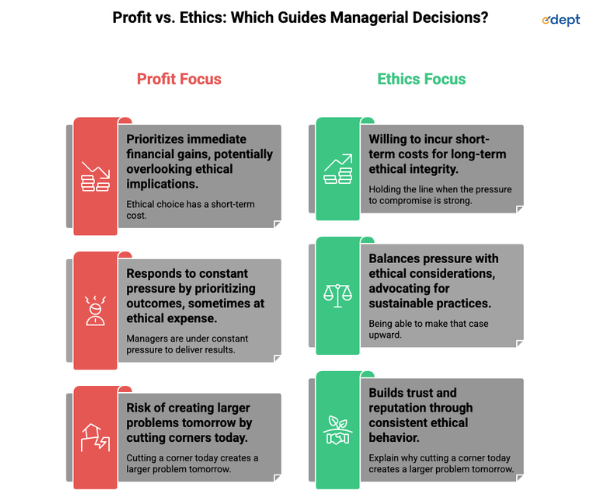
Ethical decision-making is another core element. Managers face situations every day where the profitable path and the right path are not the same thing. Ethics in management means having the principles and the courage to choose correctly even when it is uncomfortable. It means asking not just whether something is legal but whether it is fair, honest, and consistent with the values the organisation claims to stand for.
Stakeholder responsibility is the third pillar. Modern organisations are expected to consider the impact of their decisions on employees, customers, suppliers, communities, and the environment, not just on the bottom line. Business ethics for managers means understanding that organisations exist within a broader social context and that long-term success depends on earning and maintaining the trust of everyone connected to the business.
Why Business Ethics Matters Today?
There has never been a greater need for corporate ethics, and the benefits extend far beyond staying out of problems with the law.
A company’s reputation may make or break it: It’s hard to develop a good reputation for a business, but it’s easy to lose one. It’s easy to lose trust these days, and even a tiny error can hurt it. Companies that operate properly tend to get better employees, keep consumers, and bounce back more quickly when things go wrong.
Maintains legal compliance: Laws around data, the environment, and how people work are becoming harsher. Companies that follow ethical rules naturally stay in line with the law. More importantly, they generally see problems early and correct them before they get worse.
Makes work environments healthier: People who work for you pay attention to how you act. Trust grows when leaders are fair, honest, and take responsibility. People feel more comfortable, valued, and willing to give their best, which makes the whole team work better.
Gains actual trust from customers: These days, customers look for more than simply prices and products. They care about what a firm does and what it stands for. People are more likely to trust, support, and stick with a firm if it does the right thing.
Read More: Modern Business Management Growth: The Role of Digital Marketing and E-Commerce
Core Ethical Principles in Business Management
Understanding the importance of business ethics starts with knowing what it actually looks like in practice. These are the core principles that define ethical leadership in management.
Integrity
Integrity means doing the right thing consistently, whether or not anyone is watching. For managers, it means keeping promises, being honest in communications, and making decisions that align with stated values rather than convenience. Integrity is the foundation of ethical leadership because without it, every other principle becomes hollow. Teams can tell when a manager’s words and actions do not match, and the damage to trust is challenging to repair.
Accountability
Accountability means owning outcomes, including the difficult ones. Business ethics for managers requires a willingness to accept responsibility when things go wrong rather than deflecting blame or minimising failures. Managers who model accountability create teams that are more willing to flag problems early, take calculated risks, and learn from mistakes. Those who avoid it create cultures of fear and cover-up that tend to end badly.
Transparency
Transparency in ethics in management means sharing information openly and honestly with employees, stakeholders, and customers, even when the news is not beneficial. It means explaining decisions rather than simply announcing them and creating an environment where questions are welcomed rather than suppressed. Transparent leadership builds the kind of trust that sustains organisations through difficult periods and differentiates them in competitive markets.
Fairness
Fairness means applying consistent standards to decisions affecting people, from hiring and promotion to resource allocation and performance management. Ethical leadership requires managers to actively examine their biases and make sure that the processes they oversee treat everyone equitably. Unfair management practices do not stay hidden for long, and the consequences for team morale, legal exposure, and reputation can be severe.
Sustainability
Sustainability has moved from a corporate social responsibility talking point to a genuine business ethics imperative. Modern managers are expected to consider the long-term impact of their decisions on the environment, communities, and future generations, not just on this quarter’s results. Corporate ethics examples from leading organisations increasingly show that sustainable business practices are not at odds with profitability. In many cases, they drive it.
Real Examples of Ethical and Unethical Business Practices
Looking at corporate ethics examples from the real world helps make abstract principles concrete.
Patagonia
On the ethical side, Patagonia is one of the most cited corporate ethics examples in modern business. The company has built its entire brand around environmental responsibility, donating a percentage of sales to environmental causes and actively encouraging customers to buy less and repair more. Their commitment to sustainability is embedded in how the business operates at every level, not just in marketing materials. It is a clear example of ethical leadership translating into genuine business practice.
Microsoft
Microsoft under Satya Nadella is another strong corporate ethics example. Since taking over as CEO, Nadella has made transparency, inclusion, and a growth mindset central to how the company operates. The cultural shift has been reflected in both employee satisfaction scores and business performance, demonstrating that ethics in management and business results are not mutually exclusive.
Volkswagen
On the unethical side, the Volkswagen emissions scandal remains one of the most instructive corporate ethics examples of recent decades. Engineers and executives knowingly installed software designed to cheat emissions tests, prioritising short-term commercial advantage over honesty and environmental responsibility. The fallout included billions in fines, a collapsed share price, and lasting reputational damage. It is a textbook case of what happens when profit is allowed to override the importance of business ethics entirely.
The Wells Fargo
The Wells Fargo fake accounts scandal is another example that every manager should know. Pressure from senior leadership to meet aggressive sales targets led thousands of employees to open accounts without customer consent. The result was regulatory action, massive fines, and a public trust crisis that the bank is still recovering from. It demonstrates exactly how corporate pressure, when left unchecked by ethical leadership, produces outcomes that damage everyone.
Also Read: Top Mistakes Business Management Students Make in 2026
Conclusion: Business Ethics Is a Core Responsibility for Every Manager
The importance of business ethics in modern management is backed by more than principle. In 2025, Infosys reported that over 90% of its employees completed mandatory ethics and compliance training, reinforcing how seriously leading companies treat ethical culture as part of business performance. This shows that strong ethics is not just an idea, but something top organisations actively invest in.
Business ethics for managers is not a separate responsibility sitting alongside the real work of leadership. It is part of every decision, every relationship, and every outcome. Managers who lead with integrity, accountability, transparency, fairness, and sustainability do not just build better teams. They build organisations that last.
Related Links:
FAQs
What is business ethics in management?
Business ethics in management refers to the moral principles and standards that guide how managers make decisions, treat people, and lead their organisations. It covers everything from ethical decision-making and corporate governance to stakeholder responsibility and ethical leadership in day-to-day operations.
Why is business ethics important in modern companies?
The importance of business ethics in modern companies comes down to reputation, trust, compliance, and long-term performance. Organisations led by ethical managers attract better talent, earn stronger customer loyalty, avoid costly legal issues, and build the kind of culture that sustains success over time.
What are examples of ethical business practices?
Strong corporate ethics examples include Patagonia’s commitment to environmental sustainability and Microsoft’s cultural transformation under Satya Nadella. Both demonstrate how ethical leadership translates into genuine business practice rather than just public messaging.
How can managers promote ethical culture?
Managers promote ethical culture by modelling the behaviour they expect, holding themselves and others accountable, communicating transparently, and creating environments where employees feel safe raising concerns. Ethics in management starts at the top and works its way through every layer of the organisation.
What challenges do managers face in ethical decision-making?
The most common challenges include balancing profit against ethical considerations, managing data privacy responsibly, and resisting corporate pressure to compromise standards for short-term gain. Business ethics for managers requires both the principles of recognising these challenges and the courage to navigate them honestly.
How does ethics impact corporate reputation?
Ethics and corporate reputation are directly linked. Companies known for strong ethical leadership consistently earn higher trust from customers, employees, and investors. Corporate ethics examples like the Volkswagen and Wells Fargo scandals show just how quickly and severely unethical behaviour can damage a reputation that took decades to build.