Programming knowledge is often not strictly required for admission to a Master of Applied Science (MAS) in Data Science program, but it is essential for success and frequently expected or recommended by admissions committees.
Programming is often one of the biggest concerns for students considering a Data Science master’s. Many applicants assume they need extensive coding experience before they can apply, particularly when the curriculum includes Machine Learning, Data Management and other technical subjects.
So, is programming knowledge required for MAS in Data Science? According to the program brochure, prior programming exposure is preferred, but not required. The admission criteria specifically mention exposure to Python, C++ or Java as preferred rather than mandatory. Applicants must still have a bachelor’s degree in Engineering, Computer Science, Mathematics, Statistics or a related field, along with a strong quantitative background.
Programming is also an important part of the academic journey. The India Track at Mahindra University includes Programming for Data Science (Python) alongside Statistics & Probability, Data Management & SQL, Data Visualisation, Machine Learning and Cloud & Data Infrastructure Fundamentals.
This creates an important distinction: you do not need to arrive with extensive programming knowledge, but you should be prepared to develop programming skills as part of the MAS in Data Science program.
Is Prior Programming Knowledge Required for the MAS in Data Science?
No. Prior programming knowledge is not mandatory for the MAS in Data Science. The program brochure states that programming exposure in Python, C++ or Java is preferred, not required. However, applicants must still meet the broader admission criteria, including having a bachelor’s degree in Engineering, Computer Science, Mathematics, Statistics or a related field and a strong quantitative background. This distinction is important for students asking, “Is programming knowledge required for MAS in Data Science?” You do not need to enter the program with extensive coding experience, but you should be prepared to develop programming skills during the course. The India Track includes Programming for Data Science (Python) as part of its foundational and applied curriculum, alongside Statistics & Probability for Analytics, Data Management & SQL, Data Visualisation & Business, Introduction to Machine Learning, and Cloud & Data Infrastructure Fundamentals.Programming Exposure Is Preferred, Not Required
The brochure’s wording is clear: programming exposure in Python, C++ or Java is preferred, not required. In practical terms, having some programming familiarity can help you approach the technical curriculum with greater confidence. However, the brochure does not establish a minimum programming proficiency level or specify prior coding experience as a compulsory requirement.Does Lack of Programming Experience Make You Ineligible?
No prior programming experience is not listed as a mandatory eligibility criterion, so the absence of coding exposure is not stated as an automatic disqualifier. However, this should not be interpreted as a guarantee of admission for applicants with no programming background. Admission involves a joint academic evaluation to assess alignment with Illinois Tech’s MAS Data Science prerequisites, with bridging courses assigned if required. Therefore, applicants should consider their overall academic preparation, quantitative background and prerequisite alignment rather than treating programming experience as the sole admission factor.Build global-ready skills with edept’s Master’s in Data Science program
Begin Your Journey!
Why Is Programming Included in a Data Science Master’s?
Data Science combines quantitative reasoning with computational learning. Working in the field involves understanding data, analysing patterns, managing datasets and applying technical methods to solve data-driven problems. As a result, programming forms an important part of the discipline, even though prior programming experience is not mandatory for admission to the MAS in Data Science. The program reflects this broader approach by placing programming alongside Statistics & Probability for Analytics, Data Management & SQL, Data Visualisation & Business, Introduction to Machine Learning, and Cloud & Data Infrastructure Fundamentals in the India Track. This distinction is important for students considering a Data Science master’s. You do not need to enter the program with extensive coding experience, but programming is still an important part of the academic journey. The curriculum is structured to develop programming alongside the quantitative and data-management foundations needed for further study in Data Science.Programming for Data Science (Python)
Programming for Data Science (Python) is explicitly included in the India Track at Mahindra University. It is part of the foundational and applied learning stage of the Global Pathway, alongside Statistics, SQL, visualisation, Machine Learning and cloud and data infrastructure. This means students encounter programming as part of their academic preparation during the India phase rather than needing to complete programming as a separate mandatory prerequisite beforehand. The brochure specifically identifies Python for this subject, but does not provide a detailed breakdown of the Python syllabus.Programming Alongside Statistics and Data Management
Programming is taught as part of a connected Data Science foundation rather than as an isolated technical skill. The India Track brings together:- Programming for Data Science (Python)
- Statistics & Probability for Analytics
- Data Management & SQL
- Data Visualisation & Business
- Introduction to Machine Learning
What Programming Will You Learn During the India Track?
India Track incorporates programming in the foundational and application components of the MAS in Data Science Global Pathway. It is not necessary for the participants to have knowledge of programming because programming is introduced within the context of other Data Science modules. In the brochure, programming for Data Science (Python) is mentioned together with statistics, data management, visualization, machine learning, and cloud infrastructure.Programming for Data Science Using Python
Python is explicitly identified as the programming component of the India Track through the subject Programming for Data Science (Python). It is included within the foundational and applied learning stage at Mahindra University. This gives programming a defined place in the academic journey while keeping it connected to the wider Data Science curriculum. The brochure does not provide detailed syllabus information for this subject, so it would be inaccurate to assume specific Python libraries, frameworks or programming topics beyond the stated course.Programming Within a Broader Data Science Foundation
Programming is only one component of the foundation developed during the India phase. Students also study:- Statistics & Probability for Analytics
- Data Management & SQL
- Data Visualisation & Business
- Introduction to Machine Learning
- Cloud & Data Infrastructure Fundamentals
Applied Projects and Assessments
The India Track also includes Applied Projects & Assessments as part of its foundational and applied curriculum. This means the India phase combines academic subjects with an applied component. While the brochure does not specify whether particular projects or assessments are programming-focused, programming is introduced within a wider Data Science learning environment rather than being presented as an isolated subject. For students considering is programming knowledge required for MAS in Data Science, the distinction is therefore straightforward: prior programming exposure is preferred but not required, while programming is still part of the curriculum students will encounter during the India Track.Do You Need to Know Python Before Applying?
No, prior Python knowledge is not stated as mandatory for admission to the MAS in Data Science Global Pathway Program. The program brochure states that programming exposure in Python, C++ or Java is preferred, but not required. At the same time, Python is part of the curriculum. The India Track includes Programming for Data Science (Python) within its foundational and applied learning stage. This creates an important distinction for applicants: you do not have to demonstrate prior Python experience as a mandatory admission requirement, but you should be prepared to learn and use programming during the program.Python Is Preferred, Not a Mandatory Prerequisite
The brochure’s admission criteria make the distinction explicit: programming exposure in Python, C++ or Java is preferred, not required. Therefore, applicants should not interpret programming exposure as a compulsory prerequisite for applying. The brochure also does not specify a minimum Python proficiency level or require applicants to have completed a particular programming course before admission. The focus should instead be on meeting the overall eligibility requirements and being prepared for the technical components of the curriculum.What If You Have Never Programmed Before?
If you have never programmed before, the absence of prior programming experience is not listed as a mandatory barrier to admission. The brochure specifically describes programming exposure as preferred rather than required. However, this does not mean programming can be ignored. The India Track includes Programming for Data Science (Python) alongside Statistics & Probability for Analytics, Data Management & SQL, Data Visualisation & Business, Machine Learning and Cloud & Data Infrastructure Fundamentals.Is Programming More Important Than Mathematics for Data Science?
Programming and mathematics serve different purposes in Data Science, so it is more useful to view them as complementary rather than asking which is more important. For the MAS in Data Science Global Pathway Program, the admission criteria specifically call for a strong quantitative background, while programming exposure in Python, C++ or Java is preferred, not required.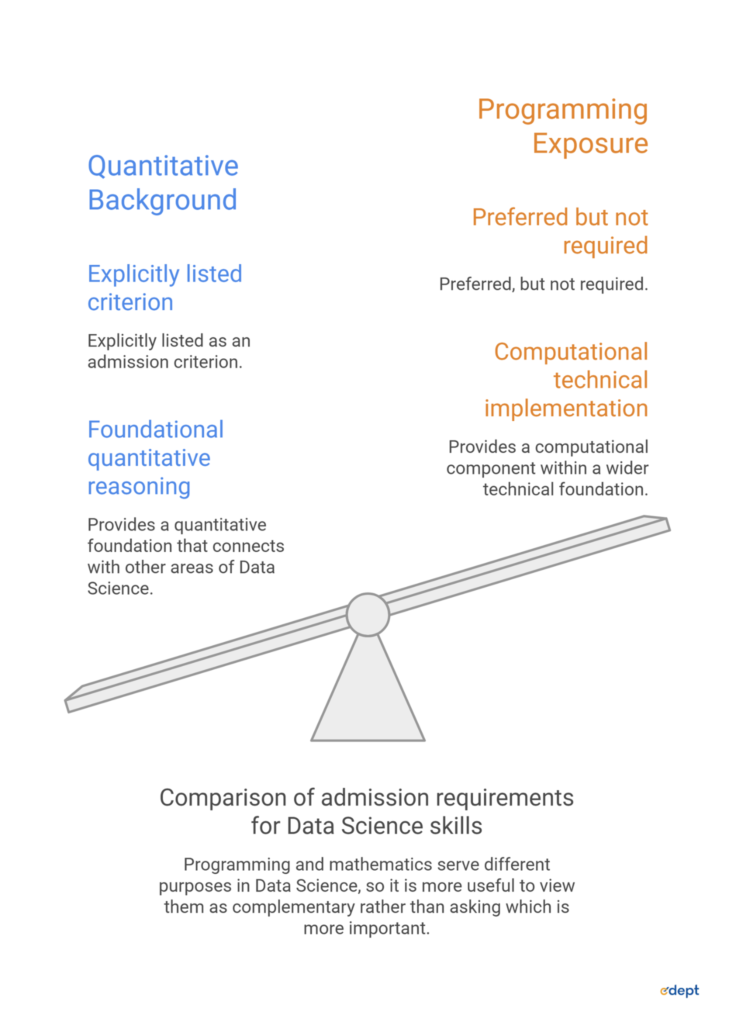
- Quantitative background: Explicitly listed as an admission criterion.
- Programming exposure: Preferred, but not required.
- The curriculum then develops both areas through subjects that combine quantitative concepts with technical and applied Data Science learning.
Quantitative Foundation
The India Track includes Statistics & Probability for Analytics as part of its foundational and applied learning. Statistics and probability provide a quantitative foundation that connects with other areas of Data Science, including Machine Learning. The India Track introduces Introduction to Machine Learning, while the USA Track progresses to Advanced Machine Learning and other advanced Data Science subjects at Illinois Tech. This progression shows how quantitative learning forms part of the foundation students build before moving into more advanced Data Science study.Programming Foundation
The programming side of the India Track includes Programming for Data Science (Python). It is taught alongside Data Management & SQL and Cloud & Data Infrastructure Fundamentals, giving programming a place within a wider technical foundation. These subjects cover different dimensions of Data Science learning. Programming provides a computational component, while SQL and data management address working with data, and cloud and infrastructure fundamentals introduce another part of the technical environment in which data systems operate.Both Skills Work Together
Data Science requires both quantitative reasoning and technical implementation. Programming and mathematics should therefore not be treated as competing skills. The curriculum reflects this by bringing programming, statistics, SQL, visualisation, Machine Learning and infrastructure together within the India Track. For applicants, the key point is that a strong quantitative background is explicitly part of the admission criteria, while prior programming exposure is preferred rather than mandatory. Once students enter the program, programming becomes one component of the broader Data Science foundation they develop.What Happens to Programming in the Advanced USA Track?
The USA Track does not list a standalone advanced programming subject. Instead, programming and computational skills become relevant within the advanced Data Science curriculum at Illinois Tech. The USA Track includes subjects such as Advanced Machine Learning, Artificial Intelligence Foundations, Big Data Analytics, and Data Engineering & High-Performance Computing. This progression builds on the foundation established during the India Track, where students study Programming for Data Science (Python), Data Management & SQL, Statistics & Probability for Analytics, and Introduction to Machine Learning. For students asking is programming knowledge is required for MAS in Data Science, it is important to distinguish between prior programming experience and the role of programming in the curriculum. Prior programming exposure is preferred rather than required, but students continue into an advanced Data Science curriculum where computational concepts are relevant.Advanced Machine Learning
The USA Track includes Advanced Machine Learning, building on the Introduction to Machine Learning included in the India Track. This creates a clear academic progression from foundational Machine Learning during the India phase to more advanced Machine Learning study at Illinois Tech. While the brochure does not specify particular programming techniques taught within Advanced Machine Learning, the subject forms part of the advanced technical curriculum.Data Engineering and High-Performance Computing
Data Engineering & High-Performance Computing is another component of the USA Track. At a high level, this subject represents the computational dimension of advanced Data Science, following the foundational work in programming, data management and infrastructure developed during the India Track. The brochure does not identify specific technologies or programming methods associated with this subject, so it is best to understand it as part of the program’s broader advanced technical curriculum rather than assume a particular programming syllabus.Big Data Analytics
The USA Track also includes Big Data Analytics, positioning students within a more advanced stage of Data Science study. This builds conceptually on the foundation developed during the India Track, where students encounter programming through Programming for Data Science (Python) and data management through Data Management & SQL. Together, the two stages create a progression from foundational programming and data skills in India to advanced Data Science subjects in the USA. The brochure does not state that Big Data Analytics specifically teaches programming techniques, but its position within the advanced curriculum shows how the earlier foundation connects to later Data Science study.How Does the 6+12 Pathway Help Build Programming Skills?
The 6+12 pathway creates an academic progression from foundational and applied learning in India to advanced Data Science study in Chicago. During the six-month India Track, students build foundational programming and data skills alongside statistics, SQL, visualisation, Machine Learning and infrastructure. They then progress to the 12-month USA Track at Illinois Tech, where the curriculum moves into advanced areas of Data Science. For students asking whether programming knowledge is required for MAS in Data Science, this structure is important. Prior programming exposure in Python, C++ or Java is preferred but not required, while programming is introduced as part of the academic journey through the India Track.Six Months of Foundation in India
The six-month India Track at Mahindra University focuses on foundational and applied learning. Its curriculum includes Programming for Data Science (Python), Statistics & Probability for Analytics, Data Management & SQL, Data Visualisation & Business, Introduction to Machine Learning, and Cloud & Data Infrastructure Fundamentals. This combination gives students a broader Data Science foundation rather than treating programming as an isolated skill. Python is positioned alongside quantitative, data-management, analytical and infrastructure subjects, allowing programming to form part of the wider preparation for advanced study.Twelve Months of Advanced Study in Chicago
After the India phase, students progress to the USA Track at Illinois Tech in Chicago. The advanced curriculum includes Advanced Machine Learning, Artificial Intelligence Foundations, Big Data Analytics, Data Engineering & High-Performance Computing, Data Strategy & Governance, and a Capstone Project or Master’s Thesis. The USA phase therefore moves beyond the foundational subjects covered in India and into more advanced areas of Data Science. Programming is not listed as a standalone advanced subject, but the technical foundation developed during the India Track forms part of the broader academic progression.Academic Continuity
The 6+12 structure is designed as a connected academic pathway rather than two unrelated stages. According to the brochure, India-earned credits align fully with the U.S. curriculum, supporting seamless academic progression from the India phase to the Illinois Tech MAS in Data Science. This continuity is particularly relevant when considering the programming knowledge required for MAS in Data Science. Students do not need to have extensive programming experience before entering the pathway, but programming is introduced during the foundational India phase and sits within a curriculum that progresses toward advanced Machine Learning, AI, Big Data and Data Engineering in Chicago. The result is a progression from foundational programming and data skills in India to advanced Data Science study in the USA, with the two phases forming part of the same academic journey.Who Can Apply Even Without Expensive Programming Experience?
The MAS in Data Science Global Pathway Program does not list extensive prior programming experience as a mandatory eligibility requirement. The brochure states that applicants should have a bachelor’s degree in Engineering, Computer Science, Mathematics, Statistics, or a related field, along with a strong quantitative background. Programming exposure in Python, C++ or Java is preferred, but not required. This means applicants can come from several academic backgrounds without needing to treat extensive coding experience as a prerequisite. However, because programming is included in the India Track through Programming for Data Science (Python), applicants should be prepared to develop and use programming skills as part of their Data Science education.Engineering Graduates
Engineering is explicitly listed among the eligible bachelor’s backgrounds for the program. Applicants are also expected to have a strong quantitative background as part of the admission criteria. For engineering graduates considering is programming knowledge required for MAS in Data Science, prior programming experience should be understood as a preferred rather than mandatory component of the eligibility criteria. Their overall academic background and quantitative preparation remain relevant to admission.Mathematics and Statistics Graduates
Mathematics and Statistics are also explicitly listed as eligible bachelor’s backgrounds. These backgrounds can provide the quantitative foundation specified in the admission criteria, even where an applicant may have less extensive prior programming experience. The curriculum then introduces programming through Programming for Data Science (Python) alongside Statistics & Probability for Analytics, Data Management & SQL and other foundational subjects. Therefore, applicants from Mathematics or Statistics should not assume that extensive programming experience is a mandatory condition for applying.Computer Science Graduates
Computer Science is another bachelor’s background explicitly listed in the eligibility criteria. CS graduates may have encountered programming during their prior education, but the brochure does not state that Computer Science applicants must have a particular level of programming experience. The same admission distinction applies: programming exposure in Python, C++ or Java is preferred, not required. Overall, the eligible academic backgrounds include Engineering, Computer Science, Mathematics, Statistics and related fields, alongside the requirement for a strong quantitative background. This broader eligibility structure is important for students asking is programming knowledge is required for MAS in Data Science: extensive prior programming is not listed as mandatory, but students should be ready to engage with programming as part of the program.How Is Programming Readiness Evaluated During Admission?
For applicants asking whether programming knowledge is required for MAS in Data Science, the admission process does not specify a separate programming test. Instead, the brochure states that applicants go through a joint academic evaluation against Illinois Tech’s MAS in Data Science prerequisites. Programming exposure in Python, C++ or Java is listed as preferred, but not required. This means programming background is considered within the broader academic profile rather than being presented as a standalone mandatory assessment.Academic Prerequisite Review
The admission evaluation considers the applicant’s overall academic preparation and alignment with the program’s prerequisites. The eligibility criteria include a bachelor’s degree in Engineering, Computer Science, Mathematics, Statistics, or a related field, together with a strong quantitative background. Programming exposure in Python, C++ or Java can strengthen an applicant’s background, but the brochure does not specify a minimum programming proficiency level or a separate coding assessment. Therefore, applicants should consider their complete academic preparation rather than focusing only on prior programming experience.Bridging Courses
The admission journey allows for bridging courses to be assigned where required following the joint academic evaluation against Illinois Tech’s MAS in Data Science prerequisites. The brochure does not state that these bridging courses are specifically intended to address programming gaps. They should therefore be understood more broadly as part of the pathway’s approach to prerequisite alignment. For prospective students, the key takeaway is that the question of whether programming knowledge is required for MAS in Data Science has a clear answer: prior programming exposure is preferred, not required, while admission is evaluated through the applicant’s broader academic background and prerequisite alignment.Programming Requirements for MAS in Data Science: At a Glance
| Question | Program Position |
| Is prior programming mandatory? | No |
| Is programming exposure preferred? | Yes |
| Preferred languages | Python, C++, Java |
| Is Python taught in the program? | Yes, Programming for Data Science (Python) |
| Is SQL included? | Yes, Data Management and SQL |
| Is Manual Learning included? | Yes |
| Is advanced computing included? | Yes, Data Engineering & High-Performance Computing |
Should You Apply If You Are Not Confident in Programming?
If you are not confident in programming, that alone does not mean you fall outside the stated eligibility criteria for the MAS in Data Science Global Pathway Program. The brochure identifies programming exposure in Python, C++ or Java as preferred, not required. At the same time, applicants are expected to have a relevant bachelor’s degree and a strong quantitative background. The more useful question is whether your overall academic background aligns with the program and whether you are prepared to develop programming skills during the course.You May Still Meet the Broad Eligibility Criteria
The program’s eligibility criteria include bachelor’s degrees in Engineering, Computer Science, Mathematics, Statistics, or related fields, along with a strong quantitative background. Programming exposure is listed as preferred rather than mandatory. Therefore, limited programming experience does not by itself rule out an applicant under the stated criteria. Admission is based on broader academic preparation and alignment with the program’s prerequisites, rather than a requirement for extensive prior coding experience.Be Prepared to Learn Programming
Although prior programming experience is not mandatory, programming is an actual part of the academic journey. The India Track includes Programming for Data Science (Python) alongside Statistics & Probability for Analytics, Data Management & SQL, Data Visualisation & Business, Introduction to Machine Learning, and Cloud & Data Infrastructure Fundamentals. This means applicants should be prepared to develop their programming skills as they progress through the program. The brochure does not state that the course begins from a particular programming proficiency level, so students should not assume that prior knowledge will be completely unnecessary for the coursework.Consider Your Overall Academic Fit
When deciding whether to apply, consider your preparation across several areas:- Quantitative preparation: A strong quantitative background is part of the stated admission criteria.
- Academic background: Engineering, Computer Science, Mathematics, Statistics and related bachelor’s degrees are listed.
- Interest in Data Science: The program combines quantitative, computational and applied subjects.
- Willingness to develop programming skills: Python is part of the India Track through Programming for Data Science.
- Prerequisite alignment: Applicants undergo a joint academic evaluation against Illinois Tech’s MAS in Data Science prerequisites.
Build global-ready skills with edept’s Master’s in Data Science program
Begin Your Journey!