Data Science has moved beyond basic programming, data analysis, and visualisation. Modern Data Science increasingly combines Machine Learning, Artificial Intelligence, large-scale analytics, data engineering, and strategic data management. This makes understanding machine learning, AI, and big data in data science important for students planning an advanced Data Science career. The demand for these skills is also reflected in current employment projections.
In 2026, the U.S. Bureau of Labour Statistics projects employment of data scientists to grow by 33.5% between 2024 and 2034, adding about 82,500 jobs. Computer and mathematical occupations overall are projected to grow 10.1% over the same period. The edept × Mahindra University × Illinois Tech Global Pathway follows this progression. Students first complete foundational and applied Data Science learning at Mahindra University in India, then progress to the STEM Master of Applied Science in Data Science at Illinois Tech in Chicago. The USA Track includes Advanced Machine Learning, Artificial Intelligence Foundations, Big Data Analytics, Data Engineering & High-Performance Computing, Data Strategy & Governance, and a Capstone Project/Master’s Thesis.
This article explains what students actually learn across these areas and how the subjects connect throughout the 6+12 academic pathway.
What Makes Machine Learning, AI and Big Data Important to Data Science?
Machine Learning, Artificial Intelligence (AI), and Big Data are interconnected areas within modern Data Science. Machine Learning focuses on learning patterns from data to support prediction and analysis. AI extends this toward intelligent systems and applications, while Big Data focuses on analysing larger and more complex datasets at scale. Together, they form important components of advanced Data Science learning. The MAS in Data Science at Illinois Tech reflects this progression through Advanced Machine Learning, Artificial Intelligence Foundations, and Big Data Analytics.
Machine Learning and the Move from Data to Prediction
Machine Learning applies data-driven methods to identify patterns and support analytical or predictive tasks. In the 6+12 Global Pathway, students first study Introduction to Machine Learning during the India Track before progressing to Advanced Machine Learning at Illinois Tech.
AI as an Advanced Data Science Area
AI represents a broader area of intelligent, data-driven applications. Artificial Intelligence Foundations is included in the Illinois Tech USA Track, positioning AI within the advanced stage of the MAS curriculum.
Big Data and the Challenge of Scale
As organisations work with increasingly large and complex datasets, Data Science requires approaches designed for analysis at scale. Big Data Analytics is therefore included as a dedicated USA Track subject, alongside Data Engineering & High-Performance Computing. This combination shows how machine learning, AI and big data in data science connect analytical methods with the technical capabilities needed for advanced data work.
What Will You Learn About Machine Learning in the MAS In Data Science
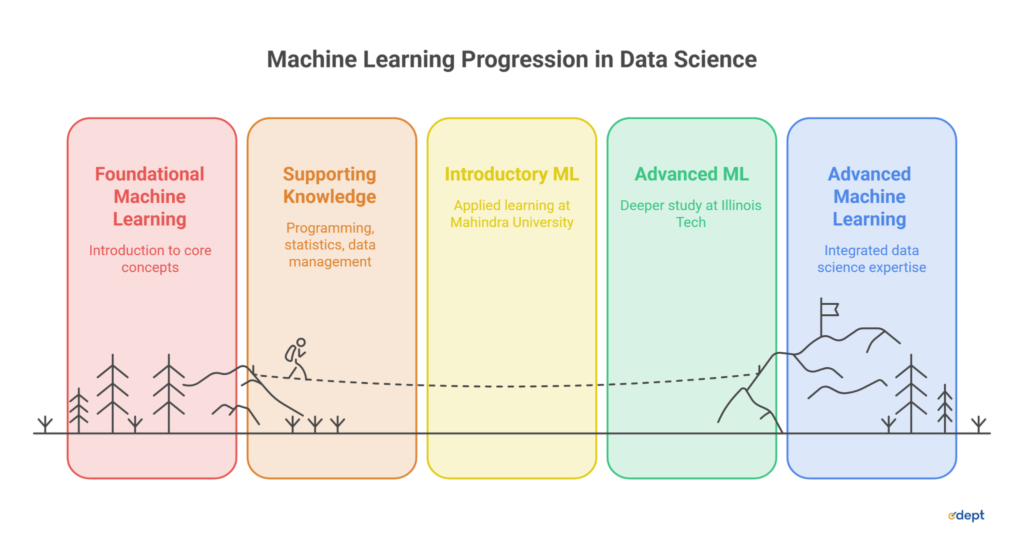
Machine Learning is a core part of the Data Science learning journey in the Global Pathway, appearing at both the foundation and advanced stages. Students begin with Introduction to Machine Learning during the India Track at Mahindra University and later progress to Advanced Machine Learning in the Illinois Tech MAS in Data Science. This structure makes Machine Learning a progression rather than two unrelated subjects.
Introduction to Machine Learning in the India Track
Introduction to Machine Learning is part of the foundational and applied learning completed at Mahindra University. Before reaching this subject, students build supporting knowledge through Programming for Data Science (Python), Statistics & Probability for Analytics, Data Management & SQL, and Data Visualisation & Business. These subjects provide the context needed to begin Machine Learning. Python helps students work with data computationally, statistics supports quantitative analysis, SQL develops data-management skills, and visualisation helps students interpret and communicate findings. Machine Learning can then build on these capabilities to introduce data-driven approaches to identifying patterns and supporting analysis.
Advanced Machine Learning at Illinois Tech
The next stage is Advanced Machine Learning, which forms part of the STEM MAS in Data Science at Illinois Tech in Chicago. It follows the introductory Machine Learning exposure from the India Track and represents a move toward more advanced Data Science study. The brochure does not specify particular algorithms, frameworks, or techniques within Advanced Machine Learning. Therefore, it is more accurate to describe the subject as the advanced stage of the program’s Machine Learning progression rather than attaching specific technologies to it.
Why Machine Learning Is Not Just About Coding
Machine Learning is closely connected with programming, statistics, data management, and analytics. Programming provides the ability to work with data and implement computational solutions, while statistics and analytics help students understand and interpret the information behind those solutions. This multidisciplinary structure is important to machine learning, AI, and big data in data science. The MAS curriculum does not isolate Machine Learning from the rest of Data Science; instead, it connects introductory and advanced Machine Learning with subjects covering data, infrastructure, AI, Big Data, governance, and applied project work.
What Will You Learn About Artificial Intelligence?
Artificial Intelligence (AI) is an important part of the advanced Data Science curriculum. In the Illinois Tech USA Track, AI is represented through Artificial Intelligence Foundations, positioned alongside Advanced Machine Learning, Big Data Analytics, and Data Engineering & High-Performance Computing. Rather than treating AI as a narrow specialisation, the curriculum introduces it as a broader academic area within Data Science. This helps students understand how AI relates to data, analytical methods, and computational approaches as they move into the advanced stage of the program.
Artificial Intelligence Foundations
Artificial Intelligence Foundations is a dedicated subject in the Illinois Tech MAS in Data Science. At a curriculum level, “foundations” indicates an academic base in AI, giving students a structured understanding of the field as part of their broader Data Science education. The subject sits within a curriculum that also covers Advanced Machine Learning, Big Data Analytics, Data Engineering & High-Performance Computing, and Data Strategy & Governance. This positioning shows that AI is one component of a wider advanced Data Science skill set rather than the sole focus of the degree.
How AI Connects with Machine Learning
AI and Machine Learning are closely related, but they are not interchangeable. Machine Learning is an important area within modern AI applications, focusing on methods that learn patterns from data, while AI represents the broader field of intelligent systems and applications. The program reflects this distinction by listing Advanced Machine Learning and Artificial Intelligence Foundations as separate subjects in the Illinois Tech USA Track.
What Is Big Data Analytics and Why Is It Part of the MAS Curriculum?
Big Data Analytics is an independent topic covered in the Illinois Tech USA Track since the requirement to handle large and complicated datasets is essential for advanced Data Science. Since organizations are creating and managing more information every day, there is a need for more than just data analysis; it is also required to have an understanding of how to analyze data on a bigger scale.
From Data Analytics to Big Data Analytics
The learning progression begins in India with subjects such as Statistics & Probability for Analytics and Data Management & SQL. These subjects help establish the analytical and data-management foundation needed to work with datasets. Students then progress to Big Data Analytics during the Illinois Tech phase, extending their learning toward larger-scale data problems. This progression is part of the broader machine learning AI and big data in data science journey, moving from foundational data skills to more advanced analytical applications.
The Role of Data Engineering
Data Engineering & High-Performance Computing complements Big Data Analytics in the USA Track. While analytics focuses on examining data to identify insights and patterns, data engineering is concerned with the technical systems and infrastructure that support data-intensive work. Together, these subjects give the MAS curriculum a broader technical scope. Students are not only learning how to analyse data at scale but also developing an understanding of the systems that enable advanced Data Science workloads.
How Machine Learning, AI and Big Data Fit Together
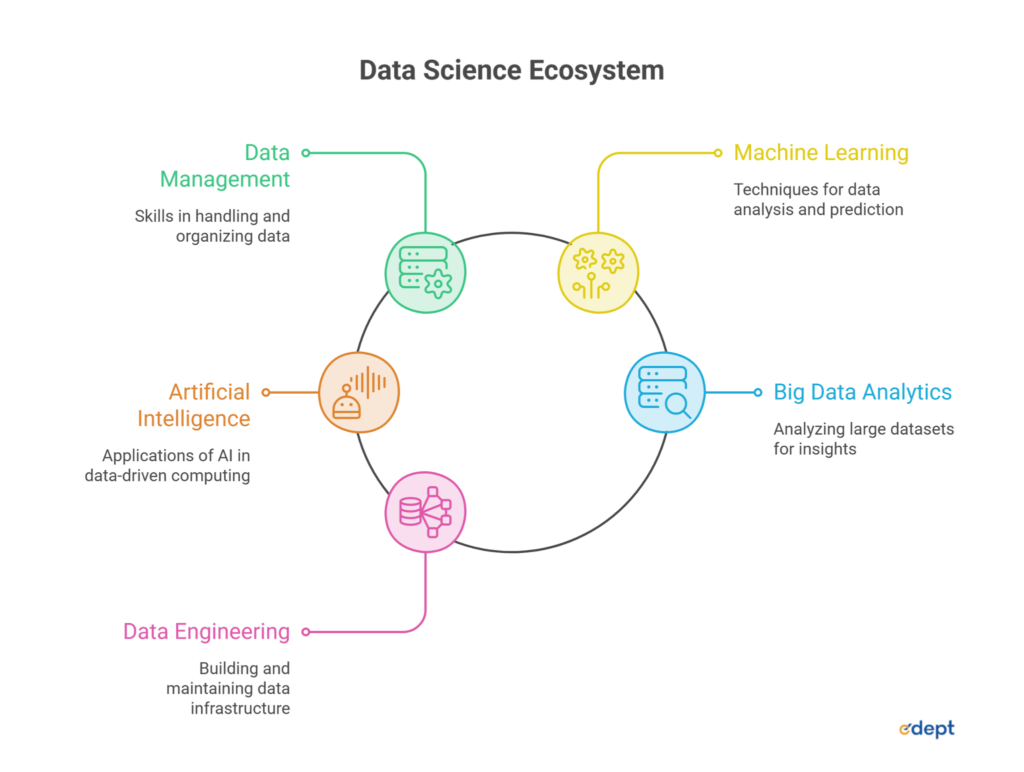
Machine Learning, AI, and Big Data Work as connected parts of a broader Data Science ecosystem. The pathway builds these capabilities progressively: students first develop the skills to work with and understand data, then move into machine learning, AI, big data, and the technical infrastructure that supports advanced data applications. This structure is reflected across the India and USA Tracks of the MAS in Data Science curriculum.
Data as the Foundation
Before approaching advanced topics, students build core data skills in India through Data Management & SQL, Statistics & Probability for Analytics, Data Visualisation & Business, and Cloud & Data Infrastructure Fundamentals. These subjects provide the foundation for managing data, understanding patterns, communicating insights, and working with supporting infrastructure.
Machine Learning as an Advanced Analytical Approach
Machine Learning builds on this foundation. Students study Introduction to Machine Learning during the India Track and later progress to Advanced Machine Learning at Illinois Tech. This creates a clear movement from foundational exposure to more advanced study rather than treating Machine Learning as an isolated skill.
AI as an Advanced Application Area
At Illinois Tech, Artificial Intelligence Foundations forms part of the advanced MAS stage. It places AI alongside Machine Learning and Big Data within the broader Data Science curriculum, giving students exposure to another important area of data-driven computing.
Big Data and the Infrastructure Behind It
Advanced Data Science also requires both analytical and technical capabilities. Big Data Analytics addresses analysis at scale, while Data Engineering & High-Performance Computing focuses on the technical systems supporting data-intensive work.
What Other Advanced Subjects Will You Study Alongside ML, AI and Big Data?
The MAS in Data Science is broader than Machine Learning, AI, and Big Data alone. The Illinois Tech USA Track also includes Data Strategy and Governance, a Capstone Project or Master’s Thesis, and Industry-Oriented Project Work. These components add strategic and practical dimensions to the technical curriculum.
Data Strategy & Governance
Data Science also involves deciding how data is managed, governed, and used within organisations. Data Strategy & Governance introduces this broader perspective, moving beyond technical model development to consider the strategic role of data. This is particularly relevant to the wider machine learning, AI and big data landscape in data science, where technical capabilities need to operate within structured approaches to managing data.
Capstone Project / Master’s Thesis
The USA Track includes a Capstone Project / Master’s Thesis as a culminating academic component. It gives students an opportunity to bring together knowledge developed across the MAS curriculum through a substantial academic project or thesis. Rather than studying Machine Learning, AI, Big Data, and other subjects independently, this component can provide a setting for applying the broader learning developed throughout the program.
Industry-Oriented Project Work
The curriculum also includes Industry-Oriented Project Work, reinforcing its applied focus. Illinois Tech is described in the brochure as having projects, labs, and collaborations with global employers. This complements the technical coursework by connecting academic learning with practical Data Science contexts. It also helps ensure the MAS is not presented simply as an ML or AI degree, but as a broader program combining technical, strategic, and applied learning.
How Does the 6+12 Pathway Prepare You for Advanced Data Science?
The 6+12 Global Pathway follows a structured academic progression rather than asking students to move directly into advanced study in Chicago. Students first complete six months of foundational and applied Data Science learning at Mahindra University before progressing to the Illinois Tech MAS in Data Science in the USA. The brochure states that India-earned credits align fully with the U.S. curriculum, supporting continuity between the two stages.
Subjects That Build the Foundation in India
The India Track establishes the core skills needed for advanced Data Science through Programming for Data Science (Python), Statistics & Probability for Analytics, Data Management & SQL, Data Visualisation & Business, Introduction to Machine Learning, Cloud & Data Infrastructure Fundamentals, and Applied Projects & Assessments. Together, these subjects provide experience across programming, quantitative analysis, data management, visualisation, Machine Learning, infrastructure, and applied work. This foundation prepares students to engage with more advanced concepts rather than encountering them without supporting knowledge.
Subjects That Build Advanced Expertise in the USA
The USA Track then moves into the advanced MAS curriculum at Illinois Tech. Students study Advanced Machine Learning, Artificial Intelligence Foundations, Big Data Analytics, Data Engineering & High-Performance Computing, and Data Strategy & Governance. The curriculum also includes a Capstone Project / Master’s Thesis and Industry-Oriented Project Work. This progression is central to understanding machine learning, AI and big data in data science.
The India phase builds the academic and technical foundation, while the USA phase develops it through advanced Machine Learning, AI, Big Data, engineering, governance, and applied project work. It is therefore more accurate to view the six months in India as the first stage of the academic pathway, not simply preparation before a separate master’s degree in Chicago.
Which Data Science Careers Can These Subjects Lead Toward?
The combination of Machine Learning, AI, Big Data, and related subjects can prepare students for several Data Science career paths. The MAS in Data Science brochure specifically highlights roles including Data Scientist, Senior Data Analyst, Machine Learning Engineer, Data Engineer, Product & Growth Analyst, and Business Analytics Manager.
Machine Learning and Data Science Roles
Data Scientists and Machine Learning Engineers can apply knowledge from Advanced Machine Learning, Artificial Intelligence Foundations, analytics, programming, and statistics. Data Scientists work with data to identify patterns and support decisions, while Machine Learning Engineers focus on developing and applying data-driven models in technical environments. The progression from Introduction to Machine Learning in India to Advanced Machine Learning at Illinois Tech can help students build toward these technical career directions.
Data Engineering and Big Data Roles
Data Engineers can benefit from knowledge of Big Data Analytics and Data Engineering & High-Performance Computing. These subjects address both the analytical challenges of working with large datasets and the technical systems that support data-intensive workloads. This makes the curriculum relevant for students interested in the infrastructure and engineering side of machine learning, AI and big data in data science.
Analytics and Business-Focused Roles
The program can also prepare students for roles such as Senior Data Analyst, Product & Growth Analyst, and Business Analytics Manager. These career paths connect with subjects covering data analysis, visualisation, business, and Data Strategy & Governance. These roles show the broader application of Data Science beyond technical model development, particularly where data needs to be interpreted and translated into business or product decisions.
Machine Learning vs. AI vs. Big Data: What Is the Difference?
|
Area |
Core Focus |
Where It Appears in the Program |
|
Machine Learning |
Learning patterns from data |
Introduction to Machine Learning + Advanced Machine Learning |
|
AI |
Intelligent data-driven systems and applications |
Artificial Intelligence Foundations |
|
Big Data |
Analysing large and complex datasets at scale |
Big Data Analytics |
|
Data Engineering |
Supporting data-intensive systems and workloads |
Data Engineering & High-Performance Computing |
These areas are closely connected rather than competing specialisations. Machine Learning uses data to identify patterns and support predictive analysis; AI covers a broader range of intelligent applications; and Big Data focuses on analysing information at greater scale. Data Engineering provides the technical foundation needed to support data-intensive workloads. The MAS curriculum brings these areas together, progressing from foundational subjects in India to advanced Machine Learning, AI, Big Data, and Data Engineering at Illinois Tech.
This integrated approach reflects the broader role of machine learning, AI and big data in data science, where analytical, computational, and infrastructure skills increasingly work together.
Build Advanced Data Science Skills Through the Global Pathway
Machine Learning, AI and Big Data are important components of the advanced MAS in Data Science curriculum, giving students exposure to key areas of modern data science. The 6+12 Global Pathway follows a structured progression: students first build their foundation in India through programming, statistics, SQL, data visualisation, introductory machine learning and cloud and data infrastructure, before progressing to advanced study at Illinois Tech. The curriculum goes beyond an ML-only focus. Alongside Advanced Machine Learning, Artificial Intelligence Foundations and Big Data Analytics, students study Data Engineering & High-Performance Computing, Data Strategy & Governance, and complete a capstone project or master’s thesis and industry-oriented project work. This broader structure helps connect technical data science skills with data systems, strategy and applied problem-solving. If you want to understand how machine learning, AI and big data in data science come together in a structured U.S. master’s pathway, explore the edept × Mahindra University × Illinois Tech Global Pathway Program and learn how the 6+12 model can take you from foundational study in India to an advanced STEM M.A.S. in Data Science in Chicago.