Not every MBA aspirant wants to spend months preparing for an entrance exam. Some already have strong academic records. Others are working professionals who would rather invest their time in gaining experience than chasing a single test score. As management education evolves, universities have started recognising that one exam cannot measure every capable candidate. A lot of students think an MBA starts with cracking CAT. In reality, that’s only one way to get in. Every year, thousands of applicants either skip entrance exams altogether or choose colleges that admit students through merit, interviews, or their own selection process. For many, it turns out to be a better fit. If you’re wondering whether you can pursue an MBA without an entrance exam, the answer is yes. Plenty of recognised universities now offer direct MBA admission, especially for students with good academics or relevant work experience. The degree is the same. The admission route is simply different. That’s why more students are exploring these options instead of putting all their hopes on one competitive exam. If you’re considering the same path, this guide will walk you through how MBA without an entrance exam admissions work, which colleges offer them, who is eligible, and what you should check before applying in 2026.
Types of MBA Programs Without an Entrance Exam
Before deciding on a college, it helps to understand that direct MBA admission is available across several different programme formats. Each serves a different kind of student, and choosing the right format is as important as choosing the right institution. Here is a breakdown of the main types of MBA without entrance exam programmes available in India.
Regular Full-Time MBA
When most people think of an MBA, this is usually the format that comes to mind. Two years on campus, regular classes, internships, projects, and placement support. Interestingly, not every college asks for a national entrance exam score anymore. Many private universities now offer MBA direct admission after looking at your academic record and conducting their own interview or group discussion. If you’re looking for a classroom environment and want to build your network while studying, this is still one of the strongest options available without an entrance exam for MBA colleges.
Distance MBA
Not everyone can leave a job and become a full-time student again. That’s exactly why distance MBA programmes continue to attract working professionals. You study from wherever you are and complete the programme over two or three years without disrupting your career. At many universities, direct admission in MBA without entrance exam is a normal part of the admission process. If you meet the eligibility criteria, you can usually apply without the pressure of preparing for a competitive test.
Online MBA
Online MBAs have changed a lot over the last few years. Before online MBAs became popular, many people assumed they were nothing more than recorded lectures and study material uploaded to a portal. That is no longer the case. Most recognised universities now include live classes, industry projects, peer discussions, and regular interaction with faculty. For students looking for MBA without CAT, an online MBA offers a flexible way to earn a degree without putting work or personal commitments on hold. It’s one of the reasons this option has gained so much attention in recent years.
Executive MBA
Executive MBA programmes are designed for working professionals who have a minimum of three to five years of work experience. Admission is typically based on work experience, academic background, and a personal interview rather than entrance exam performance. For experienced professionals looking at without entrance exam MBA colleges, the Executive MBA is often the strongest option in terms of curriculum depth and peer quality.
Part-Time MBA
Part-time MBA programmes allow students to study over three to four years while continuing to work. Classes are typically held on weekends or in the evenings. Direct MBA admission to part-time programmes is generally based on merit and interview performance, making them another accessible route for those who want an MBA without entrance requirement without stepping away from employment.
MBA Without Entrance Exam Eligibility
Before you start filling out application forms, it helps to know whether you actually meet the basic eligibility requirements. The good news is that most MBA without entrance exam programmes follow a fairly similar admission process. A few colleges may add their own conditions, but the core requirements don’t vary much.
If you’re planning to apply through direct admission in MBA without entrance exam, checking these criteria early can save you a lot of time and help you shortlist colleges that match your profile.
- The first requirement is straightforward. You should have a bachelor’s degree from a recognised university, regardless of your stream. Whether you studied commerce, science, engineering, or arts usually doesn’t matter.
- Most MBA colleges without entrance exam MBA colleges ask for at least 50% marks in graduation for general category students. For reserved categories, the minimum requirement is generally relaxed to 45%, depending on the institution.
- Still waiting for your final-year results? Many colleges allow provisional admission. You’ll simply need to submit your final marksheet later and meet the required percentage to confirm your seat.
- Age is rarely a major barrier. Most institutions require candidates to be at least 17 years old by 31 December of the admission year.
If you’re applying for an executive or part-time MBA, things can be a little different. Some colleges expect applicants to have relevant work experience before they can be considered.
You’ll also need standard documents during the application process. A valid government photo ID is mandatory, and international applicants are generally required to provide passport and visa-related documents as part of their application.
Top MBA Colleges Without Entrance Exam
Most students spend so much time thinking about admission that they forget the bigger question: Which college is actually worth joining? The reality is that an MBA is a long-term investment, and the quality of the institution matters far more than the admission route. At the end of the day, the college you choose matters more than the admission route. If you’re exploring direct MBA admission, compare placements, faculty, and industry exposure carefully. Many MBA colleges without entrance exams now offer excellent learning opportunities, making an MBA without entrance a smart option for students looking beyond competitive exams.
Shree Guru Gobind Singh Tricentenary University
SGT University in Gurugram, Haryana, offers MBA direct admission through a university-level entrance test and personal interview, making it one of the more accessible without entrance exam MBA colleges for students in North India. The university is NAAC-accredited and offers MBA specialisations across finance, marketing, HR, and operations with a dedicated placement cell.
Amity University
Amity University is one of the most widely recognised private universities in India for direct MBA admission pathways. It accepts applications for its MBA programmes through its own Amity Written Test (AMCAT) or based on graduation merit, combined with a group discussion and interview. Students looking at MBA without CAT who want a well-known brand name with a large alumni network will find Amity a credible option.
Lovely Professional University (LPU)
LPU in Phagwara, Punjab, offers MBA without entrance exam routes through its LPUNEST university entrance test or through direct merit-based admissions. It is one of the largest private universities in India by enrollment and offers a wide range of MBA specialisations with active industry tie-ups and a strong placement record across sectors.
MIT World Peace University
MIT-WPU in Pune offers MBA programmes with direct admission in MBA without entrance exam pathways through its own MET entrance test or merit-based evaluation. The university is known for its industry-integrated curriculum and has a strong presence in the Pune corporate corridor, which supports placement outcomes across technology, manufacturing, and financial services companies.
SOIL School of Business Design
SOIL School of Business Design in Gurgaon takes a different approach to admissions. Instead of focusing only on entrance exam scores, it considers your profile, written assessment, and personal interview. That’s why it is often counted among popular MBA colleges without entrance exams. The institute is also known for its focus on design thinking, leadership, and practical business learning.
GIBS Business School
GIBS Business School in Bengaluru offers MBA direct admission through a straightforward application and personal interview process, making it accessible for candidates who are not pursuing the CAT route. It offers programmes across general management, finance, and marketing with a placement assistance programme and industry guest sessions as part of the curriculum.
College Comparison Table
Here are some popular MBA colleges that offer admission without relying only on national entrance exam scores.
| College | Location | Estimated Fees | Admission Pathway |
|---|---|---|---|
| SGT University | Gurugram, Haryana | ₹2 to 4 lakh per annum | University test and Personal Interview (PI) |
| Amity University | Noida and multiple campuses | ₹3 to 6 lakh per annum | AMCAT or merit-based admission with GD/PI |
| Lovely Professional University (LPU) | Phagwara, Punjab | ₹1.5 to 3 lakh per annum | LPUNEST or merit-based admission |
| MIT World Peace University | Pune, Maharashtra | ₹3 to 5 lakh per annum | MET test or merit-based admission |
| SOIL School of Business Design | Gurgaon, Haryana | ₹8 to 12 lakh (total) | Profile evaluation and personal interview |
| GIBS Business School | Bengaluru, Karnataka | ₹2 to 4 lakh per annum | Application review and personal interview |
Direct MBA Admissions Process 2026
The direct MBA admission process varies by institution but follows a recognisable pattern across most without entrance exam MBA colleges. Knowing what to expect at each stage helps you prepare effectively and avoid last-minute surprises. Here is how the process typically works in 2026.
Standard Direct Admission Route
Getting into an MBA without an entrance exam is easier than many students think. Every college has its own admission process. Some simply look at your graduation marks and then invite shortlisted students for a personal interview or group discussion. A few also conduct a small aptitude test of their own. It is different from exams like CAT or XAT and is usually meant to understand your basic aptitude and communication skills. Because of this, many students choose this route for direct admission in MBA without an entrance exam.
Admission Through Management Quota
Some colleges also offer seats through the management quota. These seats are filled separately from the regular admission process. It’s another way to get MBA direct admission. The fees are usually higher, so rushing into a decision is not a good idea. Spend some time checking the college’s approvals, placement record, faculty, and industry exposure. Getting admission is only one part of the journey. Choosing the right college through direct admission in MBA without entrance exam will matter much more when you start looking for jobs after your MBA.
Documents Required for Direct Admission to MBA in India in 2026
Having the right documents ready before you begin the application process for without entrance exam MBA colleges saves time and avoids delays at the offer letter or enrolment stage.
- Class 10 mark sheet and passing certificate
- Class 12 mark sheet and passing certificate
- All semester or year-wise mark sheets from the bachelor’s degree
- Bachelor’s degree, provisional or final certificate
- Migration certificate from the previous institution
- Transfer certificate from the previous institution
- Character certificate from the last institution attended
- Recent passport-sized photographs
- Valid government-issued photo ID such as Aadhaar, passport, or driving licence
- Category certificate for SC/ST/OBC candidates, where applicable
- Work experience certificate for executive and part-time MBA applicants
- A medical fitness certificate is required by the institution
Things to Know Before Direct MBA Admission in India
Signing up for direct MBA admission without doing adequate due diligence is one of the more common and costly mistakes MBA aspirants make. These are the things that genuinely matter before you commit.
The without entrance exam MBA college category in India covers a very wide range of institutions, and the quality gap between the best and the worst is significant. Choosing based on the ease of admission rather than the value of what the programme delivers is a mistake that tends to become apparent only after you have graduated and are competing in the job market.
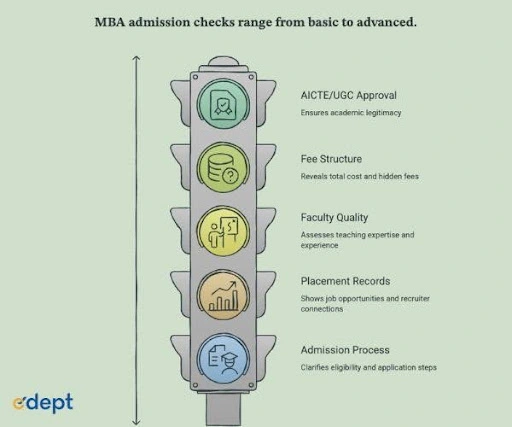
- Verify that the college is approved by AICTE and affiliated to a recognised university or has autonomous status granted by UGC
- Check the NAAC accreditation grade of the institution, with A or A+ being the most credible signals of institutional quality
- Look at the last three years of placement data in detail, not just the headline average package figure
- Speak to current students or recent alumni about the actual quality of faculty, curriculum delivery, and placement cell support
- Understand the total cost of the programme, including fees, hostel, books, and any additional charges, before comparing institutions
- Confirm whether the degree will be recognised for public sector and government job applications, if that is part of your career plan
Why Students Choose an MBA Without an Entrance Exam?
The reasons students pursue an MBA without CAT or other entrance exams are more varied than the assumption that they could not clear the exam. Understanding the actual motivations helps put the without entrance exam MBA colleges category in the right context.
Not every MBA aspirant thrives in a competitive entrance exam environment. Some students have consistently performed well throughout their academics but struggle with the pressure of a single high-stakes test. Others are working professionals or people planning a career switch. Between full-time jobs and personal commitments, spending months preparing for an entrance exam simply is not practical. For many of them, alternative admission routes make pursuing an MBA far more realistic without putting their careers or responsibilities on hold. For some students, the timeline matters, and the faster, direct MBA admission process fits better with personal or financial planning. And for a growing number of applicants, the entrance exam route simply does not align with the kind of programme they want, particularly executive, online, or international-oriented MBA formats that evaluate applicants more holistically.
Pros and Cons of Pursuing an MBA Without an Entrance Exam
Every pathway into an MBA has trade-offs worth understanding before committing. Here is an honest look at both sides of the MBA without entrance exam decision.
Advantages of MBA Without an Entrance Exam
- A faster and less stressful admission process that does not depend on a single high-stakes test performance
- More accessible for working professionals, career changers, and students from non-engineering backgrounds
- Some institutions offer holistic evaluation through interviews and profiles that better capture real potential than standardised tests
- Avoids the opportunity cost of months spent on entrance exam preparation that could be used for skill development or work experience
- A growing number of MBA without entrance exam programmes have strong industry tie-ups and placement support that compare well with entrance-exam-based institutions at a similar tier
- More flexibility in programme format, with online, part-time, and executive options more commonly available through direct admission routes
Disadvantages of MBA Without an Entrance Exam
- Without entrance exam, MBA colleges generally do not include the top-tier IIMs and IITs, which remain entrance-exam-gated
- The perceived prestige of the credential may be lower in hiring processes at companies that specifically target graduates from entrance-exam-based programmes
- The peer quality in the classroom can be more variable when admission is not filtered through a competitive examination
- Management quota seats, in particular, carry stigma in some hiring environments that are aware of how they work
- Due diligence requirements are higher because the without entrance exam MBA colleges category includes institutions of very uneven quality that require careful evaluation.
How to Choose the Right MBA College Without an Entrance Exam
Choosing among without entrance exam requires a more active research process than following a standard ranking list, because the standard rankings largely reflect entrance-exam-based institutions. Here is a practical framework for making the right choice.
The right MBA without entrance exam college for one student may not be the right one for another. Career goals, budget, location, specialisation preferences, and preferred learning format all play a role in what the right choice looks like.
- Start with accreditation. AICTE approval and UGC recognition are non-negotiable baselines. NAAC grading adds a further signal on institutional quality
- Match the specialisation to your career direction. An MBA in business analytics at an institution with strong industry partnerships in that area is more valuable than a general management programme at a more recognisable name
- Evaluate placement outcomes by looking at the companies that hired from the institution, not just the average salary figures that institutions choose to highlight
- Visit the campus if feasible, or at a minimum, speak to current students through the institution’s alumni network or LinkedIn before making a final decision
- Compare the total cost against realistic salary outcomes from the programme to assess whether the return on investment justifies the fee
Benefits of MBA Without Entrance Exam
The practical advantages of pursuing an MBA without a CAT or other entrance exams are real and worth stating clearly for students who are weighing their options.
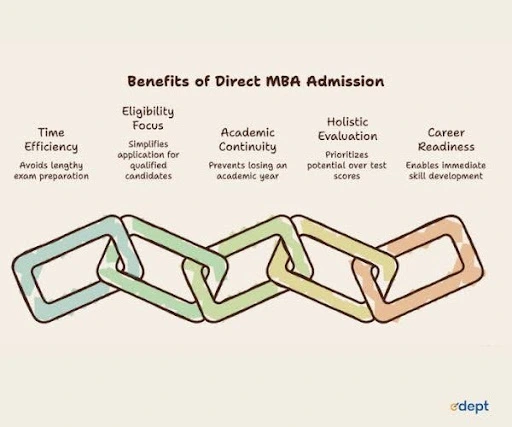
Saves Time
The entrance exam preparation cycle for CAT or XAT typically runs six to twelve months for serious candidates. Direct MBA admission bypasses this entirely, allowing students to enter a programme and start building their management career a full year earlier than the entrance exam route would allow.
Stress-Free Admission Process
The standard MBA entrance exam process involves months of preparation, exam day performance, score-based shortlisting, and then a second round of GD and PI. Direct admission in MBA without entrance exam compresses this into a more straightforward process that evaluates candidates on their overall profile rather than their performance on a single day.
Early Admission
One good thing about without entrance exam MBA colleges is that you usually do not have to wait for months to know your admission status. Many of these colleges accept applications over a longer period instead of following a strict entrance exam schedule. You can apply early and finish your admission without waiting too long. You do not have to wait for exam results or many counselling rounds. This makes the whole process easier and less stressful.
Focus on Holistic Profile
Many direct MBA admission processes evaluate candidates on the totality of their academic record, work experience, extracurricular achievements, and interview performance. This benefits students who have strong overall profiles but are not well-served by the standardised testing format of entrance exams.
Things to Watch Out For
Getting admission without an entrance exam is easier, but don’t make a quick decision. Check if the college is approved and recognised. Look at its placement record and industry exposure. Read the fee structure carefully, too. Some colleges have extra charges that are not obvious at first. A little research can make a big difference.
Accreditation
Not all without entrance exam MBA colleges are equally legitimate. AICTE approval, UGC recognition, and NAAC grading are the three checks that should precede any application. Programmes that cannot demonstrate all three warrant significant caution.
Placement Support
A dedicated placement cell with genuine employer relationships is what separates direct mba admission programmes that actually deliver career outcomes from those that offer a degree without meaningful post-graduation support. Ask specific questions about placement statistics and the companies that recruited in the last two years before applying.
Hidden Costs
Management quota admissions, in particular, can involve fees significantly above the standard programme fee. Always ask for a complete fee structure in writing before accepting any offer from without entrance exam MBA colleges.
5 Ways edept Adds Value to Your MBA Experience
Imagine this. You finally get into an MBA programme. The first few weeks go by, and it’s mostly lectures, notes, and exams. Then placement season comes around, and everyone is suddenly worried about the experience they never got.
That’s exactly why programmes backed by edept stand out.
1. You Learn Things That Actually Matter
Nobody joins an MBA to memorise slides. The idea is to become ready for the workplace. The MBA in Business Analytics and Finance at Shree L.R. Tiwari Institute of Management and Technology is built around practical business skills, so what you learn in class connects with what companies expect outside it.
2. You Don’t Wait Until Placements to Get Experience
A lot of students realise too late that recruiters ask about projects, not just marks. Here, you work on live projects while you’re still studying. By the time you graduate, you’ve already seen how businesses solve real problems.
3. Your Resume Doesn’t Stop at an MBA Degree
These days, one degree alone doesn’t always make you stand out. Along with the MBA, students also get an opportunity to earn certifications from Deloitte Learning Academy and IBM-NASSCOM. It’s a simple way to add more value to your profile before your first interview.
4. You Get Help Before the Interview Room
Interviews can be stressful when you’ve never faced one before. That’s why students receive training for aptitude tests, group discussions, communication skills, and personal interviews. Add placement support through a network of more than 300 hiring companies, and the journey feels a lot less overwhelming.
5. Precise Location
Hinjawadi isn’t just another place on the map. It’s one of Pune’s biggest IT and business hubs. When you’re studying around companies that hire MBA graduates every year, networking and industry exposure happen naturally.
At the end of the day, everyone wants the same thing from an MBA: a good career. The difference is how you get there. Some programmes give you a degree. Others help you build a profile. edept focuses on the second one, and that’s what makes the journey different.
Conclusion
If you’re looking at direct MBA admission, you really have more options now than people think. A lot of without entrance exam MBA colleges don’t ask for a national entrance test anymore. They look at your marks, take an interview, or have their own admission process. Some even give you live projects and extra certifications, which honestly help a lot when you’re looking for a job later. And here’s something interesting. Shiksha’s 2025 career data says that more than 90% of MBA graduates get placed after finishing their degree. So don’t stress too much about the admission route. What you learn and how well you use those skills will matter much more in the long run.
An MBA without entrance exam is not a compromise. For the right student, it is the right choice. It saves time, reduces the stress of a high-stakes competitive examination cycle, and opens doors to programme formats that evaluate candidates more holistically. What matters most in the end is not how you got in but what the programme delivers while you are there and what it opens up when you leave. The students who do well from direct admission in MBA without entrance exam programmes are the ones who choose carefully, verify accreditation and placement outcomes thoroughly, and commit fully to making the most of what the programme offers.
Take the first step toward your MBA with edept. Whether you are exploring the Business Analytics or Finance stream at SLRTMT or want to understand which pathway is right for your specific profile, edept’s team can walk you through your options clearly and honestly. Contact +91 97690 86795 to get started.