Every year, thousands of students and young professionals from India ask the same question: Should I go abroad to study first, or should I try to land a job directly? Both options have worked for people. But the reality is that the outcomes are very different. One path gives you more control. The other depends heavily on factors outside your hands. This guide honestly breaks down both options across employment, visa access, salary growth, and long-term settlement, so you can make a decision that actually fits your goals between study abroad vs direct work abroad.
Understanding the Two Pathways
Before comparing study abroad vs direct work abroad, it is best to understand what each pathway actually involves.
What Does Studying Abroad Mean?
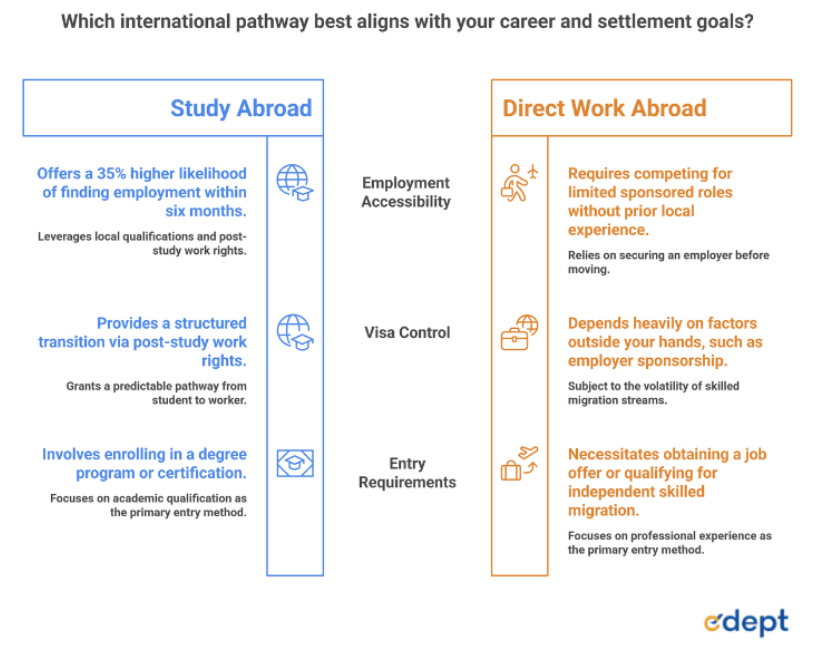
Studying abroad means enrolling in a degree program, postgraduate qualification, or career-focused certification in another country. You enter on a student visa, complete your program, and then use post-study work rights to enter the local job market. For example, a student from India who completes a Master’s in Data Science in Germany can apply for an 18-month post-study work visa to find employment there.
What Does Direct Work Abroad Mean?
Direct work abroad means securing a job offer from a foreign employer before you move. The employer then sponsors your work visa. Programs like Canada’s Express Entry or Australia’s Skilled Migration stream also allow professionals to apply independently based on points. In practice, this means competing for limited sponsored roles before you have any local experience.
Why This Decision Matters for Career Growth
The choice you make here has real consequences. It affects how quickly you find work, how employers view you, what visa options you have, and whether you can eventually settle permanently. According to a 2023 OECD report, international graduates who study locally are 35% more likely to find employment within six months of completing their program compared to those who arrive on work visas without local qualifications.
Study Abroad vs Direct Work Abroad: Key Comparison
| Factor | Study Abroad | Direct Work Abroad |
| Ease of Entry | High | Moderate to Difficult |
| Employer Access | Strong | Limited Initially |
| Local Experience | Yes | No |
| Networking Opportunities | Extensive | Limited |
| Internship Opportunities | Available | Limited |
| Work Permit Access | Strong | Depends on Sponsorship |
| PR Potential | Higher in Many Countries | Varies |
| Long-Term Career Growth | Strong | Moderate to Strong |
Why Employers Often Prefer Candidates Who Have Studied Locally
This is one of the most practical reasons to study abroad rather than arriving directly on a work visa.
Familiarity With Local Business Practices
Every country has its own way of doing business. Communication styles, workplace culture, and professional norms all of these differ. Employers know that someone who has studied locally already understands how things work. A candidate who has spent two years in Germany or Australia understands team dynamics, workplace expectations, and professional conduct in ways that a newly arrived candidate simply does not.
Access to Internships During Studies
Most international study programs include mandatory work placements or internships. This gives students real employer exposure before they graduate. For example, edept’s programs through Auctus Training Institute in Adelaide include compulsory industry placements as part of the qualification structure. That experience on a resume signals something important to an employer: this person has already worked in our market.
Stronger Professional Networks
Campus life builds networks. Alumni connections, faculty referrals, industry events, and career fairs all give students direct access to employers. This is something that someone arriving on a work visa simply does not have.
Local Qualifications Improve Employer Confidence
Employers trust what they recognize. A qualification from a local, accredited institution removes a layer of uncertainty. It tells the employer that the candidate has been assessed against local standards, taught by local faculty, and trained for the local job market.
Easier Transition Into Full-Time Employment
In many countries, students who complete a local qualification can move directly into full-time roles with the same employer who hosted their placement. This is a smoother transition than applying cold from overseas.
Challenges of Securing Direct Work Abroad Opportunities
To be fair, direct work abroad is not impossible. But the barriers are real and worth understanding.
High Competition for Sponsored Jobs
Employers in most countries receive far more applications than they can process. When they also need to manage visa sponsorship, legal costs, and paperwork, they often prefer local candidates. A 2022 LinkedIn Talent Insights report found that 72% of employers in the UK and Australia prefer candidates who do not require visa sponsorship when other qualifications are equal.
Employers Prefer Local Candidates
This is not just a preference. It is often a practical consideration. Onboarding someone internationally takes longer and costs more. Employers take that into account.
Limited International Hiring for Entry-Level Roles
Most sponsored roles are for mid to senior-level positions where the skills are genuinely hard to find locally. For graduates or early-career professionals, international hiring is far less common.
Visa Sponsorship Can Be Expensive for Employers
In the UK, for example, sponsoring a skilled worker visa costs an employer between £500 and £1,000 in fees alone, before accounting for legal and HR time. Many smaller organisations simply cannot absorb that cost.
Lack of Local Market Experience
Without local experience, international applicants often struggle to get past the first round of screening. Even highly qualified candidates find that their overseas experience does not fully translate in a new market.
Also Read: Best Countries for Fastest Work Permits
How Studying Abroad Improves Employability
This is where the study-first pathway really separates itself.
Access to Campus Recruitment
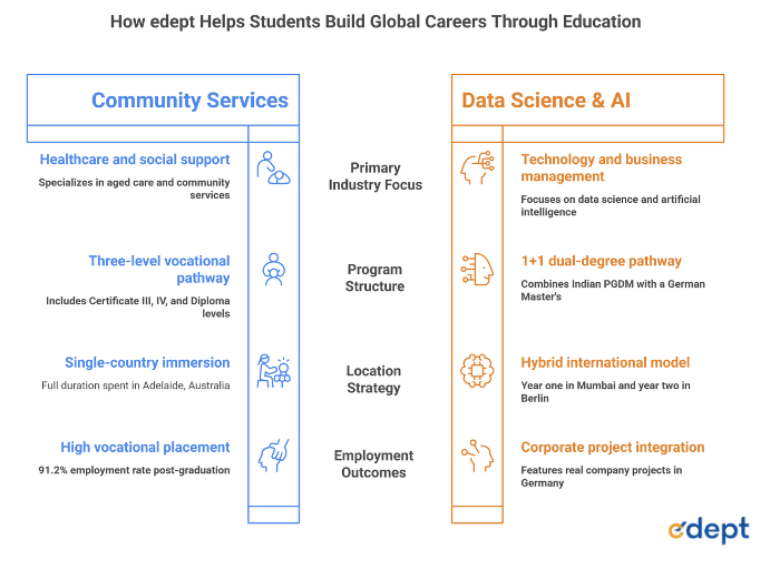
Many universities and training institutes have direct relationships with local employers. Recruiters visit campuses, post roles through careers portals, and actively hire from graduating cohorts. According to the Australian National Centre for Vocational Education Research (NCVER), 91.2% of students from programs like those offered through Auctus Training Institute were employed after graduation.
Internship and Co-op Opportunities
Programs that include structured work placements connect students directly with employers before they even complete their qualification. This is a significant advantage.
Industry Projects and Practical Exposure
Programs designed around real-world outcomes rather than just academic theory prepare students for the job market much more effectively. At Steinbeis University in Germany, students complete real company projects as part of their academic structure.
Development of Global Skills
Studying abroad builds more than technical skills. Cross-cultural communication, adaptability, and problem-solving in unfamiliar environments are skills that global employers actively look for.
Better Understanding of International Job Markets
Living and studying in a country teaches you things no online research can. You understand the job market from the inside, which gives you a practical edge in applications and interviews.
Countries Where Study-to-Work Pathways Are Especially Strong
Based on edept’s program offerings, two countries stand out as particularly strong for this pathway.
Australia
Australia has one of the most structured study-to-work pathways in the world. International students in vocational and higher education programs receive work rights during study and post-study work visas after graduation. The Certificate III in Individual Support, Certificate IV in Community Services, and Diploma of Community Services offered through edept, and Auctus Training Institute in Adelaide, all lead directly to employment in aged care and community services. Post-completion salaries range from AUD 65,000 to AUD 100,000 annually, depending on the qualification level. Adelaide is consistently ranked among the world’s most livable cities and has a growing demand for healthcare and community services professionals.
Germany
Germany has over 100,000 open roles in data, AI, cloud computing, and digital transformation. Students who graduate from a recognised German university receive an 18-month post-study work visa and can apply for the EU Blue Card, which is a pathway to long-term residency. edept’s Master’s in Data Science and AI, delivered in partnership with Steinbeis University in Berlin, follows a 1+1 dual-degree model. Students complete their first year in India at Shree L.R. Tiwari School of Business Management in Mumbai, then transfer to Berlin for year two. Starting salaries in Germany for Data Science and AI roles range from EUR 45,000 to EUR 80,000.
Salary Growth: Study Abroad vs Direct Work Abroad
Graduates who enter a market through a local qualification tend to earn at market rates from day one. Those who arrive on work visas often start lower and take longer to reach local salary benchmarks. Below are some of the detailed comparisons of the salary growth, keeping in mind the key aspects of Study Abroad vs Direct Work Abroad.
| Career Stage | Study Abroad Route | Direct Work Route |
| Entry Level | Strong, local market rate | Variable, often lower |
| Mid-Career | Steady growth with local credentials | Depends on employer support |
| Leadership | Well-positioned through networks | Harder without local recognition |
| Long-Term Earnings | Higher in most tracked cases | Moderate |
Which Industries Benefit Most From the Study-to-Work Pathway?
Let’s check which particular industry you can benefit from if considering a study-to-work pathway.
Data Analytics and AI
Germany and Australia both have strong demand for data professionals. Programs like edept’s Master’s in Data Science and AI are designed specifically for this market.
Nursing and Healthcare
Australia and Germany both face significant healthcare worker shortages. Aged care and community services roles are consistently in high demand across both countries.
Business Analytics and Management
The PGDM in Analytics offered through edept’s India track prepares students with a foundation in business statistics, Python, machine learning, and data visualisation before they transfer to Germany.
Why International Education Builds More Than Technical Skills
Studying abroad is not just about the qualification. It builds a whole set of capabilities that employers value. Living independently in a new country teaches budgeting, time management, and resilience. Working alongside people from different cultures builds communication skills that no classroom can replicate fully. These are the skills that support long-term career growth, not just initial employment.
Common Mistakes Students Make When Planning International Careers
Rushing into a decision without researching these areas is one of the most common reasons students find themselves stuck. Focusing only on immediate salary leads students to choose programs in low-demand fields. Ignoring immigration pathways means missing opportunities for permanent residency. Choosing a course without checking employer demand leaves graduates without job prospects. Not researching post-study work rights can mean completing a qualification with no legal way to stay and work. Underestimating the value of local experience means arriving unprepared for how competitive local job markets actually are.
How edept Helps Students Build Global Careers Through Education
When it comes to study abroad vs direct work abroad topic, edept runs career-focused international education programs designed specifically for Indian students aiming to work abroad. The programs currently active span two key markets: Australia and Germany.
Community Services and Aged Care: Australia
Through its partnership with Auctus Training Institute in Adelaide, edept offers a three-level pathway covering Certificate III in Individual Support, Certificate IV in Community Services, and the Diploma of Community Services. Programs include mandatory work placements, structured class schedules, and direct pathways to employment in one of Australia’s fastest-growing sectors. Auctus Training Institute is RTO and CRICOS registered and fully compliant with Australian regulatory standards. According to NCVER data, 92% of students achieved their goals through Auctus, and 91.2% were employed after graduation, making it an important point to notice when we talk about study abroad vs direct work abroad.
Master’s in Data Science and AI: Germany
edept’s dual-degree program in partnership with Steinbeis University and Shree L.R. Tiwari School of Business Management is a 1+1 pathway. Students spend year one in Mumbai and year two in Berlin. They graduate with both an Indian PGDM and a German Master’s degree. The program includes German language training at no extra cost, internship support in India, real company projects in Germany, and end-to-end visa and documentation support from edept. edept handles everything from admission to visa preparation to post-arrival support, so students can focus on learning and career preparation.
Step-by-Step Roadmap to Build an International Career Through Education
Choose a field with proven employer demand in your target country. Select a program that includes practical training and work placements. Build technical skills during your studies. Earn a recognised qualification. Complete your work placement or internship. Use post-study work rights to enter the local job market. Move into full-time employment and explore long-term residency options.
Study Abroad vs Direct Work Abroad: Who wins?
Both study abroad and direct work abroad can lead to international careers. But studying first gives you more control. It builds local experience, local networks, and local credentials before you enter the job market. Most countries with strong immigration pathways have designed them specifically to reward this route. Students who invest in career-focused education tend to find employment faster, earn better, and have stronger options for long-term settlement. If building a real international career is the goal, education is not a detour. It is the most direct route.