With the rise of cyber risks, data breaches, ransomware attacks, and digital security threats, cybersecurity has emerged as one of the most dynamic areas of the technology industry. The Global Cybersecurity Outlook by the World Economic Forum states that there are more than 4 million cybersecurity professionals needed worldwide, indicating a surge in the demand for cybersecurity specialists.
This surge has created thousands of jobs every year, which creates a simple question: Is coding for cybersecurity courses compulsory for you to kickstart your cybersecurity career? Despite this demand, many beginners are still reluctant to join the cybersecurity field primarily due to the false notion that coding is required from day one to undertake courses in cybersecurity. Students may feel discouraged from taking a course in cybersecurity or from entering a career in the field if they feel they need extensive programming experience.
The truth is more complicated. Although coding is highly beneficial in some cybersecurity careers, many entry-level positions emphasize networking, operating systems, security tools, threat monitoring, and incident response over programming. Many professionals, for example, do not start coding in Cybersecurity and have learned technical skills over time. This guide explains where coding is required, where it is optional, the cybersecurity skills employers value most, and how beginners can confidently start building a career in cybersecurity.
Is Coding Required for Cybersecurity?
One of the biggest questions that comes to mind when students enroll in cybersecurity programs is whether coding for cybersecurity courses is mandatory. The answer is quite simple, depending entirely on the career path that you choose. While programming can be a valuable skill, in several cybersecurity domains, several entry-level roles focus more on security operations, networking, and threat monitoring.
According to the World Economic Forum’s Global Cybersecurity Outlook, the cybersecurity skills gap remains a major challenge worldwide, with organizations actively seeking professionals across multiple specializations—not just coding-intensive roles. Additionally, the ISC2 Cybersecurity Workforce Study reports a global shortage of millions of cybersecurity professionals. This highlights a strong demand for both technical and non-technical security talent. Having a good understanding of the domain you are pushing for and coding knowledge can help you choose the right learning path.
Short Answer
Simple answer: No, programming for cybersecurity courses is not required for all cybersecurity jobs. There are plenty of starters who are getting into the field of cybersecurity without programming skills. But programming becomes really important if you take up specialized fields such as ethical hacking, penetration testing, malware analysis, and security engineering.
Where Coding Helps
Coding helps in automating complex processes, log analysis, scripting, and vulnerability discovery. There are also professionals that utilize programming languages for their work in ethical hacking, penetration testing, and threat hunting to make themselves more efficient and perform better analysis in cybersecurity operations. This is where it comes in handy to have skills in ethical hacking as well as an understanding of code.
Where Coding is Not Required
There is a wide range of entry-level positions in the field of cybersecurity where no programming skills are required. Monitoring, incident detection, compliance, governance, risk management, as well as SOC (Security Operations Centre) jobs could be more focused on the basics of networking, security tools, and fundamental cybersecurity knowledge rather than programming. This is one of the reasons why many individuals start exploring the field of cybersecurity from the very beginning. Hence, it can be argued that learning from scratch is a viable way to go into cybersecurity without coding.
Read more: Growing Need for Cybersecurity Experts
Cybersecurity Roles That Do NOT Require Coding
One of the biggest misconceptions about coding for cybersecurity courses is that every cybersecurity role requires programming expertise. In reality, many entry-level positions focus on monitoring systems, identifying threats, and using security tools rather than writing code. These roles provide an excellent starting point for individuals interested in cybersecurity without coding while they build foundational security knowledge.
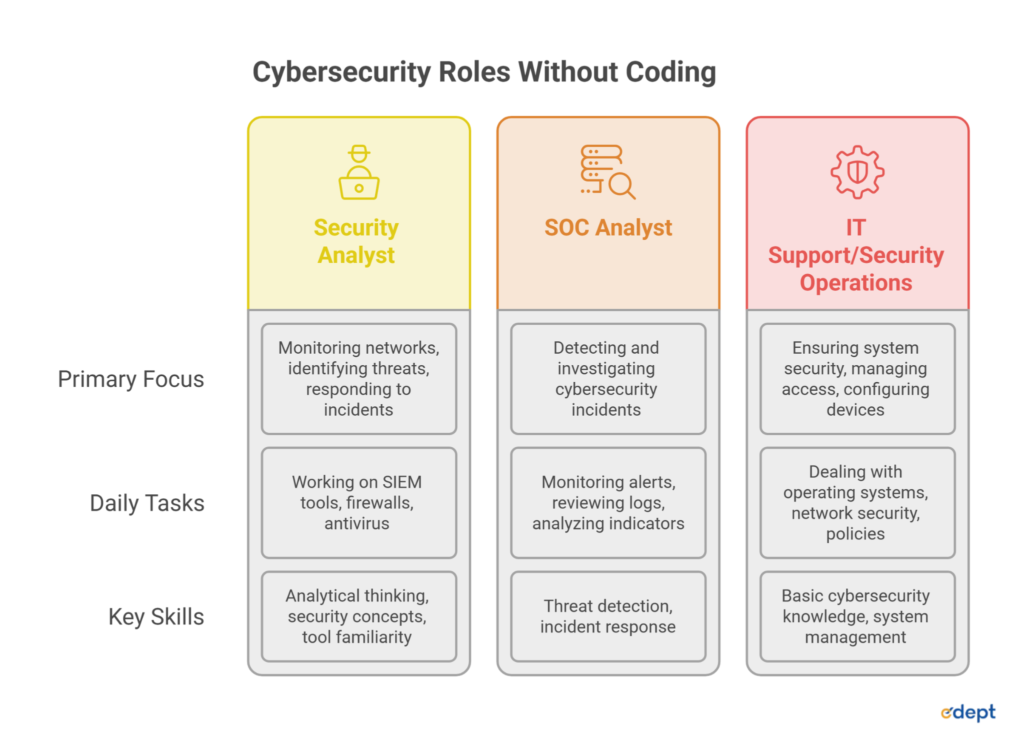
Security Analyst
A security analyst is responsible for monitoring all the organizational networks, identifying any suspicious activities, and responding to potential security incidents. Their daily work includes working on security platforms like SIEM tools, firewalls, antivirus solutions, and endpoint protection systems. To become a security analyst, you should have good analytical thinking, knowledge of security concepts, and familiarity with cybersecurity tools, instead of just coding skills at this stage.
SOC Analyst
A Security Operations Centre (SOC) Analyst mainly focuses on detecting and investigating cybersecurity incidents. The daily work of a SOC Analyst includes monitoring security alerts, reviewing system logs, and analyzing threat indicators when necessary. Many SOC Analyst roles emphasize threat detection and incident response, making them suitable entry points for professionals pursuing cybersecurity without coding.
IT Support/Security Operations
IT support and security operations staff ensure that computer systems remain secure, manage user access rights, configure devices, and follow basic security measures. Security and IT operations often deal with operating systems, network security, and security policies. Such jobs will equip you with basic cybersecurity knowledge and prepare you to specialize in security fields.
Cybersecurity Roles That Require Coding
While many professionals begin their careers in cybersecurity without programming knowledge, certain specializations rely heavily on coding and scripting skills. Roles such as Ethical Hacker, Penetration Tester, Security Engineer, and Malware Analyst often require professionals to automate security tasks, identify vulnerabilities, analyze malicious code, and develop security solutions. According to the ISC2 Cybersecurity Workforce Study, organizations continue to face a significant cybersecurity talent shortage, increasing demand for professionals with advanced technical skills. If you are considering coding for cybersecurity courses, learning languages such as Python, Bash, or PowerShell can provide a strong advantage and open doors to higher-paying, specialized cybersecurity roles.
Ethical Hacker / Penetration Tester
The task of an Ethical Hacker / Penetration Tester is to simulate cyber attacks on systems, networks, and applications to identify any vulnerabilities before being exploited by malicious hackers. The most popularly used programming languages for this purpose are Python and Bash. An Ethical Hacker / Penetration Tester must have the ability to exploit vulnerabilities and be proficient in using application security techniques.
Security Engineer
A Security Engineer is responsible for building, deploying, and managing security for systems and infrastructure. Their daily functions include automation of security tasks, enhancement of cloud security, creation of security controls, and integration of security in software development projects. The knowledge of coding/scripting becomes highly beneficial for Security Engineering.
Malware Analyst
The job of a Malware Analyst entails investigating malicious programs and analyzing the way they operate. Reverse-engineering and code analysis, together with the identification of attack methodologies of hackers, belong among the major duties of Malware Analysts. Advanced knowledge of programming can be helpful, but not necessary for Malware Analysts because operating systems, system internals, and malware behaviour are more important.
What Programming Languages Are Useful in Coding for Cybersecurity?
If you are exploring coding for cybersecurity courses, you should know exactly which programming language can make learning easier and more practical. As we already saw, not every cybersecurity role requires coding; understanding a few key languages can improve your expertise in key operations like automation, security analysis, ethical hacking, and incident response capabilities. The best approach is to start with beginner-friendly languages and gradually progress toward more advanced use cases.
Beginner-Friendly Languages
Python is often thought to be the most helpful programming language for cybersecurity beginners because of its simplicity and rich security-related library. Its uses include automation, security testing, threat investigation, and scripting. Bash scripting skills are also beneficial as they allow automating system and security processes, primarily on Linux systems. Python is the ideal starting point for coding for cybersecurity courses.
Intermediate Languages
As cybersecurity knowledge improves, JavaScript and PowerShell become common skills among cybersecurity specialists. The former is crucial to understanding web application vulnerabilities, such as Cross-Site Scripting (XSS). The latter is often applied to system administration, automation, and security in Windows.
Advanced Use Cases
Programmers may use languages like C or C++ for exploit development, reverse engineering, malware analysis, and any other cybersecurity activity that requires low-level system information.
| Languages | Common Cybersecurity Use Cases |
| Python | Automation, scripting, security tools |
| Bash | Linux administration, task automation |
| JavaScript | Web security testing, vulnerability analysis |
| C/C++ | Malware analysis, reverse engineering, exploit research |
Skills You Need Besides Coding for Cybersecurity
When we talk about coding for cybersecurity courses, we often miss out that programming is only one part of a successful cybersecurity career. In fact, there are many organizations that prioritize foundational cybersecurity knowledge, analytical thinking, and practical security skills over coding. Whether you are pursuing cybersecurity without coding or planning to learn programming later, the core skills remain important for your long-term career growth.
Networking Fundamentals
Networking is one of the key aspects of cybersecurity since cyber attacks usually target the networks themselves, the servers, and other networking hardware. Knowing about TCP/IP, DNS, virtual private networks, firewalls, and other network-related technologies will help to better understand potential cybersecurity issues and deal with them accordingly.
Operating Systems Knowledge
Many cybersecurity positions entail dealing with Windows and Linux environments. Being familiar with OS fundamentals such as file systems, permissions, and processes is important to be able to conduct security assessments of the network and spot suspicious activity on any part of it. Many entry-level cybersecurity roles require strong operating system knowledge, even when coding for cybersecurity courses is not emphasized.
Security Tools & Concepts
It will be more beneficial to be expertise different cybersecurity tools and technologies rather than just knowing how to code. Using different security tools such as SIEM solutions, anti-virus tools, and vulnerability scanning software will guarantee that all situations are handled appropriately by the cybersecurity experts. Cybersecurity skills are vital before embarking on other cybersecurity courses.
Read more: Top Skills For Cybersecurity: Complete Guide.
Can Beginners Start Cybersecurity Without Coding
Beginners can absolutely start their cybersecurity career without prior programming knowledge. Many professionals enter the field of cybersecurity through networking, IT support, system administration, and security operations roles before learning advanced coding concepts. According to the ISC2 Cybersecurity Workforce Study, the global cybersecurity workforce gap remains significant, creating opportunities for candidates with diverse skill sets and backgrounds. While coding for cybersecurity courses can become valuable as you progress into areas such as ethical hacking, malware analysis, or security engineering, it is not a prerequisite for getting started. While coding for cybersecurity courses can be useful in the long run, it is not a prerequisite for getting started in the industry.
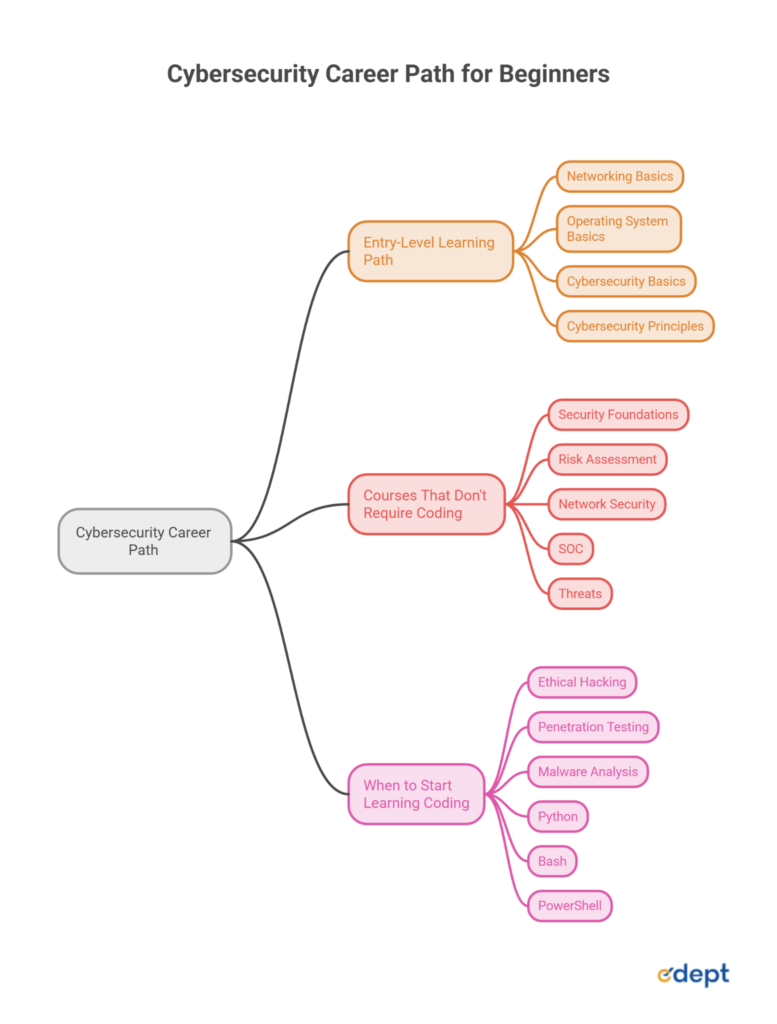
Entry-Level Learning Path
For any beginner, some vital areas of study within the cybersecurity domain include networking basics, operating system basics, basics of cybersecurity, and principles of cybersecurity. The mastery of these fundamental subjects helps you understand the technology behind it and also gives you the requisite skills in cybersecurity.
Courses That Don’t Require Coding
The majority of beginner courses are dedicated to security foundations, risk assessment, network security, SOC, and threats. If your interests lie in cybersecurity but not in coding, such programs will help you gain fundamental skills for future success in the field of cybersecurity.
When to Start Learning Coding
It is very crucial for you to start learning how to code, as you delve into the cybersecurity sector and choose a specialized area to specialize in, which could be ethical hacking, penetration testing, or even malware analysis. After having understood everything about cybersecurity basics, learning either Python, Bash, or PowerShell will greatly boost your career prospects.
Benefits of Learning Coding for Cybersecurity
While many experts start off in the field of cybersecurity without having any experience in coding, acquiring knowledge of programming languages can open up new possibilities for job opportunities in the future. By knowing how to code, security experts gain the ability to perform tasks automatically, learn more about how the application operates, analyze attacks better, and improve problem-solving skills.
Improved Job Prospects
Professionals who have both knowledge regarding cybersecurity and coding skills have better chances compared to others. Learning programming languages like Python, Bash, or PowerShell will help individuals move ahead in their cybersecurity career paths.
Higher Salary Potential
Programming can help increase income levels, as certain high-level cybersecurity positions may involve creating programs and automated tasks as well as building tools for cybersecurity. Careers like those of an Ethical Hacker, Security Engineer, or Malware Analyst tend to pay better than monitoring or support jobs, which are considered entry-level jobs.
Advanced Career Options
Several branches of cybersecurity involve coding. Knowledge about hacking techniques, vulnerability analysis, malware analysis, and even penetration testing may necessitate some level of understanding of coding. Security breaches occur very fast, and those individuals who have experience in both cybersecurity and coding are sought after by most companies.
Also read: Cybersecurity Courses in India
Common Myths About Coding for Cybersecurity
Many aspiring professionals avoid cybersecurity because of misconceptions surrounding coding for cybersecurity courses. While programming can be valuable in certain specializations, it is not the barrier that many beginners believe it to be. Understanding the reality behind these myths can help learners make more informed career decisions.
“You Must Be a Programmer”
This is one of the most common myths in cybersecurity. There are many entry-level jobs related to threat monitoring, security operations, governance, and compliance that have nothing to do with programming. Some individuals manage to build successful careers in cybersecurity with no prior programming experience.
“Coding Is Too Difficult”
Coding might appear scary, but a majority of cybersecurity experts do not require coding proficiency since all they need is a good understanding of basic scripting. Python and Bash scripts, for example, are easy to understand and learn gradually, together with other cybersecurity concepts.
“No Coding Equals No Career Opportunities”
Although coding might help one advance their cybersecurity career faster, it is not the only way to build a successful career in cybersecurity. Proficiency in network fundamentals, operating systems, security products, and incident handling techniques can also ensure one has a successful career in cybersecurity.
How to Start Learning Cybersecurity Without Coding
Starting a cybersecurity career does not require advanced programming knowledge. Many successful professionals begin by learning security fundamentals, networking concepts, and security tools before moving into specialized areas. If you are interested in cybersecurity without coding, focusing on the right learning path can help you build strong foundational cybersecurity skills and prepare for entry-level roles.
Beginner Courses & Certifications
Consider starting with cybersecurity fundamentals courses covering topics like networking, operating systems, cyber attacks, risk management, and cybersecurity. Starting with an introductory course to obtain beginner certificates, such as CompTIA Security+, Cisco Certified Support Technician (CCST) Cybersecurity, or other similar introductory courses, can assist greatly with knowledge validation and employment.
Tools to Begin With
Rather than learning code from day one in cybersecurity courses, individuals new to cybersecurity should first familiarize themselves with some common security tools. Examples of such tools are Wireshark, Nmap, SIEM platforms, vulnerability scanning software, and basic Linux commands.
Incremental Skill Development Process
Learning the fundamentals of cybersecurity and networking, and understanding security operation processes, comes first. After obtaining the necessary cybersecurity fundamentals, one will be able to move on to learning Linux administration, scripting, and the usage of security tools.
Conclusion
The idea that coding for cybersecurity courses is mandatory from the beginning is one of the biggest misconceptions in the cybersecurity industry. While programming skills can be highly valuable, especially for ethical hacking, penetration testing, security engineering, and malware analysis, they are not required for many entry-level cybersecurity roles.
Beginners should focus first on building strong cybersecurity skills such as networking, operating systems, security concepts, threat detection, and security tools. These fundamentals form the foundation of a successful cybersecurity career and are often more important than coding during the initial learning stages. As your knowledge and experience grow, learning languages such as Python, Bash, or PowerShell can help you automate tasks, improve problem-solving abilities, and qualify for advanced cybersecurity positions.
Whether you start with cybersecurity without coding or pursue programming from day one, the key is to follow a structured learning path and continuously upgrade your skills. Consistent learning and practical experience will ultimately have the greatest impact on your long-term cybersecurity career.
Related Links:
| Top Cybersecurity Skills: Complete Guide | Cybersecurity Courses After 12th |
| How to Become a Cybersecurity Expert | Cybersecurity for Startups |