Nursing and AI have become difficult to separate in practice. The nurses getting ahead in 2026 are the ones who stopped waiting to see how it would all unfold and started building the skills to work within it confidently. It is reshaping the roles that exist, the skills that matter, and the way clinical work actually gets done in 2026. From telehealth and remote monitoring to nursing informatics, new AI healthcare jobs are emerging globally at a pace that makes early preparation the single biggest career advantage a nursing professional can have.
Something significant is happening in healthcare, and nurses are sitting right at the centre of it. The AI in healthcare market was estimated to be worth USD 39.34 billion in 2025. In 2026, the market stands at USD 56.01 billion, with expectations of USD 1,033.27 billion by 2034. This will grow at a CAGR of 43.96%. Behind those numbers is a fundamental shift in how patient care is delivered, monitored, and managed, and nurses are not being replaced by it. They are being repositioned by it.
So what does AI in nursing careers actually mean in 2026? It means that nursing is expanding into roles that did not exist ten years ago, requiring skills that go beyond clinical training and offering salaries and global opportunities that have grown significantly alongside the technology itself.
This blog covers how AI is changing healthcare, what new AI healthcare jobs are emerging for nurses, what skills those roles require, which countries are leading the shift, and what nursing students and professionals can do right now to position themselves for the future of nursing AI.
AI Nursing Roles Comparison Table
| Role | Core Responsibility | Key Skills Required | Work Environment | Average Salary (India) |
| Clinical Data Analyst Nurse | Analyse patient data and support clinical decisions | Data interpretation, analytics basics, clinical knowledge | Hospitals, research centres | ₹10 LPA to ₹15 LPA |
| Telehealth Nurse | Provide remote consultation and patient support | Communication, telehealth platforms, adaptability | Remote setups, hospitals | ₹4 LPA to ₹8 LPA |
| Nurse Informatics Specialist | Manage healthcare IT systems and data workflows | EHR systems, data management, tech integration | Hospitals, IT departments | ₹8 LPA to ₹18 LPA |
| Remote Patient Monitoring Nurse | Monitor patients using wearable and AI tools | Monitoring systems, alert response, patient education | Home care, hospitals | ₹5 LPA to ₹10 LPA |
| AI Healthcare Coordinator | Oversee AI systems and clinical workflows | Project management, tech understanding, leadership | Large hospitals, health systems | ₹12 LPA to ₹20 LPA+ |
How AI Is Transforming the Healthcare Industry
AI entered healthcare quietly, then all at once. The shift from experimentation to practical deployment has accelerated significantly in the past two years, and nurses are experiencing it on the ground every day.
Rise of AI in Patient Care
There are several active implementations of AI applications in hospitals in countries such as the USA, UK, Australia, and others. The prediction is that by 2025, 90% of hospitals will employ AI technologies for early diagnosis and monitoring of patients remotely. That scale of adoption changes what nurses interact with daily. AI systems flag deteriorating patients before vital signs become critical. Predictive tools identify sepsis risk hours earlier than traditional observation. Diagnostic imaging AI spots abnormalities in scans with accuracy that rivals specialist physicians. Nurses working within these environments are not just clinical caregivers anymore. They are the human interface between AI systems and patients, which is an entirely new kind of professional responsibility and a core part of what AI in nursing careers looks like today.
Use of AI in Hospitals and Clinics
Smart hospitals are not a concept anymore. Back in April 2025, HelloCareAI pulled in $47 million in funding to scale up its AI-powered virtual healthcare platform, which is built specifically around smart hospital environments and brings together AI-supported nursing, remote health monitoring, and smoother hospital workflow management under one system. Nurses in these environments work alongside AI tools for documentation, medication management, scheduling, and patient communication. The administrative load that has historically eaten into nursing time is being automated, which in theory gives nurses more time for direct patient care and in practice creates demand for nurses who understand how to operate within and alongside these systems.
Why Nurses Must Adapt to AI?
The question is not whether AI will change nursing. That has already happened. The question is whether nurses will actively shape how it changes the profession or simply react to it. 73% of nurses believe they should be directly involved in building trustworthy AI tools, and 64% support the wider use of AI in healthcare, with 57% saying they are hopeful it will enhance care quality and improve job satisfaction. Nurses who build even a working understanding of AI systems, healthcare data, and digital health platforms position themselves for the new AI healthcare jobs that are growing fastest while the profession is short of people who can fill them.
What Does AI in Nursing Mean?
AI in nursing careers is a broader concept than most people initially assume, and understanding its full scope is what allows nurses to identify which emerging roles actually fit their interests and existing experience.
Definition and Scope
AI in nursing refers to the integration of artificial intelligence tools, systems, and data-driven processes into nursing practice. This covers everything from predictive monitoring systems that flag clinical deterioration, to virtual nursing assistants that handle patient queries, to nursing informatics platforms that analyse population health data to guide care decisions. AI in nursing careers does not mean nurses becoming technologists. It means nurses developing enough digital fluency to work effectively within increasingly technology-driven clinical environments.
Role of Nurses in AI-Driven Systems
In AI-driven healthcare settings, the nurse is the person who makes the technology mean something to the patient in front of them. AI systems produce data, throw up alerts, and generate recommendations. What they cannot do is sit with a patient, weigh up what the numbers are saying against what clinical experience is telling you, relay that to a medical team in a way they can act on, and then turn all of that into a care decision the patient actually understands and trusts. That combination of clinical expertise and technology literacy is entirely human, and it is precisely what makes AI in nursing careers an expansion of what the profession can offer rather than any kind of threat to it.
AI vs Traditional Nursing Practices
Traditional nursing relies heavily on observation, manual documentation, and experience-based pattern recognition. AI-driven nursing practice adds a layer of real-time data analysis, predictive alerting, and automated documentation that changes the pace and texture of clinical work. The comparison is not AI replacing traditional practice. It is AI extending what traditional practice can see and respond to, while freeing nurses from repetitive tasks so more time goes toward the human dimensions of care that technology genuinely cannot replace.
New AI-Driven Roles in Nursing
The most concrete evidence of AI’s impact on the future of nursing AI is the emergence of roles that simply did not exist a decade ago and the significant salary premiums many of them carry.
Clinical Data Analyst Nurse
They work through data generated by AI monitoring systems, pick out patterns that carry genuine clinical weight, and bring those findings to care teams in a way that feeds directly into better outcomes for patients. Large hospital networks, research institutions, and health systems that have put serious money into electronic health records and clinical analytics platforms are where this role shows up most often. Among AI healthcare jobs, it carries one of the steeper learning curves, but also one of the stronger salary premiums for nurses who put in the work to develop what it demands.
Telehealth Nurse
Telehealth nursing has travelled a long way from being a niche specialism to sitting comfortably within the mainstream of AI in nursing careers pathways. Telehealth nurses deliver clinical consultation, patient education, symptom triage, and follow-up care through digital platforms, typically with AI tools running alongside them to flag high-risk patients, suggest care pathways, and take care of appointment scheduling automatically. The AI-driven virtual nursing assistants market is moving from $1.76 billion in 2025 to $2.19 billion in 2026 at a CAGR of 24.4%, which gives some sense of how quickly AI-supported remote care delivery is expanding. Telehealth nursing roles are now openly available across the US, UK, Canada, and Australia in a way they simply were not a few years ago.
Nurse Informatics Specialist
Nursing informatics careers occupy a distinct space where nursing science, information technology, and data management all meet. Nurse informatics specialists design, roll out, and assess healthcare information systems, bring other nursing staff up to speed on digital tools, and serve as the clinical voice in projects where new technology is being introduced or overhauled. The pay attached to nursing informatics careers is among the most consistently strong anywhere in the nursing field, and the demand for people who combine genuine clinical credibility with working knowledge of digital systems has built steadily as healthcare organisations have continued deepening their technology investments year on year.
Remote Patient Monitoring Nurse
Remote patient monitoring nurses oversee patients using wearable devices, home health sensors, and AI-powered health management platforms. They review continuous data streams, respond to alerts, coordinate with physicians when clinical thresholds are breached, and work directly with patients to ensure they understand and use monitoring technology correctly. This is one of the AI healthcare jobs growing most rapidly, driven by the push toward home-based and community healthcare that every major healthcare system globally is pursuing.
AI Healthcare Coordinator
AI healthcare coordinators manage the clinical workflows that AI systems operate within, ensuring that AI-generated alerts are appropriately triaged, that staff training on AI tools is current, and that the integration between AI platforms and patient care processes is functioning as intended. It is a relatively new role that combines project management, clinical knowledge, and technology oversight, and it is emerging as a distinct career pathway within the future of nursing AI for experienced nurses looking to move into operational leadership.
Read More: What Students Often Miss Before Applying for Nursing Courses: A Complete Guide
Key Responsibilities in AI-Based Nursing Roles
AI in nursing careers brings a set of responsibilities that extend beyond traditional clinical duties in consistent ways across all the new role types.
Data Interpretation
Nurses in AI-driven roles regularly interpret data outputs from monitoring systems, predictive algorithms, and clinical analytics platforms. This is not a statistical analysis in the academic sense. It is the ability to read what a data system is telling you, evaluate whether it aligns with clinical observation, and make a judgement about how to act on it. This skill sits at the heart of most AI healthcare jobs available to nursing professionals in 2026.
Monitoring AI Systems
AI systems in healthcare do not run reliably without someone keeping a close eye on them, and in most AI-integrated settings, that responsibility falls to nurses. Checking that monitoring systems are working as they should, confirming that alerts are firing the way they are supposed to, and making sure anything unusual in how a system is behaving gets flagged and passed up the chain quickly are all part of the role. It is a layer of technology stewardship that nurses in more traditional settings have never had to carry, and it changes the shape of the job in ways that take some adjustment to get comfortable with.
Patient Interaction with Technology
One of the most consistently underestimated responsibilities in AI in nursing careers is helping patients understand and engage with health technology. Wearable devices, telehealth platforms, and remote monitoring tools all require patients to participate actively for them to work. Nurses who can explain these technologies clearly, troubleshoot common issues, and build patient confidence in using them are genuinely more valuable in AI-driven healthcare settings than those who cannot.
Skills Required for AI-Driven Nursing Careers
Positioning for the future of nursing AI does not require becoming a software engineer. It requires building a specific and manageable set of skills that sit alongside clinical competency.
Clinical Knowledge Plus Technology Skills
The most important thing to understand about AI in nursing careers is that clinical knowledge remains the foundation. Technology skills are built on top of it. Nurses who develop even a basic working understanding of how AI monitoring systems function, how electronic health records are structured, and how data flows through a healthcare system become significantly more competitive for the AI healthcare jobs emerging in every major market.
Data Handling and Basic Analytics
Comfort with data is increasingly a core nursing competency rather than a specialist skill. This does not mean advanced statistics. It means being able to read a dashboard, interpret a trend, understand what a threshold alert represents, and communicate data-based observations clearly to clinical colleagues. These are learnable skills that nurses can develop through targeted courses and platform-based training before they ever start a dedicated nursing informatics career.
Communication and Adaptability
AI-driven healthcare environments change frequently as technology evolves and systems are updated. Nurses who adapt quickly, communicate effectively across clinical and technical teams, and approach new tools with curiosity rather than resistance are consistently more successful in AI healthcare jobs than those with equivalent clinical skills but lower adaptability. Communication also matters for the patient-facing dimensions of these roles, where explaining AI-informed care decisions clearly and reassuringly is a daily professional requirement.
Understanding Healthcare Software
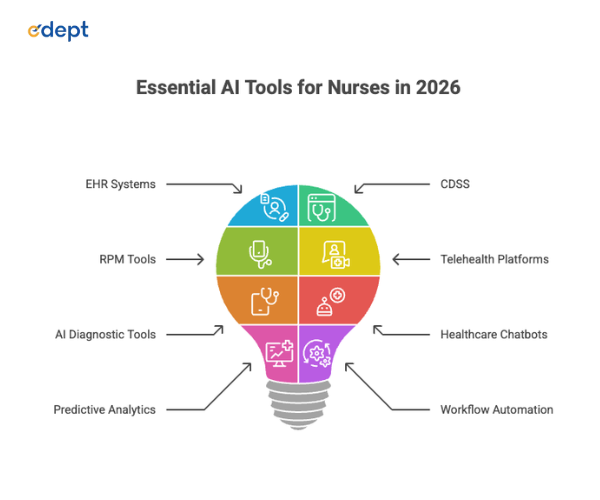
Electronic health record proficiency, familiarity with patient monitoring platforms, and a working understanding of how clinical decision support tools generate recommendations are all practical skills that AI in nursing careers depends on. These are not advanced competencies. They are achievable through structured learning and hands-on exposure, and they are increasingly listed as requirements in job postings for the new nursing roles emerging globally.
Salary Trends in AI-Based Nursing Roles
Salary is one of the more compelling parts of the AI in nursing careers conversation, and the numbers across both entry-level and specialised roles make a strong case for why developing these skills early is worth the effort.
Entry-Level Salaries
Nurses entering AI-focused roles from clinical backgrounds typically start between $70,000 and $90,000 annually in the US, with entry points in the UK, Canada, and Australia ranging from £38,000 to AUD $85,000, depending on role and employer. Telehealth nursing and remote patient monitoring roles sit toward the lower end of this range, while nursing informatics careers and clinical data analyst nurse positions typically start higher due to the additional technical skill requirements.
Specialised Role Salaries
Among nursing professionals who have not pursued advanced practice qualifications, nursing informatics careers sit at the top end of the salary range by a considerable margin. Nurse informatics specialists in India typically take home between Rs. 8 lakh and Rs. 18 lakh annually. Senior AI healthcare coordinators working within large health systems can push past Rs. 20 lakh, and clinical data analyst nurses who have built strong analytics skills over several years regularly earn above Rs. 15 lakh in the more competitive markets. What these figures reflect is the premium healthcare organisations are willing to pay for someone who can genuinely operate across both the clinical and technology sides of the work.
Global Salary Opportunities
AI in nursing careers is not a trend concentrated in one country, and the salary landscape reflects that spread. The US leads on overall compensation for AI healthcare jobs, but the UK, Canada, and Australia all offer packages that are genuinely competitive when you factor in quality of life alongside the headline figures. For Indian nurses specifically, international markets represent a significant salary jump, with nursing informatics careers abroad offering multiples of what the domestic market currently pays. Germany and the Netherlands are worth watching as emerging markets, with salaries moving upward and a meaningful shortage of internationally trained nurses with the right technology skills to meet what those healthcare systems actually need.
Countries Leading in AI-Based Nursing Jobs
The opportunity for nurses with AI skills is not evenly spread across the world. Some countries have moved faster than others, and knowing where demand is strongest is worth understanding before you decide where to take your career.
United States
The US leads global investment in healthcare AI and has the largest number of available AI healthcare jobs for nursing professionals. Virtual nursing assistant deployments, telehealth expansion, and large hospital network investments in clinical analytics have created strong demand across all the new AI-driven nursing role types. Nursing informatics careers in the US are particularly well-developed, with dedicated career pathways and professional associations supporting the specialisation.
United Kingdom
The NHS has made significant investments in digital health infrastructure, creating growing demand for nurses with technology skills across telehealth, remote monitoring, and clinical informatics roles. In the UK, the NHS has put structured digital programmes in place that actively support AI in nursing careers, and the private sector has been moving in the same direction, with a growing number of healthcare technology employers specifically looking to recruit nurses who are coming straight out of clinical backgrounds.
Canada
Canada’s push toward digital transformation in healthcare has been one of the more sustained commitments to come out of the post-pandemic period, and the demand it has created for nursing informatics careers and telehealth roles has held up consistently across all major provinces. Ontario, British Columbia, and Alberta stand out for how actively they are recruiting nurses with AI and digital health skills, and internationally trained nurses are very much part of that conversation, rather than an afterthought.
Germany
Germany is putting serious investment into smart hospital infrastructure and digital health platforms, and that investment is generating real demand for nurses who can work comfortably within AI-integrated clinical environments. Nursing informatics careers are taking shape there alongside the wider digitalisation of the healthcare sector, and the country’s well-documented nursing shortage is pushing recruitment of internationally trained professionals with the right skills up the priority list faster than many people outside the country realise.
Australia
Australia’s NDIS and aged care sectors have both expanded significantly into AI-supported care models, and the country’s telehealth system grew rapidly post-pandemic and has maintained that growth. Remote patient monitoring roles are particularly active in Australia, given the geographic spread of the population and the investment in technology as a way of extending care access. AI in nursing careers in Australia is supported by an active digital health agenda at both the federal and state levels.
Benefits of AI in Nursing Careers
The benefits showing up in hospitals and healthcare systems that have already made the shift are hard to ignore. They are practical, measurable, and felt by the nurses working within them every day, from how much time goes on paperwork to where a career can realistically go over the long term.
1. Reduced Workload
The AI nursing assistant market is forecast to reduce 20% of nurses’ maintenance tasks, saving $20 billion annually. That reduction in administrative and routine task burden is one of the most direct benefits of AI in nursing careers, freeing time for the patient-facing work that drew most nurses to the profession in the first place.
2. Better Patient Outcomes
AI-assisted monitoring, early warning systems, and clinical decision support consistently produce better patient outcomes by catching deterioration earlier, reducing medication errors, and supporting more informed care decisions. Nurses working within these systems are part of a care model that genuinely performs better for patients, which matters to most of the people who choose nursing as a career.
3. Career Growth Opportunities
The emergence of new AI healthcare jobs within nursing creates career growth pathways that did not previously exist. Nurses with the right combination of clinical experience and technology skills can move into nursing informatics careers, AI healthcare coordination, clinical analytics, and digital health leadership roles that offer both higher salaries and broader professional influence than traditional clinical progression alone would allow.
Challenges of AI in Nursing
AI in nursing careers brings genuine opportunity, but it does not come without friction. Understanding the challenges that come with this shift before you are in the middle of them makes navigating them considerably more manageable in practice.
Learning New Technologies
Not every nurse comes to AI in nursing careers with comfort around technology. Learning new systems, maintaining proficiency as platforms update, and developing enough data literacy to operate confidently in analytics-heavy roles all take time and deliberate effort. Nurses who invest in this development early face a much smaller learning gap than those who wait until technology proficiency becomes a formal job requirement.
Data Privacy Concerns
Healthcare AI systems handle sensitive patient data at scale, and nurses working within these systems carry responsibilities around data privacy and regulatory compliance that go beyond traditional clinical confidentiality obligations. Understanding the basics of data governance, HIPAA or equivalent frameworks, and the ethical dimensions of AI in patient care is increasingly part of what AI healthcare jobs require.
Resistance to Change
Healthcare is a traditional profession, and there are some who do not see AI integration in a positive light. AI-assisted nurses may be employed in situations where their team members may have reservations or doubts about the role of AI. Nurses who can navigate this professionally, explaining AI’s role clearly and modelling confident engagement with new tools, are valuable in ways that go beyond their technical skills alone.
Why Nursing Students Should Learn AI Skills Early?
Most nursing students are not thinking about AI skills yet. That is precisely what makes developing them early such a straightforward advantage in a job market that is already shifting faster than most training programmes have caught up with.
Future Job Readiness
The future of nursing AI is not arriving someday. It is already here in significant deployment across major healthcare markets. Nursing students who graduate with foundational technology skills, an understanding of digital health platforms, and even basic nursing informatics knowledge arrive job-ready in a way that students without those skills genuinely do not. The gap between the two types of graduates in terms of employability and starting salary is already visible and widening.
Competitive Advantage
Most nursing students are not actively developing AI skills during their training. That creates a genuine competitive advantage for the minority who do. In markets where AI healthcare jobs are growing fastest, the candidates who combine clinical competency with demonstrable technology skills consistently receive more interview invitations, stronger offers, and faster career progression than those who present purely clinical profiles.
Higher Salary Potential
The salary premium for AI in nursing careers is real and documented across all major markets. A career in nursing informatics, as a clinical data analyst nurse, and an AI healthcare coordinator can earn a salary well above the norm for a regular RN. The nursing student who prepares themselves for such careers is not only setting themselves up for success in their profession, but also in terms of money earned.
Build future-ready healthcare skills with edept’s career-focused programs. edept offers structured pathways designed to prepare nurses and nursing students for the emerging AI healthcare jobs reshaping the profession globally. Contact edept counsellor’s to explore programs built for the future of nursing AI.
Why Choose edept for Future-Ready Nursing Careers?
Most nursing programmes teach you what the profession looked like when the curriculum was written. edept builds around where it is heading, which in 2026 makes a more meaningful difference to your career prospects than most students initially realise.
Industry-Aligned Programs
edept builds its nursing programmes around where the profession is genuinely going, not where it stood ten years ago. The curriculum keeps pace with the growing role of AI in nursing careers, threading digital health literacy, technology-integrated practice, and the competencies that employers in AI-driven healthcare settings actually look for when they sit down to hire through everything students learn.
Focus on Emerging Healthcare Skills
Foundational nursing training is the starting point, not the finish line. Edept takes students further by building the specific skills that nursing informatics careers, telehealth roles, and other AI healthcare jobs call for in practice. That means real exposure to healthcare data, hands-on time with digital health platforms, and the kind of technology-aware thinking that puts nurses ahead in the fastest-growing corners of the global healthcare job market.
Career Counseling and Placement Support
Understanding which AI in nursing careers path aligns with a student’s clinical interests and technical aptitude requires specific, current knowledge. Edept’s career counselling is informed by real healthcare industry trends and provides practical guidance on role selection, skill development priorities, and how to position a nursing profile for emerging opportunities in the future of nursing AI.
Global Career Preparation
edept’s programs are designed with international career pathways in mind. Whether a student is targeting AI healthcare jobs in the US, UK, Australia, or an emerging market like Germany, Edept provides the curriculum alignment, credential guidance, and career support infrastructure to make that transition realistic rather than aspirational.
How to Prepare for AI-Driven Nursing Careers
Knowing that AI in nursing careers is growing is one thing. Knowing what to actually do about it, in a practical, step-by-step way, is what separates nurses who are ready for what is coming from those who are still catching up once it arrives.
1. Learn Basic Technology Skills
Electronic health record proficiency, familiarity with remote monitoring platforms, and basic data literacy are the most immediate skills to develop. These do not require advanced qualifications. They require deliberate practice with the tools that AI in nursing careers depends on, many of which are accessible through free or low-cost training platforms before any formal qualification is pursued.
2. Take Relevant Certifications
Certifications in health informatics, digital health, and telehealth nursing add credibility to a profile that combines clinical experience with technology skills. The American Nursing Informatics Association, HIMSS, and several university programs offer structured certifications specifically aligned with nursing informatics careers and other AI-focused nursing roles.
3. Gain Clinical Plus Tech Exposure
The most competitive candidates for AI healthcare jobs are those who have both clinical depth and documented technology exposure. Seeking out clinical placements in technology-integrated environments, volunteering for EHR implementation projects, or requesting involvement in digital health initiatives within a workplace are all ways of building that combination during a nursing career rather than waiting until a specific role requires it.
4. Stay Updated with Industry Trends
The future of nursing AI is moving quickly enough that staying current matters professionally. Following healthcare technology publications, joining nursing informatics professional associations, and attending digital health conferences or webinars all provide ongoing exposure to where AI in nursing careers is heading and which skills are becoming most in demand across global markets.
Also Read: Career Opportunities In The United States After Clearing NCLEX-RN
Future Scope of AI in Nursing Careers
The growth seen so far in AI in nursing careers is only part of the story. What is coming over the next several years looks considerably bigger, and the nurses who understand that early will be the ones best placed to benefit from it.
Growth of Smart Hospitals
Smart hospitals, where patient monitoring, clinical decision support, medication management, and administrative workflows all run through integrated AI systems, are no longer experimental. They are the direction that hospital capital investment is pointing globally. The virtual nursing assistant revenue is forecast to reach USD 20 billion by 2026, reflecting the scale of investment going into AI-supported clinical environments. Nurses working in these environments will increasingly need technology skills as a professional baseline rather than a specialist credential.
Remote Healthcare Expansion
Remote patient monitoring, telehealth consultation, and AI-supported home health management are all growing rapidly across every major healthcare market. The geographic and access barriers that prevented effective healthcare delivery in rural and underserved areas are being dismantled by technology, and nurses are the clinical professionals most directly involved in making that care delivery work. AI in nursing careers related to remote and community healthcare is one of the fastest-growing segments globally and shows no sign of plateauing.
AI Integration in Global Healthcare Systems
Healthcare systems in Europe, Asia-Pacific, the Middle East, and North America are all integrating AI at institutional and national levels. The demand for nurses who understand how to work within AI-integrated systems is therefore not a market-specific trend. It is a global structural shift that will define nursing informatics careers, AI healthcare jobs, and the future of nursing AI for the professional lifetimes of people currently training or early in their careers.
Conclusion
AI in nursing careers represents one of the most significant professional expansions the nursing discipline has ever experienced, and the data supporting its momentum is consistent across every major healthcare market. Healthcare roles including nurses are projected to grow as AI augments rather than replaces these jobs, with nurse practitioners projected to grow by 52% from 2023 to 2033, much faster than the average for all occupations, reflecting how AI is creating new demand for nursing expertise rather than diminishing it.
The nurses and nursing students who recognise this shift early and invest in the skills it requires are positioning themselves for AI healthcare jobs, nursing informatics careers, and the full range of roles emerging from the future of nursing AI with a competitive advantage that will compound over time. AI is not replacing nursing. It is expanding what nursing can be, who it can reach, and how much it can pay. The nurses who understand that the earliest will benefit from it most.