The United States needs nurses, and the numbers behind that statement are not small. Each year until 2034, there will be more than 189,000 job openings for registered nurses. It also means that nurses trained in other countries who pass the NCLEX-RN exam will have a strong advantage when applying for these jobs. They are more likely to be hired quickly compared to others. Nursing jobs in USA after NCLEX-RN offer competitive salaries, structured visa pathways, and a long-term career that genuinely holds up.
America’s nursing crisis is not a projection anymore. It is playing out in real time, in real hospitals, right now. According to the 2026 NSI National Health Care Retention and RN Staffing Report, more than 324,000 acute care registered nurses walked away from their positions in 2025. Hospitals brought in roughly 377,650 RNs to compensate, but the add rate dropped so sharply that the workforce gap kept widening anyway. The Bureau of Labour Statistics puts the projected number of registered nurse job openings at roughly 189,100 per year through 2034, driven by demand that domestic training pipelines simply have not been able to keep up with.
For internationally trained nurses, that gap is not just a healthcare statistic. It is a career opportunity. Nursing jobs in USA after NCLEX-RN are real, structured, and increasingly backed by employer sponsorship, competitive nurse salary USA packages, and a long-term immigration pathway that leads to permanent residency.
This guide covers what the NCLEX-RN actually is, why US hospitals are actively recruiting internationally, what the full process looks like step by step, which states and roles to target, and what the honest timeline and salary picture looks like for nurses planning this move in 2026.
What Is NCLEX-RN and Why Is It Important for US Nursing Careers?
Most countries have their own licensing exam for nurses, and the US is no different. The NCLEX-RN is the one exam that stands between an international nurse and the ability to legally practise in any US state.
What NCLEX-RN Means?
The NCLEX-RN is the National Council Licensure Examination for Registered Nurses. Every single person who wants to practise as a registered nurse in the United States has to pass it, regardless of where they trained. It is run by the National Council of State Boards of Nursing and covers clinical competency across patient care, medication management, safety, and health promotion. Passing it is the step that converts an international nursing qualification into something a US state nursing board will actually recognise.
Why International Nurses Need It?
There is no workaround for the NCLEX-RN. No amount of international experience or a strong nursing degree from back home changes this. The exam exists to ensure that every nurse practising in the US, wherever they trained, meets the same clinical competency standard. Without passing it, no state nursing board will issue a licence. Without a licence, no hospital or facility can legally employ a nurse. That is why it is the absolute first step toward any NCLEX RN jobs USA pathway.
Basic Eligibility to Take NCLEX-RN
To sit the NCLEX-RN as an internationally trained nurse, a few things generally need to be in place first. A nursing degree from a recognised institution, usually a BSc Nursing or equivalent. A credential evaluation through CGFNS or an accepted equivalent body. Approval from the nursing board of the state being targeted. Evidence of English language proficiency, with the exact requirement varying depending on the state. The exam itself can be taken at Pearson VUE centres globally, including in India, which means nurses can clear it before making any move to relocate.
Why the U.S. Is Hiring International Nurses in 2026
The US nursing shortage is not a new conversation, but the scale of it in 2026 has made it impossible for hospitals and healthcare systems to keep filling gaps from the domestic workforce alone. International nurses are no longer a contingency plan. They have become a necessary part of how American healthcare stays functional.
Growing Nursing Shortage
The projected nursing staff supply in 2026 will only cover 91.94% of demand, leaving a national shortage rate of 8.06%, with registered nurses specifically facing a 10% shortage. This is not a dip that is going to correct itself next year. It is the product of an ageing population creating more healthcare demand, an ageing nursing workforce heading toward retirement, and nursing schools that have been physically unable to train replacements fast enough. For nurses working through the NCLEX-RN pathway, this structural shortage is what gives nursing jobs in USA after NCLEX-RN long-term durability rather than making it feel like catching a temporary wave.
Hospital Workforce Gaps
Many healthcare organisations have stopped treating international nurse recruitment as a contingency plan. It has become a core workforce strategy. Hospitals, long-term care facilities, rehabilitation centres, and other providers are actively competing for qualified international candidates, using signing bonuses, relocation packages, and green card sponsorship as part of the offer.
That competitive dynamic works in favour of nurses looking to work in USA after NCLEX. The era of international nurses having to fight to be considered has passed. The challenge now is navigating the process well, not convincing anyone that international talent is worth hiring.
Better Salary Opportunities
Glassdoor’s April 2026 data, based on over 207,000 submitted salaries, puts the average registered nurse salary in the United States at $100,406 per year, with the typical range sitting between $84,902 at the 25th percentile and $119,656 at the 75th percentile. For nurses coming from countries where nursing pay is a fraction of that, the nurse salary USA is not just an improvement. For many, it is a genuinely life-changing income shift.
Step-by-Step Process to Work in the U.S. After Clearing NCLEX-RN
Clearing the NCLEX-RN is a significant milestone, but it is only the starting point. The path from passing the exam to actually working in USA after NCLEX involves several steps that need to be worked through in the right order, and knowing what to expect at each stage makes the process considerably less daunting.
Visa Pathway Flowchart:
Nursing Degree
↓
CGFNS Credential Evaluation
↓
State Board Application
↓
Clear NCLEX-RN
↓
US Job Offer + Employer Sponsorship
↓
VisaScreen Certificate
↓
EB-3 Visa / Immigrant Visa Processing
↓
Arrive in the USA + State Nursing Licence
↓
Begin Working as an RN in the USA
Step 1: Clear NCLEX-RN
This is where the whole journey starts. The NCLEX-RN can now be taken at international test centres, so nurses do not need to be physically present in the US to clear it. Most people spend three to six months preparing seriously before sitting the exam. Passing it confirms clinical competency and is the non-negotiable foundation of any nursing jobs in USA after NCLEX-RN path.
Step 2: Complete Credential Verification
This step tends to run alongside NCLEX-RN preparation rather than sitting neatly after it, so starting early makes a genuine difference. International nurses are required to submit their academic qualifications to an approved evaluation body, and for the vast majority, that means going through the Commission on Graduates of Foreign Nursing Schools, better known as CGFNS. They work through your nursing education transcripts, clinical hour logs, and registration records from your home country to determine whether your qualification meets US equivalency standards. Some states will accept evaluations from other bodies, but CGFNS carries the broadest recognition across the country and remains the more reliable choice for anyone serious about securing nursing jobs in USA after NCLEX-RN.
Step 3: Apply for State License
Clearing the NCLEX-RN and completing credential verification brings you to the next practical step, which is submitting your application to the Board of Nursing in whichever state you are planning to work in. This is not a one-size-fits-all process. Each state sets its own requirements, and the differences between them are worth understanding before you commit to a location. Compact licence states deserve particular attention here. A licence issued in one of these states is recognised across all compact member states, which opens up a considerably wider range of NCLEX RN jobs USA without requiring you to go through the licensing process again every time you move or consider a different posting. For nurses weighing up where to work in USA after NCLEX, choosing a compact licence state from the outset is often the smarter long-term decision.
Step 4: Secure Job Offer from U.S. Employer
Most internationally recruited nurses find their US job offer through staffing agencies that specialise in international placements, or through direct hospital recruitment programmes. Having NCLEX-RN already cleared makes an application significantly stronger, and many employers will not move to a formal offer until they can confirm the exam has been passed. The job offer is also what triggers the visa sponsorship process, so it is a critical step rather than just a formality.
Step 5: Visa Processing and Immigration Steps
The EB-3 immigrant visa is the most travelled route for nurses looking to work in USA after NCLEX. The employer takes care of the immigration petition. On the nurse’s side, the requirement is a VisaScreen certificate that confirms NCLEX clearance and English proficiency. From there, consular processing is handled back in the home country. Timelines shift depending on country of birth. Retrogression in the visa bulletin creates delays for nurses from India and the Philippines in particular. Planning for 12 to 24 months from job offer to actual arrival in the US is realistic and avoids unpleasant surprises.
Top Nursing Job Roles in the United States After NCLEX-RN
The US healthcare system employs nurses across a wide range of settings and specialisations, and clearing the NCLEX-RN opens doors to more of them than most international nurses initially realise. Here is a look at the roles that are most accessible and most in demand for nurses pursuing nursing jobs in USA after NCLEX-RN.
1. Registered Nurse (RN)
The general RN role is the most widely available entry point for internationally trained nurses coming through the NCLEX RN jobs USA pathway. Getting your academic qualifications recognised in the US is one of the first real hurdles international nurses face, and it runs through an evaluation body. For most nurses, that means the Commission on Graduates of Foreign Nursing Schools, more commonly referred to as CGFNS. They work through your nursing education transcripts, clinical hour logs, and registration records from your home country to determine whether your qualification holds up against US equivalency standards. Certain states will accept evaluations from other bodies, but CGFNS is the one that carries the most consistent recognition across the board and tends to be the safest choice when you are unsure which route to take.
2. ICU Nurse
ICU nurses care for critically ill patients who need round-the-clock monitoring and complex interventions. The specialisation involved means ICU roles command higher nurse salary USA figures than general ward positions, with ICU nurses typically earning between $95,000 and $120,000 annually depending on the state and facility type.
3. Emergency Room Nurse
ER nurses work in some of the most demanding clinical environments in US healthcare, managing trauma cases, acute illness, and constantly shifting patient volumes. The current shortage environment has made ER nursing one of the most actively recruited specialisations internationally. Documented emergency experience from a home country genuinely moves the needle when applying for these roles.
4. Pediatric Nurse
Pediatric nurses work with infants, children, and adolescents across hospital units, children’s hospitals, and outpatient settings. International nurses with well-documented paediatric experience tend to be competitive candidates, particularly in regions where demand for paediatric services is growing alongside population increases.
5. Geriatric Nurse
The single biggest driver of the US nursing shortage is an ageing population generating more healthcare need than the system can currently meet. That makes geriatric nursing one of the most reliably high-demand specialisations in the country. Nursing homes, assisted living facilities, and home health agencies recruit heavily for these roles, and they tend to be more accessible as an entry point for newly arrived international nurses than acute hospital environments.
6. Travel Nurse
Travel nursing involves 8 to 13 week contracts at hospitals across the country. It is typically a path that internationally arrived nurses explore after building two to three years of US clinical experience, because the packages, which include accommodation, travel allowances, and significantly higher hourly rates, are structured around experienced nurses. Travel nurses can bring in between $2,000 and $4,000 per week depending on specialty and location.
7. Home Healthcare Nurse
Home healthcare nurses make patient visits to provide medical care, wound management, medication administration, and clinical monitoring at home. This sector has expanded considerably as ageing population preferences and healthcare system incentives both push toward home-based care over institutional settings. Home healthcare roles are plentiful and offer a degree of scheduling flexibility that some nurses find genuinely attractive as an entry point into the US market.
Best U.S. States for Nursing Jobs
Where you choose to work in USA after NCLEX matters more than many nurses initially factor in. Salary, working conditions, and long-term prospects vary considerably from one state to another. A handful of states consistently rise to the top when it comes to demand, nurse salary USA, and overall quality of life.
State Salary Comparison Table
| State | Average Annual RN Salary | Nursing Shortage Level | Notes |
| California | $148,330 | High | Highest paying, high cost of living |
| New York | $104,000+ | Moderate | Strong hospital networks |
| Texas | $82,000–$95,000 | High (12.6% shortage) | High demand, lower cost of living |
| Florida | $75,000–$90,000 | High | Growing elderly population |
| North Carolina | $75,000–$85,000 | Growing | Projected 12,500 vacancies by 2033 |
California
California sits at the top of the nurse salary USA rankings, with registered nurses earning an average of $148,330 annually, according to 2025 BLS data. The state has the strongest nursing union presence in the country, legal protections on nurse-to-patient ratios, and a persistent high demand driven by its large and ageing population. Getting in is competitive, but the financial outcomes for nurses who successfully work in USA after the NCLEX in California are the strongest of any state.
Texas
Texas has seen its nursing shortage rate climb steadily, hitting 12.6% in 2026 with a projected deficit of 14.3% by 2030 according to the Texas Center for Nursing Workforce Studies. Salaries of $82,000 to $95,000 paired with a cost of living that is considerably lower than California make Texas one of the most practically appealing destinations for internationally recruited nurses. Employers there routinely offer signing bonuses and relocation packages when competing for NCLEX RN jobs USA candidates.
Florida
Florida’s elderly population is one of the largest and fastest-growing in the country, and that is directly reflected in nursing demand. Geriatric care, rehabilitation, and home health roles are consistently available. Average nurse salary USA in Florida sits between $75,000 and $90,000, and the absence of state income tax in Florida improves the effective take-home compared to higher-tax states with similar nominal salaries.
New York
New York’s average nursing salary exceeds $104,000 and gives nurses access to some of the most prominent hospital networks in the country, including NYU Langone, Mount Sinai, and NewYork-Presbyterian. Urban nursing in New York City is demanding in ways that most other markets are not, but the clinical exposure and career development potential that come with it are genuinely hard to match.
North Carolina
North Carolina is projecting nearly 12,500 nursing vacancies by 2033, with burnout and safety concerns driving ongoing attrition from the existing workforce. Salaries of $75,000 to $85,000 are lower than coastal markets, but the cost of living is meaningfully more affordable, and North Carolina employers are among the more active international recruiters in the country.
Salary After Clearing NCLEX-RN
One of the most compelling reasons nurses from around the world pursue nursing jobs in USA after NCLEX-RN is the earning potential. Nurse salary USA figures vary by state, specialisation, and experience level, but even entry-level positions offer compensation that compares favourably to most other countries.
Entry-Level Salary
Internationally trained nurses arriving fresh to the US market typically start toward the lower end of the nurse salary USA scale while they build US-specific clinical experience and professional references. Entry-level RN salaries generally range from $65,000 to $85,000 annually depending on state, facility type, and specialty. Nurses with zero to two years of experience should expect starting salaries roughly 15 to 20% below their state’s average. That gap closes quickly with performance and demonstrated competency.
Specialised Nursing Salaries
Specialisation is the fastest, most reliable route to meaningfully higher nurse salary outcomes in the USA. ICU, ER, oncology, and operating room nurses consistently earn above the general RN average. Clinical Nurse Specialists average $114,000 per year, Certified Registered Nurse Anaesthetists average $217,000 per year, and Nurse Midwives average $120,000 per year. These figures represent the premium end of what the nursing career spectrum makes accessible over time.
Travel Nursing Salary Potential
Travel nursing tends to appeal to internationally arrived nurses once they have two to three years of US clinical experience behind them. Weekly packages running between $2,000 and $4,000, plus accommodation allowances and tax-free stipends, mean that experienced travel nurses can earn substantially more annually than their permanently placed peers. It is a realistic financial goal for nurses who have established their US credentials and want to maximise nurse salary USA earnings while maintaining schedule flexibility.
Skills U.S. Employers Look for in International Nurses
Landing NCLEX RN jobs USA requires more than just passing the exam. US healthcare employers have a clear picture of what they want from international nurses, and understanding those expectations before you apply puts you in a noticeably stronger position.
Clinical Skills
US hospitals want documented competency in specific core procedures. IV administration, wound care, patient assessment, medication management, and electronic health record documentation all come up consistently in NCLEX RN jobs USA recruitment. Nurses who can point to experience with high-acuity patients and evidence-based protocols in their application tend to come across as significantly more prepared than those with similar academic qualifications but less clinical specificity.
Communication Skills
Clear, professional English communication is a baseline expectation in US clinical settings, not a bonus. This means SBAR handover reporting, written EHR documentation, patient education conversations, and multidisciplinary team discussions all need to be handled with confidence. Nurses whose English carries an accent do not face a disadvantage. Hesitation or lack of clarity, specifically in clinical communication contexts, is what raises concerns for employers during assessment.
Patient Care Standards
US healthcare runs on specific patient rights frameworks, safety protocols, and regulatory standards that differ from what most international nurses trained within. Arriving with at least a working familiarity with HIPAA patient privacy principles, Joint Commission safety standards, and person-centred care frameworks puts nurses in a noticeably stronger position during onboarding and clinical assessment. These are learnable before arrival and worth investing time in.
Documentation and Compliance Knowledge
US nursing is documentation-heavy in a way that sometimes surprises internationally trained nurses. Electronic health record proficiency, accurate medication reconciliation, and regulatory compliance documentation are daily professional realities in NCLEX RN jobs USA. Nurses who arrive with some familiarity with EHR platforms like Epic or Cerner, even at a basic level, gain a practical advantage during the onboarding period that shows up early in performance evaluations.
Challenges International Nurses Face in the U.S.
Working in USA after NCLEX comes with real rewards, but it also comes with challenges that are worth understanding before you make the move. None of them are insurmountable, but going in with a clear picture of what to expect makes the adjustment considerably smoother.
1. Visa Delays
The EB-3 pathway is reliable, but it is not quick, and that distinction matters for planning. Retrogression in the visa bulletin, where priority dates move backward due to high demand, hits nurses from India and the Philippines significantly harder than nurses from most other countries. Working with an experienced immigration attorney and planning for a realistic window of 12 to 24 months from confirmed job offer to physical arrival avoids the kind of timeline assumptions that create real financial and professional problems.
2. Licensing Documentation
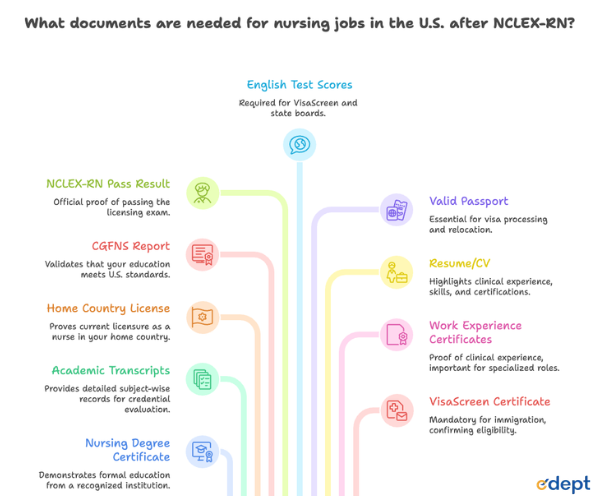
The paperwork involved in CGFNS evaluation, state board applications, and VisaScreen certification is genuinely administratively demanding. Transcripts, registration certificates, clinical hour documentation, and identification documents frequently need to be notarised or apostilled through official channels, which takes time and coordination that many nurses underestimate. Starting this process as early as possible, ideally running it alongside rather than after NCLEX-RN preparation, is what keeps the overall timeline from blowing out unnecessarily.
3. Cultural Adaptation
Moving to a new country to work in USA after NCLEX means adjusting to a clinical culture that operates differently from most international environments. Hierarchies in US hospitals tend to be flatter. Patient advocacy is more explicit and more expected. The pace in acute settings is often faster. Nurses who spend time researching US clinical culture before arrival, and who connect with communities of internationally trained nurses who have already made the transition, tend to land more confidently and adapt more quickly.
Why Choosing the Right Nursing Program Matters for Global Careers?
The exam you sit and the licence you earn matter enormously, but so does the foundation you built before any of that. The nursing programme you trained in shapes how prepared you are for the NCLEX-RN, how smoothly your credentials get verified, and how confidently you step into nursing jobs in USA after NCLEX-RN when the opportunity arrives.
NCLEX Preparation Support
The gap between completing a nursing degree and being genuinely prepared for the NCLEX-RN is wider than many nurses expect. Programs that weave NCLEX-style clinical reasoning questions into regular coursework, develop familiarity with US healthcare terminology, and emphasise the kind of clinical judgement the exam actually tests produce graduates who approach it with far more confidence than those who treat NCLEX preparation as something to tackle after graduation.
Clinical Exposure
US employers assessing applications for nursing jobs in USA after NCLEX look closely at clinical training depth. Documented hours across multiple departments, exposure to high-acuity patients, and clear evidence of hands-on competency all strengthen an application in ways that academic credentials alone cannot. Programs with robust hospital affiliations and structured clinical placement systems consistently produce more competitive international candidates.
International Placement Guidance
The CGFNS process, state board application requirements, VisaScreen certification, and employer recruitment pathways are all complex, all evolving, and all interconnected. Programs and institutions that provide structured international career guidance, or connect graduates with advisors who genuinely understand the US nursing pathway, reduce the time and guesswork involved in making the transition from qualified nurse to employed nurse in USA after NCLEX.
Build a global nursing career with Edept’s career-focused nursing programs. Edept offers structured pathways designed to prepare internationally trained nurses for NCLEX-RN success and international placement. Connect with an Edept counsellor to explore what is available for your nursing career journey.
Why Choose edept for Global Nursing Career Pathways?
Finding a programme that genuinely prepares you for an international nursing career rather than just getting you through an exam is harder than it sounds. Edept is built around that distinction, combining academic rigour with the practical, globally recognised preparation that nurses need to work in USA after NCLEX and beyond.
Programs Aligned with Global Opportunities
edept designs its nursing programs with international career outcomes in mind from the start. The curriculum is built around the competencies that US and other international healthcare employers actually look for, and NCLEX-RN preparation is integrated throughout rather than added on after everything else is done.
Admission Support
Nursing program admissions, credential documentation, and eligibility requirements are overwhelming to navigate without guidance that is specific and current. edept provides structured admission support that cuts through the complexity and helps students understand exactly what is needed and how to get it in place without unnecessary delays at a stage that is already demanding enough.
Career Counseling
Knowing which states to target, which employers sponsor international nurses, how to position a nursing profile effectively for NCLEX RN jobs USA recruitment, and what realistic timelines look like requires specific, up-to-date knowledge that most general career advisors simply do not have. edept’s career counselling is grounded in actual international nursing pathways rather than generic advice that does not account for how the process works in practice.
International Career Guidance
From navigating CGFNS documentation to making sense of the EB-3 visa process, Edept provides guidance that helps nurses make well-informed decisions about their path to work in USA after NCLEX rather than piecing together information from multiple sources and hoping it is current and accurate.
Step-by-Step Career Roadmap From Nursing Student to U.S. Nurse
Knowing the destination is one thing. Having a clear, practical map of how to get there is what actually moves things forward. Here is a straightforward roadmap that takes you from nursing student to working professional pursuing nursing jobs in USA after NCLEX-RN, without unnecessary detours.
1. Complete Nursing Degree
A WFOT-accredited or nationally recognised nursing degree is where the foundation gets built. The quality of clinical training during the degree has a direct and measurable impact on NCLEX-RN preparedness and on how a US employer reads the application that eventually lands in front of them.
2. Gain Clinical Experience
One to three years of post-graduation hospital or healthcare experience builds the documented clinical competency that both CGFNS and US employers need to see. ICU, ER, or paediatric experience is particularly valued and opens more doors than general ward experience alone when targeting competitive NCLEX RN jobs USA positions.
3. Clear NCLEX-RN
With CGFNS evaluation either underway or complete, register and sit the NCLEX-RN at an international Pearson VUE centre. Serious preparation typically takes three to six months. Passing on the first attempt keeps the timeline moving efficiently and strengthens the application significantly when approaching US employers.
4. Apply for U.S. Jobs
With NCLEX cleared, reach out to US employers directly or through international staffing agencies with active recruitment relationships. A clear target state, a well-prepared application, and documented references from previous clinical roles improve the chances of a strong offer that includes the employer visa sponsorship needed to move the immigration process forward.
5. Relocate and Build Career Growth
The first two to three years in the US are about adapting to a new clinical environment, building local experience, and establishing professional networks. From there, specialisation pathways, travel nursing contracts, advanced practice qualifications, and permanent residency through the EB-3 process all become realistic steps in what is, for most nurses who make this move, a genuinely long-term career in one of the world’s strongest healthcare systems.
Future Scope for Nurses in the U.S.
The opportunity for international nurses in the US is not a short-term window. The structural factors driving demand, an ageing population, a retiring domestic nursing workforce, and an expanding healthcare system, are not going away. Nurses who work in USA after NCLEX and build their careers there are entering a market that will need them for decades.
Rising Healthcare Demand
According to the BLS, five of the twenty fastest-growing occupations are in the nursing industry, and registered nurses top the list of professions projected to see the highest net increase in new jobs by 2034. For nurses arriving through the NCLEX-RN pathway, that sustained structural demand translates into real long-term career security rather than a window that might close.
Advanced Practice Nursing Roles
After building several years of US clinical experience, internationally trained nurses become eligible for advanced practice pathways. Nurse Practitioner, Certified Registered Nurse Anesthetist, and Clinical Nurse Specialist programmes all become accessible with the right foundation. CRNAs average $217,000 per year, and Nurse Practitioners average $120,000 per year, representing the upper tier of nurse salary USA earnings that the career can grow into over time.
Long-Term Immigration Opportunities
The EB-3 visa pathway leads directly to permanent residency, and for nurses who choose to settle permanently in the US, from there to citizenship. The US immigration system formally recognises nursing as a priority occupation. The long-term immigration pathway for nurses who work in USA after NCLEX is more clearly mapped and more consistently supported than equivalent pathways in most other countries competing for the same international nursing talent.
Conclusion
The case for nursing jobs in USA after NCLEX-RN does not rest on optimism. It rests on structural data that has been pointing in the same direction for years. The US is projected to face a shortage of approximately 78,610 full-time equivalent registered nurses by 2025, worsening to a 10% national RN shortage by 2027, even as the broader workforce slowly recovers. Nursing schools turned away 65,766 qualified applicants in the 2023 to 2024 academic year alone, not because those applicants were unqualified, but because there was simply no capacity to take them. That supply gap is not closing anytime soon, and it is exactly what is keeping international nurse recruitment active, sponsored, and competitive.
For internationally trained nurses, the path from NCLEX-RN clearance to a US nursing licence, an EB-3 visa, and a career in one of the world’s strongest healthcare systems is more accessible in 2026 than at any previous point. It takes planning, disciplined documentation, and realistic timeline expectations. The nurse salary USA outcomes waiting at the end of that process, combined with a long-term immigration pathway and genuine career progression, make it one of the most compelling moves a qualified nursing professional can make right now.