BBA graduates can pursue diverse career paths across Finance, Marketing, Human Resources, Operations, and Technology, with entry-level salaries typically ranging from ₹3 to ₹6 LPA and higher-paying specialized roles offering ₹8 to ₹15+ LPA
Going for the right career choice after your BBA can determine your future. In 2026, the ever-changing job market offers BBA graduates many career paths in areas like finance, marketing, analytics, and entrepreneurship. But the challenge is not choosing the right one among the pool of options, but doing it based on skills and industry demand. Choosing the right career paths after BBA is essential in having a smooth career ahead.
Employer surveys reveal that more than 70% now look for skills rather than just degrees, so BBA graduates need to focus on practical skills. This article will guide you to explore popular careers after BBA, salary expectations, industry growth, and how to choose a career in the dynamic job landscape.
What to Do After BBA in 2026?
A BBA degree opens your door into multiple industries, but success depends entirely on how you build your skills and specialization after graduation. IN 2026, companies are actively looking for candidates who combine business knowledge with practical skills like analytics, digital marketing, and financial decision-making.
Why BBA Is a Strong Career Foundation
A Bachelor of Business Administration (BBA) degree offers basic information about management, finance, marketing and operations. It provides a good grasp of business ideas, communication skills and problem-solving.
Contemporary BBA degrees, especially in finance and analytics, also teach Excel, SQL, Power BI, and emulate an AI-enabled business environment, providing skills that are required in the job market.
Key Challenges Freshers Face After BBA
BBA graduates are often confused about their careers. The main reason is the lack of specialisation, and degrees are not always aligned to specific job roles.
The other major challenge is the gap between academic knowledge and industry experience. Industry seeks individuals with tools, experience, and exposure, which often don’t come with a degree.
Top Career Paths After BBA (Industry-Wise Breakdown)
There are several thriving industries that BBA graduates can consider. It’s important to identify your passions and skills while aligning them with employment opportunities. In 2026, employers favour your skills and specialization, so these career paths are very important.
Banking & Finance Careers
Finance and banking are popular career choices after BBA. Financial analyst, investment analyst, and banking associate are some of the popular positions for BBA grads entering the finance industry.
The Indian banking sector is set to grow by more than 8-9% per year, with a robust need for talent. The emergence of fintech and digital banking means growth beyond traditional roles.
Marketing & Digital Marketing Careers
Marketing has evolved to be digital-first, resulting in a demand for digital marketers, brand strategists and performance marketers. Roles include marketing executive, SEO executive, and brand strategist.
India’s digital advertising market is projected to reach over ₹1 lakh crore by the end of 2026, creating a need for marketers.
Human Resource Careers
HR is key for talent management, recruitment and growth. Example roles include HR executive, recruiter, and talent acquisition specialist. As companies prioritise employee engagement and retention, HR has a key strategic role.
Business Analytics & IT Careers
One of the most promising careers for BBA graduates is business analytics. Business analysts, data analysts, and operations analysts are some of the roles in strong demand.
The global data analytics market will reach more than $130 billion by 2026, with companies needing information for decision-making.
Sales & Business Development Careers
Sales jobs are results-oriented and have rapid growth. Roles include sales executive, account manager and business development associate.
This is a high-demand career as companies reward revenue-generating and relationship-building skills.
Entrepreneurship & Startup Careers
BBA graduates can also start their own businesses. India has one of the highest growth rates of startups in the world (100,000+ startups).
Being an entrepreneur is freeing but demands planning, risk-taking and business acumen.
E-commerce & Retail Careers
Online shopping creates jobs such as category manager, operations executive, and supply chain analyst. E-commerce in India is predicted to grow to $200 billion by 2026, opening job opportunities.
Read more: What is the Best BBA Specialization?
Salary Trends After BBA in 2026
Salaries after completing your BBA do vary based on the industry you work in, your hands-on skills proficiency, and specialization. In 2026, organizations are offering higher salaries only to those candidates who are proficient with practical skills, certifications, and tool-based knowledge rather than just theoretical learning and degrees.
According to industry reports, professionals who are specialized in skills with high demand earn 30-50% highers salaries than general graduates, making skill development a key factor in salary growth.
Entry-Level Salary Insights
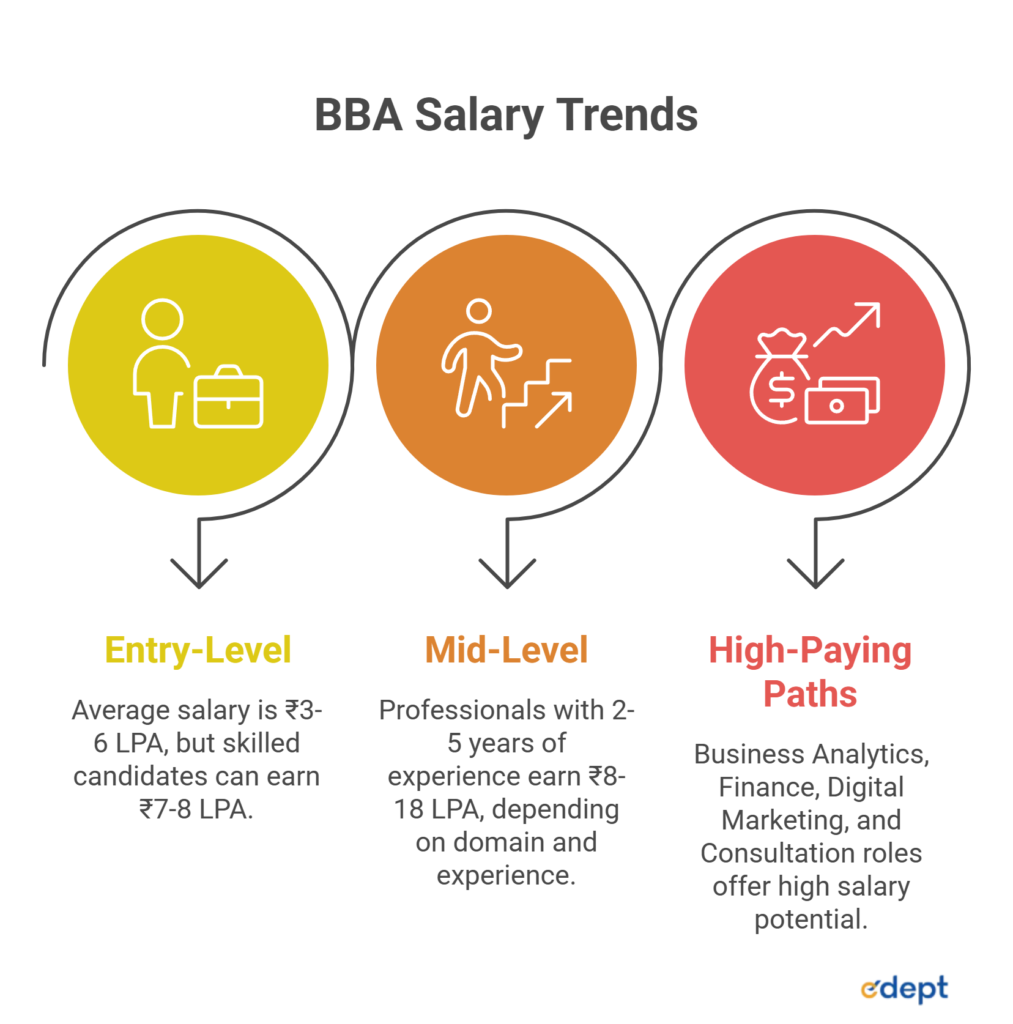
The average salary of BBA graduates is between ₹3 LPA and ₹6 LPA in entry-level roles like marketing executive, HR executive, sales executive, or business analyst trainee. Though those candidates who are proficient in industry-relevant skills like analytics, digital marketing, or finance tools can earn up to ₹7-8 LPA even at the starting level.
Mid-Level Growth Opportunities
Professionals who have 2-5 years of experience can earn between ₹8 LPA and ₹18 LPA. Salary pay depends entirely on the domain you work in and the experience you bring to the table.
Key roles like marketing manager, HR manager, and business analyst see strong growth in salary due to increased responsibilities and specialization.
High-Paying Career Paths
There are some domains who got high salary potential after BBA, especially when combined with certifications or advanced skills.
- Business Analytics: ₹10-20+ LPA
- Finance and Investment Roles: ₹12-25 LPA
- Digital Marketing Leadership Roles: ₹8-18+ LPA
- Consultation Roles: ₹15-30 LPA
Why Skill-Based Learning Is Essential After BBA
BBA degrees alone will not be sufficient to get a high salary in 2026. The job market is moving towards skill-based recruitment, where what you can do in terms of skills and industry tools matters more than what you know theoretically.. This explains why many degree-holders are facing unemployment.
Gap Between Degree and Industry Requirements
The main post-BBA problem is the gap between university teaching and industry expectations. Students are taught business theories, but employers want practical knowledge in software, data analysis, and business problem-solving.
Industry experts estimate that many graduates are not “employable” because of a lack of hands-on experience, creating a skill gap.
Importance of Practical Skills and Tools
Today’s employers want job-ready candidates. Excellent data analysis skills, proficiency in tools such as Excel, Power BI, SQL, digital marketing and financial analysis are now a mandate in many industries.
Modern BBA programs with practical teaching, industry projects and tool training equip students with skills to improve their job prospects.
Role of Certifications & Specializations
Certifications are key to skill recognition and profile enhancement. Courses that map to industry certifications, such as CFA, analytics and digital marketing certifications, enhance your prospects.
Being an expert in a field such as finance, analytics, or marketing enhances your profile and the possibility of getting a higher-paying job.
Why Choose edept for Career-Focused Programs After BBA
To pursue a high-growth career after a Bachelor of Business Administration (BBA), it is essential to select the right program. Institutions offering programs in partnership with schools such as the Shree L. R. Tiwari School of Business Management, powered by edept, focus on bridging the gap between academia and industry.
Industry-Aligned Curriculum
The program is designed for practical application, with a focus on finance, analytics, fintech, AI in business, and other technologies. It is oriented towards industry standards and frameworks like CFA.
Practical Learning & Real-World Projects
The program includes live industry projects, global immersion programs and capstone projects, ensuring practical experience before entering the workforce.
Students get to work with global partners on business challenges and build their portfolios.
Placement Assistance & Career Support
Edept program offers 100% placement assistance, which includes resume building, mock interviews, and networking, giving students access to a network of 300+ recruiting partners.
Flexible Learning Options
Students benefit from structured learning combined with practical exposure, which is specifically designed for both freshers and career-focused learners.
Programs Designed for High-Growth Careers
Edept’s program specifically includes specializations like data analytics, finance, digital business, and management, which are among the fastest-growing career domains today.
Higher Education vs Skill-Based Courses – What Should You Choose?
After completing their BBA, the biggest decision students face is whether they should pursue further education, like an MBA or focus on skill-based courses. The right choice depends entirely on your career goals, financial situation, and how quickly you want to enter the job market.
When to Choose MBA or PG Programs
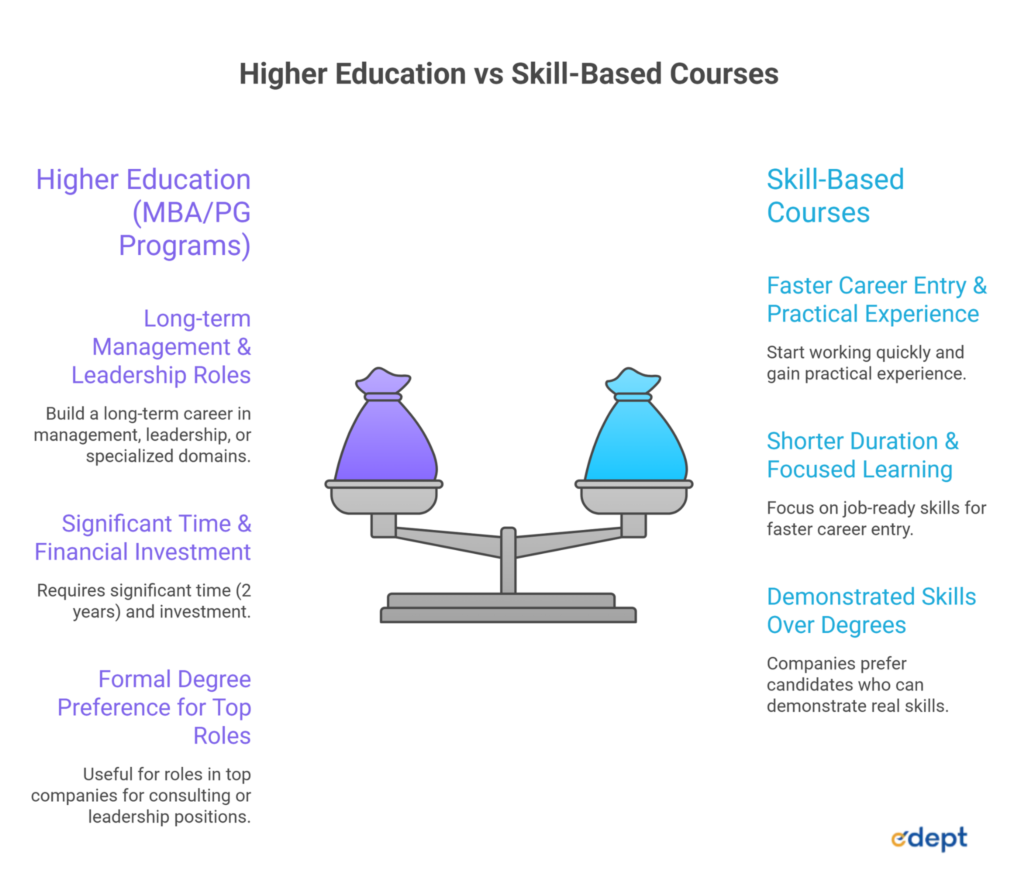
An MBA or postgraduate degree is a good option if you want to build a long-term career in management, leadership, or specialized domains like finance, marketing, or HR.
It is especially useful if you aim for roles in top companies for consulting or leadership positions, where a formal degree is often preferred. However, it requires significant time (2 years) and investment, and returns depend heavily on the institute’s quality.
When Skill-Based Courses Are Better
Skill-based courses are ideal if you want to start working quickly and gain practical experience. These courses focus on job-ready skills like analytics, digital marketing, finance tools, and business strategy.
In 2026, many companies prefer candidates who can demonstrate real skills over just degrees, making these courses highly effective for faster career entry.
Hybrid Approach (Degree + Skills)
The most effective strategy today is a hybrid approach, which combines a degree with practical skills. This gives you both academic credibility and industry readiness.
Programs that integrate live projects, certifications, and industry exposure, along with a degree, help students stand out in a competitive job market.
Skills Required to Build a Successful Career After BBA
In 2026, earning a BBA degree alone won’t be enough to succeed in the management domain; you will need to combine business knowledge, skills and technology. Employers are looking for people with strategic, communication and digital skills.
Business & Communication Skills
Communication and business knowledge are crucial for most post-BBA jobs. Presentation, negotiation, collaboration and leadership skills are crucial in a corporate setting.
Those who can communicate effectively and manage clients or teams excel in marketing, HR, and management.
Analytical & Decision-Making Skills
In the digital era, businesses need professionals who can interpret data and make decisions. Problem-solving, critical thinking and data analysis are critical skills.
Analyzing and interpreting business data, financial statements, and market data helps professionals make informed decisions.
Digital & Technical Skills
Technology skills are essential for all industries. Being proficient in Excel, Power BI, SQL, digital marketing platforms, and other basic analytics tools is a big plus.
Modern BBA degrees also offer insights into AI, fintech and data analytics, keeping graduates up-to-date.
Also read: Top Mistakes Business Management Students Make in 2026
How to Choose the Right Career Path After BBA
Selecting the right career after BBA is essential for a successful career. There are several choices, but the decision should not be influenced solely by trends but rather by a combination of your interests, industry needs, and prospects.
Based on Your Interests & Strengths
First, discover your interests and abilities. If you excel in mathematics, finance, or analytics may be a great choice. If you are creative and enjoy talking to others, marketing might be more suitable.
Matching a career to your interests enhances job satisfaction and career advancement.
Based on Industry Demand
Select a career with future growth. Business analytics, digital marketing, fintech and consulting are in high demand in 2026 because of digitalisation.
A career in a hot field increases your chances of finding a good job.
Based on Salary & Growth Potential
Passion is key, but so is pay and prospects. Certain careers, such as analytics, finance and consulting, have higher salary prospects.
Knowing future growth prospects helps in making a pragmatic choice.
Future Career Trends for BBA Graduates (2026 & Beyond)
The world for BBA graduates is changing fast, driven by technology, globalisation and data analytics. Students need to plan their careers with an eye on the latest trends and growth areas.
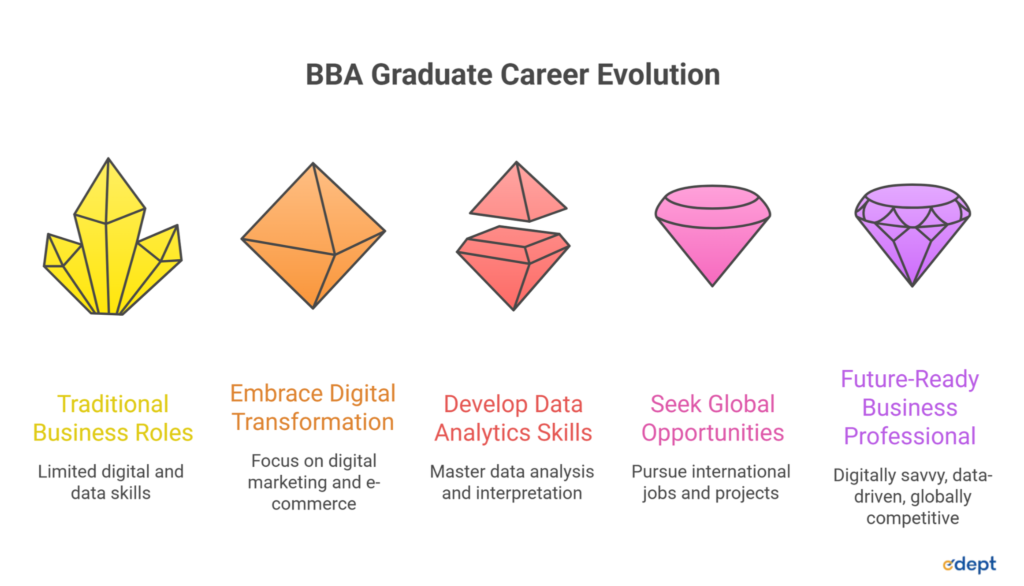
Increasingly, business jobs are being digitised. Digital marketers, e-commerce specialists, fintech and product managers are in high demand as firms embrace digital and automation.
Rise of Digital & Tech-Driven Roles
Increasingly, business jobs are being digitised. Digital marketers, e-commerce specialists, fintech and product managers are in high demand as firms embrace digital and automation.
Increasing Demand for Data & Analytics Skills
Data is now at the core of business decisions. Data analysts, report creators, and data interpreters are in high demand.
Analysts project a strong demand for data professionals, making analytics one of the most in-demand skills after a BBA.
Global Career Opportunities
Thanks to globalization and work from home, there are now international jobs and projects for BBA graduates.
BBA programs with global exposure, industry partnerships, and international certifications prepare students to be competitive in the global market.
Final Verdict: How your next steps after BBA will decide your future
After BBA, one can choose from many career options such as finance, marketing, analytics, and entrepreneurship. But it’s essential to select the right one based on your passion, expertise and demand.
In 2026, the most important factor is not just your BBA degree, but also your skills, specialization, and experience. Applicants with learning tools, industry exposure and a portfolio stand out in the job market.
Whether you opt for higher education, skill-based education or a combination, the secret is to make the right choices and to start early.
Related Links:
| Internship for BBA students | Complete guide to entrepreneurship after BBA |
| Skills employers look for in BBA graduates | How business analytics improve marketing strategies |