The cloud computing job market in 2026 is highly lucrative, with global spending on public cloud services expected to reach $905.33 billion. While often considered a mid-level field, many entry points exist for those with foundational knowledge of AWS, Azure, or Google Cloud.
In today’s digital world, cloud computing is transforming the way businesses work. From storing all the documents on the cloud to running an entire organization remotely, cloud computing has changed the way we access and manage data. It is not just a niche-specific skill reserved for large enterprises; it has become the backbone of how modern businesses operate, storing data, running applications, managing security, and scaling organisations. This shift towards the cloud has created thousands of job roles, and hence professionals with the knowledge to build, manage, and secure cloud systems are in high demand.
The cloud computing market in India is expected to reach a projected revenue of US$76,385.7 million by 2030. A compound annual growth rate of 26.5% is expected for the Indian cloud computing market from 2025 to 2030. The requirement for cloud professionals is rapidly rising in India and across the globe. Cloud computing is not just a single job role; it consists of an ecosystem of roles, each of them having its own skill requirements, salary range and growth opportunities.
Whether you’re a fresher who is just stepping into this field or a working professional who is searching for a better job opportunity, this blog will guide you to understand the popular career path in cloud computing, the essential certifications and skills required and the salary structure of various job roles.
What Is Cloud Computing & Why It’s a High-Demand Career
Cloud computing, in simple language, is the delivery of computing services such as storage, processing power and networking over the internet. You don’t need to rely on local servers or personal computers. Nowadays, users and businesses can access and store data on remote servers, which are mainly managed by cloud providers such as AWS, Microsoft Azure and Google Cloud.
Overview of Cloud Computing
Cloud computing is simply the act of delivering computing services over the internet. There are 3 core service models you should know; IaaS (Infrastructure as a Service) helps in providing essential compute, storage and networking resources, which are on demand. PaaS (Platform as a Service) provides a ready-made environment where developers can build and deploy applications. SaaS (Software as a Service) delivers fully managed software applications over the internet. You don’t have to buy and maintain expensive hardware; businesses use various platforms such as AWS, Microsoft Azure and Google Cloud to access various infrastructure that is on demand. They need to pay only for their specific requirements and scale up when they need it; this benefits them from any overhead expenses of managing physical data centres.
Why Cloud Careers Are Growing in 2026
Cloud careers are experiencing a massive growth in 2026, with the cloud computing market projected to exceed $1 trillion. Every industry, be it healthcare, IT, education, retail, or software, is running its workload on the cloud. The reason is very simple; it is less expensive and saves money, improves efficiency and speed, and helps companies to scale their business without buying physical storage. Some of the key reasons for the growth in cloud computing are AI/ML integration, shortage of skilled professionals, and adoption of internal developer platforms.
Demand for Skilled Cloud Professionals
The demand for skilled cloud professionals is very high, but the interesting part is that there is a huge skill shortage and talent gap in the cloud domain. The demand for skilled professionals is driven by rapid AI integration, crucial security needs and various cloud strategies. Many companies are reporting difficulties in filling cloud roles. This is the right time to build your skills because you will be entering a field where demand is massive, and competition is low.
Cloud Computing Career Path Overview (Fresher to Expert)
A career in cloud computing often involves building, designing, and managing scalable infrastructure to support business operations. A cloud career involves a natural progression. Understanding the pathway will help you in setting realistic expectations and achieving your goal.
Entry-Level Stage (0–2 Years)
Most beginners and freshers start their career from this stage. Here you start learning about the fundamentals of how cloud platforms work, how to monitor the systems, and how to handle basic configuration. Roles are mainly focused on administration, support and learning new things on the job every day.
Mid-Level Stage (2–5 Years)
After spending a few years in this field, you start moving into more specialized roles. Here the professionals start taking ownership of more complex tasks, such as infrastructure designing, workflow automation and handling CI/CD pipelines. They come with significantly higher salaries and more complex responsibilities.
Senior/Expert Level (5+ Years)
At this stage, the professionals are not just building the system; they are helping in making strategic business decisions. Cloud architects help in designing solutions; the consultants advise the entire organization on the cloud strategy. These roles often come with the highest salaries, are the most influential in nature, and have the greatest responsibility.
Entry-Level Cloud Job Roles (Fresher Level)
The entry-level cloud job roles mainly focus on monitoring, supporting and maintaining the cloud infrastructure, and they require basic foundational knowledge of AWS, Azure or Google Cloud.
Cloud Support Associate
This is the first step for beginners who are entering the cloud support associate role. They are mainly responsible for monitoring the cloud environment, responding to various alerts, and troubleshooting errors. Here you will gain good exposure to real-time errors, systems, and problems and use real tools to solve them.
Junior Cloud Engineer
A junior cloud engineer is responsible for handling basic deployment, task configuration & infrastructure support under the guidance of senior engineers.
System Administrator (Cloud-Based)
The role of system administrator has evolved a lot with the adoption of the cloud. Nowadays, system admins manage servers and user access, but all of this is done on cloud platforms, not with physical machines.
Mid-Level Cloud Job Roles
The mid-level cloud job roles typically focus on implementing, designing, and securing cloud infrastructure. They help in automating deployments and managing hybrid environments.
Cloud Engineer
A cloud engineer is one of the most in-demand job roles in the industry. They help in designing, building, and managing cloud infrastructure. They work closely with the operation & development team and ensure that the cloud environment is aligned with business needs.
DevOps Engineer
Here the software development team meets the operations team. They help in building and managing automation pipelines and handle the CI/CD workflows. This role requires experience with tools such as docker, Kubernetes, jenkins, terraform, and Ansible.
Cloud Security Specialist
A cloud security specialist helps in designing, implementing, and monitoring security measures that help in protecting the cloud environment from any kind of threats or data breaches.
Also read: Everything about Cloud Security
Advanced Cloud Job Roles (Expert Level)
The advanced cloud job roles offer high salaries and the most strategic responsibilities.
Cloud Architect
A cloud architect is responsible for designing end-to-end cloud solutions. They help in choosing the right platforms, building the infrastructure, planning for scale and finally ensuring that everything is connected securely and efficiently.
Cloud Consultant
A cloud consultant’s role involves working with the organization to assess the current IT setup and guide them in adopting cloud services and optimizing operations. This role includes a combination of technical expert, strategist and communicator. Advising a business regarding cloud decisions requires both technical knowledge and the ability to explain clearly.
Site Reliability Engineer (SRE)
They mainly focus on system reliability and automation. This job role acts as an intersection between software engineering and operations. They help in reducing system downtime, automating operational work, and finally building systems that can handle massive usage.
Skills Required for Each Career Level
A career in cloud computing often demands a mixture of both technical proficiency and soft skill knowledge. Entry-level roles mainly focus on foundational knowledge, while mid-level roles require automation skills, and advanced-level roles demand technical as well as strategic decision-making skills.
Skills for Freshers
The entry-level or beginner-level professionals usually focus on building a strong foundation. Some of the skills which are essential include basic networking concepts, an introduction to a minimum of one cloud platform, experience with Linux fundamentals and understanding storage and virtualization.
Skills for Mid-Level Professionals
The mid-level roles focus their shift towards more depth and specialized related job roles. Some of the key skills include proficiency in Terraform, CloudFormation, or Ansible; deep knowledge about Kubernetes, Docker, and CI/CD pipelines; and the ability to manage SQL & NoSQL databases.It also helps in managing advanced AI/ML integration.
Skills for Experts
The senior-level job roles require both technical skills and soft skills. Experts’ roles are different because of their ability to think more strategically and take the lead. They should have the ability to align cloud strategies with business goals; they should have a deep understanding of risk mitigation, data governance and cloud cost optimization.
Salary Trends in Cloud Computing Roles
The cloud computing salaries in 2026 are highly competitive in nature. According to Glassdoor, the average annual median base pay for cloud professionals in India is ₹490,000. The salaries usually depend on your experience level, location, and skill set.
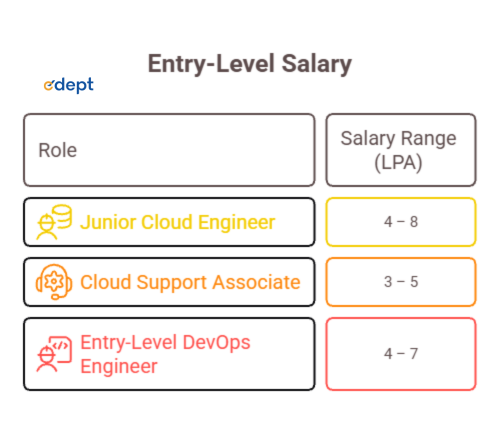
Entry-Level Salary
The entry-level cloud computing roles in India generally have a salary ranging between ₹3.5 LPA and ₹8 LPA.
- Junior Cloud Engineer: ₹4L – ₹8L per annum
- Cloud Support Associate: ₹3L – ₹5L per annum
- Entry-Level DevOps Engineer: ₹4L – ₹7L per annum
Mid-Level Salary Growth
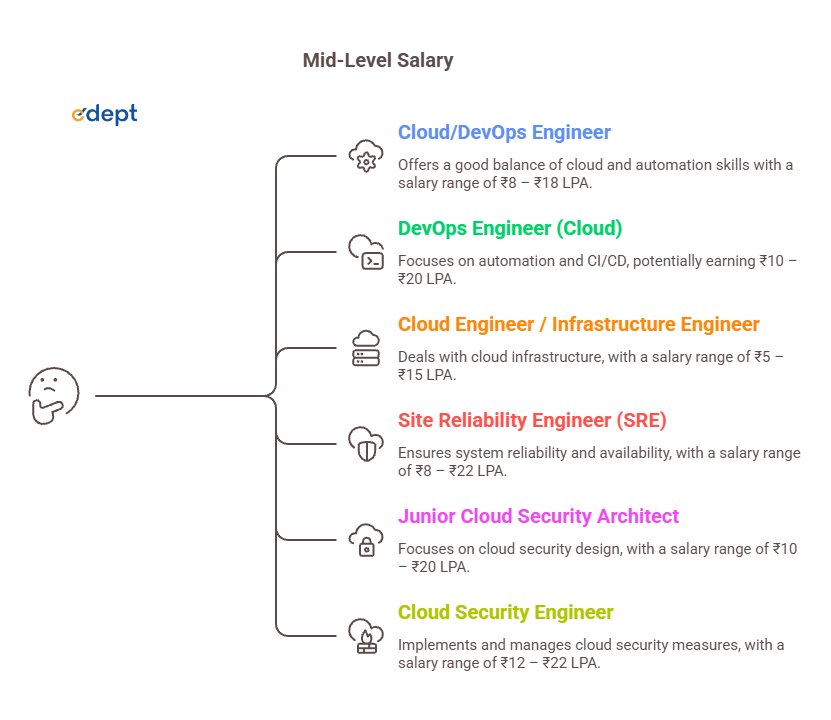
The mid-level roles of cloud computing professionals in India range between ₹8 LPA and ₹20 LPA.
- Cloud/DevOps Engineer (3–6 years): ₹8 – ₹18 LPA
- DevOps Engineer (Cloud): ₹10 – ₹20 LPA (focus on automation and CI/CD)
- Cloud Engineer / Infrastructure Engineer: ₹5 – ₹15 LPA
- Site Reliability Engineer (SRE): ₹8 – ₹22 LPA
- Junior Cloud Security Architect: ₹10 – ₹20 LPA
- Cloud Security Engineer: ₹12 – ₹22 LPA
Senior-Level Salary Potential
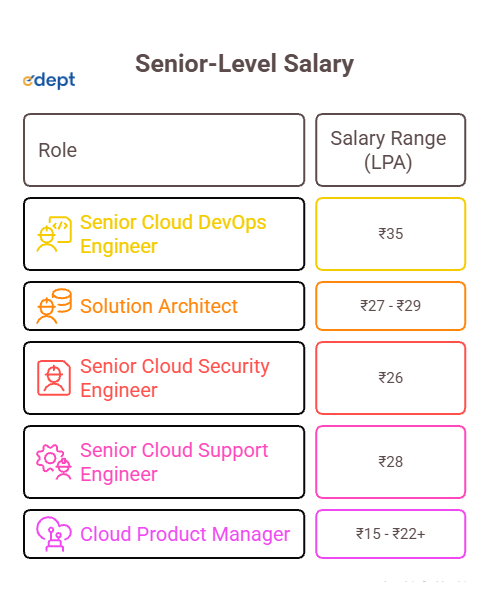
The senior-level roles of cloud computing professionals with 10+ years of experience in India range between ₹20 LPA and ₹35 LPA.
- Senior Cloud DevOps Engineer: ₹35 Lakhs per year.
- Solution Architect: ₹27 Lakhs – ₹29 Lakhs per year.
- Senior Cloud Security Engineer: ₹26 Lakhs per year.
- Senior Cloud Support Engineer: ₹28 Lakhs per year.
- Cloud Product Manager: ~₹15 Lakhs – ₹22 Lakhs+ per year.
Certifications Required for Career Growth
Certifications are not just mere additions to your resume; they are the first thing which a recruiter notices while scanning your resume. Some of the best certifications in cloud computing are discussed below.
Beginner Certifications
AWS Certified Cloud Practitioner: This is the best certification for your foundation. It covers fundamental cloud concepts, AWS services, and pricing.
Microsoft Certified: Azure Fundamentals (AZ-900): It is also ideal for beginners who are interested in exploring Microsoft’s cloud platform.
Google Associate Cloud Engineer: A strong foundational certification for those entering the GCP world.
Intermediate Certifications
AWS Certified Solutions Architect: Associate: One of the most valuable mid-level certifications in the industry. It helps in demonstrating the ability to design and deploy AWS solutions.
Microsoft Azure Administrator (AZ-104): It mainly covers managing Azure identities, storage, compute, and networking.
Certified Kubernetes Administrator: It is essential for professionals moving into DevOps and container management.
Advanced Certifications
AWS Certified Solutions Architect Professional: It is the expert-level AWS credential for architects designing complex systems.
Google Professional Cloud Architect: It helps in demonstrating the ability to design, develop, and manage robust cloud solutions on GCP.
Certified Information Security Manager (CISM): It is valuable for cloud security professionals moving into senior roles.
Why Skill-Based Learning Is Critical for Cloud Careers
Skill-based learning is very crucial for cloud careers because the industry is evolving at a very fast rate, with over 80% of companies projected to fully transition into cloud-based operations in 2026. Employers are looking for professionals with hands-on experience and practical skills, not just someone who has theoretical knowledge.
Importance of Hands-On Experience
When you read about AWS S3 and actually configure a cloud storage bucket, they are very different experiences. The latter is what hiring managers are testing for. Cloud platforms usually give you free tiers and sandbox environments so you can practise for real. It helps you in building your confidence and facing the professional world more confidently.
Role of Projects & Internships
When you build a real project, start deploying a new web application, or set up CI/CD pipelines, it gives you the confidence to speak in the interview more practically and confidently. The internships in cloud roles, even which are for a short period of time, carry significant weight on your CV. They help in demonstrating your professional exposure and the ability to work within a team environment.
Industry Demand for Practical Skills
Increasingly, companies are designing their hiring processes around practical assessments, not just theory. Cloud skills are tested through hands-on tasks, technical interviews, and scenario-based questions. The more comfortable you are with actual cloud tools, the more confidently you will perform.
Why Choose edept for Cloud Computing Training
If you are planning to build a career in cloud computing, the quality of your training matters. Edept’s cloud computing programmes are built around one goal: making you job-ready.
Industry-Aligned Curriculum
Edept’s curriculum is designed to meet what the industry actually expects. Every module covers real-world cloud job roles and the specific skills employers ask for, not just theoretical content.
Hands-On Projects & Practical Training
Learning at Edept means getting your hands on real cloud environments. You work on projects that simulate actual job scenarios. Instead of just watching videos, you get to build real projects, deploy new applications, configure networks and many more interesting tasks.
Placement Assistance & Career Support
Edept provides structured support for your job search, from resume building and mock interviews to job referrals and career guidance. You are not left to figure it out on your own.
Structured Career Roadmap for Students
Whether you are just starting from zero or looking to level up, Edept gives you a clear, step-by-step path, from beginner foundations to expert-level skills. No guesswork, just a structured roadmap that takes you where you want to go.
Build job-ready cloud skills with https://www.edept.co
How to Start Your Cloud Career (Step-by-Step Guide)
If you want a step-by-step guide on how to start your cloud career, just follow the steps below. You should start getting comfortable with Linux, Python, and basic networking skills.
Step 1: Learn Fundamentals
You should first start with the basics and understand how cloud computing actually works. You should start getting comfortable with Linux, Python and basic networking. Various free resources from AWS, Azure, and Google are a very good starting point.
Step 2: Choose a Cloud Platform
You should pick any one platform to focus on first, be it AWS, Azure, or GCP. AWS is most accepted globally; Azure is important for enterprise environments; GCP is strong in data and AI workloads. Starting with one will give you a depth of understanding about cloud computing.
Step 3: Build Projects
You should start applying what you are learning each day. Start by deploying a simple application. You can also set up an automated backup system. You can create a virtual network. Each project teaches you something new every day.
Step 4: Get Certified
You should start earning a beginner-level certification on your chosen platform. This will help you validate your knowledge for employers and give you a clear pathway to work toward
Step 5: Apply for Jobs
You should start applying for entry-level roles such as cloud support associate, junior cloud engineer, or system administrator positions. Use your projects and certification to demonstrate your readiness.
Common Mistakes to Avoid in Cloud Careers
Some of the common mistakes to avoid in a cloud career are as follows:
Learning Without Practice
If you know just theory alone, it will not get you hired. If you are not actually working in a cloud environment as you learn new things every day, then you are missing the most important part of your preparation.
Ignoring Certifications
While certifications alone can’t help you land a job, they are important credentials that you can add to your résumé. You should never ignore certifications; those are the ones that recruiters look for when they start filtering out the resumes.
Not Building a Portfolio
Projects matter. A GitHub profile with cloud projects, a portfolio of things you have built, or even a simple document describing your work carries weight. Do not finish a course without having something to actually show for in your interview.
Future Scope of Cloud Job Roles
Cloud job roles are in high demand, and they are rising every day. The future is exceptionally strong, as more than 80% of businesses are transitioning to cloud platforms.
Growth in Multi-Cloud Environments
Many organizations are moving away from just a single-cloud setup toward multi-cloud strategies, using AWS, Azure, and GCP together. This creates demand for professionals who can work across various platforms and can manage complex, distributed infrastructure.
Integration with AI & Data Technologies
Cloud and AI are becoming inseparable. Cloud platforms have now started hosting machine learning pipelines, data warehouses, and AI-powered services at scale. Professionals who know both cloud infrastructure and data technologies are especially valuable and in high demand
Increasing Global Demand
Cloud adoption is growing not just in India but also globally. This means cloud professionals have opportunities beyond their local job market; remote roles, international placements, and freelance consulting are all realistic pathways for skilled cloud practitioners.
Cloud computing is one of the best career paths to pursue in 2026. It has great salary potential and offers strong career opportunities and growth. This field is a great choice for aspiring tech professionals. Whether you want to become a cloud engineer, DevOps expert, security specialist, or cloud architect, you just need a clear career path.
You should start by learning the basics and building your foundation, then start earning certification on your chosen platform and gain hands-on practical experience, and finally, you can start preparing a very detailed resume for your dream job role. The requirement for cloud professionals is rapidly rising in India and across the globe. This is the perfect time for you to begin a career in cloud computing.
Conclusion
Cloud computing is one of the best career paths that you can choose in 2026. It has great salary potential and offers strong career opportunities and growth. This field is a great choice for aspiring tech professionals. Whether you want to become a cloud engineer, a DevOps expert, a security specialist, or a cloud architect, you just need a clear career pathway.
You should start by learning the basics and building your foundation, then start earning certification on your chosen platform and gain hands-on practical experience, and finally, you can start preparing a very detailed resume for your dream job role. The requirement for cloud professionals is rapidly rising in India and across the globe. This is the perfect time for you to begin a career in cloud computing.