Not everyone has sufficient time for entrance exams, and honestly, not every career path requires one. Direct admission in data analytics courses has opened the door for students from all backgrounds to build real, job-ready skills without the wait. This blog breaks down whether that convenience actually translates into career value, or whether it comes at a cost.
India is sitting on one of the biggest talent crunches in its digital history. NASSCOM’s 2025 projections put the shortfall of data professionals at over 11 lakh, and job openings in data science and business analytics are growing at roughly 28% annually. At the same time, the number of students trying to break into this field has never been higher. That collision of demand and supply has pushed a very practical question to the front: Do you really need to clear a competitive entrance exam to build a career in data analytics, or is direct admission in data analytics courses a legitimate and equally effective route? The short answer is yes, it can be, but with conditions attached. This blog walks through the ROI, the risks, what to watch for, and whether the convenience is actually worth it.
What Is Direct Admission in Data Analytics Courses?
Not everyone wants to spend months preparing for an entrance exam. Direct admission in data analytics courses skips that step entirely, letting you enrol based on eligibility and get straight to learning.
Meaning of Direct Admission
Direct admission in data analytics courses simply means you get in without sitting for any centralised entrance exam. Most programs select students based on basic eligibility, a first-come-first-served basis, or a light institute-level screening, such as a short interview or a quick aptitude check. Nothing more complicated than that. It removes the competitive filter but does not necessarily remove all quality filters.
Types of Courses Offering Direct Admission
The data analytics admission process under the direct route covers a wide range of formats. Short-term certification programs are the most common. Private college degree programs in data science or analytics increasingly offer direct routes. Online platforms offering structured data analytics courses India-wide have also made direct enrollment the default, often with rolling admissions throughout the year.
Admission Criteria
Most programs offering data analytics without an entrance exam require either a 10+2 qualification or a graduation degree, depending on the level of the course. Some platforms accept students from any stream, including arts and commerce, which has opened the field considerably beyond its earlier engineering-heavy profile.
Why Direct Admission Is Becoming Popular
A few years ago, this route barely existed. Today, students across India are actively choosing direct admission in data analytics courses, and the reasons behind that shift are pretty straightforward.
1. Rise of Skill-Based Education
Employers hiring data analysts in 2026 are far more focused on what candidates can actually do than on how they were admitted. Skill-based learning is a genuine alternative to exam-gated programs due to the shift towards project portfolios, tool proficiency and practical problem-solving. Direct admission in data analytics courses fits naturally into this framework.
2. Faster Career Entry
For someone who wants to transition into analytics within six to twelve months, waiting for an entrance exam cycle is a real cost. Data analytics courses India that offer direct admission allow students to start learning immediately, build skills faster, and enter the job market without a year-long delay.
3. Accessibility for All Backgrounds
One of the more meaningful changes in recent years is that data analytics is no longer treated as an exclusively technical field. Commerce graduates who understand business logic, arts students with strong communication skills, and working professionals from non-tech industries are all finding pathways through the data analytics admission process via direct enrollment, and employers are increasingly open to these profiles.
Advantages of Direct Admission in Data Analytics
Beyond the obvious convenience, direct admission in data analytics courses comes with some real, tangible benefits that go beyond just skipping an exam. Here is what actually works in your favour.
1. No Entrance Exam Stress
Preparing for competitive entrance exams takes months, and for someone who already knows they want to study data analytics, that preparation time is not always the most efficient use of energy. Direct admission in data analytics courses removes that barrier, letting students channel their effort into building actual skills from day one rather than clearing a qualifying round first.
2. Faster Enrollment and Learning Start
Many data analytics courses India operating on direct admission run multiple intake cycles throughout the year. This means a student who decides to pursue analytics in March does not have to wait until July or August. They can start almost immediately, which translates to earlier project experience, earlier internship eligibility, and earlier job readiness.
3. Flexible Learning Options
The data analytics admission process for directly enrolled programs usually comes with formats built around real life. Online classes, weekend batches, self-paced modules, hybrid structures, these options are there. For working professionals trying to manage a job and studies at the same time, that flexibility is not a bonus feature. It is often the only reason the program is manageable at all.
Disadvantages You Must Consider
Direct admission sounds appealing, but it is not without its downsides. Before you commit to any program, these are the gaps worth knowing about so you are not caught off guard later.
1. Quality Varies Across Institutes
This is probably the biggest issue with the direct admission space. Without a standardised entry filter, the quality gap across Data analytics courses India is wider than most people expect. Some programs are genuinely well-structured, industry-relevant, and produce strong outcomes. Others are running on outdated content, thin faculty involvement, and zero real placement infrastructure. The fact that no entrance exam was required tells you nothing about what the learning experience actually looks like on the other side.
2. Limited Access to Top Colleges
India’s most reputed institutions, IITs, IIMs, and established private universities, are still running entrance-based data analytics admission processes for their flagship offerings. Direct admission in data analytics courses is largely a private certification and online platform story. If a premium institutional name on your resume is the goal, the entrance-based route is probably still the one you will need to take.
3. Placement Support May Be Weak
Not every program offering data analytics without entrance exam invests equally in what comes after the coursework ends. Placement support varies drastically, from dedicated hiring partner networks and mock interview sessions to a PDF of job links sent over email. Before enrolling in any directly admitted program, the placement track record is the single most important thing to verify.
Read More: Data Analytics Admission in India: Your Ultimate Document Checklist
Cost vs ROI Analysis
Fees are only one part of the equation. What matters more is what you actually get back, in terms of skills, salary, and career momentum, once the course ends.
Course Fees Comparison
Certification-level Data analytics courses India available through direct admission typically range from ₹15,000 to ₹80,000, depending on duration and platform reputation. Private college degree programs with direct admission are considerably higher, often running between ₹1.5 lakh and ₹4 lakh over two to three years. Online platforms with structured cohort-based programs generally fall in the middle range.
Job Opportunities After Completion
Finishing a data analytics course through the direct route opens up more doors than most people expect at the entry level. Roles like data analyst, business analyst, reporting analyst, junior BI developer, and operations analyst are all realistic targets, and companies across fintech, e-commerce, and healthcare are actively hiring for them.
On the salary side, Glassdoor’s March 2026 data puts the average data analyst salary in India at ₹6.5 LPA. The top 25 percent of earners cross ₹11 LPA. Freshers with strong tool skills are landing first jobs in the ₹4 to ₹7 LPA range across most cities.
Return on Investment
The ROI of direct admission in data analytics courses depends almost entirely on two things: how skill-focused the program is, and how seriously the student engages with it. A ₹50,000 program that produces a solid portfolio and gets you to a ₹5 LPA first job pays back within three months of employment. A ₹1 lakh program with no placement support and a weak curriculum is a poor investment regardless of admission route. Skills, not the entry method, determine actual outcomes.
Direct Admission vs Entrance-Based Admission
Both routes lead to the same careers. The real difference lies in the process, the institutions available, and how quickly you can get started. Here is how the two actually compare.
| Factor | Direct Admission | Entrance-Based Admission |
| Admission Process | Simple, merit or first-come basis | Competitive exam, interview rounds |
| Time to Enrol | Days to weeks | Months, fixed cycles |
| Institute Range | Mostly private, online platforms | Includes top public institutions |
| Cost | Varies, often lower | Often higher, especially for degrees |
| Flexibility | Usually higher | Often fixed schedule |
| Learning Quality | Depends entirely on the institute | More standardised, audited |
| Career Outcomes | Skills and portfolio-driven | Brand + skills combination |
| Placement Support | Inconsistent | Generally stronger at top institutes |
Admission Process
Direct admission follows a simpler path. The process is to submit documents, meet eligibility criteria, pay fees, and begin. Entrance-based programs require months of preparation, a competitive score, counselling, and often a waiting period. Both routes can lead to the same careers. The process itself is not the determining factor.
Learning Quality
Learning quality in both direct and entrance-based data analytics courses India depends far more on the institute than on how you got in. A well-designed certification with project-based learning and experienced instructors will produce better analysts than a poorly run degree program, regardless of the admission method. Evaluate the curriculum and faculty, not just the admission route.
Career Outcomes
Hiring managers at analytics firms are evaluating portfolios, GitHub repositories, tool proficiency, and problem-solving ability. They are not asking candidates how they were admitted. Skills and demonstrated work are what move a data analytics career forward. The data analytics admission process you went through becomes irrelevant once you can show what you know how to do.
Also Read: Complete Guide to Data Analytics Course Fees in India 2026
Who Should Consider Direct Admission?
Direct admission is not the right fit for everyone, but for certain people, it genuinely makes more sense than waiting for an exam cycle. Here is who stands to benefit most.
Students Seeking Quick Job Entry
If getting into the workforce within the next year is the goal and you meet basic eligibility, direct admission in data analytics courses is a practical path worth taking seriously. The faster enrollment cycle combined with structured skill-building can have you job-ready in six to twelve months, without sitting around waiting for the next annual exam window to open.
Working Professionals
For professionals already in a job who want to move into analytics or simply add data skills to what they already do, the flexible formats that come with data analytics without entrance exam make a genuine difference. You do not have to choose between your current role and building toward the next one. Weekend batches, online modules, and part-time structures make it possible to learn without leaving your job.
Career Switchers
Someone coming from finance, marketing, operations, or even a non-technical background who wants to move into analytics will often find direct admission more accessible. It does not penalise you for not having an engineering background, and domain knowledge from a previous career is genuinely valuable in analytics roles.
Key Factors to Evaluate Before Choosing
The admission route is the easy part. What actually determines your outcome is the program you pick. These are the factors worth examining closely before you sign up for anything.
Curriculum and Tools Covered
Before committing to any Data analytics courses India through the direct route, make sure the curriculum actually covers what the job market is asking for. Python, SQL, at least one BI tool like Power BI or Tableau, statistics fundamentals, and data visualisation are non-negotiable. The numbers back this up, too. In 2026, job postings across Naukri and LinkedIn India, Python shows up in 68% of analytics roles and Power BI in 72%. A program that leaves any of these out is leaving you underprepared before you even start applying.A program that does not teach these tools is not preparing you for the actual job market.
Practical Learning and Projects
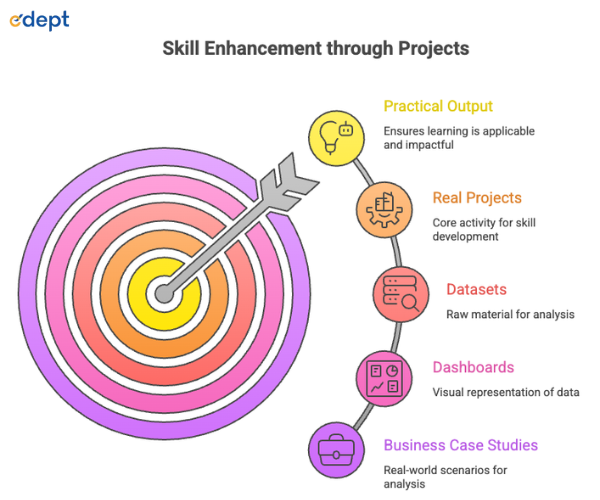
Real-world project work separates programs that produce job-ready graduates from those that produce certificate holders. Look for programs that use actual datasets, simulate real business problems, and require you to build and present solutions. A portfolio of three to five projects is worth more in a job interview than any certification credential alone.
Placement Support
Ask specific questions: How many students from the last batch were placed? What companies hired them? What is the average time between course completion and the job offer? Does the program offer resume reviews, mock interviews, and referrals to hiring partners? Platforms like Edept offer structured placement support with real industry connections, which is the kind of post-course infrastructure that actually determines outcomes for students entering through direct admission.
Common Mistakes to Avoid
Most people who regret their choice did not make a bad decision on purpose. They just skipped the right questions. Here are the mistakes that catch students off guard most often.
Choosing Low-Quality Institutes
The direct admission in data analytics courses landscape has programs of widely varying quality. Do not select a program purely based on brand recognition from advertisements. Research alumni outcomes, read reviews from actual graduates, and verify what tools and projects the curriculum includes before paying anything.
Ignoring Placement Records
Placement is not a marketing metric. It is the only real measure of whether a program translates learning into careers. Ask for verifiable data. If an institute cannot provide specific placement statistics for the data analytics admission process cohort, treat that as a warning sign.
Focusing Only on Low Fees
Cheaper does not necessarily mean better. The program that costs ₹20,000 without any placement facilities or with outdated tools might end up costing you a lot more in terms of time wasted. You also lose money compared to the program that costs ₹60,000 but provides excellent results.
Final Verdict: Is It Worth It?
Direct admission in data analytics courses is genuinely worth it when the program is structured around practical skills, uses current industry tools, provides mentorship, and backs its graduates with real placement support. It is not worth it when the program is built around certificates rather than competencies, or when the institute cannot demonstrate that its graduates are actually getting hired.
The data analytics admission process you choose matters far less than what you do once you are inside the program. Skills, projects, and the ability to demonstrate real work will define your career outcomes. The admission route is just the starting point. Choose an institute like Edept that makes that starting point count, and the return on your investment will follow.
The momentum behind data analytics in India is not slowing down. India’s data industry is projected to reach US$20 billion by 2026, forming nearly 32% of the worldwide market, and salaries for analytics professionals are growing at 12 to 15% annually, with no structural reason for that to change. What this means practically is that the window for entering the field is wide open, and direct admission to data analytics courses is a legitimate door for students who choose the right program.
The question was never really about entrance exams. It was always about outcomes. Verified placement records, skill-focused curricula, real project work, and industry connections are what create those outcomes. If a directly admitted program delivers on those, it is worth every rupee. If it does not, even an entrance exam on the other side would not have saved the investment. Choose based on what the program produces, not how you got in.
Related Links: