Entrepreneurship after BBA is not the gamble it used to be. India added over 44,000 startups in 2025 alone, and the ecosystem backing young founders has genuinely never looked better. A BBA gives you the business fundamentals most founders spend years trying to pick up. This step-by-step startup roadmap tells you what to do and in what order.
India’s startup numbers in 2026 tell a story that is hard to look away from. Over 44,000 new startups were added in 2025 alone, the highest single-year count since the Startup India programme first launched. More than 2.23 lakh startups are now officially recognised as of March 2026, between them generating over 23.36 lakh direct jobs across the country. But the number that actually stands out is not the total count. It is the shift in who is doing the building. Young founders under 30 are leading nearly 40% of new ventures, and the mindset around entrepreneurship after BBA has changed from something people considered a backup plan to something people are actively choosing first.
So what does entrepreneurship after BBA actually look like in practice? Simply put, a BBA gives you the business fundamentals that most first-time founders have to learn the hard way, which already puts you ahead of the curve before you have written a single business plan.
This blog walks through the full startup roadmap for BBA graduates, from identifying your idea and validating it with real customers to registering your business, funding, and building toward long-term growth.
Why BBA Graduates Are Well-Suited for Entrepreneurship
A BBA does more to prepare you for entrepreneurship than most students give it credit for. Here is why the foundation it builds actually matters when you start a business.
Strong Business Fundamentals
Here is something most BBA students do not fully appreciate until they are on the other side of graduation. The marketing, finance, accounting, and operations knowledge from a BBA degree is exactly what most first-time founders are scrambling to pick up after they launch. You are learning it before you need it, which is a genuine advantage.
Most founders who did not study business spend their first year making expensive, avoidable mistakes in exactly these areas. A BBA graduate who understands why cash flow matters more than profit in the early stages, or why pricing decisions affect more than just revenue, starts from a more informed place.
Exposure to Real-World Case Studies
Case study learning during a BBA is closer to founder training than most students realise while they are sitting through it. Analysing how companies like Zomato, Mamaearth, or Nykaa made early-stage decisions builds the kind of strategic pattern recognition that actually transfers when you face your own ambiguous calls as a founder.
The BBA entrepreneurship guide most students follow does not spell this out clearly enough. Every case study you worked through was a compressed version of a real business problem. That exposure compounds quietly until you need it.
Growing Startup Ecosystem in 2026
The infrastructure facilitating entrepreneurship post-BBA is better now than ever before. While government programs, angel groups, incubators, co-working spaces, and startup communities have reached far beyond the metropolitan regions to second- and third-tier cities, India is the world’s third-largest startup ecosystem, with over 111 unicorns and continuous investments from the public and private sectors in education technology, climate technology, healthcare technology, and artificial intelligence enterprises. It is a much friendlier atmosphere for rookie entrepreneurs now than it was just three years ago.
Is Entrepreneurship the Right Choice After BBA?
Entrepreneurship sounds exciting until you are three months in with no customers and dwindling savings. Before committing, it is worth asking honestly whether this path actually suits who you are.
Key Traits of Successful Entrepreneurs
No BBA entrepreneurship guide is complete without being honest about this. Entrepreneurship is genuinely not the right call for everyone, and the earlier you know that, the better the decision you will make.
The traits that tend to matter most are risk tolerance, meaning a real comfort with uncertainty and financial ambiguity. Resilience, the ability to stay functional after setbacks that would discourage most people. Adaptability, a genuine willingness to change direction when the evidence says the current approach is not working. And self-motivation the ability to keep moving without external structure telling you what to do each day.
If most of these describe you accurately, entrepreneurship after BBA is worth pursuing seriously. If they do not, building skills in a structured environment first is a perfectly legitimate path that many successful founders have taken.
Pros and Cons of Starting Early
Reasons starting right after a BBA make sense because:
- Personal financial obligations are typically lower in your early twenties than later
- Energy, time, and risk appetite are genuinely higher at this stage
- Access to college networks, incubators, and student startup programs is still available
- Failure at this stage carries fewer long-term consequences than it will later
Reasons to think carefully:
- Limited industry experience makes some strategic decisions genuinely harder
- A smaller professional network means fewer warm introductions to customers or investors
- Without savings to self-fund, you will likely need external capital sooner
Alternative Paths: Job First, Startup Later
Working for two to three years before starting is not a concession. It is strategic preparation. Many of India’s most successful founders spent time at McKinsey, Paytm, or Flipkart before starting their own ventures, and what they learned in those roles made them significantly more effective when they eventually did.
A side project approach, building and testing a business idea while employed, is increasingly common and often the smartest move. It lets you validate whether real customers will pay for something before you bet your livelihood on it.
Read More: Skills Employers Actually Look For In BBA Students: Here’s The Full List
Step-by-Step Startup Roadmap for BBA Graduates
Most startup advice skips the order of operations entirely. This roadmap lays out exactly what to do first, what comes next, and why the sequence matters more than most people realise.
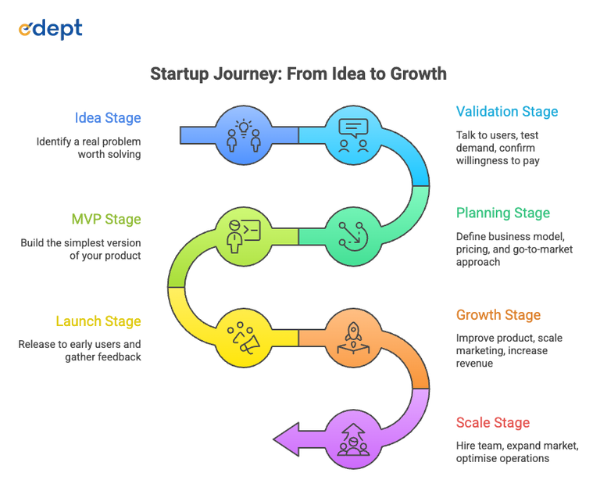
Startup Roadmap at a Glance:
Identify Idea → Market Research → Business Plan → Build MVP → Register Business → Launch & Market
Step 1: Identify a Business Idea
The startup ideas that tend to work are not the ones that sound most impressive in a pitch. They are the ones that solve a problem someone is genuinely frustrated by, often a problem the founder themselves has experienced.
Ask yourself honestly:
- What specific problem am I solving, and for which target audience exactly?
- Does this problem come up often enough to build a business around?
- Is there existing demand, or would I have to create awareness from scratch?
- Do I have any real advantage in solving this problem compared to someone else?
Real example: Ritesh Agarwal did not invent hospitality. He noticed that affordable, standardised budget accommodation in India was genuinely terrible and built OYO Rooms around solving that specific frustration. He found the gap before he built the product.
Step 2: Conduct Market Research
Once an idea feels promising, the instinct is to build it immediately. That instinct is worth resisting. Spending time understanding the market before building anything is where how to start business after BBA diverges from how most first-time founders actually behave, and it makes a significant difference to how the money gets spent.
Market research at this stage means understanding your target customer well enough to describe their daily frustration in their own words. It means knowing who your competitors are, what they are doing well, and what gap they are leaving open. It means getting at least a rough sense of whether the market is large enough to support a business.
Useful tools: Google Trends, SurveyMonkey for primary surveys, Reddit and Quora for understanding real customer frustration with existing solutions, Statista for market size data
Step 3: Create a Business Plan
A business plan is not a document you write to impress investors. It is the process of forcing yourself to think rigorously through every aspect of how your startup will actually function.
A practical startup roadmap business plan covers:
- The specific problem you solve and for whom
- How you make money and at what margins
- How you will reach your first customers
- What it costs to run the business each month
- Revenue and expense projections for 12 to 24 months
- How much funding you need and what you will use it for
Even if the plan changes completely within six months of launch, the discipline of writing it surfaces assumptions that would have cost you significantly more to discover the hard way.
Step 4: Build a Minimum Viable Product (MVP)
An MVP is the simplest version of your product that does just enough to put in front of real customers and find out whether they will actually use it and pay for it. The point is not to build something polished. The point is to find out whether the core value you think you are offering actually resonates with real people before you invest months into building the full version.
Real example: Dropbox launched with a two-minute explainer video before a single line of the actual product code was written. The response to that video told them whether people wanted the thing they were planning to build. They validated demand before investing in supply.
For how to start business after BBA, internalising the MVP mindset is one of the most practically valuable things you can take into a startup. Build the minimum, test it with real people, and let what they do rather than what they say guide what you build next.
Step 5: Register Your Business
Once real customers are using and paying for your MVP, it is time to make the business legally official. This protects you, makes it possible to open business bank accounts, and unlocks access to government schemes and formal investment.
Practical steps for business registration in India:
- Choose a structure. Sole proprietorship for the simplest setup, LLP or Private Limited Company for anything that will take external investment or employ people
- Register with MCA for Pvt Ltd or LLP structures
- Apply for DPIIT recognition under Startup India, which unlocks tax benefits and scheme access
- Register for GST once your turnover crosses the applicable threshold
- Open a dedicated business bank account and keep personal and business finances completely separate from day one
This is the part of the startup roadmap for students that gets delayed the longest. Getting it done early prevents complications that become genuinely expensive to untangle later.
Step 6: Launch and Market Your Startup
The launch is where many first-time founders either freeze with perfectionism or overspend trying to reach everyone at once. The most effective early launches are focused and deliberate, aimed at the specific people most likely to become early adopters rather than the entire market simultaneously.
Digital marketing approaches that work well for early-stage startups:
- Build an audience in your target community before the launch date, not after
- Create genuinely useful content for the people you want to serve, so they find you through what they are already searching for
- Build a waitlist or email list before launching, so you have an actual audience when the product goes live
- Make it easy and worth it for early customers to refer others
- Measure everything from the start, even roughly, so you know which channels are worth doubling down on
Skills Required to Succeed as an Entrepreneur
Having a good idea gets you started. Having the right skills is what keeps the business alive. These are the ones that actually make the difference when things get difficult.
1. Business and Financial Skills
Understanding your own business finances is not optional. Even if you plan to hire an accountant eventually, a founder who cannot read their own P&L, does not know their monthly burn rate, and cannot project how long their runway lasts is flying blind in a way that ends badly more often than not.
BBA graduates have a head start here, but applying classroom finance concepts to real business decisions where the consequences are actual money and actual people is a genuinely different experience from passing a finance exam.
2. Marketing and Sales Skills
In the early stages of any startup, the founder’s ability to find customers and sell to them is often the single most important factor in whether the business survives. Marketing creates interest. Sales converts that interest into revenue. Both require understanding your customer at a level of detail that goes well beyond a generic persona.
Tools to learn and use: Google Analytics, Meta Ads Manager, HubSpot for CRM and email, Mailchimp for campaigns, Canva for visual content
3. Leadership and Team Management
At some point, building the business means building the team. Hiring the right people, setting clear expectations, giving feedback that actually improves performance, and creating an environment where capable people want to stay are all skills that require deliberate development.
Most founders struggle with delegation initially. The transition from doing everything yourself to trusting others to do it is one of the more psychologically demanding parts of growing a startup, and it is worth thinking about before you are in the middle of it.
Build your entrepreneurial skills with edept’s industry-focused programs. edept offers practical, industry-aligned programs in marketing, analytics, and business management that founders actually use day to day. Contact edept’s counsellor to explore programs built for future entrepreneurs.
Also Read: How Business Analytics Can Improve Marketing Strategies
Funding Options for Startups
Every founder eventually faces the funding question. The answer is rarely as simple as finding an investor. Here is what the real options look like and when each one makes sense.
Bootstrapping
Bootstrapping means running the business on your own savings and early customer revenue rather than outside investment. It keeps you in full control, forces efficient use of every rupee, and validates your business model without the pressure of investor expectations sitting over every decision.
Zerodha bootstrapped all the way to becoming India’s largest retail brokerage before taking any external capital. That is an extreme example, but it illustrates something worth holding onto when the pressure to raise funding feels urgent before it actually is.
Angel Investors and Venture Capital
Angel investors put their own money into early-stage startups in exchange for equity. For most BBA graduates, angels are the more realistic first external funding conversation, not VCs. Networks like Indian Angel Network, Mumbai Angels, and LetsVenture are worth exploring once you have real traction and a clear pitch.
Venture capital comes later in the startup roadmap for students, with larger cheques and formal expectations around growth. Most VC firms want demonstrated product-market fit and early revenue before engaging seriously, which means angel investment and customer traction come first.
Government Schemes and Loans
India has built a meaningful set of government-backed funding vehicles for early-stage entrepreneurs:
- Startup India Seed Fund Scheme: Grants and soft loans for DPIIT-registered startups covering proof of concept through initial market entry
- MUDRA Loans: Micro-loans for small and micro businesses through the PM MUDRA Yojana
- SIDBI: Funding specifically for MSMEs and startups at competitive terms
- State-level schemes: Most Indian states now have their own startup policies with grants, subsidies, and incubation support
These are worth the administrative effort, particularly in the early bootstrapping phase when non-dilutive capital has real value.
Common Challenges Faced by New Entrepreneurs
Nobody warns you about how different the hard parts of entrepreneurship feel when they are actually happening to you. Here are the challenges that catch most first-time founders off guard.
Lack of Funding
Running out of money before reaching profitability or the next funding milestone is the most common reason startups fail. The practical responses are controlling costs more aggressively than feels necessary, extending runway by reaching revenue-generating milestones quickly, and being honest with yourself early when a funding assumption is not playing out as expected.
Market Competition
Finding out that a well-funded competitor is already working on a similar problem is something most founders experience. The response is not to walk away. It is to find the specific segment, angle, or underserved customer where you can genuinely win. Early-stage startups consistently do better competing with depth on a narrow front than trying to beat incumbents across the entire market.
Scaling the Business
Getting from first traction to consistent growth is often the hardest phase in the startup roadmap. Processes that worked when you had ten customers break down at a hundred. Scaling requires building systems, learning to hire for the right things, and delegating in ways that feel genuinely uncomfortable for founders who built the business by handling everything themselves.
Why Skill-Based Learning Is Crucial for Entrepreneurs
Knowing business theory and actually running a business are two very different things. The gap between them is where skill-based learning makes the most meaningful difference for early-stage founders.
Importance of Practical Knowledge
In the early stages of entrepreneurship after BBA, you are the marketing team, the finance function, the sales team, and the product manager simultaneously. Practical skills in each area mean you spend less time and money outsourcing things you do not understand, and you make better decisions when you hire for those functions later.
Learning Digital and Analytical Skills
Data literacy is no longer optional for founders. Understanding your customer acquisition cost, conversion rate, monthly active users, and churn rate at a basic level lets you make decisions based on what is actually happening rather than what you hope is happening.
Digital skills in marketing and analytics let you run and measure your own early campaigns rather than depending on an agency or a hire before you have the revenue to support either.
Skills worth building before launch: Google Analytics, Excel, basic SQL, Power BI or Tableau, and at least a working knowledge of digital advertising platforms
Role of Mentorship and Guidance
Most founders who built something meaningful credit a mentor as one of the most important factors in how they navigated the hard parts. A good mentor gives you perspective from experience that investors and employees rarely provide honestly. They have usually made the same mistakes you are about to make, which means their guidance often saves time and money that you do not have much of in the early stages.
Finding a mentor through incubators, alumni networks, LinkedIn outreach, and startup events is worth treating as a serious priority rather than something to get around to eventually.
Why Choose edept for Entrepreneurship and Business Programs
There are plenty of business programs out there. What sets edept apart is how directly the curriculum connects to what founders and employers are actually looking for right now.
Industry-Aligned Curriculum
edept builds its programs around what the business world is actually hiring for and what founders are actually struggling with in 2026. The curriculum covers startup management, digital marketing, data analytics, and business strategy in a way that reflects current market realities rather than frameworks from five years ago.
Hands-On Learning and Real Business Projects
Every edept program includes real projects rather than theoretical case studies. Students build actual business scenarios, work with real data, and develop output they can point to as evidence of capability when talking to investors, early customers, or potential co-founders.
Mentorship and Career Support
edept connects students with industry professionals. These industry professionals will provide practical guidance throughout the program. For students pursuing entrepreneurship after BBA, this mentorship component closes the gap between knowing something theoretically and understanding how it actually plays out in a real business context.
Programs Designed for Future Entrepreneurs
edept’s programs are structured around the domains that matter most for founders in 2026, including data analytics for decision-making, digital marketing for customer acquisition, and business management for operational effectiveness. These are not general programs. They are built around the specific skills the startup roadmap for students demands at every stage.
Step-by-Step Startup Roadmap: Quick Checklist
Before you get too deep into building, use this checklist to make sure the foundations are actually in place. Skipping any of these early steps tends to cost more later.
Idea Validation
- ☐ Identified a specific problem with a clearly defined target user
- ☐ Conducted at least 20 real customer conversations to validate that the problem exists
- ☐ Researched existing competitors and identified what gap they are leaving open
- ☐ Confirmed genuine willingness to pay through early conversations or pre-orders
Skill Development
- ☐ Basic digital marketing skills in place
- ☐ Financial modelling fundamentals understood well enough to build a basic forecast
- ☐ At least one domain-specific certification completed
- ☐ Mentor identified and a relationship actively initiated
Funding Strategy
- ☐ Bootstrapping runway calculated honestly
- ☐ Relevant government schemes researched and applied for where eligible
- ☐ Investor pitch deck drafted covering problem, solution, market size, and early traction
- ☐ Angel investor networks identified and initial outreach planned
Launch Plan
- ☐ MVP built and tested with at least 10 to 20 real users who are not friends or family
- ☐ Business is legally registered
- ☐ Initial marketing channels identified and early tests run
- ☐ First revenue target set with a realistic timeline attached to it
Future Scope of Entrepreneurship After BBA
The opportunity for BBA graduates thinking about entrepreneurship is not shrinking. If anything, the next few years look considerably more interesting than what has already passed.
Rise of Digital Businesses
Digital businesses need less money to start, do not depend on physical infrastructure to grow, and can reach customers in completely different cities or countries without opening a single office. For anyone figuring out how to start business after BBA, digital-first models in SaaS, e-commerce, ed-tech, health-tech, and content are the most practical starting points. The path from idea to first paying customer is shorter, and the path to funding is clearer than in most other categories.
Growth of the Startup Ecosystem
The support available to first-time founders in India in 2026 looks genuinely different from what existed even three years ago. Startup recognition grew by 51.6% in FY 2025-26 compared to FY 2024-25, and direct employment from startups increased by 36.1% in the same period. For anyone following a startup roadmap for students, that structural improvement matters. Better institutional support, more active investors, and a maturing ecosystem mean the environment around you is more equipped to help than it has ever been.
Global Market Opportunities
Something worth noting in any honest BBA entrepreneurship guide is that Indian startups are no longer treating global expansion as a later-stage ambition. Many are building for international markets from day one. With knowledge of the English language, competitive pricing, advanced digital capabilities, and an increasing reputation in the technology world, entrepreneurship after a BBA degree is not just about providing solutions to the needs of domestic clients anymore. Founders who think beyond India from the start access markets and investors that domestically focused startups simply cannot.
Conclusion
The conditions for entrepreneurship after BBA in 2026 are genuinely more supportive than they have ever been. Youth founders under 30 are leading 38% of new ventures in India, and over 44,000 startups were added in 2025 alone, the highest single-year increase since Startup India began, reflecting a generation that is choosing to build rather than wait.
A BBA gives you the business foundations that most founders have to learn through expensive trial and error. A clear startup roadmap converts that foundation into structured execution. And the skills, mentorship, and practical exposure that Edept’s programs provide close the remaining gap between knowing how businesses work in theory and building one that actually functions in the real world.
The founders who make it are rarely the ones with the best ideas on paper. They are the ones who validate early, build practical skills consistently, stay honest about what the data is telling them, and keep moving despite the uncertainty that never fully goes away. If entrepreneurship after BBA is genuinely where you want to go, the ecosystem in 2026 is ready to support that decision more meaningfully than it ever has before.
Related Links: