Internships for BBA students are no longer optional. They are the single most effective way to bridge the gap between a business degree and an actual job offer. This blog covers when to start, how to find the right opportunities, what skills you need, and the step-by-step approach that turns an internship into a placement advantage.
The numbers around graduate employability in India tell a story that every BBA student needs to hear before it is too late. The India Skills Report 2025 puts management graduates at the top of the employability rankings at 78%, and 93% of students surveyed said they wanted hands-on experience through internships. So the awareness is clearly there. What the Unstop Talent Report 2025 found, however, is that 46% of MBA graduates still finish college without a job offer or even an internship lined up. That gap between knowing what needs to be done and actually doing it is where most students lose ground, and it is entirely avoidable with the right approach.
So, when and how should internships for BBA students actually start? The short answer is earlier than most students think, and more strategically than most students plan.
This blog covers everything from when to apply and what types of internships to target, to how to prepare your application and what to do once you are in.
Why Internships Are Essential for BBA Students
A BBA degree tells employers what you studied. An internship tells them what you can actually do with it. That distinction matters more than most students realise until they are sitting across from a recruiter who wants examples, not theory.
Bridge Between Theory and Practice
A BBA program teaches you how markets work, how organisations are structured, and how business decisions get made. What it does not teach you is how it actually feels to sit in a client meeting, manage a deadline under real pressure, or figure out why a campaign is not converting.
Internships fill that gap. They take what you learnt in the classroom and put it into a context where it either works or it does not, and you get to find out which while the stakes are still relatively low.
Internship opportunities for business students exist precisely because companies know that fresh graduates learn faster when they are applying knowledge to real problems rather than studying about it.
Impact on Placements and Career Growth
Employers prefer candidates with experience. This is not an opinion. It is one of the most consistent findings in hiring research.
Students who have completed relevant internships arrive at placement interviews with:
- Real examples to use in competency-based questions
- Demonstrated awareness of how businesses actually operate
- A track record that signals reliability and initiative
Internships for BBA students directly improve placement outcomes because they make the candidate more credible and more interesting to interview, regardless of where the internship was done.
Skill Development Through Internships
You cannot fully develop communication, teamwork, and problem-solving skills in a college classroom. These skills require the friction of real professional situations, disagreements in teams, tight deadlines, difficult clients, and ambiguous briefs.
BBA internship tips from working professionals consistently point to the same insight: the skills that grow most during an internship are not the ones listed on your resume. They are the ones that shape how you actually work with people, which turns out to matter enormously once you are employed full-time.
When Should BBA Students Start Internships?
One of the most common questions BBA students ask is when to start internships. The answer depends on the year, but the general principle is the same: earlier than you think and more intentionally than you might naturally plan.
First Year: Exploration Stage
First-year internships are about exposure, not expertise. You do not need great skills to be useful in a first internship. You need curiosity, basic communication skills, and the willingness to do tasks that more experienced people do not want to do.
Short internships of four to eight weeks during summer break work well at this stage. Target small businesses, startups, NGOs, or family connections where you can observe how a real organisation runs without needing to perform at a high level immediately.
The goal of first-year internship opportunities for business students is simple: figure out what you find genuinely interesting and what you definitely do not. That clarity shapes every subsequent decision about which skills to build and which roles to target.
Second Year: Skill Development Stage
By second year, you should have a clearer sense of which domain interests you most, whether that is marketing, finance, HR, operations, or something else. Internships at this stage should be domain-specific and longer, typically eight to twelve weeks.
This is the stage where internships for BBA students start producing genuinely marketable experience. A second-year marketing internship where you managed social media accounts, ran a small campaign, or analysed customer data gives you something concrete to talk about in third-year placements.
When to start internships BBA second year depends on when your college schedule allows, but summer and winter breaks are the most common and practical windows.
Final Year: Career-Focused Internships
Third-year internships carry more weight than most students give them credit for. A lot of companies treat final-year internships as extended tryouts, and pre-placement offers go to the interns who show up, deliver, and make themselves genuinely useful.
Internship opportunities for business students in the final year should be pointed at the specific sectors, companies, and roles you actually want after graduation. This is not the time to take whatever comes along. The goal is straightforward, it is to walk away with either a job offer in hand or a reference strong enough to meaningfully support your placement process.
Read More: How Business Analytics Can Improve Marketing Strategies
Types of Internships for BBA Students
Not all internships are the same, and the type you choose says a lot about where you are headed. Some build technical skills, others sharpen business thinking, and a few open doors that a degree alone simply cannot. Knowing the difference helps you choose deliberately.
1. Marketing and Digital Marketing Internships
Marketing internships are among the most widely available for BBA students and cover a broad range of activities including social media management, content creation, market research, campaign coordination, and performance analysis.
Digital marketing internships in particular are in high demand and relatively accessible because companies of all sizes need help managing their online presence. A student who can show they managed a brand’s Instagram or ran a Google Ads campaign with real results has something concrete to show.
Platforms to find these: LinkedIn, Internshala, Naukri, company websites
2. Finance and Accounting Internships
Finance internships are a different beast from marketing ones. The work is more structured, the expectations around accuracy are higher, and walking in without a solid grasp of Excel and basic financial concepts will show up quickly. Most of these roles involve financial analysis, reconciliation, reporting, and some level of forecasting support.
If consulting, investment banking, or corporate finance is where you want to end up, a finance internship is not optional. Banks, NBFCs, CA firms, and consulting companies are where most of these opportunities sit, and getting one early puts you in a noticeably stronger position when final placements come around.
Skills Worth Having: Excel, basic financial modelling, and the kind of attention to detail that does not switch off when the work gets repetitive.
3. HR and Operations Internships
HR internships give students hands-on exposure to recruitment, employee engagement, training coordination, and day-to-day HR operations. Operations internships tend to focus on supply chain, logistics, process management, and finding ways to make things run more efficiently.
Both are excellent entry points for students who are not yet certain about their domain specialisation, as they provide broad exposure to how businesses run internally rather than customer-facing functions.
How to Find the Right Internship
Finding an internship is not just about applying to everything and hoping something sticks. The students who land the right opportunities tend to be deliberate about where they look, how they approach companies, and what they lead with when they do.
Online Platforms and Job Portals
The most accessible internship opportunities for business students are listed on platforms designed specifically for this purpose:
- Internshala: India’s most widely used platform for student internships across every domain
- LinkedIn: Increasingly important for finding internships at corporate companies and startups
- Naukri: Also lists internship roles, particularly in larger companies
- Unstop: Good for competitions and internship programmes run by large brands
- Company websites: Many companies post internships directly without listing them on portals
Set up job alerts on at least two platforms so new listings reach you as soon as they are posted.
College Placement Cells
Your college placement cell is an underused resource that most BBA students only engage with in final year. They often have tie-ups with companies that specifically recruit interns from the campus, and these roles are less competitive than open market applications.
Engaging with your placement cell from second year onward puts you ahead of peers who only show up in third year and gives you access to opportunities that are not publicly listed.
Networking and Referrals
A surprisingly large proportion of internships, especially in smaller companies and startups, are filled through personal connections rather than formal applications. This is not nepotism. It is how professional relationships work.
Tell your family, your professors, your seniors, and your LinkedIn connections that you are looking for an internship in a specific domain. Be specific about what you are looking for rather than asking generically. Specific requests are much easier for people to act on.
Skills Required to Get Internships
Companies do not expect interns to know everything, but they do expect something. Showing up with a few relevant skills already in place tells a recruiter you are serious, saves the team time, and quietly puts you ahead of most other applicants at your level.
Communication and Soft Skills
Every internship application, regardless of domain, involves a recruiter assessing whether you can communicate professionally. This includes:
- Clear, grammatically correct written communication in emails and cover letters
- Confident verbal communication in phone or video interviews
- The ability to listen and understand instructions without constant clarification
BBA internship tips from recruiters consistently emphasise that soft skills are what often separate candidates with similar academic profiles.
Basic Technical Skills
Most business internships in 2026 will assume you already know a few things before you walk in. Not advanced skills, just the basics that save the team from having to teach you things they would rather not spend time on.
- Excel: Data entry, basic formulas, and pivot tables are the minimum requirements. Struggling with these in week one leaves a poor first impression.
- Google Workspace or Microsoft 365: Docs, Sheets, Slides, and professional email. These are the tools most teams run on daily.
- Social media platforms: Not just personal use, but a genuine understanding of how business accounts are managed and what the numbers on them mean.
- Basic analytics: Being able to open a dashboard or read a report and understand what it is telling you without needing a walkthrough every time.
Internship opportunities for business students open up considerably when you arrive with even these foundational skills in place. Companies are far more willing to take on a student who reduces their onboarding burden than one who adds to it.
Industry-Specific Knowledge
Showing that you have done some homework about the company and the domain you are applying to is one of the clearest signals of genuine interest. Read about the company’s products, competitors, and recent news before any interview. Understand the basics of the role you are applying for well enough to ask an intelligent question.
Also Read: Is BBA Enough or Should You Pursue MBA Immediately?
How to Prepare for Internship Applications
Most students underestimate how much preparation goes into a strong internship application. The ones that get noticed are rarely put together overnight. A little groundwork before you start applying makes a bigger difference to your response rate than most people expect.
Build a Strong Resume
A BBA resume for internship applications should be clean, one page, and focused on what you can offer rather than padding.
Include:
- Add your education and any coursework that actually connects to the role you are applying for.
- Include earlier experience even if it was short, informal, or unpaid. It still counts.
- List certifications you have completed, especially anything in analytics, marketing, or business tools.
- Show projects that produced something real, what you built, what tools you used, what came out of it.
- Mention extracurricular activities that show you took on responsibility or led something outside the classroom.
Avoid generic objective statements. Replace them with a two-line summary of what you are looking for and what you bring.
Prepare for Interviews
Most internship interviews are conversational rather than heavily technical, but that does not mean they require no preparation. Certain common questions include:
- Why this company and why you want this role?
- What relevant skills or experience do you have?
- Tell me about a time you solved a problem or worked in a team
- What do you know about our products or industry?
Practise your answers out loud. Hearing yourself say something is different from reading it in your head, and it makes a real difference to how you come across.
Create a Portfolio
Even for a first internship application, a small portfolio demonstrates initiative. This could include:
- A sample social media content plan for a hypothetical brand
- A basic financial analysis of a publicly available company
- A market research write-up on an industry you are interested in
- Any academic projects that demonstrate relevant skills
You do not need much. Two or three things that show you can actually do something are more impressive than a long list of courses you completed.
Common Mistakes BBA Students Make
Many BBA students do not make dramatic mistakes during their internship search. They make small, avoidable ones that quietly add up. Knowing what those are before you start applying saves you a lot of wasted effort and more than a few missed opportunities.
1. Starting Too Late
The single most common mistake is waiting until third year to start thinking about internships. By the time most students begin applying in final year, students who started earlier have already built experience, skills, and networks that are genuinely difficult to catch up with.
The when to start internships BBA answer is not third year. It is first year for exploration and second year for serious domain-specific experience.
2. Ignoring Skill Development
Applying for internships without building relevant skills first leads to rejection, and repeated rejection leads to discouragement. The right sequence is to build at least basic skills in your target domain before applying, so that your application is based on something real rather than just enthusiasm. Internships for BBA students are competitive at good companies. Preparation matters.
3. Choosing Irrelevant Internships
Taking any internship just to have something on your resume is a mistake that shows up clearly during placements. Recruiters can tell the difference between a student who spent their internship doing random administrative tasks and one who worked on a specific project in a relevant domain.
Internship opportunities for business students are varied enough that you do not need to settle for irrelevant experience. A short, focused internship in your target domain is always more valuable than a longer, prestigious-sounding one that had nothing to do with what you want to do.
Benefits of Internships for Career Growth
Internships do more than fill a line on your resume. The students who take them seriously tend to come out with clearer career direction, stronger professional networks, and a level of practical confidence that no amount of classroom preparation quite replicates.
Better Job Opportunities
Students with two or three relevant internships on their resume are simply more competitive at placement time. They have more to talk about, more examples to give, and more confidence in their ability to handle the job because they have already handled some version of it.
Higher Salary Potential
Internship experience consistently correlates with higher starting salary offers. Students who arrive at placements with demonstrated practical experience tend to receive and negotiate better packages than those who are purely academic profiles.
Industry Exposure
Beyond the specific skills and experience, internships give students something that no amount of classroom learning can provide: a realistic understanding of what working in a particular industry or function actually feels like. This is very valuable for making informed career decisions rather than guessing.
Why Skill-Based Learning Improves Internship Opportunities
Companies shortlist interns based on what they can contribute from day one. The more relevant skills you bring to the table before you apply, the less convincing you have to do once you get in the room.
Practical Skills Matter More Than Marks
73% of recruiters in India prioritise skills over college reputation. Practical skills are not something you either have or do not have. They are built through courses, certifications, and real projects, and the difference they make to internship and job opportunities is tangible enough that most students who invested in them early will tell you it was worth it.
The students who land the best internship opportunities for business students are not always the ones with the best GPA. They are the ones who can demonstrate that they know how to do things.
Certifications Increase Chances
A relevant certification signals commitment to learning and validates specific skills in a way that a degree alone cannot. For internship applications in particular, where many applicants have similar academic profiles, a Google Digital Marketing Certificate or a Power BI certification creates a clear differentiation.
The most valuable certifications are the ones where you actually practised the skill, not just passed a quiz. Pair every certification with a small project that demonstrates the learning.
Projects Make You Stand Out
A portfolio of small, relevant projects does more for an internship application than most students realise. A student who built a basic sales dashboard in Power BI, ran a practice SEO audit on a local business website, or conducted a competitor analysis for a college project has tangible evidence of capability.
Get internship-ready with Edept’s industry-focused programs. Edept builds the practical skills, tool proficiency, and career support that make internship applications more competitive and interviews more confident. Contact edept to explore programs designed for business students.
Why Choose edept for Career-Focused Programs
Plenty of programmes will teach you concepts. Fewer will prepare you for what hiring actually looks like in 2026. edept’s programs are built around the gap between the two, which is exactly where most students lose ground during placements and internship applications.
1. Industry-Aligned Curriculum
edept designs its programs around what employers and internship recruiters are actually looking for. It is not based on theoretical frameworks that have no connection to current hiring. The curriculum maps directly to the skills required for the most in-demand internship roles in marketing, analytics, business analysis, and management.
2. Hands-On Training and Live Projects
Every edept program includes live projects that give students real output to add to their portfolio. These are not case study simulations. They are actual projects that produce work you can share with internship recruiters as evidence of what you can do.
3. Placement and Internship Assistance
Edept provides dedicated support for both internship applications and final placements. This includes:
- Resume building tailored to specific roles and industries
- Interview preparation, including mock sessions and feedback
- Direct connections with companies looking for skilled interns
- Career coaching throughout the program
4. Programs for High-Demand Roles
The programs offered by edept are crafted in such a manner that it equips BBA graduates for job openings in today’s world of business. The fields of data analysis, digital marketing, and business management do not belong to a random list of professions. They are precisely the sectors that provide increasing internship openings for business graduates in 2026.
Step-by-Step Plan to Start Your First Internship
Step 1: Identify Your Interest Area
Before applying anywhere, spend time honestly assessing what you find interesting. Not what sounds impressive, not what your parents suggest, but what you would genuinely enjoy spending eight hours a day learning about.
Look at the broad domains available to BBA students: marketing, finance, HR, operations, consulting, digital. Read about each one, talk to seniors working in those areas, and narrow down to one or two that genuinely interest you.
Step 2: Learn Required Skills
Know your target domain. After that, identify the two or three skills that most internship listings in that area require. Build those skills before you apply. Even a basic level of proficiency changes your application from a cold pitch to a credible one.
BBA internship tips from hiring managers consistently emphasise that applicants who demonstrate specific skill development are far more likely to get interviews than those who only reference their degree.
Step 3: Apply on Multiple Platforms
Do not rely on a single platform. Apply on Internshala, LinkedIn, and directly through company career pages simultaneously. Most students underestimate how much volume is needed in internship applications, particularly for competitive roles.
Personalise each application slightly to reflect the specific company and role. A cover letter that shows you read about the company is significantly more effective than a generic one.
Step 4: Prepare for Interviews
Before any internship interview, do three things and do them properly rather than skimming through them the night before.
- Look into the company’s products, anything recent in the news about them, and who their main competitors are
- Pull together two or three examples from your academic work or extracurricular activities that show you can actually do something relevant
- Write down two thoughtful questions to ask at the end, because showing up with nothing to ask reads as disinterest
BBA internship interview tip: be specific when you answer, be straight about what you do not know yet, and make it obvious you are genuinely interested in the company rather than just ticking a box.
Step 5: Gain Experience and Upskill
Once you are in an internship, treat it as if it were a full-time job. Show up on time, deliver on your commitments, ask good questions, and look for ways to contribute beyond your assigned tasks.
When the internship ends, update your resume and LinkedIn with what you did and what you learned. Then identify the next skill gap and start filling it before the next application cycle begins.
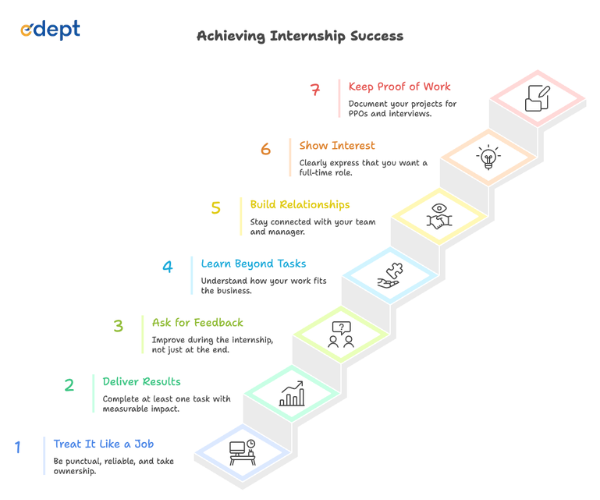
Future Scope: Internships to Full-Time Jobs
For a growing number of BBA graduates, the path from internship to full-time role is shorter than it used to be. Companies increasingly use internships to identify talent early, and students who perform well rarely have to start the job search from scratch.
Pre-Placement Offers (PPOs)
Pre-placement offers are full-time job offers made to interns before they graduate. They are the clearest example of how internships for BBA students can directly convert to employment, and they are more common than most students realise at companies that run structured internship programs.
Students who receive PPOs consistently say the same thing: they were given real responsibility during their internship, they delivered on it, and the company wanted to retain someone who had already proved themselves useful.
Career Growth Opportunities
Internship experience accelerates career growth after joining a company full-time because it builds the contextual understanding and professional habits that pure academic training does not. Students who interned in a relevant domain before graduating typically reach their first promotion faster than those who arrived without any professional experience.
Long-Term Industry Benefits
The professional network built during internships has long-term career value that most students do not fully appreciate until years later. Colleagues, managers, and clients from early internships become the professional network that generates referrals, recommendations, and opportunities throughout a career.
Internship Preparation Checklist
Use this before your first application:
Profile and Documents
- ☐ Resume updated, one page, no errors
- ☐ LinkedIn profile complete with photo and summary
- ☐ Email address is professional
Skills
- ☐ Basic Excel proficiency confirmed
- ☐ At least one domain-specific skill started
- ☐ One relevant certification completed or in progress
Research
- ☐ Target domain identified
- ☐ List of ten target companies built
- ☐ Internship listings reviewed on at least two platforms
Portfolio
- ☐ At least one project documented and ready to share
- ☐ Portfolio link or folder accessible
Interview Preparation
- ☐ Two or three examples from experience prepared
- ☐ Company research done before each interview
- ☐ Two questions ready to ask interviewers
Conclusion
Internships for BBA students are not a nice-to-have. They are the most direct path from a business degree to a meaningful placement offer. The India Skills Report 2025 shows that employability among Indian graduates has jumped significantly over the past decade, but the report also makes clear that internships are one of the key enablers of that improvement, with 93% of students expressing strong interest in hands-on experience as the defining factor in job readiness.
The students who build the best careers after BBA are not necessarily the ones with the highest grades. They are the ones who started early, applied deliberately, built relevant skills, and treated every internship as a genuine opportunity to prove what they could do. Start in first year, go deeper in second year, and use final year to convert experience into offers. That timeline, followed consistently, makes the difference between a strong placement and a disappointing one.
Related Links: