The best BBA specialization depends on your career goals, personality, and interests, with high-demand options including Marketing, HR, Finance, and International Business for 2026, offering strong ROI and technical skills.
Choosing the best BBA specialization is one of the most important decisions you will make as an undergraduate student. It shapes the skills you build, the roles you qualify for, and the salary you can expect after graduation. In 2026 and the upcoming years, employers are no longer looking for generalists. They want graduates who bring domain expertise from day one. A well-chosen specialization signals that you are ready to contribute and not just learn on the job.
This guide breaks down the four most popular BBA specializations, which are Marketing, HR, Finance, and International Business, so you can make a confident and informed choice.
What Are BBA Specializations & Why They Matter?
A BBA program specialization is a more detailed course of study that lies within the larger scope of the BBA program itself. Unlike the broader curriculum of a BBA program, which covers business management in general, a BBA specialization enables you to develop specific skills relevant to an industry of your choice, thereby becoming “job-ready” after completing your studies.
What is a BBA Specialization?
A BBA specialization refers to the narrow field of concentration chosen by students while pursuing their degree program in the field of business studies. Although the general coursework includes the areas of management, economics, and communications, a specialization requires you to explore further into one particular area, such as brand management, people management, financial analysis, and international business.
It can be equated to the distinction between understanding how a business operates and knowing how to manage its operations effectively.
Importance of Choosing the Right Specialization
Choosing the wrong specialization can be costly for your professional life since it will determine the kind of jobs available to you as well as the industry that would employ you. Without doing any research into your specialization choice, you will be stuck in mismatched jobs that will limit your career growth and cause dissatisfaction.
Specializations need to take into account three aspects: your own personal strengths, your career plans, and the market demands.
Demand for Specialized Skills in 2026
The current labor market situation has changed greatly. Companies in various sectors, such as banks, FMCG companies, consultancies, and IT firms, are less inclined to hire specialists who have been trained as generalists in their first year out of college. On the contrary, these businesses seek employees who possess certain skills measured by performance in certain tasks. Specializing is now mandatory.
Overview of Major BBA Specializations
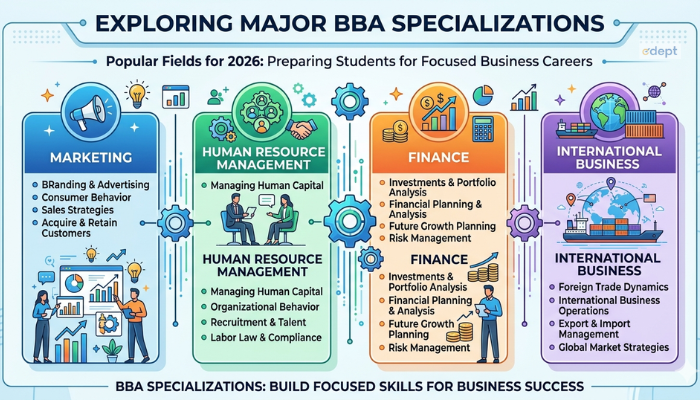
The BBA specializations provide custom career options through specialization in particular functional aspects of businesses. Specializations that will be popular among students in 2026 include International Business, Marketing, and Finance. The programs incorporate core concepts of business along with specialized skills in the respective industry.
Marketing
Students who pursue a specialization in marketing will learn about branding, advertising, consumer behavior, and sales strategies. They will be able to take on jobs that involve acquiring and retaining customers through communication.
Human Resource (HR)
Specialization in human resource management teaches students about managing human resources, organizational behavior, recruitment, and labor law. This specialization helps graduates get jobs that involve working in the area between business management and human resource management.
Finance
Finance specialization involves understanding investments, analyzing them, and making plans for future growth and risk management. This field prepares graduates to take up jobs in banking, finance, and investments.
International Business (IB)
International business specialization involves learning about foreign trade, international business operations, and export/import management, among other things.
BBA in Marketing: Scope, Skills & Careers
BBA in Marketing is a three-year program that primarily deals with consumer behavior, branding, and digital marketing strategy, opening up career options such as Marketing Manager, Digital Specialist, and Sales Manager.
Key Subjects in Marketing
A marketing specialization typically covers digital marketing, consumer behavior, brand management, market research, advertising, and sales strategy. Students also explore emerging areas like social media marketing, content strategy, and performance analytics.
Skills Required
Marketing professionals need a blend of creative and analytical thinking. Strong communication, storytelling ability, data interpretation, and platform proficiency, particularly across tools like Google Ads, Meta Business Suite, and CRM platforms, are increasingly expected at the entry level.
Career Opportunities
Graduates with a BBA in Marketing can pursue roles such as Marketing Executive, Brand Manager, Digital Marketing Analyst, Content Strategist, and Market Research Analyst. With experience, paths open toward Brand Director, CMO, or Marketing Consultant roles.
Typical Starting Salary: ₹3–5 LPA for marketing executives; higher for performance and digital roles at product companies.
Check: Is BBA Enough or Should You Pursue MBA Immediately?
BBA in HR: Scope, Skills & Careers
Human Resource Management (HRM) is a three-year bachelor’s program that trains students for the management of an organization’s human resources. The high demand in IT, banks, and manufacturing industries means graduates can be employed as HR Executives, Recruiters, or Trainers, earning an average salary of ₹3–5 LPA.
Key Subjects in HR
HR specialization covers recruitment and selection, training and development, compensation management, labor laws, organizational behavior, and performance management. Increasingly, HR curricula also include people analytics and HR technology tools.
Skills Required
Effective HR professionals combine interpersonal skills with strategic thinking. Active listening, conflict resolution, leadership, data literacy, and knowledge of employment regulations are core competencies. The ability to handle sensitive conversations with empathy and professionalism is equally important.
Career Opportunities
HR graduates typically begin as HR Executives, Talent Acquisition Specialists, or Learning and Development Associates. With experience, roles like HR Business Partner, Talent Manager, and HR Director become accessible. The rise of HR analytics has also opened up more data-focused roles within the function.
Typical Starting Salary: ₹2.5–4.5 LPA for entry-level HR roles; specialist and HRBP roles command higher packages.
BBA in Finance: Scope, Skills & Careers
Finance is one of the most career-dense BBA specializations available today. From investment banking to fintech startups, from corporate treasuries to portfolio management firms, finance professionals are in demand across virtually every sector of the economy.
But not all finance programs are built the same. What separates a strong finance graduate from an average one is the depth of the curriculum, the tools they have worked with, and the industry exposure they have received before graduation.
Key Subjects in Finance
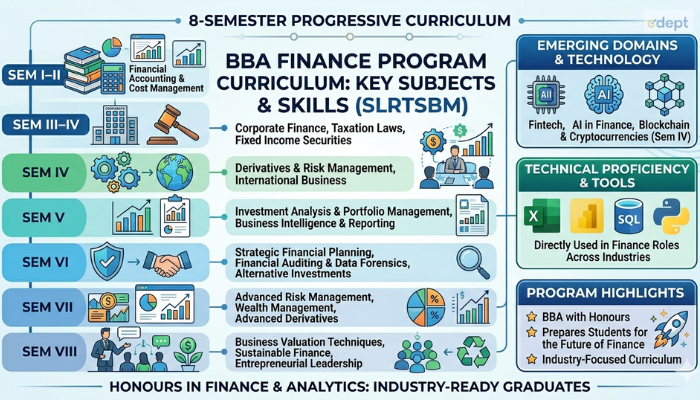
A rigorous BBA Finance program covers a broad and progressively deep set of topics. At Shree L. R. Tiwari School of Business Management (SLRTSBM), the BBA with Honours in Finance and Analytics curriculum spans 8 semesters and includes:
- Financial Accounting and Cost & Management Accounting (Sem I–II)
- Corporate Finance, Taxation Laws, and Fixed Income Securities (Sem III–IV)
- Derivatives & Risk Management, Blockchain & Cryptocurrencies in Finance, and International Business (Sem IV)
- Investment Analysis & Portfolio Management, Business Intelligence & Reporting Systems (Sem V)
- Strategic Financial Planning, Financial Auditing & Data Forensics, and Alternative Investments (Sem VI)
- Advanced Financial Risk Management, Wealth Management, and Advanced Derivatives (Sem VII)
- Business Valuation Techniques, Sustainable Finance, and Entrepreneurial Leadership (Sem VIII)
Alongside finance theory, students also build technical proficiency in Excel, Power BI, SQL, and Python, tools that are directly used in finance roles across industries.
The program also covers emerging domains like Fintech, AI in Finance, and Blockchain, preparing students for the direction the industry is heading, not just where it stands today.
Skills Required
Finance professionals need strong analytical thinking and numerical ability — but that is only the starting point. In 2026, employers also expect data literacy, proficiency in reporting tools, understanding of regulatory frameworks, and the ability to communicate financial insights clearly to non-finance stakeholders.
At SLRTSBM, students develop these skills through a combination of live projects, internships, and skill certifications in Excel, Power BI, and SQL, ensuring they are industry-ready well before graduation.
Career Opportunities
A BBA in Finance will help students pursue careers in a variety of high-growth domains, including:
- Banking & Financial Services – Financial Analyst, Credit Analyst, Relationship Manager
- Investment & Asset Management – Portfolio Analyst, Investment Associate
- Corporate Finance – FP&A Analyst, Treasury Associate
- Fintech – Product Analyst, Risk Analyst, Business Analyst
- Insurance – Underwriting Analyst, Claims Analyst
- IT & Analytics Companies – Business Intelligence Analyst, Data Analyst (Finance)
- Consulting & KPOs – Research Analyst, Valuation Analyst
As a course mapped to the curriculum of CFA, the graduates of the SLRTSBM course will have an added advantage while applying for certifications like CFA Level 1 or FRM. Average Entry-level Package: ₹4-7 LPA for finance roles; may be higher for CFA and analytics roles based on the hiring company.
Read More: Modern Business Management Growth: The Role of Digital Marketing and E-Commerce
BBA in International Business: Scope, Skills & Careers
BBA International Business is another interesting career choice. In the field of BBA International Business, the major concentration will be on global business, cross-cultural management, and global finance. One can find job opportunities in MNCs and Export-Import companies in the BBA international business. Some necessary skills that one should have include effective cross-cultural communication and negotiating skills.
Key Subjects in IB
International Business specialization covers global trade frameworks, export-import management, international marketing, foreign exchange management, trade laws, and cross-border business strategy. Students also explore geopolitics, global supply chains, and the regulatory environments of key markets.
Skills Required
IB professionals need strong cross-cultural communication skills, an understanding of global economic systems, strategic thinking, and adaptability. Language proficiency and awareness of international trade agreements are added advantages in this field.
Career Opportunities
Graduates with a BBA in International Business can pursue roles such as International Business Manager, Export-Import Coordinator, Global Supply Chain Analyst, Trade Finance Associate, and International Marketing Executive. Multinational corporations, logistics companies, and global consulting firms are the primary recruiters.
Typical Starting Salary: ₹3.5–6 LPA depending on the company and geography of the role.
Salary Comparison Across BBA Specializations
Choosing specializations in BBA has a great impact on the starting salary and prospects of an employee, as the specialties of finance, marketing, and international business generally pay off best.
| Specialization | Entry-Level Salary (India) | Top Roles | Growth Potential |
| Marketing | ₹3–5 LPA | Brand Manager, Digital Marketer | High (especially digital) |
| Human Resources | ₹2.5–4.5 LPA | HR Business Partner, Talent Manager | Moderate to High |
| Finance | ₹4–7 LPA | Financial Analyst, Portfolio Manager | Very High |
| International Business | ₹3.5–6 LPA | Global Business Manager | High (MNCs) |
Note: Salaries vary based on institution, city, company size, and individual performance. CFA or other professional certifications can significantly increase finance salaries.
Which BBA Specialization Is Best for You?
The best BBA specialization depends on your career goals, personality, and interests, with high-demand options including Marketing, HR, Finance, and International Business for 2026, offering strong ROI and technical skills.
Based on Your Interests
- Do you enjoy stories, campaigns, and understanding consumer behavior? → Marketing
- Do you like working with people, solving disputes, and forming a team? → HR
- Are you fascinated by numbers, market trends, and finances? → Finance
- Are you interested in business around the world? → International Business
Based on Career Goals
- Would you like to work in banking, investments, or fintech? → Finance
- Do you want to work in a multinational company? → IB or Finance
- Would you like a career in personnel management or organizational development? → HR
- Do you plan to develop a new brand or product? → Marketing
Based on Market Demand
Currently, finance and marketing are professions with the largest number of jobs in India. The specialization of finance, in particular, is gaining popularity, and those with the ability to analyze financial information will be especially needed in 2026.
Why Skill-Based Learning Matters in Every Specialization
Skill-based learning is important across all BBA specializations, as it connects theory to practice, ultimately affecting employability and the sustainability of one’s career. In view of the ever-evolving nature of industries, thanks to the use of artificial intelligence, automation, and other technologies, employers have become interested in abilities rather than diplomas.
Practical Skills vs Theoretical Knowledge
A degree gives you the theoretical foundation. Skills give you the ability to execute. Employers consistently rank practical skills — whether that is running a campaign, building a financial model, or conducting an HR audit — above academic scores when making hiring decisions.
Importance of Internships & Projects
Internships and live projects are where learning becomes real. They expose students to workplace dynamics, real problem-solving, and professional accountability. Programs that embed internships and industry projects into the curriculum — rather than leaving them to chance — significantly improve placement outcomes.
Certifications That Add Value
Industry certifications signal to employers that a student has gone beyond the syllabus. In Finance, CFA Level 1 and FRM are globally recognized. In Marketing, Google Ads and Meta Blueprint certifications are widely valued. In the data space, Power BI, SQL, and Python proficiency have become near-essential.
Why Choose edept for Career-Focused BBA Programs
Industry-Aligned Specializations
Edept partners with universities and institutes in designing educational programs based on contemporary industry requirements rather than past solutions. The BBA with Honors in Finance and Analytics program at SLRTSBM, designed as an educational collaboration with Edept, is one such program. The curriculum is AICTE-approved, CFA Institute-aligned, and incorporates new areas such as Fintech, Artificial Intelligence in Finance, and Sustainable Finance.
Hands-On Learning & Live Projects: Global Industry Immersion
The Global Industry Immersion Program by Edept provides practical exposure through projects for students before their graduation. There are three phases of this immersion:
- Foundation Immersion (2-3 Weeks | ~25 hours) – Begin to Think Like an Industry Professional
- Applied Immersion (4-6 Weeks | 40-60 hours) – Develop and Deliver Real Solutions
- Advanced Immersion (8-12 Weeks | 80-120 hours) – Lead Global Capstone Projects
They are working with projects provided by a global industry ecosystem of clients including Deloitte, IBM, Salesforce, EY, Infosys, JPMorgan Chase, Greenpeace, etc. Students get live project briefs, feedback from mentors and clients, and chances to deliver their projects in front of executives. This isn’t a simulated experience. It is real work, reviewed by real clients.
Placement Assistance & Career Support
The career support system at SLRTSBM, powered by Edept, covers every step from enrollment to employment:
- Career counseling sessions
- Mock interviews
- Soft skills training (communication, leadership, teamwork)
- Domain skills development
- Industry-specific guest lectures and workshops
- A 300+ company recruiting network, including HDFC Bank, Axis Bank, Deloitte, EY, KPMG, PwC, BlackRock, JPMorgan Chase, TCS, Kotak, Bajaj Finserv, Paytm, PhonePe, and many more
Programs Designed for High-Demand Careers
The BBA with Honours in Finance and Analytics is built for students who want to enter finance, investment, analytics, or fintech — sectors that are actively hiring and growing. With CFA pathway support, certifications in Excel, Power BI, and SQL, and a curriculum that includes AI in Finance and Blockchain, graduates step into the job market with skills that are immediately relevant.
Common Mistakes Students Make While Choosing a Specialization
The most common blunders committed by students in the selection process of their specialization area are as follows: failing to think before making friends without thinking, opting for areas where money is high even if the interest is lacking, and not researching enough about the field itself. This usually results from low self-awareness. Let’s check some of the major common mistakes that students make while choosing the BBA specialization.
Following Trends Without Research
Finance and International Business are currently very trendy areas to specialize in. However, basing one’s decision on the popularity of a certain specialization and not considering individual strengths and preferences usually results in underperformance and disinterest in the subject. Learn more about the actual work done in these fields before specializing in any of them.
Ignoring Skill Requirements
Specializations require specific sets of skills that should be considered carefully before making a choice. The numerical and analytical skills required in finance can be very challenging for some students. In the case of digital marketing, creative and communication abilities matter the most. Disregarding one’s skills can become a serious error.
Not Considering Career Goals
A specialization always implies something. Specializing in finance makes perfect sense if the future goal is to work in investment banking. Studying International Business or Finance would be more beneficial for someone aiming to become a multinational leader. Thus, it is always necessary to work backward in such situations.
Future Scope of BBA Specializations
There is an impressive scope of specialization in BBA programs. Data-related knowledge and skills have become indispensable for various industries. Below is a detailed description of the trending BBA specialization scopes in all fields.
Growth in Finance and Analytics Roles
Finance and data analytics go hand-in-hand today. There is a need for specialists who can understand not only finance but also use analytical methods. The BBA Honors program in Finance and Analytics prepares graduates for such positions. Careers in fintech, investment analytics, and financial data science are rapidly growing areas of the Indian job market.
Increasing Demand for Finance Professionals
Demand for specialists with a degree in finance continues to grow in line with the expansion of capital markets, the growth of the entrepreneurial environment, and increased financial penetration in the country. The most wanted professionals in major banks, asset management agencies, and consulting companies possess the knowledge that is necessary for passing the CFA exam.
Global Opportunities in International Business
With more Indian corporations developing internationally and foreign companies entering the Indian market, there is an increased demand for specialists with experience in international business. In addition, throughout the decade, cross-cultural competencies and knowledge of international trade will remain valuable.
Marketing in a Digital-First Economy
Marketing is also becoming more digital. Performance marketers, content strategists, and marketing analysts with data skills will continue to grow in the coming years.
The Best BBA Specialization is:
Each BBA program specialty leads its own way. The BBA Marketing Specialization is right for creative minds who have a keen interest in creative and communication-driven activities. HR is for those who like working with people. International Business gives opportunities in international trade and business.
A career choice such as finance, particularly in combination with a good analytical background, promises wide opportunities and very high salary prospects at any stage, entry-level as well as more senior positions. Those who aspire to pursue careers in high-demand areas of finance in banks, investments, financial technologies, or corporate finance will have excellent educational and professional opportunities through programs like the BBA with Honors in Finance and Analytics from the Shree L. R. Tiwari School of Business Management.
Whatever you choose, make sure your specialization aligns with your interests, builds real skills, and puts you in front of the right employers before you graduate.
Related Links: