Required documents for Data Analytics admission in India typically include academic transcripts (10th, 12th, Bachelor’s), entrance exam scores (e.g., CUET, CAT, MAH-CET), a Statement of Purpose (SOP), letters of recommendation (LOR), and a resume.
In today’s dynamic business environment, one thing is most constant and certain: data. With massive technological advancements, each day lakhs and lakhs of data are produced by businesses, but there is no use for unstructured and raw data. You need proper skills and techniques to evaluate data and generate valuable and meaningful insights from it. This is where data analytics comes in. It helps in analyzing, recording and transforming raw data into strategic and actionable insights. The data analytics market in India is projected to reach US$21,286.4 million by 2030. A compound annual growth rate of 35.8% is expected of the Indian data analytics market from 2025 to 2030.
Data analytics helps in shaping the way businesses & organizations in today’s digital world make strategic decisions. Businesses across sectors, from healthcare and fintech to e-commerce, retail, banking, and government, depend on data-driven decision-making & are generating more data than ever before. According to NASSCOM, India itself will need 11 million data professionals in 2026.
Now, if you are willing to join a data analytics programme, one thing that matters most, like your eligibility, is your documents. A very strong application can easily get rejected if proper documentation is not submitted. Your application gets delayed or rejected if any of your certificates go missing, if you do not provide a clear marksheet or if the files you have uploaded do not match the college format. For this reason, the candidates should be very aware of their documentation and not consider it a last-minute formality.
This guide will give you complete knowledge and up-to-date information on all the documents that are required for data analytics admission in India.
Why Documents Are Important for Admission
Documents are a very important and critical factor for admission because they serve as verified and official proof of a student’s identity and eligibility as well as academic history. These documents ensure transparency and compliance, allowing universities and colleges to confirm your qualifications and hence preventing any type of fraud. If any of your documents are missing or inaccurate, it can delay or even reject your application.
Verification of Eligibility
The colleges and institutions need to make sure that you actually qualify for the programme for which you have applied. Your academic certifications and marksheets serve as the primary proof that you have met the minimum percentage criteria for your admission. For example, for a postgraduate degree in a data analytics course in India, a minimum of 50% marks is required at graduation, and that must be properly documented.
Identity & Background Check
The colleges and universities also need to make sure that the candidate is genuine. Your documents, such as the Aadhar card, birth certificate, passport, and PAN number help in identifying who you actually are. Without valid ID proof, your application cannot be processed.
Smooth Admission Process
Most of the students lose their admission time, not because they were ineligible but because they either submitted the wrong documents or the files were wrongly formatted. If all your documents are clear, the admission team can process your application very smoothly and fast. This ensures you receive your offer letter, fees receipt and enrolment on time without any delays
Common Documents Required for All Data Analytics Courses
Whether you are applying for a UG course or a PG course, there are a few sets of documents that are similar for almost every institution. You can think of it as a core admission checklist or requirement.
Academic Certificates
These documents are most crucial in your application process. You need your marksheet from the Class 10 and Class 12 board exams. Now if you are applying for a postgraduate programme, you need your graduation marksheet and all semester mark sheets along with your final degree certificate. You should make sure all the marksheets are original and issued by legally recognized institutes or universities.
Identity Proof
Your identity proof document typically includes an Aadhaar card, a passport, and a PAN card. Some institutions accept a voter card or a driving licence too. For globally recognized programs, you need a valid passport, which is mandatory.
Passport-Size Photographs
You will need your current and present passport-size photo whose background can be black or white. Certain specifications are given by the universities regarding the photo size. Always you need to carry extra photocopies and keep a high-resolution image for online purposes.
Address Proof
Your residential address needs to be properly documented, either through an electricity bill, a telephone bill, your Aadhar card or bank statements. Some institutions also accept rent agreements. Make sure such documents are recent and not more than 3 months old.
Documents Required for Undergraduate (UG) Courses
If you want to apply directly after class 12 for a BSc, BTech or a BCA degree, then all your school-level documents must be properly arranged, because those documents form the base of your application.
10th & 12th Marksheets
These two are the most important documents for your undergraduate programme. Your Class 10 marksheet is used to confirm your date of birth, academic records, and identity details. Whereas your class 12 marksheet is used to establish your eligibility for the undergraduate programme. In most cases, to apply for a UG undergraduate programme in data analytics, you need a minimum of 50% marks in your Class 12 examination, which can vary depending on the institution. You always keep attested copies of both these documents
School Leaving / Transfer Certificate
Sometimes universities and colleges ask for your school-leaving certificate, which is issued by your school and confirms that you have officially left the institution after completion of your studies. This document is mandatory for maximum UG admissions. The document must carry your school principal’s seal and signature. Without this, your transition from school to college is not recognized formally.
Migration Certificate (if applicable)
A migration certificate is a document that is required when you move or transfer from one education board to another. For example if you have completed your class 12 from a CBSE board and now you want to apply to a state university or a private institution, which is affiliated with a different board, then in such conditions, you need a migration certificate. This document is not mandatory, and it is not always required.
Documents Required for Postgraduate (PG) Courses
If you are willing to go for a postgraduate degree in data analytics, be it an MSc, MBA or PGDM. The document requirement is slightly more detailed.
Graduation Degree & Marksheets
Your Bachelor’s degree certifications are your main documents when you want to go for a PG programme. You need all your semester mark sheets and final certification when you want to apply for higher education. If your final results are still pending, you can request a provisional certificate from your college. The original certificate and marksheet must be submitted before your final admission.
Entrance Exam Scorecard
Some programmes require you to have cleared national-level entrance exams, such as CAT, MAT, or XAT, to apply for a PG in analytics. Many institutes like IITs and IISc consider GATE exam scores. Many institutions have their own entrance exams. Always check all the requirements before applying
Work Experience Certificate
Most PG programmes do not require prior work experience, but very few executive or industry-integrated programmes require work experience. If you have work experience, you need a proper experience certificate from your employer specifying your designation, date of employment and total period of work.
Documents Required for Certification & Diploma Courses
Short-term certifications and diploma courses generally have less strict admission requirements. They have a relaxed admission procedure but require a minimum level of documentation to process your application.
Basic Academic Proof
Most certification programmes require your Class 12 marksheet or your graduation degree. For working professionals, a graduation degree is sufficient. You just have to make sure you have a properly scanned copy ready for online submission.
ID Proof
Valid government ID proof is a must for any certification programme. An Aadhaar card, passport, or PAN is universally accepted and suitable for any certification or diploma course, whether online or offline.
Resume (if required)
Various advanced certifications, particularly from premier institutes or B-schools, sometimes require an updated resume. Your resume helps them access your background properly and helps you in customizing your learning experience. You should always keep a clean one- or two-page CV ready.
Additional Documents You May Need
Beyond some standard documents, there are a few other important documents that certain institutes or specific circumstances might require.
Category Certificate
If you belong to a certain specific reserved category, you must submit a valid caste certificate, issued by a government authority. This document is required for claiming seat reservations, fee concessions or scholarship benefits. Just ensure that the certificate is current and issued by the respective central or state government.
Income Certificate
If you are planning to apply for merit-cum-means scholarships or any government financial assistance schemes, you will need an income certificate issued by the revenue authority. It is used to confirm your family’s financial stability and annual income and hence helps to determine the scholarship eligibility.
Passport
If you are applying for a global programme, be it a dual degree outside India or any internationally recognised programme, then a valid passport is an absolute necessity. It is required for a visa application, travel documentation and enrolment at a foreign university.
Statement of Purpose (SOP)
Certain institutes and globally recognised universities often require an SOP. It is a document of 400-600 words, where you explain your career goals, why you chose this programme, how you want to see yourself in the next 5 years, and your academic background. Treat your SOP very carefully, because it is very important for your admission.
Also Read: Complete Guide to Data Analytics Course Fees in India
Documents Required for Online vs Offline Admission
With a large number of institutes providing both online and offline modes of admission, it is very important to understand the difference in the submission of documents, because it can save a lot of your time and confusion.
Online Admission
For an online admission, you need to upload scanned copies of all your documents through the portal of the respective institute. You have to ensure all the scans are clear, properly arranged, and saved in the format accepted by the institute. Many portals have size restrictions, so upload all the files by checking all the requirements carefully. You should keep all the digital copies in an organized folder.
Offline Admission
For an offline admission, you need to submit physical photocopies of all your documents, and they should be self-attested. You also need to bring all the original documents at the time of admission or at the time of counselling. You should keep all the documents in a well-organised format and keep at least 10 photocopies of each document.
Verification Process
Whether you are applying online or offline, the institutions will call you to check all your original documents at a certain stage of the admission procedure, be it at the time of counselling, at the time of admission, or even on the first day of your programme. You should never send your original documents by post unless they are specifically instructed. You should always organize all your documents properly in a folder or file and carry them at the time of admission. Always remember that “submitted” does not automatically mean “verified. If your name, date of birth, marks, or category details do not match across documents, your admission may be held up until clarification is provided.
Common Mistakes to Avoid
Even if we are well prepared, sometimes we make errors that delay your admission process. Here are some of the most common mistakes and how we can avoid them.
Submitting Incomplete Documents
This is the most common reason for your applications to be rejected or delayed. You should always check the institution’s official document checklist before submitting your final documenrsts. If any document is missing, your application will be delayed.
Uploading Incorrect Formats
Many online portals of the institutions accept only specific file formats. You should upload the images with the specific formats mentioned in the portal. If there is any error while uploading, then your documents will not get submitted properly.
Missing Deadlines
Document submission dates are different from the final application date. You are always required to submit the documents first. You should mark all the document submission dates in your calendar first so that you don’t miss any deadlines.
Tips for a Smooth Admission Process
Some of the tips for a smooth admission process include
Prepare Documents in Advance
Some important documents, such as your migration certificate, transfer certificate, and category certificate, take time to obtain from the respective authority. You should begin collecting your documents and organising them before the application window starts.
Keep Digital & Physical Copies Ready
You should always maintain a digital folder, which consists of all the scanned copies of all your documents. You should also maintain a physical folder with all your documents, as well as multiple self-attested photocopies.
Verify Requirements for Each College
The document requirements differ for various institutes, even for the same type of programme. You should always refer to the admission page or the prospectus shared with you to check all the document requirements. Do not just assume that you have the same checklist for every institute.
Quick Checklist of Documents
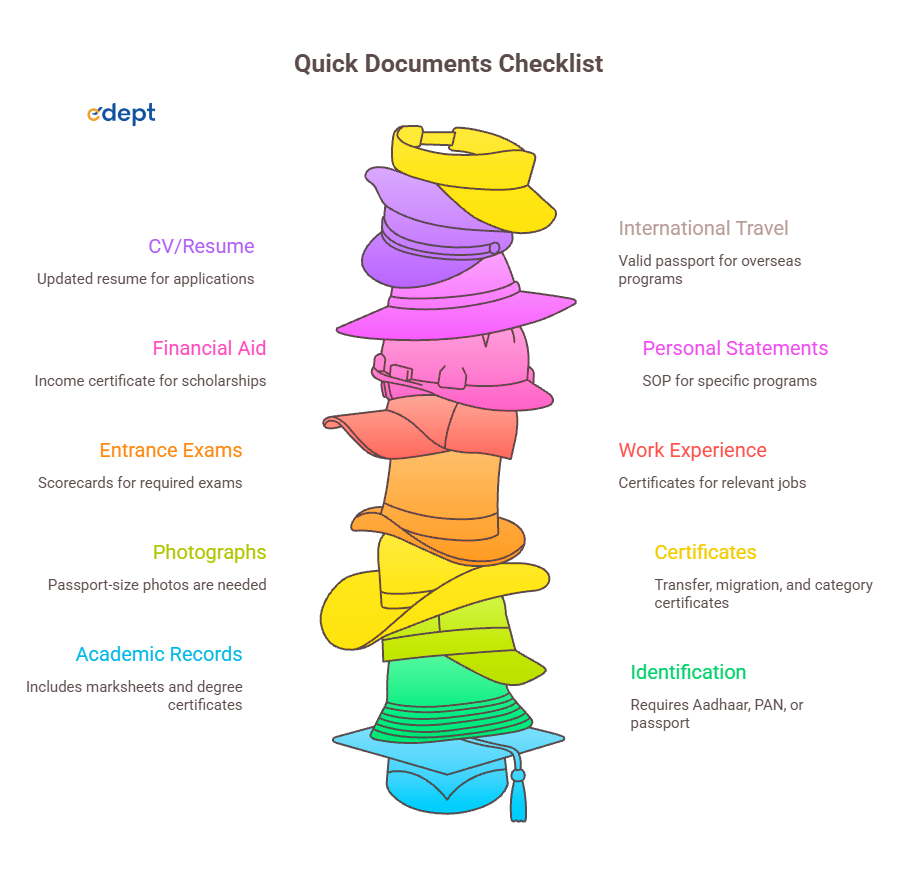
Here is the checklist to stay updated. Before you start applying, make sure you have these ready:
☐ Class 10 Marksheet
☐ Class 12 Marksheet
☐ Graduation Degree Certificate
☐ All Semester Marksheets (UG/PG)
☐ Aadhaar Card / PAN Card / Passport
☐ Passport-Size Photographs
☐ Transfer / School Leaving Certificate
☐ Migration Certificate (if applicable)
☐ Entrance Exam Scorecard (if required)
☐ Work Experience Certificate (if required)
☐ Category Certificate (SC/ST/OBC/EWS)
☐ Income Certificate (for scholarships)
☐ Statement of Purpose / SOP (if required)
☐ Updated CV or Resume (if required)
☐ Valid Passport (for international programmes)
Thinking about studying abroad? Here’s a global dual degree in Data Science & AI
If you are ready to take your data analytics career to the next level or you are trying to aim higher and want to explore a global programme, here’s a programme that’s worth understanding.
The Master’s in Data Science & AI by edept, offered in partnership with Steinbeis University (Germany) and Shree L.R. Tiwari School of Business Management, Mumbai, is a dual-degree programme designed specifically for Indian students who want a globally recognised qualification without the full financial burden of studying abroad from day one.
Here’s how it works: you spend your first year studying in Mumbai, covering everything from Python and SQL to machine learning and business statistics. The second year takes you to Berlin, where you dive deeper into AI, data strategy, and high-performance computing and complete a master’s thesis at Steinbeis University.
To know more about the programme, click here: https://www.edept.co
Conclusion
Getting into a good data analytics programme is not just about how much you scored or about your grades; it’s also about whether all your documents are complete. The documents required for data analytics admission may look simple on paper, but they can decide how smooth or stressful your admission journey becomes. Whether you are applying for a UG, PG, diploma, or certification course, the first step is to be prepared with all your required documents.
A very strong application can easily get rejected if proper documentation is not submitted. Your application gets delayed or rejected if any of your certificates go missing, if you do not provide a clear marksheet or if the files you have uploaded do not match the college format. For this reason, the candidates should be very aware of their documentation and not consider it a last-minute formality. Start collecting your documents early; verify all the requirements and keep all the photocopies ready along with your passport-size photograph. Keep both the digital and physical copies ready and well organized. You can use this guide as a base and match it with the exact rules of the college you are applying to.