Data analytics course fees in India in 2026 vary significantly based on format, ranging from nearly free to over ₹3,00,000 for top-tier, job-guaranteed programs. Typical professional training costs between ₹30,000 and ₹1,50,000, with specialized PG diplomas in India available at higher prices.
Data analytics in 2026 is defined by AI workflows, real-time insights, and a shift towards strategic decision-making. Businesses across sectors, from healthcare and fintech to e-commerce, retail, banking, and government, depend on data-driven decision-making & are generating more data than ever before. According to NASSCOM, India itself will need 11 million data professionals in 2026. A data analyst is among the top 5 most in-demand tech roles in India.
Companies nowadays make decisions based on acquired data, which is why several job roles, such as ‘data analyst’, ‘business intelligence analyst, SQL analyst’, and ‘reporting analyst’, are hired in large numbers. From startups to Fortune 500s, every company in today’s digital world depends on data, and they are in search of skilled data professionals who can help in making data-driven decisions.
Whether you are just a fresh graduate who is trying to enter the data field or a working professional looking to upskill, the first question that comes to your mind is, “How much will this actually cost me?” or “How much should I invest in the data analytics course?” Data analytics course fees in India vary greatly. Generally, it ranges from a few thousand rupees to several lakhs, depending on the type of course, the institution from where you want to pursue the programme, and the mode of study, which can be either online or offline. In this guide, we will break everything down so that you have a clear picture of the actual fee structure, the various factors that drive cost, how you can calculate ROI, and practical tips that can help you decide how you can get maximum value for your money.
Overview of Data Analytics Course Fees in India
Data analyst course fees in India have significantly changed due to advanced AI analytics tools, real-time insights, and strategic decision-making. Current programmes include exposure to various tools such as SQL, Tableau, Power BI, and Excel, along with working on capstone projects and industry mentorship. All these have an effect on your fee structure.
Average Fee Range
The average data analytics course fee in India ranges between ₹15,000 and ₹200,000, depending on the course type, mode of the course, and the institution. Short-term certifications usually range between ₹500 and ₹10,000, whereas PG programmes with intensive bootcamps can range between ₹40,000 and over ₹200,000, including placement support. Sometimes, postgraduate programmes from reputed institutions may cross ₹1,500,000, although most working professionals and career switchers tend to spend between ₹40,000 and ₹200,000 for a well-structured and job-orientated programme.
Low- vs High-Cost Programs
The budget and low-cost programmes, which are mostly free and online, are easily accessible and affordable, but they provide only foundation knowledge; they cover only the basics, such as Excel foundation, SQL for beginners, or sometimes a bit of Tableau. They don’t provide any in-depth studies, mentorship, or career support.
On the other hand, premium and high-cost programmes come with live and interactive classes, industry-orientated curriculum, mentorship, capstone projects, various tools, training, and placement support. The price difference is very real, but you get various advantages and career exposure if you opt for a premium programme.
What You Get at Different Price Points
In the courses, which generally range between ₹500 and ₹10,000, you will get very little exposure; you just get a foundational idea about the programme. This will not help you get a good job. The courses range between ₹40,000 and ₹150,000; here, you get a structured, well-planned curriculum. You get an opportunity to work on industry projects and sometimes receive career support, also. The premium programmes with more than ₹1.5 lakh include live and interactive classes, an industry-orientated curriculum, mentorship, capstone projects, various tool training and placement support. The curriculum often includes advanced levels of analytics and cloud computing; here, you can be very confident of landing a good job.
Data Analytics Course Fees by Course Type
Data analytics course fees in India vary widely depending on the course type and the type of programme you are interested in pursuing, such as certification, diploma, undergraduate and postgraduate programmes. On your decision the fee structure depends.
Certification Courses
For the certification courses the fee generally ranges between ₹500 and ₹10,000. They are beginner-friendly and just entry points to a data analytics career. Their certification programmes are generally short, from a few weeks to a maximum of a few months. Various platforms such as Coursera, edX, and Great Learning offer such certifications. Here you will learn just basic statistics and foundational concepts such as an introduction to SQL, Tableau, and basic Excel. They are just good for adding a credential to your existing resume and building awareness.
Diploma & Professional Courses
For the diploma and professional courses the fee generally ranges between ₹9,000 and ₹200,000. The courses last for a maximum of 12 months, and they cover more than just the basics. They cover various tools such as Excel, Tableau, Power BI, SQL, and Python in full depth, with practical knowledge and industry projects. Institutes like Scaler, Upgrad, and Simplilearn offer such programmes. A bit better courses in this category sometimes provide career support, mock interviews, and mentorship.
Undergraduate Programs
It is a three- or a four-year degree programme in data science, analytics, or computer science. Here the fee structure generally depends on the institutes, such as private institutes and state universities, which charge a bit less than the premier B-schools, the IITs. The fee generally ranges between ₹90,000 and ₹2,100,000. They are best suited for students who are eager to explore the data field after class 12 and want a complete, comprehensive foundation before entering the workforce.
Postgraduate Programs
Postgraduate programmes such as an MBA in business analytics, an MSc in data science, and PG Diplomas are the costliest degree programmes. The fee generally ranges between ₹20,000 and ₹2,300,000. Here IGNOU & state universities offer affordable course fees, whereas premier B schools, IIMs & ISB charge significantly higher, but they provide complete placement support, mentor guidance, internships, a strong alumni network, and add great credibility to your resume.
Fees Based on Learning Mode
It is not just about what you study; how you study also holds equal importance. It has a big impact on the amount invested and the experience you will gain.
Online Courses
Online data analytics courses are the most cost-effective and affordable. The fee generally ranges from ₹399 to ₹150,000. The self-paced programmes from Udemy and Coursera can cost a minimum of ₹399, whereas structured, detailed and instructor-led online courses range between ₹40,000 and ₹150,000. The online programmes are very flexible in nature; you can learn at your own pace. The most important factor is looking for programmes which has live lectures and industry projects, not just video lectures
Offline Classroom Training
In offline classroom training you get an opportunity to interact with your fellow members and have a direct interaction with your mentor. Here the fees vary depending on the cities you belong to. It generally ranges from ₹20,000 to ₹120,000. It provides structured learning, regular assessments, and sometimes access to career services also.
Bootcamps & Intensive Programs
Bootcamps and intensive training programmes are generally designed to make you job-ready as fast as possible. They usually run for 3 to 6 months with a strong focus on job readiness. They usually cover important tech stacks, capstone projects, and tools that can help you get placed in a reputed company. The fees generally range from ₹100,000 to ₹280,000. It is suitable for someone who wants a fast career transition.
Factors That Influence Data Analytics Course Fees
You may be wondering why two courses covering the same topics have a 1 lakh price difference. The reason is that a data analytics course is influenced by the mode of learning, the depth of the curriculum, the programme duration, and the reputation of the institution. All these are important factors that affect the course fees.
Course Duration
The short-term courses usually cost less, but they are less effective. They do not provide detailed and in-depth information. Sometimes, a 3-month bootcamp with daily live interactions and industry projects can provide better job opportunities than a self-paced program of 12 months with no practical exposure and mentorship. When you want to evaluate the cost based on duration, you should focus on how much active learning and exposure in the practical field you are getting, not just the days of the course.
Curriculum Depth
A course that covers mainly the basics of Excel and the foundation of SQL will cost much less than a course that includes Python, Tableau, machine learning, and cloud computing. In 2026, generative AI is entering the data analytics field. The courses that include AI and advanced analytics cost much more than the general courses. It completely depends on your goal, whether you want in-depth knowledge or just basic knowledge and move on with it. You should check the curriculum in detail; that is the most important part when you are trying to upskill yourself or wanting to try a new field.
Placement Support
Placement support is one of the most important factors that influence data analytics fees. The programmes or courses that invest in placement services, internships, industry projects, and resume building usually charge more. If a program offers 100 per cent placement, then you should be aware and ask them about their history of placed candidates, which companies they have been placed in, and approximately how much salary they have been offered. Do complete research on all these.
Cost vs ROI: Is It Worth the Investment?
Let’s talk about the numbers now. At the end of the day, the main thing which matters is, if I am investing a lump sum of money, will I get a good ROI?
Entry-Level Salary vs Course Cost
The starting data analyst salary in India ranges from ₹4.5 LPA to ₹8 LPA. The salary usually depends on the location, skill set, and company. Some graduates from premier institutions earn more than ₹ 10 LPA. Someone who is spending ₹60,000–₹100,000 on a programme that leads him to a ₹5 LPA job. The payback period in this case is less than a year. That is a very good return on investment.
Payback Period
For most of the programmes which are job-orientated, the payback period ranges from 6 to 18 months. Now suppose you have invested 1 lakh in a programme, and after completion you have landed a job, and you earn ₹5 LPA. In this case you have recovered your course fees within 3 months of your first salary.
Skill-Based ROI
Most individuals fail to understand this: the ROI in analytics is not driven by how much you have paid, but it’s about the new skill set which you have learnt. The employers simply don’t pay you for your certificate; they pay you for your capability to clean messy and complex data, write good SQL queries, and build interactive and meaningful dashboards. The candidates who can build a strong portfolio by showcasing their skills and the projects they have worked on can easily surpass a candidate who has an expensive degree but no real-world experience. You should always choose a course where you can work practically on live projects.
Hidden Costs You Should Consider
While tuition fees are often advertised prominently, the total cost of the programme, which includes certain hidden, indirect and opportunity costs, is not mentioned properly. The total fees can rise 5-15% depending on these expenses.
Certification Exam Fees
Many professional certification exams, such as the Google Data Analytics Certificate, Microsoft Power BI Associate, or Tableau Desktop Specialist, require a completely separate exam fee, which ranges from ₹5,000 to ₹30,000. These exams are very important, and you should prepare for such exams, but before that, make sure you have planned your budget properly.
Learning Tools & Software
While many courses provide you free access to the tools you will use during the course, in a few cases, some tools, such as Tableau, Power BI, and SAS, require paid licenses. Sometimes the institute includes all these subscription costs in the fees themselves; hence, for the whole programme, you have free access to all these tools. Another important factor is that you should have a good laptop capable of running such high-level tools.
Opportunity Cost
If you are a working professional and want to pursue a full-time course, then you should not forget the income that you are giving up for this course. Online and part-time programmes would be much better for working professionals rather than full-time degrees. But it completely depends on your economic strength; if you are financially strong enough to take this challenge, you can surely go for a full-time programme, but if you think you are not ready for a full-time program and cannot sacrifice your job, then an online and part-time program is your best choice.
Comparison: Low-Cost vs Premium Data Analytics Courses
If you think you are spending a lot of money on a course, then automatically you will learn more than others and get a better job opportunity. Then you are absolutely wrong. Certain conditions are worth understanding.
Curriculum Quality
Low-cost courses often charge less than 20K and cover foundational knowledge; you get exposure but only the basics. You will learn about SQL and Excel, but you will not be able to practically apply them. You will not be able to solve complex queries or handle real data sets. They are mostly theory-based, and you will not become job-ready with such courses.
The premium program includes industry projects, mentorship, internships, and practical work on real data sets in its curriculum. They provide a lot more exposure than the low-cost programmes. They make you job-ready, and you easily crack an interview after completing the course.
Project Exposure
Here, the gap arises more. Low-cost courses typically include guided exercises, assessments, and mock data sets. The premium programmes include live capstone projects; the candidates work on live, real-world scenarios. When you build a portfolio and mention all the live projects and real cases you have worked on, it increases your resume credibility a lot, and hence, the chances of getting a better job opportunity increase.
Placement Outcomes
Premium courses often provide complete placement support. Here, the students are properly coached, guided, and well prepared to face any interview. They are given special classes to build a professional resume, which will help them to land a job easily. But that said, if a course promises you 100% placement provided, you need to make sure: are they giving guaranteed placements or guaranteed access to job interviews only, not job offers.
Also Read: Data Analytics Courses: A Complete Guide for Students After 12th & Graduation in India
How to Choose the Right Course Based on Budget
To choose the right course based on the budget requires balancing your cost, your time commitment, what you are willing to give, and, finally, your career goals. Your budget helps in shaping your career options, but there is always room for a smart choice that you can make.
Budget Under ₹50,000
If your budget is less than 50,000, you should go for well-structured courses from reputable platforms. You should look for programmes where you can get practical exposure and work on live projects. Various programmes on Coursera, edX, and IBM offer such certifications. You can also practise on platforms such as HackerRank, Kaggle and LeetCode for practical experience. For this budget, your self-paced effort matters a lot; the course will only set your direction, but your effort will build your portfolio.
Budget ₹50,000–₹150,000
This is the most important and valuable range for career switchers and fresh graduates. They have an instructor and a mentor-based programme, along with tool-based training using SQL, Python, Power BI, or Tableau. They also provide capstone projects and practical, real-world scenarios. Placement support and guidance are also provided along with portfolio building. Before selecting any course, check their placement support, mentor standards and quality. Is the curriculum industry-led? Visit their websites and do complete research.
Budget Above ₹1.5L
At this stage, you can easily apply for a postgraduate programme, a dual degree or a globally recognised programme. Here, you can achieve great credentials, and ROI is higher, but you need to commit fully to such courses. You need to prioritize those programmes which have a strong alumni network and industry partnerships and can give you global opportunities. These programmes provide 100% placement support. They have brand value and provide vast networking opportunities.
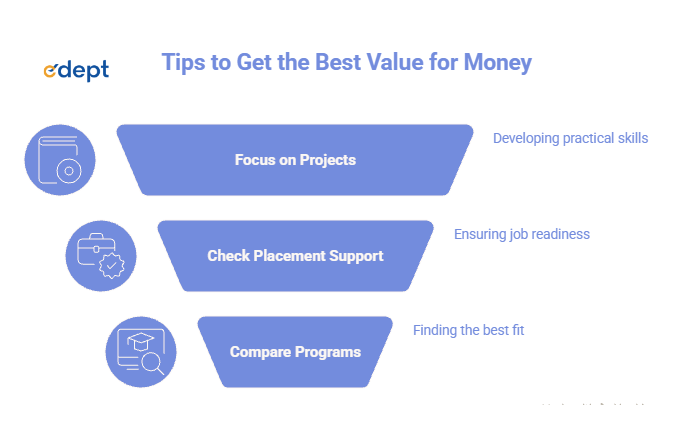
Tips to Get the Best Value for Money
If you want to get the best value for your money, then choosing the course is not the only important factor. What you are learning and doing in the course matters most.
Focus on Projects & Portfolio
Whatever course you pursue, your main goal should be to build a portfolio of all your skills and the projects you have worked on. You should be ready with a portfolio that demonstrates your work and your skills. Work on various case studies, real-world scenarios, and platforms like Kaggle to increase your credibility. The employers in 2026 are now looking for professionals who can handle data and solve complex problems; they are not interested only in your degree; they want to know your skills and your real-world experiences.
Check Placement Support
Many institutes guarantee that they provide placement support, but when you actually start looking at their history, you get to know the real story. While choosing any high-value courses, always be sure of the placement assistance. Which companies hired from the programme, and what is their success rate?
Compare Multiple Programs
You should never commit to the first program that you see on Google or just when you see an ad running. You should compare at least 4 programmes, check your budget with them, and check their market and job trends. Look deeply into the curriculum and check whether it is industry-led. Check all the mentor backgrounds, student reviews, placement support, and what tools you will actually learn in the course. You should do complete detailed research and then move forward.
Thinking Beyond India? Here’s a global dual degree in Data Science & AI
If you are ready to take your data analytics career to the next level or you are trying to aim higher and want to explore a global programme, here’s a programme that’s worth understanding.
The Master’s in Data Science & AI by edept, offered in partnership with Steinbeis University (Germany) and Shree L.R. Tiwari School of Business Management, Mumbai, is a dual-degree programme designed specifically for Indian students who want a globally recognised qualification without the full financial burden of studying abroad from day one.
Here’s how it works: You spend your first year studying in Mumbai, covering everything from Python and SQL to machine learning and business statistics. The second year takes you to Berlin, where you dive deeper into AI, data strategy, and high-performance computing and complete a master’s thesis at Steinbeis University.
To know more about the programme, click here https://www.edept.co
Conclusion
This guide makes one thing very clear: that data analytics course fees in India vary enormously. A short-term course of ₹500 will not land you a job, but neither will a ₹300,000 programme if you do not work hard and give your 100%. What genuinely matters here is you actually learn what you are doing; you are capable of building new things, which will increase your credibility in the job market.
An expensive course with no proper curriculum is no better than a medium-range course, which provides an industry-led curriculum and placement support. Before you think about investing, you should be aware of the ROI. Make your decisions on the basis of outcomes such as what skill you are going to learn, projects to be completed, if there is any internship opportunity available, and how the placement support is. Do your homework and research in detail. Compare a few courses, attend demo sessions, and make a decision which matches your career goals and budget.
Related Links: