Getting into data analytics is one thing. Actually growing your salary year on year is a different game entirely. The people moving fastest are not necessarily the ones with the fanciest degrees. They are the ones who picked up Python and SQL early, stayed curious about AI tools, and built a portfolio that gave hiring managers something real to look at.
Right now, data professionals are sitting in one of the strongest job markets anyone has seen in years. India alone is expected to generate over 11 million jobs in data and analytics by 2026, and the average salary for a data analyst has settled at around ₹6.5 to 7 LPA, climbing quickly once experience and specialisation start doing their work.
The real question for anyone looking at this field is straightforward. Which data analytics courses with highest salary potential are actually worth committing to in 2026? Not the ones with the most modules or the flashiest website, but the ones with curriculum depth, real tool exposure, genuine placement support, and a clear line to the roles that actually pay well.
This blog lays it all out. The best data analytics courses India has to offer, salary comparisons across roles, the skills that move compensation higher, and a practical framework for choosing a program that actually delivers.
Why Data Analytics Courses Offer High Salary Potential
Data analytics skills are genuinely scarce right now, and companies across every industry are paying well to find people who have them.
Data-Driven Decision-Making Demand
Walk into any major business today, and data is running the show behind the scenes. Marketing tracks customer patterns. Finance builds risk models. Operations run on predictive logistics. Skilled analysts are genuinely hard to find, which keeps salaries competitive and demand consistent regardless of what the broader economy is doing.
Skill-Based Hiring Trend
Pay in this field is tied directly to what you can do, not just what degree you hold. Someone who walks in already comfortable with Python, SQL, Tableau, or Power BI tends to start at a noticeably better salary than someone with only theoretical training. Employers have been shifting toward skill-based hiring for years now, and that shift directly rewards people who invest in the right course.
Cross-Industry Demand
BFSI, e-commerce, SaaS, healthcare, manufacturing, government. Data analytics skills travel across all of them. That cross-industry reach means analysts are never entirely dependent on one sector staying healthy. It is one of the cleaner reasons why data analytics careers tend to be more stable than roles tied to a single industry.
Top Data Analytics Courses With Highest Salary Potential
Picking the right course makes a real difference to where you end up financially. Some programs consistently train candidates who command stronger salaries, and the gap between them is worth understanding before you enrol.
1. Data Science and Analytics Programs
If you want to talk about data analytics courses with the highest salary potential, data science programs are always at the top of the list. They cover the full stack, including machine learning, statistical modelling, AI, deep learning, advanced analytics, and the core data skills that everything else builds on. Graduates go after roles like Data Scientist, ML Engineer, and AI Analyst.
Data Analysts who add ML, AI, and cloud skills to their profiles are expected to see 30 to 50% higher salary growth than peers who do not invest in those areas. That gap is significant, and it tends to widen over time.
Reasons this path makes sense:
- Full analytics workflow from data wrangling to model deployment
- Doors open to tech giants, research labs, and product companies
- Qualifies for the highest-paying data analytics jobs faster than general programs
Typical salary range: ₹8 to 25 LPA depending on specialisation and experience
2. Business Analytics Courses
Business analytics courses do something slightly different. They connect data insights to actual business strategy rather than stopping at the technical output. Students learn to frame business problems analytically, work through them, and then communicate findings to people who are not data professionals. Roles that follow include Business Analyst, Analytics Consultant, and Strategy Analyst.
For students coming from commerce, management, or non-technical backgrounds, these programs work particularly well because they blend analytical thinking with domain knowledge that purely technical programs often skip entirely.
Strong hiring happens in:
- Management consulting firms
- Financial services
- E-commerce and product companies
- IT services with client-facing analytics roles
Typical salary range: ₹5 to 18 LPA, depending on company and domain
3. Big Data Analytics Courses
Big data courses tackle a specific and genuinely specialised problem. When datasets get too large for conventional tools, you need Hadoop, Apache Spark, distributed computing, and cloud data infrastructure. Roles that come out of these programs include Big Data Engineer, Data Architect, and Cloud Data Engineer.
These roles pay well for a straightforward reason. The skills are specialised, and the organisations that need them are large. Banking institutions, telecom companies, and major e-commerce platforms hire for these profiles regularly and at premium salary levels.
Skills covered:
- Hadoop and Spark for distributed processing
- Cloud platforms, including AWS, Azure, and GCP
- Real-time data pipelines and stream processing
Typical salary range: ₹10 to 30 LPA for experienced professionals
4. AI and Machine Learning Integrated Courses
These programs sit at the premium end of data analytics courses India has to offer. They far extend past common analytics into neural networks, NLP, computer vision, reinforcement learning and generative AI. Graduates frequently pursue such positions as AI Analyst, ML Specialist, NLP Engineer and AI Product Manager.
The math requirements are steeper than general analytics courses. The salary premium more than compensates for that extra effort. Companies building AI-powered products pay top-of-market compensation for people who can contribute to model development and deployment from day one.
Why this course type consistently leads data analytics salary 2026 comparisons:
- Skills are scarce relative to demand
- Applicable across every industry going through AI transformation
- Opens both individual contributor and leadership roles faster than most paths
Typical salary range: ₹12 to 35 LPA and above for senior specialists
5. Data Analytics Certification Programs
For career changers or people who want to upskill without committing to a multi-year program, short-term certifications are the most practical entry point. Programs covering SQL, Python, Power BI, Tableau, and foundational statistics can be completed in weeks to months and produce job-ready candidates faster than any other format.
The ROI is strong because employers increasingly hire on demonstrated skills. The catch is choosing certifications that are tool-specific and industry-recognised rather than generic.
Best suited for:
- Working professionals transitioning into analytics
- Recent graduates who want practical credentials quickly
- Non-IT students building a data skill set alongside their existing domain knowledge
Typical starting salary: ₹3.5 to 6 LPA, depending on tools and prior background
6. MBA in Business Analytics
MBA specialisation in business analytics provides a profile that allows a move to leadership, consulting, and strategy positions more quickly than a technically-oriented program would permit. The roles this path opens are Analytics Manager, BI Lead, Chief Analytics Officer, and Data Strategy Consultant.
The salary ceiling here is among the highest across all data analytics courses with the highest salary potential, because the combination of strategic thinking and data capability is exactly what senior hiring panels are looking for and rarely find.
This course makes the most sense if:
- You have or plan to accumulate a few years of work experience
- Management or consulting is the actual career direction you want
- Leading analytics teams is more appealing than working within them
Typical salary range: ₹12 to 40 LPA for mid to senior positions
Read More: How to Choose a Data Analytics Course With Guaranteed Placement
Salary Comparison by Data Analytics Roles
Not all data analytics roles have the same scale, and the gap between entry-level and specialist positions is bigger than most people realise before they start mapping out their career.
Entry-Level Salaries
Glassdoor’s March 2026 data, based on 11,253 salary submissions, puts the average data analyst salary in India at ₹6.5 lakh per year. The 25th percentile sits at ₹4.25 lakh and the 75th percentile at ₹11 lakh.
Typical entry-level ranges:
- Data Analyst: ₹3.5 to 7 LPA
- Junior BI Analyst: ₹4 to 6 LPA
- Analytics Associate: ₹3.5 to 5.5 LPA
Mid-Level Salaries
The two to four years of experience and the fact that the tools are strongly certified, and the project impact was proven, will push compensation to a level that is far beyond the entry level.
Typical mid-level ranges:
- Senior Data Analyst: ₹8 to 15 LPA
- Data Engineer: ₹10 to 18 LPA
- Business Intelligence Analyst: ₹8 to 14 LPA
- ML Engineer: ₹12 to 20 LPA
Senior-Level Salaries
Six or more years of experience, a strong portfolio, and deep specialisation in AI, cloud, or big data put professionals in the highest compensation brackets. Leadership roles add further premiums.
Typical senior-level ranges:
- Senior Data Scientist: ₹18 to 30 LPA
- Analytics Manager: ₹20 to 35 LPA
- AI Specialist: ₹22 to 40 LPA
- Chief Data Officer / Head of Analytics: ₹35 LPA and above
Role vs Salary vs Skills: Quick Comparison
Before you commit to a learning path, a salary breakdown helps you see how roles, salaries and the skills behind them actually line up. Here is a practical guide to consider:
| Role | Entry | Mid-Level | Senior | Key Skills |
| Data Analyst | ₹3.5–7 LPA | ₹8–15 LPA | ₹18–25 LPA | SQL, Python, Power BI |
| Data Scientist | ₹6–10 LPA | ₹12–20 LPA | ₹22–35 LPA | ML, Python, Statistics |
| ML Engineer | ₹8–12 LPA | ₹14–22 LPA | ₹25–40 LPA | TensorFlow, PyTorch, Cloud |
| Big Data Engineer | ₹7–12 LPA | ₹14–22 LPA | ₹22–35 LPA | Spark, Hadoop, AWS |
| Business Analyst | ₹4–8 LPA | ₹10–18 LPA | ₹18–30 LPA | Excel, SQL, Tableau |
| Analytics Manager | ₹12–18 LPA | ₹20–30 LPA | ₹30–45 LPA | Leadership, BI, Strategy |
Skills That Maximise Salary in Data Analytics
Certain skills consistently push salaries higher in data analytics. Also, knowing which ones to prioritise early saves a lot of time spent learning things that have little financial gain.
Core Technical Skills
Three tools show up in nearly every data analytics job description in India:
- SQL for querying and managing databases
- Python for manipulation, automation, and building models
- Excel for rapid analysis and business reporting
Mastering Python, SQL, and Power BI can push salary up by 15 to 35% in the entry to mid bands. These are not nice-to-have additions. They are the baseline every employer expects before the conversation even starts.
Visualisation Tools
Turning raw numbers into something non-technical stakeholders can actually use is one of the most consistently valued skills in the market:
- Tableau for interactive dashboards and complex visualisations
- Power BI for Microsoft ecosystem environments and business reporting
- Looker and Metabase are increasingly appearing in startup job descriptions
Analysts who build dashboards that leadership actually uses regularly earn more than those who only produce reports that sit in inboxes.
Advanced Skills
The skills that move salaries into the upper bands are the ones fewer people have genuinely built:
- Machine learning for predictive modelling and pattern recognition
- Cloud platforms, including AWS, Azure, and GCP
- Big data tools like Spark and Kafka for large-scale processing
These are what separate candidates competing for data analytics courses with highest salary potential outcomes from those settling for average compensation at every experience level.
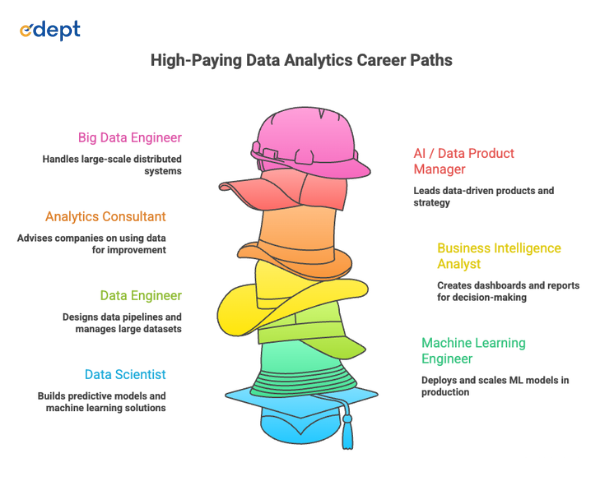
Factors That Influence Salary Potential
Salary in data analytics does not follow a single formula. Several factors shape what you actually earn. Understanding them early helps you make smarter decisions about where to focus your effort.
1. Course Type and Level
The type and level of program you complete sets your starting point and your growth rate. Short certifications get you in faster, but typically at a lower entry point. A full degree or postgraduate program opens higher starting bands and accelerates the path to management. Both are valid depending on where you are starting from and what timeline you are working with.
2. Institute Reputation
An institution’s reputation affects how employers read a credential, especially in campus placements. Tier-1 institutions and programs that are being offered in collaboration with recognised industry partners are more weighty. Programs that have been tested by such companies as KPMG or provided in partnership with the existing universities can indicate quality that generic online certificates are not always able to achieve.
3. Experience and Projects
Certificates tell employers you have foundational knowledge. A portfolio tells them what you can actually do with it. There is a real difference between those two things, and hiring managers feel it almost immediately. Projects from internships, personal work, or program capstones give you something concrete to walk through in detail during an interview. That kind of evidence consistently separates candidates who get called back from those who do not, and it carries far more weight than the name on a completion certificate when companies are filling data analytics roles in 2026.
How to Choose a High-Salary Data Analytics Course
With so many courses available, picking the right one is genuinely confusing. The difference between a course that lifts your salary and one that just adds a certificate is worth knowing upfront.
Check Curriculum Depth
Good data analytics courses India offers with high salary potential go well beyond surface-level tool tutorials. Look for programs that cover the full workflow, including data collection, cleaning, analysis, modelling, and presentation. Programs that use real datasets, industry case studies, and hands-on tools training produce graduates who can contribute from week one. Employers pay a genuine premium for that kind of readiness.
Focus on Practical Learning
You will not get the best-paying data analytics jobs only with theoretical knowledge. The difference between candidates at any level is real-life experience.
Programs that weave in live projects, internships, hackathons, or industry capstone assignments give you something concrete to show employers rather than just concepts you have studied. When weighing your options, be honest about how much of the curriculum is actually hands-on versus how much is sitting through lectures. That balance matters more than most people realise.
Evaluate Placement Support
A program’s placement record is the clearest indicator of its real-world value. Look for specific data on placement rates, average packages, and the actual companies hiring graduates. Programs with dedicated career services, industry networks, mock interviews, and resume support consistently produce better salary outcomes than programs where career support is treated as an afterthought.
Future Trends in Data Analytics Salaries
The data analytics job market is changing faster than most people track. Where salaries are heading over the next few years depends on forces that are already quietly reshaping the field today. Below you can find the list of the factors that are shaping salaries today:
AI and Automation Impact
Data analysts are not being replaced by AI. It is transforming their spending time. Regular reporting and data preparation are becoming more automated, and this moves the premium to analysts who are capable of working with AI tools, interpreting the model outputs, and binding data insights to strategy. The data analytics salary 2026 data indicate that this is true, where AI and ML skills fetch a high premium over general analytics skills at all levels of experience.
Increasing Salary Growth Trends
Salary growth in data analytics is outpacing most other professional fields in India right now. Analytics professionals are seeing average annual hikes of around 9%, with stronger performers and better-skilled professionals seeing 15 to 25% jumps at role transitions. The overall trajectory for the highest-paying data analytics jobs in India is firmly upward through the rest of the decade.
Demand for Specialised Skills
Generic data skills are becoming the baseline, not the differentiator. The actual salary premiums will be offered in 2026 to those professionals who will have real depth in cloud data engineering, NLP, generative AI applications, and real-time analytics. Students choosing data analytics courses in India right now should prioritise programs that build real depth in at least one specialisation over broad but shallow coverage of many areas.
Also Read: Data Analytics Admission Eligibility: Everything You Need to Know
What edept Offers?
Practical, Tool-Based Learning From Day One: edept does not wait until the final year to make things real. From the first semester itself, students work with actual datasets, industry tools, and hands-on assignments rather than sitting through theory-heavy lectures. That early exposure is what builds genuine confidence before placements.
Small Batches, Stronger Outcomes: edept keeps intake intentional and limited. Smaller groups mean more attention, better guidance, and a learning environment where students actually get the support they need rather than getting lost in a crowd. Not everyone gets in, and that is deliberate.
Industry-Aligned Curriculum Built Around What Companies Actually Want: The program is not built around what looks good on paper. It is structured around real hiring needs, covering data fundamentals, cloud platforms, programming logic, and practical problem-solving because those are the things companies test for when they sit across from a fresher in an interview room.
Career Support That Goes Beyond the Classroom: edept understands that a degree without direction does not get you very far. The guidance does not stop at academics. Students get support through the placement process, with a team that stays involved from skill-building through to the point where an actual opportunity lands.
Conclusion
Choosing the right data analytics courses with the highest salary potential in 2026 comes down to three things. How well the program actually builds the skills employers want. How much real experience does it give you along the way? And how seriously it takes placement support after you finish. Candidates who build genuine depth in AI, ML, and cloud platforms are consistently seeing salaries 30 to 50% higher than peers who stop at the basics, and cities like Bangalore continue to offer some of the most competitive packages for technically strong analysts in the country.
The data science and AI combination produces the highest-earning candidates over time. Business analytics programs deliver excellent ROI for anyone aiming at a management or consulting career. The certification programs provide a quick way of entry with a good initial salary. The future of the data analytics salary 2026 is based on rewarding individuals with real and demonstrable abilities rather than on accruing generic credentials. Whether you are starting or pushing toward higher-paying roles, choose a program with curriculum depth, hands-on learning, and serious career support. That combination is what turns a course fee into actual salary growth over the years that follow.
Related Links: