Indian infrastructure acts as a key pillar in powering the nation’s economy, public services, and national security. With rapid digitalization in organizations, cyber attacks are increasing rapidly, with an increase in vulnerabilities. According to the Indian Computer Emergency Response Team (CERT-In), India handled over 29.44 lakh cyber incidents in 2025, reflecting the growing scale of cyber threats targeting digital infrastructure. Sectors like energy, banking, healthcare, and transportation need strong cybersecurity frameworks to protect themselves from attacks. Effective national cybersecurity strategies are becoming essential to safeguard critical infrastructure and ensure safe and seamless services across the country.
Cybersecurity for Critical Infrastructure India focuses on protecting essential systems from disruptions, cyber attacks, data breaches, and cyber espionage. Safeguarding digital infrastructure is crucial amid rising cyber threats, both domestic and cross-border, to ensure economic stability and national security. Strong cyber protection strategies, advanced monitoring systems, and coordinated government initiatives are important in protecting critical infrastructure from cyber attacks in India.
What Is Critical Infrastructure in India?
Critical infrastructure refers to systems, networks, and assets that are essential for the functioning of a nation’s economy, security, and public welfare. Infrastructures in India include power generation systems, financial institutions, communication networks, and transportation services. If any cyber attacks or technical failures happen on these systems, it will severely damage the national stability and impact the daily lives of people affected by them.
With rapid development in digital infrastructure and an increase in connectivity, many of these sectors rely on advanced information systems and cloud technologies; thus, vulnerabilities are bound to show up, leading to an increase in cyber risks, highlighting the importance of Critical infrastructure cybersecurity in India and strong national cybersecurity policies.
Key Sectors of Critical Infrastructure in India
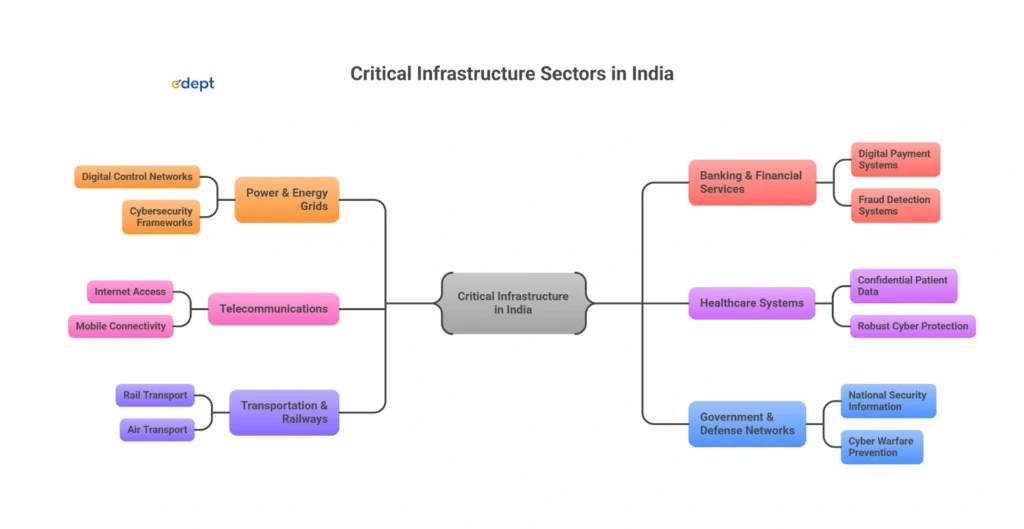
Critical Infrastructure in India comprises multiple sectors that support essential public services and economic activities. To maintain operational stability and national security, these sectors must be safeguarded from cyber threats.
Power & Energy Grids
Power grids and energy distribution systems are being guided with digital control networks. Any cyber attack on power infrastructure could disrupt the whole electricity supply across large cities. Strong cybersecurity frameworks and monitoring systems ensure continuous power generation and distribution across the country.
Banking & Financial Services
India’s banking sector operates through digital payment systems, online banking platforms, and financial transaction networks. If any financial institutions are struck by any cyber attacks, it would lead to massive financial losses, data theft, and economic instability. Fraud detection systems and advanced encryption enable financial infrastructure to protect itself from cyber threats.
Telecommunications
Telecommunication networks enable communication across the country and support digital services such as internet access and mobile connectivity. Attacks on telecom systems could disrupt communication networks and digital services. Protecting telecom infrastructure is vital for maintaining connectivity and economic activity
Healthcare Systems
Hospitals, medical databases, and healthcare management systems contain confidential patient information. Cyber attacks on healthcare infrastructure can cause disruption of medical services and compromise confidential patient data. The implementation of robust cyber protection measures ensures patient safety and security.
Water Supply Infrastructure
Water supply systems are a critical part of India’s infrastructure, supporting drinking water distribution, irrigation networks, and urban water management systems. Many water utilities now rely on digital control systems and IoT-based monitoring for pump operations and distribution management. Cyber attacks targeting these systems could disrupt water supply, contaminate data, or interfere with treatment processes. Strong cybersecurity frameworks, continuous monitoring, and secure control systems are essential to protect water infrastructure and ensure safe and reliable water services for communities.
Transportation & Railways
India’s transportation infrastructure, such as the rail and air transport systems, has begun using digital platforms in its day-to-day activities. Cybersecurity systems have been put in place to ensure that these systems are not interfered with, which would affect the country.
Government & Defense Networks
Government communication systems and defense networks handle sensitive data that carries national security information. Cybersecurity tools help prevent any cyber warfare and unauthorized access to confidential government data.
Also Read: Role of AI in Cybersecurity
Why These Sectors Are Prime Targets for Cyber Attacks
Critical Infrastructure sectors are home to sensitive data and essential services, which are literally the things cyber attackers crave. Any disruption in these systems can cause widespread economic damage and public disruption. Attackers do exploit vulnerabilities in outdated systems, weak network security, or human errors. To avoid these, strengthening national cybersecurity frameworks helps organizations detect threats early and respond effectively to potential cyber incidents.
Major Cybersecurity Threats to Critical Infrastructure in India
With expanding digital systems, several cyber threats pose serious risks to India’s infrastructure. Let’s understand these threats and see how organizations safeguard their data from these threats by developing stronger protection strategies.
Ransomware Attacks
Ransomware attacks lock down key systems with encryption and then demand that victims give up their financial resources in order to regain access. When ransomware occurs within industries of healthcare or banking, these organizations can face a devastating impact, both financially and operationally. As a result of this threat today, organizations are responding with various cybersecurity strategies to prevent themselves from being subjected to ransomware attacks.
Distributed Denial of Service (DDoS)
DDoS attacks flood networks with excessive traffic, making systems inaccessible to legitimate users. Through these attacks, cyber attackers disrupt online banking services, telecom networks, and government portals.
Advanced Persistent Threats (APTs)
Sophisticated and protracted cyber espionage operations called APTs usually take place in a series of organized networks. Such operations intend to gather classified data for future use or to monitor important systems used by government agencies.
Insider Threats
An insider threat happens when one of your employees uses their access rights to wrongfully distribute or modify sensitive information. It’s critical that you implement effective access controls and continuously monitor your facilities to reduce your organization’s risk of an insider threat.
Supply Chain Attacks
Supply chain attacks are where an attacker targets a third-party software application or service supplier and exploits software vulnerabilities to access large-scale host infrastructures, thus enabling larger attacks on multiple victims.
Industrial Control System (ICS) Attacks
Industrial Control Systems (ICS) are widely used in sectors such as power plants, manufacturing facilities, and water treatment plants to manage automated operations. Cyber attackers often target ICS networks to disrupt physical infrastructure or manipulate operational processes. If compromised, these systems can cause large-scale service outages or safety hazards. Strengthening network segmentation, monitoring industrial networks, and implementing secure control protocols are essential to protect ICS environments from cyber attacks.
Role of Government Agencies in Protecting Critical Infrastructure
Government agencies play a crucial role in strengthening cybersecurity frameworks for critical infrastructure across India.
Indian Computer Emergency Response Team (CERT-In)
CERT-In is the sole national body responsible for incident response to cybersecurity incidents in India and is responsible for monitoring cyber threats, issuing cybersecurity alerts, and coordinating responses to cyber attack incidents.
National Critical Information Infrastructure Protection Centre (NCIIPC)
NCIIPC protects critical information infrastructures (CII) from cyber threats in four main sectors: banking, energy, telecommunications, and government networks.
Ministry of Electronics and Information Technology (MeitY)
MeitY creates national-level policies and regulations related to cybersecurity and digital government governance; they also work with other national agencies to help build the foundation of India’s cyber protection enterprise.
Defence Cyber Agency (DCA)
The Defence Cyber Agency (DCA) is a specialized unit under the Indian Armed Forces responsible for strengthening the country’s cyber defense capabilities. It focuses on protecting military networks, critical defense infrastructure, and strategic communication systems from cyber threats. The agency also develops cyber warfare strategies and coordinates with other national security bodies to respond to large-scale cyber incidents. By monitoring threats and improving cyber resilience, the DCA plays an important role in India’s overall national cybersecurity framework.
Technologies Used to Protect Critical Infrastructure
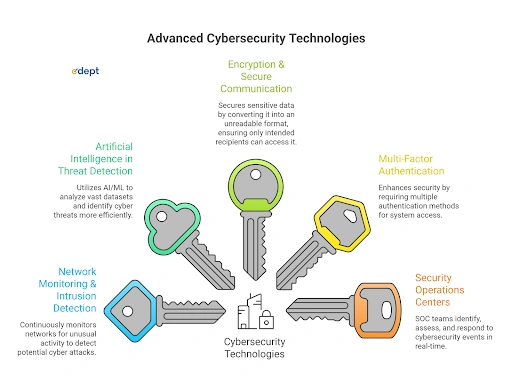
Cybersecurity technologies that are advanced are essential for protecting infrastructure systems against cyber threats.
Network Monitoring & Intrusion Detection Systems
Infrastructure systems have numerous aspects, including constantly monitoring the network for unusual/abnormal behaviors that could indicate a potential cyber attack.
Artificial Intelligence in Threat Detection
AI/ML Security Systems can look at many terabytes of data, explore it for any anomalies, and detect and identify potential cyber threats more quickly than less advanced systems.
Encryption & Secure Communication
Encryption is used to secure “sensitive” data by changing it from a format that is readable to an unreadable format, thus ensuring that any messages sent through digital networks will only be readable by the intended recipient.
Multi-Factor Authentication
Multi-Factor Authentication provides an added level of security since it requires that multiple authentication methods be used before a user can gain access to a system.
Zero Trust Security Architecture
Zero Trust Security Architecture follows the principle of “never trust, always verify.” Instead of assuming that users or systems inside a network are safe, every access request must be continuously verified and authenticated. This approach limits unauthorized access and reduces the risk of lateral movement within networks. Zero-trust models are increasingly used to strengthen cyber protection in India’s critical infrastructure systems.
Threat Intelligence Platforms
Threat intelligence platforms collect and analyze information about emerging cyber threats, attack patterns, and malicious activities. These platforms help organizations identify vulnerabilities and respond to threats before they cause damage. By sharing real-time threat data across security teams and government agencies, threat intelligence systems improve the effectiveness of national cybersecurity strategies and help protect critical infrastructure from advanced cyber attacks.
Security Operations Centers (SOC)
SOC Teams are at the forefront of identifying any events on the network related to cybersecurity, helping to determine whether those events are potential threats, and quickly responding to those threats.
Read more: Cyber Hygiene: Best Practices to Implement Data Security in 2026
Real-World Cybersecurity Incidents in India
India has faced numerous cyber events that underscore the need for protecting critical infrastructure.
Power Grid Cyber Incident
Cybersecurity professionals reported that attackers are trying to use malware to target power generation facilities throughout India’s infrastructure to gain access to energy sector systems; therefore, the security of India’s energy sector is of great concern.
Banking Sector Data Breaches
Indian Banks and Digital Payment Systems have suffered multiple data breaches due to the unauthorized acquisition of customer data being utilized with credit and debit cards, which emphasizes the need for stronger cybersecurity.
Healthcare System Attacks
Hospitals and other healthcare-related databases are being targeted by Ransomware that has temporarily disrupted the provision of medical services and, by related means, exposed private medical records of patients.
AIIMS Delhi Cyber Attack (2022)
One of the most significant healthcare cyber incidents in India occurred in November 2022, when the All India Institute of Medical Sciences (AIIMS), Delhi, was hit by a ransomware attack. The attack disrupted hospital servers, forcing staff to temporarily shift to manual record systems for patient data and appointments. The breach exposed vulnerabilities in healthcare cybersecurity infrastructure and highlighted the risks facing critical digital health systems. This incident emphasized the importance of stronger national cybersecurity measures and better protection strategies for India’s healthcare and public service infrastructure.
Importance of Cybersecurity Workforce in Protecting Infrastructure
The importance of advanced technology in safeguarding digital networks is not diminished by the fact that human resources are a significant part of the defence equation, as well as an essential component in protecting non-technical assets. If an organization is to successfully defend its critical infrastructures from attack by cybercriminals, there must be an adequately trained workforce of cybersecurity professionals to monitor the network, identify possible weak points or vulnerabilities, and respond to attacks that are directed toward critical infrastructures. Within the energy, banking, telecommunications, and healthcare industries, cybersecurity experts work ceaselessly to identify anomalous behaviours, operate Security Operations Centres (SOC), and implement security measures designed to reduce the potential for interruption of critical services.
As such, we must invest in cybersecurity education, workforce development programmes, and specialised training initiatives to protect critical infrastructure from cyber attack in India. Effective integration of technology, policy, and operational defences by a robust cyber security workforce to protect the digital backbone of the nation will provide the best way to defend against the future threats posed by cyber crime.
Challenges in Securing Critical Infrastructure
Securing critical infrastructure comes with multiple challenges. Many systems operate on legacy technologies and do not have the security features of modern security systems. Additionally, with rapid digital transformation, the attack surface increases significantly for cybercriminals. Another challenge is that India has a shortage of skilled cybersecurity professionals. To help alleviate these challenges, training programs must be improved, infrastructure must be upgraded, and national coordination of cybersecurity must be enhanced.
Future of Cybersecurity for Critical Infrastructure in India
A combination of cutting-edge technology, improved policy structures, and international collaboration will determine the outlook for Cybersecurity with respect to Critical Infrastructure in India. The increase in the use of Artificial Intelligence, Threat Intelligence Platforms, and Automated Security Systems will provide more opportunities to recognize and to respond to their respective impacts on Cybercrime. Investing in Workforce Development in India, as well as the Cyber Protection Initiative, will provide India with the means to increase its ability to protect its Digital Environment in the future.
Emerging technologies will play a key role in strengthening infrastructure protection:
Quantum-resistant encryption
With the rise of quantum computing, traditional encryption methods may become vulnerable. Quantum-resistant encryption is being developed to protect sensitive infrastructure data from future computational threats.
Cyber-physical security
Critical infrastructure, such as power grids, transportation networks, and industrial systems, relies on both digital and physical components. Cyber-physical security helps protect these interconnected systems from attacks that could disrupt real-world operations.
5G infrastructure protection
As India expands its 5G networks, securing the communication infrastructure becomes essential. Strong cybersecurity frameworks will be required to protect high-speed networks supporting smart cities, IoT devices, and digital services.
Conclusion: Why Cybersecurity Is Critical for India’s National Infrastructure
India’s Critical Infrastructure is constantly evolving and is always under threat of cyberattacks. Therefore, Cybersecurity is an integral part of protecting the Nation’s Critical Infrastructure and will play an instrumental role in safeguarding Energy, Financial, Telecommunications, and Government networks as digital systems become more interconnected. To sustain and further develop Cybersecurity for our Nation’s Critical Infrastructure requires not only improvements to the National Strategy for Cybersecurity, but also investing in Advanced Cybersecurity Technologies as well as enhanced collaboration between Government Agencies and the Private Sector. Taking effective cybersecurity measures protects the Nation’s economic and national security and will continue to be necessary for the protection of critical infrastructure in India.
Related Links: