MBA without an entrance exam is worth pursuing if you choose a UGC/AICTE-accredited institution and prioritize flexible learning, entrepreneurship, or career advancement over Tier-1 college prestige.
MBA continues to be one of the most sought-after postgraduate degrees in India and globally, with over 3 lakh+ students appearing for exams like CAT every year. Entrance exams like CAT, MAT, and XAT have been the primary gateway to top B-schools.
Though the admission patterns in recent years show there has been a noticeable rise in MBA admissions without entrance exam options. Many private and deemed universities now offer direct MBA admission, allowing students to bypass competitive exams and secure seats through alternative selection processes.
This shift does raise important questions in everyone’s mind. While skipping entrance exams may seem like an easier path, factors like college quality, placement opportunities, and return on investment become even more critical. Not all MBA programs deliver the same value.
Keeping all of these in mind, in this guide, we will break down everything you need to know, from eligibility and advantages to career scope and ROI, so you can decide whether an MBA without CAT or other entrance exams like XAT, etc., is the right move for your future.
What Is MBA Admission Without Entrance Exam?
MBA admission without an entrance exam is an alternative pathway where students can pursue an MBA without appearing for competitive tests like CAT, MAT, or XAT. Instead of relying on some exam scores, colleges will assess candidates through internal selection, which will evaluate the person on their overall academic and personal potential.
This model has gained popularity in recent years as demand for MBA seats continues to grow. In India alone, 5000+ management institutes and many other private institutions are offering direct MBA admission to fill up the seats and provide opportunities to students.
While this route increases accessibility, it also places greater responsibility on students to evaluate the quality, credibility, and outcomes of the program they choose.
Direct Admission Explained
MBA admission without entrance exams refers to a process where students can secure seats without appearing for tests like CAT, MAT, or XAT. Instead, colleges offer direct MBA admission through merit-based selection or management quota. In most cases, the evaluation happens at the institution level, focusing on academic background and overall profile rather than competitive exam scores.
Types of Colleges Offering It
This admission route is primarily available in private universities and deemed universities. These institutions generally have an easier selection process with more flexibility compared to the government colleges. While some maintain decent academic standards, others may vary significantly in quality, making it important for students to research before applying.
Admission Criteria Used Instead
Colleges and institutions evaluate candidates based on graduation marks, personal interviews, and sometimes work experience, unlike the traditional selection process, which had entrance exams.
Why Do Colleges Offer MBA Without Entrance Exams?
The rise of MBA admission without entrance exam options is becoming popular for its flexibility and accessibility. With over 5000+ MBA colleges in India, not all seats get filled through competitive exams like CAT or XAT. As a result, many institutions introduce direct MBA admission routes to ensure consistent enrollment.
Specifically, private and deemed universities have the autonomy to design their own admission processes. This allows them to move ahead of traditional, rigid entrance-based filtering and recruiting candidates based on their overall profile instead.
Ultimately, this approach benefits both institutions and students by allowing the colleges to fill their seats fast and efficiently, and students gain more pathways to pursue an MBA without CAT or similar exams.
Increasing Demand for MBA Seats
The demand for MBA programs continues to grow, with lakhs of students applying every year. However, entrance exams filter out a large percentage of candidates, leaving many seats vacant. Direct admission through custom selection criteria helps colleges fill up these seats faster, giving more students a chance to pursue management education.
Flexibility in Private Institutions
In comparison to government institutions, private universities have more control over admission policies, giving more flexibility. This allows them to offer MBA without an entrance exam and evaluate students through interviews, academic records, and overall profiles instead of standardized tests.
Focus on Accessibility
Not all students have equal access to coaching or resources for entrance exams. Direct MBA admission makes management education more accessible by reducing dependency on exams and focusing on broader eligibility criteria, helping a wider range of students enter the field.
Ready to elevate your Management career?
Enrol for MBA in Business Analytics by Shree Guru Gobind Singh Tricentenary University powered by Edept. Click here!
Advantages of MBA Without Entrance Exam
Choosing MBA admission without an entrance exam can offer several practical benefits, especially for students looking for flexibility and faster entry into management education. With lakhs of applications competing for limited seats through exams like CAT, alternative pathways such as direct MBA admission provide a less stressful and more accessible option.
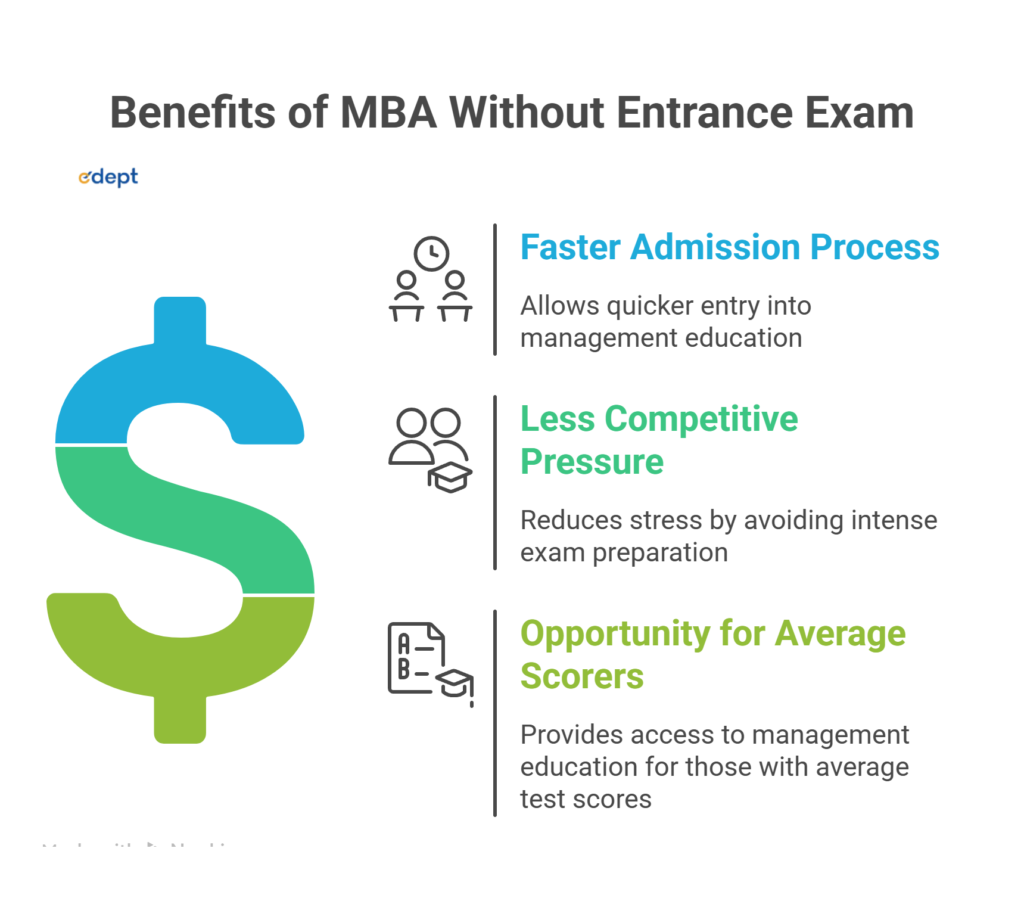
Faster Admission Process
One of the biggest advantages is speed. Instead of spending 6-12 months preparing for entrance exams and waiting for results, students can secure admission quickly through institutional processes. This is crucial in starting your MBA journey earlier by saving your time, which is crucial for those who are eager to enter the job market or switch careers.
Less Competitive Pressure
Entrance exams are highly competitive, with acceptance rates in top B-schools often below 5-10%. Opting for an MBA without CAT reduces this pressure significantly. Students can focus more on interviews and profile building rather than just intense exam preparation. These benefits lead the students to have a balanced and less stressful admission experience.
Opportunity for Average Scorers
Not every student performs well in standardized tests, and that doesn’t reflect their real potential. Direct MBA admission creates opportunities for average scores to pursue management education based on their academic consistency, communication skills, and overall personality rather than just exam performance.
Disadvantages You Must Consider
While MBA admission without an entrance exam feels too good to be true, it comes with trade-offs you shouldn’t ignore. The biggest risk lies in choosing the best college, its quality, placements, and long-term career prospects. Data shows that top-tier MBA institutes in India report average salaries of ₹20–35 LPA, while many lower-tier colleges offering direct MBA admission fall in the ₹3-8 LPA range. We simply can’t ignore this gap as it defines a candidate’s corporate life after completing their post-graduation.
Limited Top-Tier College Access
Most top B-schools like IIMs, FMS, or XLRI strictly require entrance exams. This means if you choose an MBA without CAT, you are automatically limiting access to the highest-ranked institutions. While some private colleges offer decent programs, the absence of top-tier exposure can impact networking, peer learning, and long-term opportunities.
Placement Concerns
Placement quality varies significantly across colleges offering direct admission. Many institutions lack strong industry connections, which leads to lower placement rates or average salary packages. Students risk heavily in a degree that may not deliver the expected career outcomes without proper research.
Perception & Brand Value
The reputation of your MBA college plays a major role in how employers evaluate your profile. Degrees from lesser-known institutes may carry lower brand value, especially in competitive industries. While skills matter, initial opportunities are often influenced by college credibility, making this an important factor to consider.
Cost vs ROI Analysis
When considering MBA admission without an entrance exam, returns on the cost (ROI) become one of the most important factors. Many institutions offering direct MBA admission charge significantly higher tuition fees than top government colleges, which offer lower fees. At the same time, placement outcomes may not always match the investment, making it essential to evaluate whether the degree will truly pay off in the long run.
Fee Structure
Private colleges offering MBA without CAT often charge between ₹5–15 lakh for the full program, and in some cases even higher. Since these institutions do not rely on entrance-based filtering, fees can be a major revenue driver. Comparing tuition costs with facilities, faculty quality, and placement support is a must for students before making a decision.
Placement Outcomes
Average salary packages in such colleges typically range from ₹3–8 LPA, depending on the institute’s reputation and industry connections. While some top private universities perform better, many struggle to provide consistent placement opportunities, which directly affects the financial value of the degree.
Return on Investment
ROI depends on how quickly you can recover your investment. With moderate salaries, the payback period can range from 2 to 5 years or more. Choosing a college with strong placements and industry exposure is key to ensuring your MBA delivers real career value.
Career Scope After MBA Without an Entrance Exam
Admission in MBA programming without entrance exams does not limit your options, rather it does shift the focus toward skills, college quality, and practical exposure. While the degree itself opens doors across industries, your outcomes will largely depend on how well you build expertise during the program. According to industry trends, management roles continue to grow steadily, with India’s management job market expanding alongside sectors like consulting, finance, and startups.
Job Roles Available
Fresh graduates can explore roles in marketing, human resources, finance, and operations. Common job profiles include marketing executive, HR associate, business analyst, and operations manager. These roles are widely available across industries, making an MBA without CAT a viable pathway if you focus on developing relevant, job-ready skills during your course.
Salary Expectations
Entry-level salaries range between ₹3–8 LPA, depending on the college, specialization, and individual performance. Top private universities may offer higher packages, but in most cases, salary depends more on your practical knowledge, internships, and communication skills than just the degree itself.
Growth Opportunities
After completing an MBA program, career growth is largely skill-driven. With consistent performance, certifications, and industry experience, professionals can move into managerial and leadership roles over time. Long-term success depends less on how you entered the MBA and more on how you leverage the opportunities during and after the program.
Key Factors to Evaluate Before Choosing
Choosing MBA admission without an entrance exam requires thorough evaluation because the admission route puts more responsibility on you to pick the right college. Not all MBA institutions offer the same quality of faculty and placement. One wrong decision, and it will ruin all your career goals and outcomes. Placement rates and salary outcomes are different across different sectors, and a complete evaluation before going for a program is essential before enrolling.
College Accreditation & Ranking
Always check whether the college is AICTE, UGC approved or holds NAAC accreditation. Rankings and reputation also matter, as they influence faculty quality, curriculum standards, and industry recognition. A well-accredited institute adds credibility to your degree and improves long-term career prospects.
Placement Records
When checking out the college records, review the college’s placement reports carefully. Don’t rely on just marketing claims but thoroughly review all the records. Look at the average salary, the highest package, and the placement percentage. Colleges with consistent placement performance and strong recruiter networks provide better career security after graduation.
Industry Exposure & Internships
Practical experience is critical in management education. Check whether the college offers internships, live projects, industry visits, and guest lectures. Strong industry exposure helps you build real-world skills, improve employability, and stand out in a competitive job market.
Who Should Consider MBA Without Entrance Exam?
MBA admission without an entrance exam is not for everyone, only those who know how to plan next steps smartly can thrive. If your priorities are flexibility, speed, and skill development over brand name, this route can still deliver solid career outcomes. With thousands of seats going unfilled every year, direct MBA admission provides an alternative path for students. If you want to move forward without spending a year on entrance exam preparations, this is for you.
Students with Time Constraints
If you don’t want to spend months preparing for exams like CAT or MAT, this option saves time. You can directly apply and start your MBA, which is especially useful if you want to enter the job market quickly or avoid a gap year.
Working Professionals
For working professionals, preparing for entrance exams can be difficult. MBA without CAT offers a flexible way to upgrade qualifications while continuing work, helping in career growth, and also transitioning into roles without disrupting the income.
Students Focused on Skills Over Brand
If your career goal is to gain practical knowledge, build skills, and enter the workforce rather than targeting top-tier institutes, this route will work well. Success will entirely depend on your effort and skill-building rather than the college brand alone.
Alternatives to Consider
Before you opt for MBA admission without an entrance exam, it is considered smart to evaluate other options that may offer better long-term value. While direct MBA admission provides convenience, alternatives can improve college quality, placement outcomes, and overall ROI. In India, top MBA graduates often secure packages of ₹15–30 LPA, showing how the right path can significantly impact your career growth.
Preparing for Entrance Exams
Investing 6-12 months in preparing for exams like CAT, XAT, or MAT can open doors to top-tier institutes. These colleges do offer better faculty, peer learning, and placement opportunities. If you can commit time and effort, this route often delivers stronger long-term returns.
Online/Executive MBA Programs
Online and executive MBA programs are ideal for working professionals. They offer flexibility, allowing you to study while gaining work experience. Many reputed institutions now provide these programs, combining convenience with credible certification and industry-relevant skills.
PGDM & Specialized Programs
PGDM and specialized management programs in areas like business analytics, finance, or marketing can be strong alternatives. Some institutes offer industry-focused curricula and better placement support, making them a practical choice for students aiming for niche roles or faster employability.
Conclusion
MBA admission without an entrance exam can be a good option — but only if it aligns with your goals. If you value speed, flexibility, and want to avoid competitive exams, direct MBA admission can help you move forward quickly. However, if your goal is top-tier placements, strong brand value, and higher salary potential, the entrance exam route may offer better long-term returns.
The key takeaway is simple: college quality matters more than the admission route. A well-accredited institute with strong placements will always outperform a poorly ranked college, regardless of how you got in.
Before making a decision, take time to research — check accreditation, placement records, faculty, and industry exposure. Don’t choose convenience over value blindly.
In the end, the right choice isn’t about easy vs hard — it’s about what sets you up for a successful career