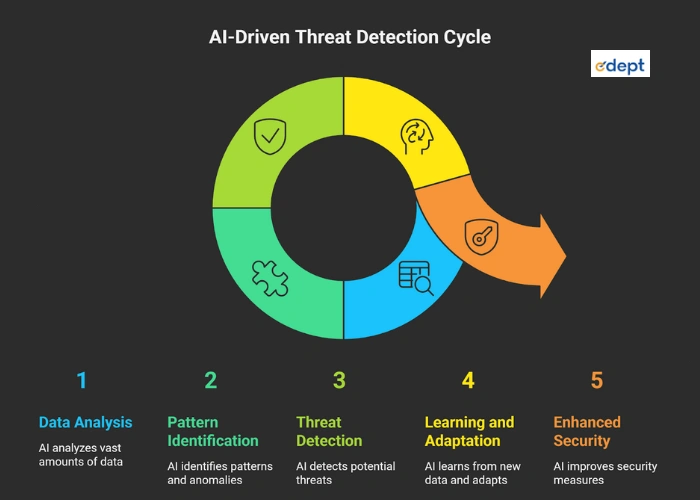
Artificial Intelligence identifies cyber attacks in real time by continuously analyzing massive datasets to establish behavior baselines for users and devices, immediately flagging anomalies, such as unusual traffic or unexpected data access.
Traditional security systems are falling short in handling the current rise in cyber threats. Malware, ransomware, and phishing attacks are all being acted as Cyber Attacks in Real Time, spreading across networks within seconds. According to IBM’s Cost of Data Breach Report 2023, average breach identification and containment operations now take 277 days when big organisations rely on manual systems. This delay comes with a price, costing around $4.45 million per breach.
This is where AI-powered threat detection becomes critical. Artificial Intelligence enables real-time threat detection by analysing millions of operations across networks and cloud platforms, serving as the backbone of modern cybersecurity. AI systems are proficient in spotting suspicious behaviour, tracking it, and allowing the security team to stop attacks before they spread across the network and server. With an increase in cybercrime, AI in cybersecurity is no longer an option but a necessity.
What Is Artificial Intelligence in Cybersecurity?
In cybersecurity, artificial intelligence refers to the use of machine learning, analytics, and automation to detect and respond to cyber attacks. Traditional security tools mostly rely on a set of fixed rules and signatures, making them ineffective against new or evolving attacks. On the other hand, AI systems work in a very different way, by learning from data, enabling AI threat detection to adapt as threats evolve.
Generally, AI observes how a system behaves normally, analyzes its login patterns, network traffic, and user activity in real-time threat detection environments. As it trains itself, it builds a baseline benchmark of what normalcy looks like inside an organisation. When anomalous activity, like an attack or even a small operation that goes against the trained pattern, like a user trying to access any sensitive data at an odd hour or a compromised server transmitting data to an unknown location, the AI-powered threat detection system flags it as suspicious.
This capability of recognising abnormal behaviours makes AI in cybersecurity threat detection very effective against unknown attacks, zero-day vulnerabilities, and unknown threats. AI threat detection thrives where traditional security systems fail.
Why is AI Important in Modern Threat Detection?
Cybersecurity is a rapidly evolving field, and traditional security systems are increasingly lagging behind modern threats and cyber attacks. That’s where AI threat detection comes in. According to Cybersecurity Ventures, global cybercrime costs have reached $10.5 trillion annually in 2025. Modern threats like botnets, attacks increasingly use automation and artificial intelligence on a large-scale. Big organisations from top countries known for cybersecurity jobs and work culture are now in need of skilled professionals who are proficient enough to handle these Cyber Attacks well.
With the evolution in data production by companies, the chances of Cyber Attacks are increasing side by side. Cloud computing, mobile devices, remote work, and IoT systems generate millions of security events every day, which become unmanageable through manual processes over time. This acts as a blind spot, acting as a perfect ground for attackers to work on without getting detected.
This is where AI-powered threat detection becomes crucial. AI systems perform real-time threat detection by monitoring networks and servers continuously without getting exhausted, analysing every pattern and attack that a human would miss. According to IBM, organizations that use AI-powered threat detection significantly reduce data breach detection and response time by over 100 days, thus lowering financial and operational damage.
How Artificial Intelligence Detects Cyber Attacks in Real Time
Artificial Intelligence detects real time cyber security attacks, continuously analyzing user behavior and activity, and system data to identify unusual patterns. Through AI threat detection and real-time threat detection, security systems spot threats before they begin to spread and damage the server.
Machine Learning Algorithms
Machine learning models are specifically trained on large datasets that contain examples of both cyber attacks and normal activities. Over time, these models become increasingly proficient in differentiating between safe behaviour and dangerous behaviour. Whenever new data comes, the model then compares it with whatever pattern it has noticed in the old data, and then only points out if it can see anything suspicious using AI-powered threat detection.
For example, if an API suddenly starts getting hundreds and thousands of requests in seconds, AI recognises it as a distributed denial-of-service (DDoS) attack or automated bot-driven abuse and triggers an alert.
Data Handling and Processing
AI systems generally process a large amount of security data in real time. This consists of network logs, use activity data, cloud logs, and endpoint data. By analysing all of this information together, AI in cybersecurity threat detection creates a complete picture of what exactly happens across the organisation, thus making real-time threat detection more accurate.
Real-Time Alerting Systems
When a threat comes under the radar of AI, it immediately prompts an alert and automated actions. Blocking malicious IP addresses, disabling jeopardised accounts, and isolating infected systems are some immediate actions AI takes. This fast action response immediately allows AI-threat detection and halts the attack from spreading.
AI + SIEM Integration
Organisations gain advanced correlation and visibility by integrating AI-powered threat detection with SIEM systems. AI thrives here by using multiple tools to analyze data and complex attack patterns, which traditional SIEM systems often fail to detect independently. This combination improves real-time threat detection and overall security effectiveness.
AI Techniques Used in Cyber Threat Detection
AI uses different techniques used in real time threat detection to help security systems detect all anomalies and thwart any real time cyber security attacks.
Anomaly Detection
AI is proficient in tracking and identifying behaviours that do not match normal system behavior using multiple techniques. Anomaly detection is one of the most important ones in AI-powered threat detection. Anomalies like unexpected data transfers, unusual logins, or irregular software behaviour are identified using this technique, thus allowing real-time threat detection.
NLP for Phishing Detection
NLP stands for Natural Language Processing. It helps analyze emails, messages, and websites using AI threat detection systems to detect phishing attempts and malicious content. Since phishing is one of the most common real time cyber security attacks, NLP plays a crucial role in quarantining any attacks, as a result, safeguarding the sensitive data of users.
Predictive Analytics
AI uses data stored during the training and testing phase to learn patterns of Cyber Attacks and predict which system is most vulnerable and under threat. Predictive analytics allows AI threat detection system to predict where attacks are likely to occur. Historical data comes in handy when predicting the pattern of likely threats and prevents any anomalies from spreading further using real-time threat detection.
User and Entity Behavior Analytics
AI monitors the behavior of the user over time, thus helping detect accounts that look compromised when they work against the working pattern of the user. When the user behaves differently from established usage patterns, the AI threat detection system raises an alert. This process is very crucial to identify compromised accounts in real-time threat detection environments. AI threat detection thrives when working behavior data is clean and not corrupt.
Threat Intelligence Matching
Real-time activity is compared against global threat databases to identify known malware, ransomware, and modern attack methods. Threat intelligence matching allows AI-powered threat detection systems to run network activity against any known attack techniques. Matching current behavior against these threats, AI identifies active real time cyber security attacks and prevents them from spreading further in the system.
Enroll in B.Voc in Cybersecurity and Digital Forensics by Shree L.R. Tiwari College of Engineering, powered by edept.
Benefits of Using AI in Real-Time Cybersecurity
AI in real-time cybersecurity reduces response times, enhances threat detection, and automates routine tasks, enabling proactive defense against emerging threats. It uses machine learning to analyze massive data volumes for anomaly detection, reducing false positives and allowing security teams to focus on critical incidents. The key benefits have been explained below.
Early Detection of Threats
With predictive modelling, the AI threat detection system understands the patterns of attacks and helps identify future attacks before any serious damage occurs. This allows organizations to keep track of real-time cybersecurity attacks and save costs incurred by damages. Early detection of threats like ransomware and data breaches by AI threat detection security systems is very critical, as these attacks are very fast, and even a few minutes of delay can result in significant loss.
Reduced Incident Response Time
Fast detection means the containment time of the threat is fast, too. Faster isolation means less damage, reduced time between detection and action, which is critical for stopping fast-acting attacks. Once a threat is detected, AI-powered threat detection systems will immediately trigger alerts to take action against these attacks by either isolating infected devices or simply blocking the IP addresses. This capability of detecting threats and taking action in seconds keeps AI in cybersecurity threat detection one step ahead of the cyber attackers.
Lower Operational Costs
AI-powered threat detection and automation reduce the need for large security systems and reduce operational costs. AI threat detection reduces the need for manual and large security systems to work around the clock. As a result, organizations can maintain strong security against real-time cybersecurity attacks without implementing extra staffing costs, thus making cybersecurity more efficient and cost-effective.
Enhanced Network Visibility
AI provides a good view of all system activity by enabling analysis of real-time network traffic. AI-powered threat detection provides a centralised view of activity across the entire IT environment. Better visibility also improves decision-making during incidents and strengthens overall real-time threat detection abilities.
Scalable Protection
AI protection not only works in small and simple environments, but AI thrives in protecting large and complex data centres too. Whether an organization has hundreds or millions of users, AI threat detection continues to monitor and protect systems effectively. AI-powered threat detection systems are built to handle millions of data points at a single time, without losing the accuracy of the data.
24/7 Automated Monitoring
Cyber threats don’t wait for a perfect time to create havoc on servers, it can happen at any time, including nights, weekends, and holidays. AI threat detection systems never go on breaks, unlike traditional human-operated security systems, so continued protection with real-time threat detection is always in operation.
Challenges and Risks
AI-powered threat detection comes in handy with its real-time threat detection, thereby bringing powerful advantages to cybersecurity. But every notion comes with its own limitations. One of the biggest challenges is false positives when AI flags normal activity as malicious. According to a study by Gartner, security teams spend up to 30% of their time investigating and quarantining alerts that ultimately turn out to be non-threats. Too many fake alerts ultimately can lead to missing out on real threats.
Another big issue is data quality. AI systems rely heavily on accurate and well-labelled data to properly function. If this data is corrupt, biased, or outdated and incomplete, AI models are bound to make incorrect decisions. In cybersecurity, this means missing out on real Cyber Attacks or even blocking legitimate users.
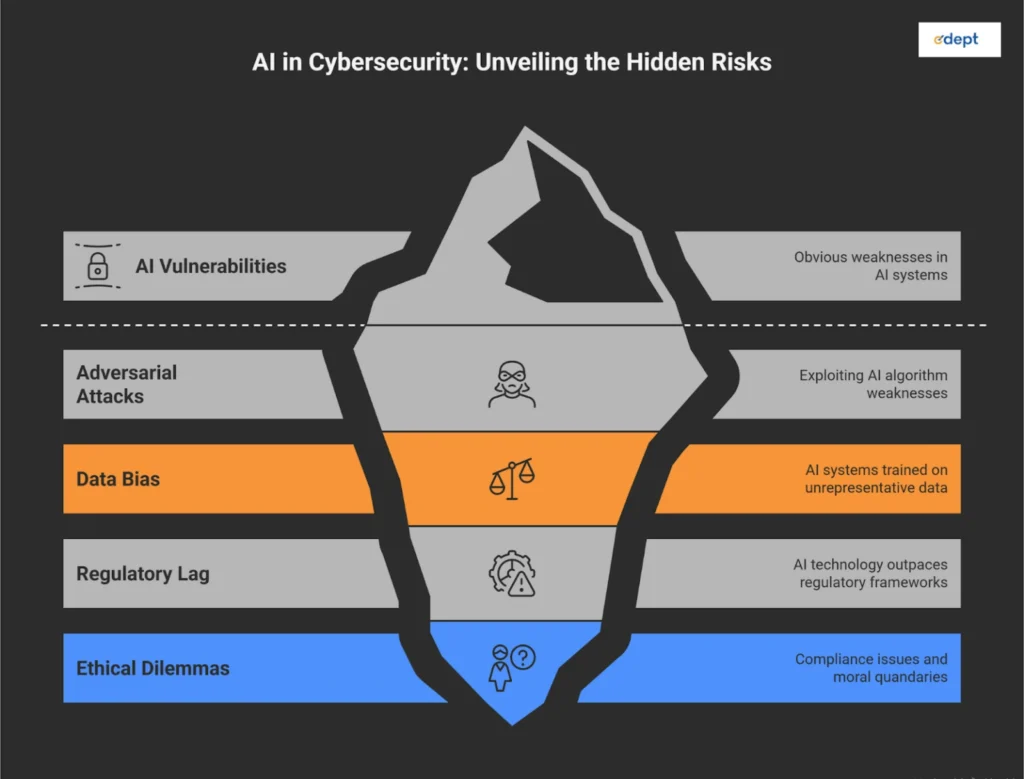
AI-driven security platforms require high cash injection and infrastructure with skilled professionals and continuous tuning. This creates a challenge of high implementation cost and complexity. According to IBM, organizations that deploy AI-based security solutions, though they save money in the long run, incur significantly higher upfront costs. Money saved later is through faster breach detection and lower recovery costs.
Changing trends in cybersecurity are making the cybercriminals work more smartly by also implementing AI in their Cyber Attacks. Attackers use AI to generate phishing emails, automate password cracking, and create malware that can adapt to security systems. This AI vs AI arms race goes on and on in cybersecurity.
Lastly, privacy and ethical risks cannot be ignored. A massive amount of user and network data is analysed by AI systems, which is very concerning regarding the privacy of users, as well as how personal and sensitive data and information are being collected, stored, and used. Organizations must ensure that AI-driven security tools comply with data protection laws and ethical standards while providing effective threat detection side by side.
Also Read, Cyber Security Courses After 12th – India vs Global Markets
Real-World Use Cases of AI in Cybersecurity
Real-world use cases of AI threat detection systems in cybersecurity include protection of email systems, banking, and transactions by identifying real time cyber security attacks as they happen. Using real-time threat detection, AI plays a crucial role in stopping the Cyber Attacks before any serious damage is done.
Banking & Financial Security
Transactions in banks are monitored using AI-powered threat detection in real time to detect fraud, identify theft, and unauthorised access. AI generally analyzes spending patterns of users to identify suspicious activity, in return helping financial institutions to stop fraud before money is lost. This protects both the customers and banks from financial damage.
Internet of Things (IoT) Devices
Smart Cameras, medical equipment, industrial sensors, and other IoT devices often lack a strong built-in security system. AI in cybersecurity threat detection helps them by detecting unusual patterns of communication or unexpected behavior. Thus, attackers fail to exploit IoT devices as entry points into bigger network environments.
Email Phishing Detection
Phishing is one of the most common attack methods used by cyberterrorists. AI threat detection scans emails for suspicious language and malicious attachments before they reach the end user. By acting as a shield and blocking phishing emails early, AI significantly reduces the chances of users accidentally giving away their data and sensitive information.
Cloud Security Automation
Cloud environments change continuously as new servers and users are added. AI threat detection monitors these changes in real time to detect any misconfigurations, unauthorised access, and data leaks. This helps the organizations to keep their cloud system secure without any manual hiccups.
Malware Detection
Traditional antivirus tools mostly rely on known malware signatures. AI threat detection, on the other hand go beyond this and analyzes how a file behaves when it’s running. If a file starts acting weird, AI can identify it and block it immediately from spreading further.
How AI Will Make Cybersecurity Safer in the Future
AI will continue to grow as technology advancements happen. The future of AI in Cybersecurity will always be in green as AI threat detection is soaring high cause of its advantages over manual security systems. Future systems will be able to identify any weak points in networks and recommend fixes before attackers exploit them. This will help organizations stay one step ahead of attackers by quarantining threats even before they happen.
Security platforms will become automated, using AI to investigate alerts and to determine the severity of threats to take action without human intervention. Thus reducing the workload on security systems and in return improving response speed.
As cyberattacks are becoming more advanced, AI will evolve alongside them. By learning new patterns from attacks, an AI threat detection system will continuously adapt, making real digital environments safer and more resilient over time. This is where programs like edept come into the picture. They provide industry-aligned courses that focus more on AI-driven security skills to prepare learners for the future of cybersecurity.
Become a Certified Cybersecurity Expert
Final Verdict: How Artificial Intelligence Identifies Cyber Attacks in Real Time?
Artificial Intelligence is revolutionising tech industries, and cybersecurity doesn’t lag. Organizations can detect threats and stop real-time Cyber Attacks through AI threat detection more accurately and efficiently than ever before. As cyber threats continue to thrive in volume, AI-powered threat detection will remain the foundation of modern digital defense, protecting businesses and user data in an increasingly connected world.