5G technology is transforming connectivity, but it also introduces serious cybersecurity risks. Learn the major threats and security challenges in 2026.
5G Technology and Cybersecurity Risks in 2026 are now inseparable topics. As 5G networks expand across industries, they unlock ultra-fast speeds, low latency, and massive device connectivity. At the same time, they introduce complex cybersecurity risks that traditional security models cannot handle. From smart cities to healthcare systems, 5G-powered environments increase attack surfaces at an unprecedented scale. In 2026, understanding 5G technology and cybersecurity risks is critical for developers, enterprises, and cybersecurity professionals.
What Is 5G Technology?
5G technology is the fifth generation of mobile networks designed to deliver higher data speeds, lower latency, and support for millions of connected devices. Unlike earlier networks, 5G uses a decentralized architecture with software-defined components, cloud-native infrastructure, and edge computing.
This architectural shift enables innovation but also introduces new cybersecurity risks that require advanced security strategies.
Why 5G Technology Increases Cybersecurity Risks
The relationship between 5G technology and cybersecurity risks is driven by three major changes. First, network virtualization replaces physical infrastructure with software-based components. Second, massive IoT adoption connects billions of devices with varying security standards. Third, edge computing moves data processing closer to users, reducing centralized control.
Each change expands the cyber threats landscape and creates new entry points for attackers.
Key Cybersecurity Risks in 5G Networks
In 2026, the cybersecurity landscape for 5G networks is defined by a shift from hardware-centric to software-driven architectures. While 5G introduces “secure by design” features, its increased complexity and massive connectivity expand the attack surface for both cybercriminals and nation-state actors.
Expanded Attack Surface
5G technology dramatically increases the number of connected devices. Every device becomes a potential attack vector. Poorly secured IoT devices pose one of the biggest cybersecurity risks in 5G environments.
Network Slicing Vulnerabilities
Network slicing allows multiple virtual networks to run on shared infrastructure. While efficient, improper isolation can lead to cross-slice attacks. This is a unique cybersecurity risk associated with 5G technology.
Software-Based Network Exploits
5G relies heavily on software-defined networking. Vulnerabilities in code, APIs, or misconfigurations can be exploited remotely. Secure coding and configuration management become critical defenses.
Edge Computing Security Risks
Edge nodes process sensitive data closer to end users. These distributed systems are harder to monitor and secure consistently. Compromised edge devices can enable data theft or service disruption.
Supply Chain Attacks
5G infrastructure depends on multiple vendors and third-party components. A single compromised supplier can introduce systemic cybersecurity risks across the network.
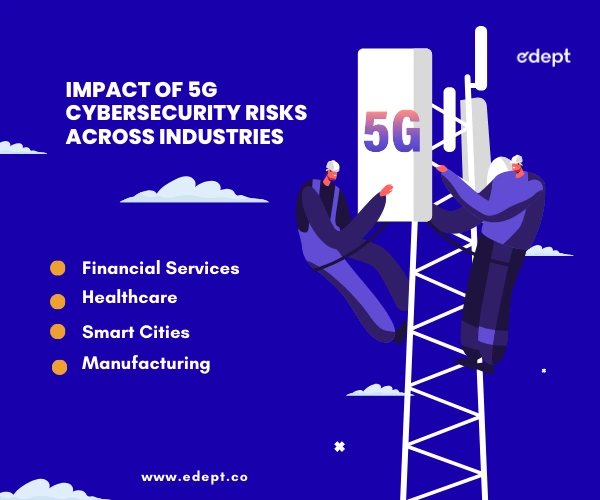
Impact of 5G Cybersecurity Risks Across Industries
5G’s massive connectivity vastly expands the attack surface, creating immense risks across industries—from IoT device hacking and powerful DDoS attacks to supply chain vulnerabilities, network slicing breaches, and attacks on critical infrastructure (power, transport, healthcare), leading to potential data interception, system shutdowns, privacy violations, and even national security threats, requiring a shift to advanced security like Zero Trust.
Healthcare
5G enables remote surgery, patient monitoring, and real-time diagnostics. Cybersecurity risks in healthcare can directly impact patient safety if systems are compromised.
Manufacturing
Smart factories rely on 5G-connected machinery. Cyberattacks can halt production, manipulate data, or damage equipment.
Smart Cities
Traffic systems, utilities, and surveillance networks run on 5G. Cybersecurity failures can disrupt essential services and public safety.
Financial Services
Low-latency trading and mobile banking benefit from 5G but also face higher risks of fraud, data breaches, and service outages.
Security Challenges Unique to 5G Technology
Traditional perimeter-based security models fail in 5G environments. Identity-based security, zero-trust architectures, and continuous monitoring are essential. Encryption must be applied across devices, networks, and applications. Security teams must also manage real-time threat detection across distributed infrastructure.
Addressing 5G technology and cybersecurity risks requires collaboration between network engineers, developers, and security analysts.
How Organizations Can Mitigate 5G Cybersecurity Risks
Organizations must adopt security-by-design approaches. This includes secure coding practices, strong authentication mechanisms, network segmentation, and continuous vulnerability assessments. Automated monitoring and AI-driven threat detection play a growing role in protecting 5G environments.
Training cybersecurity professionals specifically for 5G security is now a priority.
Enroll in B.Voc in Cybersecurity and Digital Forensics by Shree L.R. Tiwari College of Engineering, powered by edept.
Career Opportunities in 5G Cybersecurity
The rise of 5G technology and cybersecurity risks has created strong demand for skilled professionals. Roles such as 5G security analyst, network security engineer, and cloud security specialist are growing rapidly. Professionals with knowledge of telecom security, cloud infrastructure, and threat modeling have a competitive advantage.
Cybersecurity careers linked to 5G offer long-term growth and global opportunities.
Check Cyber security Course in India
Why candidates should enrol through edept
edept prepares learners to handle real-world 5G technology and cybersecurity risks through hands-on training and industry-aligned curriculum. The program focuses on network security, cloud security, secure architecture, and threat analysis. Learners gain practical exposure to modern attack scenarios and defensive strategies, making them job-ready for emerging 5G security roles.