A data analyst is responsible for collecting data and managing, preparing after data cleaning, conducting statistical analysis and preparation, visualization, and reporting, and supporting business decisions.
In today’s fast-paced economy, which is constantly thriving towards digitalisation, organisations are drowning in raw data, from customer interactions and sales transactions to operational workflows and media activity. However, raw data is meaningless unless it’s properly processed and interpreted. That’s where data analytics come in. Are you wondering What Does a Data Analyst Do? This blog will guide you through data analyst responsibilities, required skills, tools, challenges, and career opportunities. After reading this blog, you can decide whether a career in data analytics is the right path for you.
Kickstart Your Career in Data Analytics
Train with edept and gain hands-on skills to become a job-ready data analyst.
What is a Data Analyst?
A data analyst is an expert professional who specializes in transforming raw data into actionable insight. This enables organisations to make data-driven decisions that help in improving performance, reducing risks, and driving growth. From identifying trends to creating dashboards visually, the major role is central to modern business intelligence. A data analyst is accountable for the collection, processing, and analysis of data that assists in discovering insights to sustain business decisions. Unlike the raw datasets, which become challenging to understand, a data analyst works closely to collect data into structured reports, applies statistical research, and delivers results through data visualization.
Read: What is Data Analytics? A Complete Guide 2026
What Are the Roles & Responsibilities of a Data Analyst?
The roles and responsibilities of a data analyst vary by the size of the company, industry. Here is the detailed description of the responsibilities of a data analyst:
- Collection and Organization of Raw Data from databases, CRM systems, spreadsheets, and APIs.
- Cleansing & Preparation of Data involves removing duplicates, correcting errors, and standardizing values.
- Interpretation of data with the help of statistical tools and analytical methods to identify patterns, correlations, and trends.
- Report building and dashboards to visualise tools with the usage of programming tools like Power BI, Tableau, or Excel.
- Collaboration with the teams across finance, marketing, operating, and product development to sustain data-driven decision making.
- Recommendation of business strategies by highlighting work opportunities, process improvements, and risks.
However, data analysts do not just look at numbers; they are accountable for providing context, clarity, and solutions that guide both the short-term and long-term tactics, along with strategies.
What Does a Data Analyst Do?
So what does a data analyst do? This question strikes most of the aspirants. They act as interpreters between intricate numbers and real-world solutions by confirming that the decision makers understand what the data indicates. Check the common roles explained below:
Data Collection & Management
The role of a data analyst is to gather data from internal databases, third-party sources, or online platforms. They ensure that there is an ample amount of accuracy and proper security of any sought of sensitive data.
Data Cleaning & Preparation
If you are an aspiring data analyst, it is important to know that you have to remove inconsistencies and formatting issues. They help in structuring the datasets for future analysis.
Statistical Analysis & Exploration
Identification of key metrics, performance indicators, and anomalies. You get to run statistical models, too, in order to get better insights.
Reporting & Visualisation
You have to design dashboards that are easy to handle and easy to understand. You have to further present findings to stakeholders in a non-technical way.
Supporting Business Decisions
When it comes to supporting business decisions, you have to advise on pricing strategies, risk management, product improvements, and customer acquisition.
Become a Job-Ready Data Analyst in 2026
Learn with industry projects, internships, and placement support.
What Skills Are Needed for a Data Analyst?
The technical skills and soft skills required to ace the career as a data analyst have been provided in the following pointers:
Technical skills:
- Statistical analysis and probability.
- Programming in Python, SQL, or R.
- Data visualization with Power BI, Tableau, or Excel.
- Database management (PostgreSQL, MySQL, data warehouses).
- Data cleaning & wrangling to distill disorganized datasets.
Soft Skills
- Communication to present results to non-technical groups.
- Critical thinking for determining significant insights.
- Attention to detail to guarantee accuracy.
- Problem-solving for transforming conclusions into answers.
Step Into a High-Demand, High-Paying Career
Upskill with practical training and begin your journey in data analytics.
Tools & Technologies Used by Data Analysts
Data analysts use a wide range of techniques and technologies that depend on their specialisation. Below are some of the most common tools and technologies used by data analysts.
- Visualization Tools: Tableau, Google Data Studio, Power BI
- Programming Languages: R, Python
- Collaboration Tools: Google Sheets, Jupyter Notebooks
- Querying & Database Tools: SQL, MySQL, PostgreSQL
- Big Data Tools: Apache Spark, Hadoop
- Statistical Tools: SPSS, SAS
Industries and Career Paths for Data Analysts
Below is the list of multiple industries where the types of data analysts are spread.
- Marketing & Advertising: Customer Segmentation and Campaign Performance.
- Finance & Banking: Fraud Detection, Risk Management, and Investment Strategies.
- Retail & E-Commerce: Supply Chain Optimization, and Consumer Behavior Tracking.
- Healthcare: Medical Research, Patient Data Analysis, and Hospital Efficiency.
- Technology & IT: Performance Metrics, and Product Usage Analysis.
Data Analyst Career Progression – Over the Years

Data Analyst vs. Data Scientist vs. Business Analyst
While Data Analyst, Data Scientist, and Business Analyst may sound similar but the job roles differ to serve distinctive purposes.
- A Data Analyst is a professional who explains what happened and the probable reasons for the situation’s occurrence.
- A Data Scientist takes help from advanced techniques such as machine learning to forecast what is going to happen in an organization.
- A Business Analyst focuses on the alignment of insights with the strategy of companies that are considered less technical.
We have explained a small glimpse of the differences between Data Analyst vs. Data Scientist, vs. Business Analyst. However, there are some detailed blogs by the experts of edept to justify the differences. Click on the link below to learn more about the differences between Business Analytics Vs Data Analytics, and on the other hand, Data Science Vs Data Analytics.
Check,
How to Become a Data Analyst?
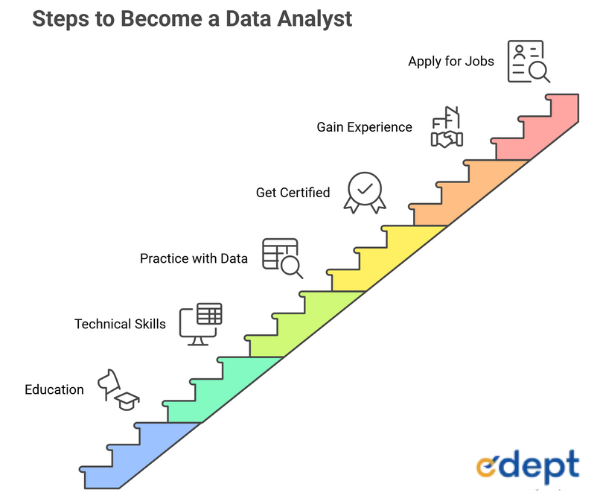
To become a data analytics professional, follow the steps below.
- The first step is to get the right education, which includes having a degree in mathematics, statistics, computer science, etc. However, online certifications in data analytics are also accepted.
- Development of core technical skills using SQL for querying databases, Tableau/Power BI for visualization, and Python or R for analysis.
- Practice with real data by using data sets available from Kaggle or the UCI Repository by building personal projects and dashboards.
- Get certified by Google Data Analytics Professional, Tableau, and Microsoft Certified Data Analyst Associate.
- You can also gain experience by freelancing on projects or taking internships.
- Apply for job roles at entry-level roles such as Junior Data Analyst.
Common Challenges Data Analysts Face
The data analyst jobs are rewarding and offer handsome salaries from the entry level. However, there are some challenges that you might face because of its importance in the organisation.
- You may find messy or incomplete datasets that may require heavy cleaning.
- As the job role requires handling sensitive information therefore data privacy regulations are required.
- As a data analyst, you may have to explain and communicate technical information to non-technical stakeholders, which can be a bit challenging sometimes due to your job role.
- Adaptation to the ever-evolving tools and technologies may be required in this fast-changing environment of data analytics.
Is Data Analytics a Good Career Choice?
Yes, data analytics is one of the best career options all over the world. Data analytics are the backbone of the organization, and the demand for a skilled, professional, and efficient data analyst is worldwide. Below are some of the insights to get an idea of why you should consider data analytics as a good career choice.
- Based on industry reports, the global data analytics market is expected to grow at a CAGR of over 25% from 2024 to 2030, which will create millions of job offers.
- Problem-solving, playing with Statistics will be your daily job.
- Business Intelligence, Data Science, or Analytics Leadership is the ladder to career growth.
- In India, the demand is equally strong, with over 50,000+ job options available annually. The average salary of a data analyst is INR 5,00,000 to INR 12,00,000.
- In the United States, the average data analyst salary offered is $65,000 to $90,000.
With the help of edept’s industry-focused data analytics courses, you can easily fast-track your journey as a data analyst into a demanding career.
Also, read: Data Analytics Course Syllabus 2025: Everything You Need to Know
Conclusion
Now, answering your question, what does a data analyst do? Here is the simple answer. They are responsible for collecting, interpreting, and analyzing the data, which will be helpful for the companies to make smarter decisions. By applying statistical analysis, data visualization, and most importantly, problem-solving, data analysts transform raw data into actionable strategies that help in driving growth. With the correct mixture of critical thinking, technical skills, and adaptability, a career in data analysis is not only rewarding but also future-proof.
Ready to Become a Successful Data Analyst?
Take your career from learning to employment with edept’s placement assistance.